
A Practical Guide to Broad Match Keywords
A Practical Guide to Broad Match Keywords


Broad match keywords are Google Ads' default setting and its widest targeting option. Think of it as casting a massive fishing net—you're aiming to catch a ton of fish, even if some aren't exactly what you're looking for. The whole point is to show your ads for searches that are related to your keyword, not just the specific phrase you typed in.
So, What Exactly Are Broad Match Keywords?
Let's cut through the official definitions for a second. Imagine you're selling "women's running shoes." If you pop that into Google Ads as a broad match keyword, you're essentially telling Google, "Hey, find people who seem to be looking for something like this."
Google's AI takes that instruction and runs with it. It starts thinking about user intent, not just words. Your ad might pop up for searches like "ladies jogging sneakers," "best athletic shoes for women," or even "marathon footwear for her." The system is smart enough to connect concepts, synonyms, and related ideas.
This is a world away from the other match types. To really get a feel for the differences, it’s worth taking a moment to understand the various keyword match types and the specific job each one does.
The Classic Trade-Off: Reach vs. Control
The big story with broad match keywords has always been the trade-off between reach and control. You get your ads in front of a huge audience and can discover new search terms you never would have thought of. The catch? You're giving up the pinpoint precision you get with phrase and exact match.
This is the fundamental question every PPC manager has to answer when building a campaign. Are you aiming to capture anyone who might be remotely interested, or are you focused only on those who type in a very specific query?
The goal is to work with the automation rather than fighting against it. The goal is to get the power of Google's AI working for you as the wind beneath your wings.
Before you dive in and commit your budget, getting a solid handle on all the Google Ads keyword match types is a must. It gives you the context to make the right call.
A Quick Comparison
To see this in action, let's put broad match head-to-head with its more controlled siblings, Phrase Match and Exact Match. This little table makes the core differences really obvious.
Keyword Match Type Comparison Reach vs Control
As you can tell, broad match is designed to give Google the most freedom to explore and find you customers. While that might sound a little scary (and it can be, if you're not careful), it's also the secret to uncovering new pockets of demand and scaling your campaigns. In the next few sections, we'll get into how to do it right without blowing your budget.
How Google AI Reinvented Broad Match

If you’ve been running ads for a while, you probably have some... strong opinions about broad match. Let’s be honest, most of them probably aren't good. For years, it was notorious for one thing: burning through budgets by matching your ads to wildly irrelevant searches. It was the setting you handled with extreme caution, if you used it at all.
But here’s the thing: today’s broad match keywords are not the same beast. Google has poured a ton of resources into its AI, completely overhauling how this match type works. It's no longer just a blunt instrument playing a word-matching game.
Now, it’s a sophisticated targeting engine that tries to figure out what a user actually wants, not just the exact words they typed. This modern version looks at a whole host of signals to predict searcher intent and find customers you might have otherwise missed.
Beyond Words to User Intent
So, what really changed? Google's AI now sifts through a rich tapestry of data points before deciding to show your ad. Think of it less like a dictionary and more like a detective piecing together clues to solve a case.
The algorithm now weighs several key signals:
- Search History: What has this person looked for before? Do their past searches give any clues about what they’re trying to find right now?
- Device Type: Are they on a phone, suggesting they might be on the move and need something local? Or are they on a desktop, maybe doing deeper research?
- Location Signals: Where is the search coming from? This helps the AI serve ads that are geographically relevant.
- Time of Day: User needs can shift dramatically between the morning commute and a late-night browsing session.
- Other Signals: Google looks at dozens of other signals—including the content of your landing page—to make sure the ad and the destination are a solid fit.
This holistic approach is what allows a seemingly random search to connect with your ad and turn into a valuable conversion. The AI is spotting patterns and connections that are simply impossible for a human to see or manage manually.
The Deliberate Shift Away from BMM
Remember Broad Match Modifier (BMM)? For a long time, it was the go-to for advertisers who wanted more reach than phrase match but more control than old-school broad match. It was our happy medium.
Google’s decision to phase out BMM wasn't just a spring cleaning. It was a clear signal that they were all-in on this new AI-first direction. As Google’s Smart Bidding algorithms got smarter, the new broad match became far more effective. When Google began sunsetting BMM in early 2021, it marked a strategic shift toward AI-driven matching. Today, you can’t even create new BMM keywords, as Google has essentially folded that functionality into how phrase match works. To get the full story, you can check out these insights on the end of Broad Match Modifier.
The goal is to work with the automation rather than fighting against it. The goal is to get the power of Google's AI working for you as the wind beneath your wings.
By getting rid of BMM, Google nudged advertisers to put their trust in this smarter, more intuitive system. The message was clear: let the AI do the heavy lifting. Pairing modern broad match keywords with Smart Bidding strategies like Target CPA or Target ROAS is now the recommended best practice, creating a powerful duo where the AI handles both the targeting and the bidding.
Balancing The Risks And Rewards
Let's be real for a minute. Using broad match keywords can feel like you've struck gold, uncovering profitable customer searches you never would have thought of. But on the flip side, it can feel like you're just lighting a pile of cash on fire. Both feelings are completely valid.
The truth is, broad match is a powerful tool, not a magic wand. Getting it right comes down to understanding the trade-offs and managing them smartly. It’s a high-risk, high-reward play, and it demands your attention.
The Upside: Discovering Untapped Potential
The single biggest reward of broad match is discovery. It casts a massive net that can pull in valuable, long-tail keywords your competitors are totally missing. This is your chance to find brand-new pockets of customer demand and expand your reach way beyond what phrase or exact match can deliver on their own.
That wider net often comes with a nice little bonus: lower costs. A deep dive into Google Ads performance data consistently shows that broad match keywords pull in the lowest cost-per-click (CPC) across campaigns. This makes sense—there’s just less competition for these broader, more varied search terms.
Broad match is the end game. The goal is to work with the automation rather than fighting against it. The goal is to get the power of Google's AI working for you as the wind beneath your wings.
The Downside: Managing The Chaos
Okay, now for the risky part. The very same freedom that leads to all that great discovery can also lead to a ton of wasted ad spend. Without a tight leash, your ads can show up for totally irrelevant searches, pulling in clicks from people who have zero interest in what you’re selling.
This isn’t just about burning through your budget; it can also tank your performance metrics. Showing up for the wrong searches leads to a lower click-through rate (CTR), which can drag down your Quality Score and make it even harder to compete.
This is where the real work comes in. The risks are very real, but they are also very manageable. Your secret weapon for taming broad match isn't some complex bidding strategy—it's a rock-solid negative keyword strategy.
- Proactive Negatives: Start with a list of terms you already know are irrelevant. Think common sense stuff like "free," "jobs," "DIY," or competitor brand names you have no business bidding on.
- Reactive Negatives: Live in your Search Terms Report. You need to constantly check it to find and exclude the junk queries that are eating up your budget.
Getting this process right is the single most important factor for success. To do that, you need a deep understanding of how to use Google Ads negative keywords to continuously sharpen your targeting. By telling Google what not to target, you’re giving the AI the guardrails it needs to find the right customers without driving off a cliff.
Broad Match Pros vs Cons
So, what's the final verdict? Here’s a quick breakdown of the trade-offs you need to consider before going all-in on broad match.
Ultimately, broad match isn't inherently "good" or "bad"—it's a professional-grade tool. When managed carefully with a robust negative keyword strategy, the rewards can easily outweigh the risks, opening up massive growth opportunities for your campaigns.
Winning Strategies For Broad Match Campaigns
Alright, let's get into the good stuff. You see the potential of broad match, but you've also heard the horror stories of burned budgets. So, how do you actually build a campaign that taps into its discovery power without lighting your money on fire?
This isn't about just flipping a switch and hoping for the best. It’s a very deliberate process. The goal is to give Google's AI enough room to explore and find new customers, but within a set of firm guardrails you control. Think of it like teaching a brilliant but hyperactive puppy—you want to encourage its energy, but you also need to set clear boundaries so it doesn't chew up the furniture.
Start With a Dedicated Broad Match Campaign
First rule of Broad Match Club: don't mix your broad match keywords into your existing, finely-tuned phrase and exact match campaigns. Seriously, don't do it. That's a surefire way to muddy your data, lose control of your budget, and have absolutely no idea what’s actually working.
Instead, build a brand-new campaign just for broad match. This is non-negotiable, and here’s why:
- Budget Control: You can set a specific, conservative budget for your broad match experiment. This protects your proven, core campaigns from any wild swings while the AI learns.
- Clear Data: Performance is completely isolated. You'll know, without a doubt, which conversions and which wasted clicks are coming from your broad match strategy.
- Targeted Strategy: It lets you pair your wide-net keywords with the right bidding strategy right from the start.
Speaking of which, you have to pair broad match with a Smart Bidding strategy like Target CPA (Cost Per Acquisition) or Maximize Conversions. They are designed to work together. Smart Bidding uses real-time conversion data to figure out which auctions are worth entering, taking the guesswork out of it for you.
Master The Art of Negative Keywords
If you only remember one thing from this entire guide, make it this: your success with broad match keywords will live and die by your negative keyword strategy. This is your steering wheel. It’s how you tell the AI where not to go.
The single most important tactic for success with broad match is mastering negative keywords. Continuously refining these lists by mining your Search Terms Report is the difference between profit and loss.
You’ll build your negative lists in two phases: proactively (before you launch) and reactively (once you're live).
Build Your Starter List (Proactive): Before spending a penny, create a list of obvious "no-go" terms. These are the words you know for a fact are irrelevant. Think common junk terms like "free," "jobs," "DIY," "reviews," or the names of competitors you don’t want to show up for.
Live in Your Search Terms Report (Reactive): This is where the real work happens. Once your campaign is running, you need to be in your Search Terms Report regularly—I mean daily, at first. This report shows you the actual search queries people typed that triggered your ads. Your job is to hunt down the irrelevant, money-wasting searches and add them as negative keywords.
This whole process is a balancing act between discovery and risk management.
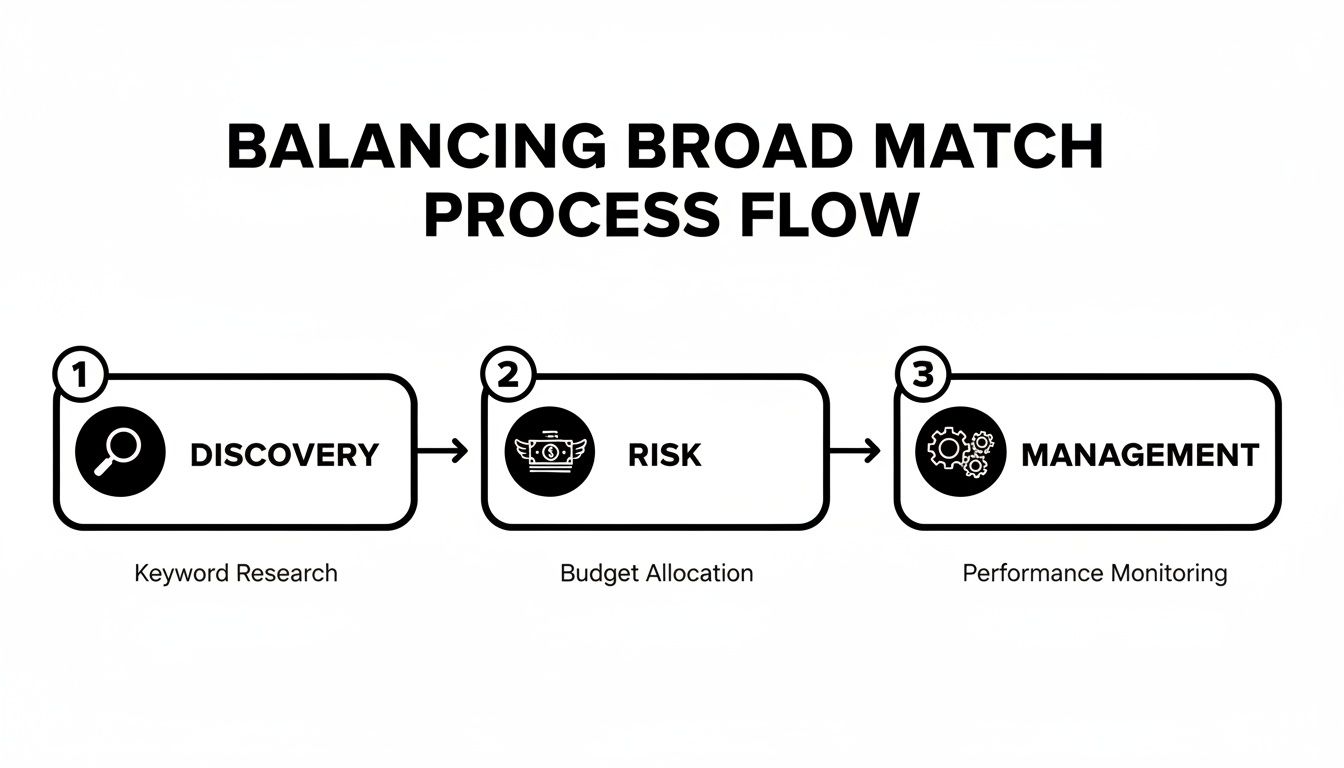
It’s this constant cycle of review and refinement that slowly carves your wide-open broad match campaign into a sharp, efficient conversion-driving machine.
A Practical Step-By-Step Launch Plan
Ready to do this? Here’s a simple, proven playbook for launching your first broad match campaign the right way.
- Step 1: Create a New Campaign. Keep it totally separate from everything else.
- Step 2: Set a Conservative Budget. Start small. You can always increase it later. A budget of $25-$50 per day is a perfectly reasonable place to begin.
- Step 3: Choose Your Keywords. Pick just a handful of your proven, top-performing keywords from other campaigns. You don't need a massive list.
- Step 4: Implement Smart Bidding. Set your campaign to Maximize Conversions or Target CPA to give the algorithm a clear goal.
- Step 5: Apply Your Proactive Negative List. Get your initial list of negatives uploaded before the campaign even starts spending.
- Step 6: Monitor and Refine. This is the most important part. Get in that Search Terms Report daily for the first week or two. Be aggressive about adding new negatives to stop the bleeding and teach the AI what you don't want.
This structured approach lets you safely test the waters, gathering priceless data while keeping your risk low. As you clean up your traffic and the algorithm learns, you'll start to see the real magic of broad match keywords—uncovering new pockets of customers you never would have found otherwise. This entire workflow, from cleanup to expansion, is exactly what Keywordme is built to accelerate.
Tame the Broad Match Beast with Keywordme

Let's be honest. Trying to manage broad match campaigns by hand is a nightmare. You're constantly drowning in Search Term Reports, wrestling with spreadsheets, and manually updating negative keyword lists. It's a soul-crushing grind that burns hours and kills opportunities.
This is exactly where Keywordme steps in. We turn those tedious, repetitive tasks into simple, one-click actions, giving you back your time and your sanity.
Imagine finding a junk search term and instantly adding it as a negative keyword without ever leaving the Google Ads interface. No more exporting CSVs. Our Chrome plugin makes that a reality. It’s the kind of workflow fix that can easily save you hours every single week, letting you focus on the high-level strategy that actually makes you money.
Say Goodbye to Manual Negative Keyword Lists
Building and applying negative keyword lists is, without a doubt, the most critical—and most mind-numbing—part of managing broad match keywords. Doing it by hand is painfully slow, full of potential for errors, and just doesn't work when you're trying to scale. A single copy-paste mistake can literally cost you thousands in wasted ad spend.
Keywordme handles this entire process for you. As you find irrelevant search terms, our tool automatically builds clean, perfectly formatted negative lists. You can then apply them to the right ad group or campaign with a single click, ensuring your targeting gets sharper and more efficient over time.
The real power of broad match is unlocked not by finding more keywords, but by relentlessly eliminating the wrong ones. Automation makes that process scalable and sustainable.
This constant, easy refinement is what turns a chaotic broad match campaign into a predictable profit engine. You’re actively teaching Google’s AI what you don’t want, which forces it to spend your budget on what actually works.
Instantly Capitalize on Winning Search Terms
The real magic of broad match is discovering new, high-converting search terms. But that magic fizzles out if you can't act on your discoveries quickly. Manually pulling a great search term, creating a new ad group, and adding it as a phrase or exact match keyword is a clunky, multi-step process.
Keywordme turns that entire workflow into a single click.
See a search term that’s printing money? Instantly promote it to a new, more controlled ad group as a phrase or exact match keyword. This lets you:
- Protect Your Winners: Lock in proven terms where you can set specific bids and write super-relevant ad copy.
- Scale with Precision: Build out new campaigns based on real performance data, not just a gut feeling.
- Improve Ad Relevance: Perfectly match your headlines and descriptions to the search term, boosting your CTR and Quality Score.
Being able to expand your campaigns this quickly is a game-changer. It’s also worth noting that for brand monitoring beyond paid ads, understanding tools like What is Google Alerts can round out your broader marketing strategy.
A Smarter Way to Manage Broad Match
All the strategies we've talked about—running dedicated campaigns, pairing them with Smart Bidding, and being aggressive with negatives—are the keys to success. But the manual labor required is what stops most advertisers from ever getting there. There just aren't enough hours in the day.
Keywordme was built to close that gap between knowing what to do and actually being able to do it. It handles the boring, repetitive work so you can focus on analysis and growth. Our platform isn’t just a time-saver; it’s a system for implementing best practices at scale, making your broad match keywords both safer and way more profitable.
By removing the manual bottlenecks, you can finally use broad match the way it's meant to be used: as a powerful discovery engine that constantly feeds your account new, high-intent customers. To see how this efficiency can apply to your entire process, check out our guide to automate keyword research for even more workflow tips.
At the end of the day, a smarter workflow always leads to better results, less wasted cash, and campaigns that run circles around the competition.
A Few Lingering Broad Match Questions
Even after you've got a solid plan, a few questions always seem to pop up when you start running broad match keywords. It's totally normal to feel a little hesitant. Let's tackle some of the most common hangups so you can move forward with confidence.
These are the real-world questions that come up again and again. Getting them sorted out can be the difference between a winning campaign and a headache.
Can Broad Match Really Work for Small Budgets?
This is probably the number one question on everyone's mind. The short answer is yes, absolutely—but it comes with a big "if." You have to be incredibly disciplined. Broad match was really built for big budgets with tons of data, but that doesn't mean smaller accounts can't play.
The secret sauce is control. If you're spending less than $50 a day, you can't just set broad match loose and hope for the best. Your budget is simply too small to absorb the costs while the AI figures things out.
To make it work, you need to get aggressive with your negative keywords from the very first day. Think of it as giving the AI a very short leash, forcing it to learn within the tight, cost-effective boundaries you set.
Broad match can work at any budget level, but it’s definitely easier with more data and a bigger spend. If you’re short on data, you have to make up for it with an extremely proactive negative keyword strategy.
For smaller budgets, success isn't just a possibility; it's totally achievable if you're willing to be the strict supervisor of your campaign.
How Often Should I Check My Search Terms Report?
The real answer here is: it depends entirely on how old your campaign is. You'll look at a brand-new broad match campaign way differently than one that's been humming along for months.
Here’s a practical timeline to keep in your back pocket:
- First 1-2 Weeks (The Critical Phase): You need to be in your Search Terms Report daily. No excuses. This is when your campaign is most volatile, and you'll be finding and blocking irrelevant search terms left and right. Daily check-ins stop small budget leaks from turning into massive floods.
- First Month (The Stabilization Phase): After that initial sprint, you can probably dial it back to 2-3 times per week. You'll still find some junk, but the amount of new, weird stuff should start to slow down as the AI learns from all the negatives you've added.
- Ongoing (The Maintenance Phase): Once your campaign is stable and hitting its stride, a weekly check-in is usually enough. At this point, you're just keeping things tidy and watching for any strange new search trends before they cause problems.
This phased approach makes sure you put your time where it counts the most—right at the beginning—without getting stuck doing daily checks forever.
What Happened to Broad Match Modifier (BMM)?
If you’ve been doing PPC for a while, you definitely remember Broad Match Modifier, or BMM. It was that "just right" sweet spot for a lot of us, giving more reach than phrase match but way more control than old-school broad match. You’d just pop a + in front of a word to lock it in, like +women's +shoes.
Well, back in 2021, Google officially retired BMM. It wasn't just phased out; its behavior was essentially folded into phrase match.
Today’s phrase match acts a lot like BMM used to. It's smart enough to understand the meaning behind a search, allowing for synonyms and different word orders, but it’s much tighter than the wide-open net of modern broad match. So if you're looking for the spiritual successor to BMM, it’s today’s phrase match. Getting rid of BMM was a clear signal from Google that they want advertisers to trust the AI behind broad match and embrace more automation.
Trying to manage all this by hand is a massive time-suck. We built Keywordme to get rid of that grind, turning hours of digging through Search Term Reports into a few simple clicks. Our tool automates the repetitive cleanup, letting you put these best practices to work at scale so your broad match keywords are both safer and more profitable. See how much time you can get back by starting your free trial at https://www.keywordme.io.
.svg)