
What Is a Good CTR Rate for Your Ads?
What Is a Good CTR Rate for Your Ads?


Pinning down a single "good" CTR is a bit like asking for the perfect temperature—it all depends on where you are and what you're doing. While you'll often hear that a good CTR for Google Search ads is anything over 3%, that number is just a starting point. The real answer changes dramatically based on your industry, the ad channel you're using, and what you're trying to achieve.
What Click-Through Rate Really Tells You
At its heart, Click-Through Rate (CTR) is a simple but incredibly revealing metric. It shows you how many people who saw your ad or organic listing actually bothered to click on it.
Think of it like a first impression. A high CTR is a great sign that your message hit the mark. A low one? It's a clear signal that there's a disconnect between what you're showing and what your audience wants to see.
The math behind it is super simple:
(Total Clicks on Ad / Total Impressions) x 100 = Click-Through Rate (CTR)
So, if your ad gets shown 1,000 times (impressions) and scores 50 clicks, you've got a 5% CTR. It’s a foundational piece of the puzzle for figuring out ad performance. For a full breakdown, you can dive into our complete guide on what is click-through rate.
Why Context Is Everything for CTR
A "good" number is never one-size-fits-all. A CTR that's perfectly fine for a broad display ad campaign designed to just get your name out there would be a total flop for a super-targeted search ad for a specific product.
It all comes down to user intent.
Someone typing a search into Google is on a mission—they’re actively hunting for something. That makes them way more likely to click than someone just scrolling through a news site who happens to see your display ad pop up. This difference in mindset creates a massive gap in what you can expect from your campaigns.
To help you get a better handle on where you stand, here's a quick look at average CTRs across different channels.
Quick Guide to CTR Benchmarks by Channel
This table offers a quick snapshot of average CTRs across major digital advertising channels, helping you see where your campaigns stand at a glance.
As you can see, the channel you choose plays a huge role in defining what a "good" CTR looks like for your campaigns.
Establishing Your Baseline
To set goals that actually make sense, you need to know what the landscape looks like. Recent data shows just how much these numbers can swing. For example, Google Search Ads averaged a 3.17% CTR, which is more than ten times higher than the average for Display Ads at a tiny 0.46%. That really drives home the impact of user intent.
On top of that, performance varies wildly between industries.
- High Flyers: Industries like dating and personals (6.05%) or travel (4.68%) naturally see higher engagement because the user's need is often immediate and emotional.
- Tougher Crowds: On the flip side, more competitive or complex sectors like technology (2.09%) and B2B (2.41%) tend to have lower average CTRs.
Having these benchmarks gives you a much-needed frame of reference. It helps you stop chasing a generic "good CTR" and start measuring your own performance in the context of your specific market and channel.
So, What's a Good CTR? Let's Talk Industry Benchmarks
Figuring out what a "good" click-through rate is without looking at your specific industry is a bit like guessing the weather without knowing the season. What's considered fantastic for one type of business could be a huge red flag for another. Context is everything.
Why the massive difference from one industry to the next? It all comes down to the customer's mindset, how crowded the market is, and how badly they need what you're selling. Think about it: someone searching for concert tickets is in a completely different headspace than someone looking for a lawyer. The first click is driven by excitement, while the second involves a lot more caution and higher stakes.
Google Ads Benchmarks Across Different Sectors
Let’s get into the hard numbers. The average CTR for Google Ads across all industries recently climbed to an impressive 6.42%. That means for every 16 people who saw a search ad, about one of them clicked. This is a nice little bump up from the 6.11% we saw in 203.
Some industries are just natural superstars. Arts and entertainment, for instance, pulls in a massive 13.04% CTR on average. Travel isn't far behind at 10.16%, and sports and recreation scores a healthy 9.66%.
On the other end of the spectrum, you have tougher fields like attorneys and legal services, which average around 5.3%. Similarly, dentists see about 5.38%, and home improvement is at 5.59%.
This huge range proves you can't just aim for one magic number. An arts organization hitting 13% is knocking it out of the park, but a law firm achieving a 5.5% CTR is likely doing better than most of its direct competitors.
The chart below gives you a quick visual on how different channels stack up.
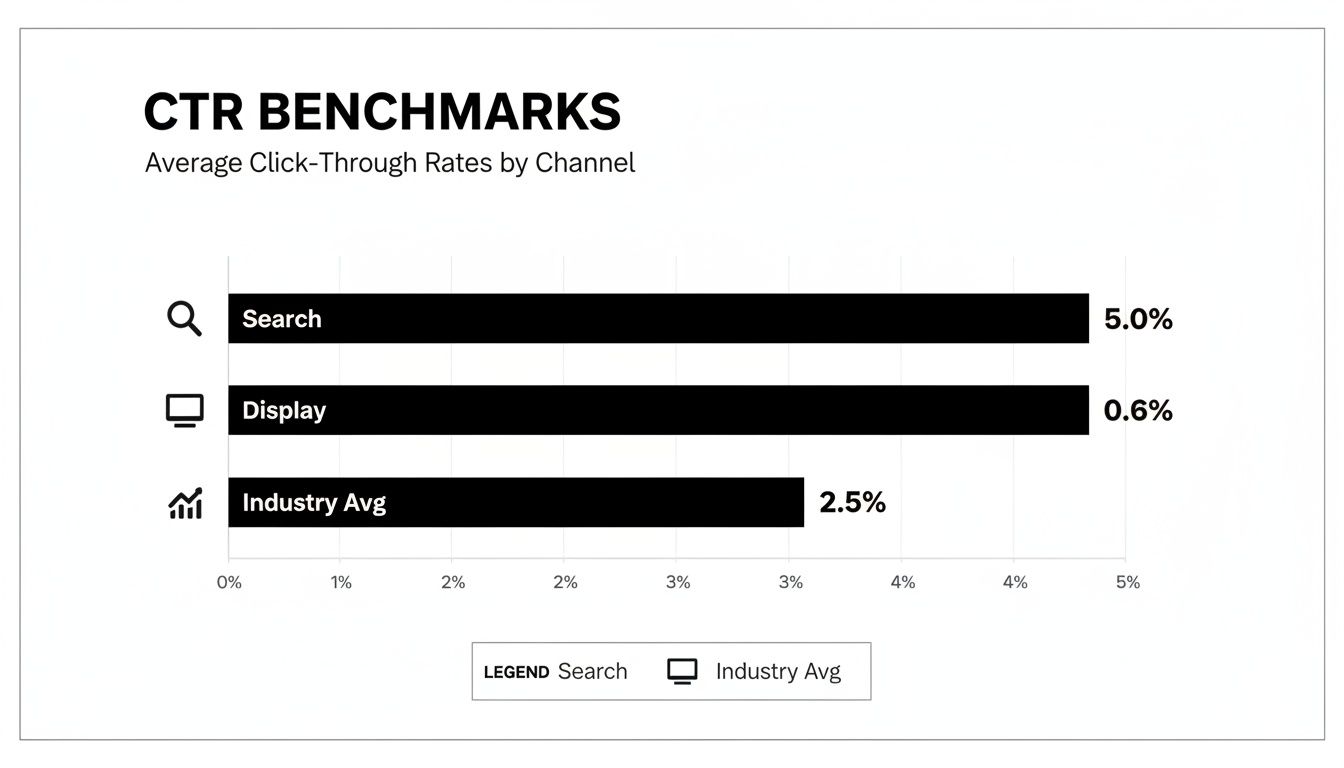
As you can see, Search ads consistently crush Display ads. It's a powerful reminder of what happens when you get your ad in front of someone who is actively looking for a solution.
Why Some Industries Have It Easier Than Others
So what gives certain industries that natural edge? It’s really a mix of a few key things that shape how people respond to ads.
- Passion and Fun: Industries like Arts & Entertainment or Travel tap into people's hobbies and dreams. The decision to click is emotional and doesn't feel like a huge commitment, so engagement is naturally higher.
- Urgent Problems: Think about the Auto or Real Estate sectors. When someone's car breaks down or their lease is up, they have an immediate need. That urgency translates directly into more clicks.
- Less Crowded Spaces: Some niche hobbies or specialized B2B services just don't have as much competition. With fewer ads fighting for eyeballs, it's simply easier to stand out and earn that click.
On the flip side, super competitive industries like legal, finance, and home improvement are a different story. The customer is often more guarded, doing a ton of research before they even think about clicking, let alone buying. This caution naturally leads to lower CTRs. To get the full picture, it's helpful to look at industry conversion rate benchmarks, which can give you a more complete view of performance beyond just the initial click.
The Bottom Line: A "good CTR" is completely relative. Your goal shouldn’t be to hit some universal average, but to outperform the average for your specific industry. That's the only comparison that really matters.
Setting Realistic Goals for Your Niche
Knowing where you stand is the first step to getting smarter with your strategy. If you're in a highly competitive market, even a small, steady increase in your CTR is a massive win. If you're in a high-engagement field, you have more room to experiment and really push the envelope.
Use these benchmarks as your starting point to set goals that actually make sense for your business. For a closer look at how these numbers break down on Google's platform, check out our guide on https://www.keywordme.io/blog/google-ads-industry-benchmarks. It’ll help you dial in your targets even further.
The Core Factors That Move Your CTR
Ever had two nearly identical ads perform completely differently? One gets all the love, the other sits there collecting dust. It’s not a mystery. Specific factors are at play that search engines like Google look at very closely.
Getting a handle on these elements is the first step to stop just watching your CTR and start actively controlling it. A good CTR isn't something you just stumble upon—it’s built on a foundation of relevance, quality, and smart positioning. When those pieces click into place, you don't just get more traffic; you often end up paying less for it.
Your Ad's Relevance and Quality Score
The single biggest force behind your CTR is ad relevance. Think of it from the searcher's perspective. They type something into Google because they have a specific need or question. Your ad's one and only job is to be the best, most direct answer to that need on the entire page.
This is where Google’s Quality Score comes in. It’s a diagnostic tool, graded from 1 to 10, that tells you how well your ads, keywords, and landing pages align. A high Quality Score is Google's way of giving you a thumbs-up, signaling that your ad is a great match for what the user wants. That directly boosts your chances of earning the click.
A huge piece of your Quality Score is something called Expected Click-Through Rate (eCTR). Google actually predicts how likely your ad is to be clicked based on its past performance. A solid history of getting clicks tells Google your ad is doing its job, which leads to a better Quality Score, better ad positions, and often, lower costs.
Improving your Quality Score starts a powerful feedback loop. Better ads get more clicks, which improves your score. That better score helps your ads show up more often and in better spots, leading to... you guessed it, even more clicks.
The Power of Ad Position
It’s no secret that where your ad shows up on the page matters. A lot. But the difference between the top spot and everything else is more dramatic than most people realize. It’s not just a small advantage; it’s a total game-changer.
Research from over 16,000 campaigns shows that ads in the coveted Position 1 pull in an average CTR of 7.94%. Now, add a great Quality Score to the mix: ads in Position 1 with scores of 8-10 saw their CTR jump to an incredible 9.8%. On the flip side, ads in that same top spot with a poor score of 1-3 plummeted to just 5.1%. You can dig into more of these insights in the 2025 Google Ads benchmarks on Wordstream.com.
The lesson here is crystal clear: you can't just bid your way to the top and expect great results. Your ad's relevance and quality are what truly unlock the potential of that premium real estate.
The Role of Compelling Ad Copy and Extensions
Think of your ad copy—the headline and description—as your 3-second elevator pitch. You have a tiny window to grab someone's attention and convince them your link is the one worth clicking.
The best ad copy speaks directly to the searcher's problem or desire. It uses strong, action-oriented words, includes the keyword in a natural way, and ends with a clear call-to-action (CTA) that tells them exactly what to do next.
But the copy itself is only half the story. Ad extensions are your secret weapon. These are the extra bits of info you can add—like your phone number, location, links to specific pages, or special offers. They make your ad physically bigger, more informative, and way more noticeable. Using extensions can literally push your competitors further down the page while giving users more reasons to click your ad.
Your CTR Control Panel
So, how do all these pieces fit together? Think of them as levers you can pull to influence your click-through rate. Here’s a quick breakdown of what you can control and how to do it.
By focusing on these four areas, you can move from passively hoping for clicks to actively engineering a higher CTR.
Actionable Strategies to Boost Your CTR
Alright, you know what CTR is and what a "good" one looks like. Now for the fun part: actually making it better. It's time to roll up our sleeves and get tactical, because moving the needle on your CTR comes down to making deliberate changes. The best part? Even small tweaks can lead to some seriously impressive gains in traffic and ad performance.
Let's jump into a few practical, real-world strategies you can start using today to get more clicks and make every ad dollar work harder.

Write Magnetic Headlines and Ad Copy
Think of your headline as the gatekeeper. It's the very first thing someone sees, and it has to do all the heavy lifting to grab their attention and match what they're looking for. If the headline falls flat, the rest of your ad doesn't stand a chance.
Here are a few tried-and-true formulas for headlines that practically beg to be clicked:
- Use Numbers: Our brains are just wired to love lists. A title like "10 Ways to Improve Your Garden" almost always feels more concrete and clickable than a vague "How to Improve Your Garden."
- Add Brackets or Parentheses: Tacking on a little extra info like
[Free Template]or(With Examples)can bump up clicks by nearly 40%. It sets expectations right away and makes your ad pop on the page. - Include Dates: For fast-moving topics, adding the current year (like "Best SEO Tips for 2024") is a powerful signal that your content is fresh, not stale.
Once you’ve hooked them with the headline, the ad description needs to seal the deal. Don't just list what your product does; tell them how it solves their problem. Always wrap it up with a strong call-to-action (CTA) that tells them exactly what to do next, like "Shop Now and Save 25%" or "Get Your Free Quote Today."
Maximize Your Real Estate with Ad Extensions
Want a dead-simple way to make your ads bigger, more useful, and way more clickable? Use ad extensions. These are extra bits of info you can tack onto your ad, and they physically take up more space on the search results page. This shoves your competitors further down and naturally draws more eyes to your ad.
Think of ad extensions as a free upgrade for your ads. They don't cost anything extra, and they give people more reasons and more ways to click through to your site.
Some of the most valuable extensions include:
- Sitelink Extensions: These are extra links to specific pages on your site, like "About Us," "Contact," or "Pricing." They're perfect for helping users jump straight to what they need.
- Callout Extensions: Use these to shout out key benefits or features. Think short, punchy phrases like "Free Shipping," "24/7 Customer Support," or "Eco-Friendly Products."
- Structured Snippets: These let you highlight specific aspects of your offerings in a neat list, like "Brands: Nike, Adidas, Puma" or "Services: SEO, PPC, Content Marketing."
Master Negative Keyword Management
One of the most powerful—and weirdly overlooked—ways to improve CTR is to get serious about your negative keywords. Every single time your ad shows for a search that's completely irrelevant, it hurts your CTR. You're racking up impressions from people who were never, ever going to click.
This is how you stop the bleeding. By adding words like "free," "jobs," or "DIY" to your negative keyword list, you prevent your ad from showing up to the wrong crowd. A little cleanup goes a long way, ensuring your budget is spent on people who are actually looking for what you sell. This naturally boosts your good ctr rate.
To really dig into this, check out our deep dive on negative keywords in Google Ads. Manually digging through search term reports is a total grind, which is why tools like Keywordme are built to automate the cleanup, helping you protect your CTR in just a few clicks.
Embrace a Culture of A/B Testing
You should never just assume you know what will work best. A/B testing (or split testing) is your secret weapon. It’s the simple practice of running two slightly different ads against each other to see which one gets better results. It’s a data-driven way to take all the guesswork out of optimization.
You can test almost anything, but the key is to test just one element at a time so you know exactly what made the difference.
- Headlines: Pit a question against a statement.
- Descriptions: Try focusing on features in one version and benefits in another.
- Calls-to-Action: Does "Learn More" outperform "Get Started"? Let the data decide.
- Landing Pages: Test a different layout or a more compelling offer.
By constantly testing and iterating, you'll uncover what truly connects with your audience. This ongoing process of refinement is how you achieve a consistently high CTR for the long haul. And if you're ever stuck for ideas, an AI Ad Generator can be a great way to brainstorm fresh ad creatives that grab attention.
Don't Let Your CTR Fool You: Measuring What Really Matters
It’s easy to get obsessed with click-through rate. Seeing a high CTR can feel like you've won the game, but that's a dangerous trap to fall into. While a strong CTR is a great sign that your ad is catching people's attention, it’s not the finish line. In fact, focusing on it exclusively is one of the fastest ways to burn through your ad budget with very little to show for it.
Think of your CTR like a friendly greeter at your shop's front door. They're amazing at getting people to step inside. But if nobody actually buys anything, what’s the point? That’s the critical link between clicks and results. A great CTR only counts if it leads to something meaningful.
The Problem with "Vanity Clicks"
Getting a high CTR isn't that hard if you're not careful. You could write a clickbait-y headline or blast an ad out to a massive, untargeted audience. You'll definitely see your click numbers jump. A display ad might even hit a 10% CTR—a number that looks amazing in a report—but if those clicks come from people who have zero interest in your product, they're just empty calories.
We call these vanity clicks. They puff up your metrics and make you feel good, but they do absolutely nothing for your real business goals, whether that's getting leads, making sales, or driving sign-ups. The true measure of a campaign isn't how many people click; it's how many of the right people click.
A high CTR paired with a low conversion rate is a massive red flag. It’s a classic sign that your ad is writing checks your landing page can't cash, or you're simply attracting the wrong crowd.
Sometimes, a Lower CTR is a Huge Win
This is going to sound backward, but bear with me: a lower CTR can actually be a sign of a much healthier, more profitable campaign.
Let's say you're running ads for a pricey B2B software platform. You test two versions:
- Ad A: "Free Business Tools for Everyone!" - CTR: 8%
- Ad B: "Enterprise Project Management Software for Teams of 50+" - CTR: 2.5%
Ad A looks like the winner, right? But then you look at the data. All its clicks are from freelancers and tiny startups who aren't your target customer. They hit your landing page, see the price and features, and bounce immediately.
Ad B, on the other hand, gets way fewer clicks, but nearly every person who clicks is a qualified lead from a company that fits your ideal customer profile. The ad itself acts as a filter, warding off the wrong people. You're paying less for wasted clicks and getting traffic that has a real chance of converting. This is exactly why a good ctr rate always needs context.
Match Your CTR to Your Campaign Goals
To really understand what your CTR is telling you, you have to connect it to what you’re trying to achieve. Different goals demand different interpretations of your click-through performance.
Here’s a simple way to think about it:
- Brand Awareness Campaigns: Here, a high CTR is often a primary goal. You just want to get your message in front of as many relevant people as possible. Clicks are a great signal that your creative is resonating, even if you aren't expecting immediate sales.
- Lead Generation Campaigns: The focus shifts from the number of clicks to the quality of the lead. A moderate CTR from a super-targeted audience is perfect. You'd much rather have 10 clicks that turn into 3 qualified leads than 100 clicks that result in nothing.
- E-commerce Sales Campaigns: For these, CTR needs to be looked at alongside conversion rate and return on ad spend (ROAS). For instance, a lower CTR on a retargeting ad aimed at past customers might be totally fine if it brings in a high number of repeat purchases and a killer ROAS.
At the end of the day, a "good" CTR is one that helps your bottom line. It’s time to stop chasing clicks for their own sake and start focusing on attracting the traffic that will actually grow your business.
Common CTR Mistakes That Drain Your Budget
Chasing a higher click-through rate is a great goal, but it's surprisingly easy to fall into a few common traps that do more harm than good. A high CTR is just a vanity metric if it’s built on a foundation of wasted clicks and irrelevant traffic. Getting a handle on these pitfalls is the real secret to building a smart, profitable ad strategy.
So many marketers get sucked into writing clickbait-style ad copy. They throw out these sensational headlines that promise the world, all in the name of getting that click. It might pump up your CTR for a hot second, but it's a short-sighted move that almost always backfires.
Think about it: when someone clicks an ad expecting one thing and lands on a page that doesn't deliver, what do they do? They bounce. Immediately. That high bounce rate signals to search engines that your page isn't relevant, and you just paid for a click that had zero chance of ever turning into a customer.

Targeting Overly Broad Keywords
Another classic mistake? Casting way too wide a net with your keywords. Going after broad terms will definitely get your impression numbers looking impressive, but it’s a surefire way to attract the wrong crowd. You end up showing your ad for searches that are barely related to what you actually sell.
Let's say you sell high-end "leather messenger bags" and decide to bid on the keyword "bags." You'll get a firehose of impressions from people looking for backpacks, purses, even plastic grocery bags—none of whom are your customer. The result is a rock-bottom CTR and a budget that vanishes on totally unqualified traffic. A good ctr rate comes from precision, not just volume.
A low CTR on a super-specific keyword is often more valuable than a high CTR on a generic one. It tells you that you're getting in front of a much more qualified, ready-to-buy audience.
Forgetting About Negative Keywords
This is the big one. Neglecting your negative keyword list is probably the costliest mistake you can make. When you don't actively block irrelevant search terms, it's like leaving your front door wide open. Every time your ad shows up for searches containing words like "free," "jobs," or "DIY," you're burning cash on clicks that will never, ever convert.
Getting serious about negative keyword management isn't just a "nice-to-have"—it's essential. By constantly cleaning up your lists, you stop wasting money showing ads to the wrong people. This one habit alone will naturally push your CTR up, because your ads are only being seen by a more relevant, high-intent audience.
Got Questions About CTR? We've Got Answers.
Let's tackle some of the most common questions that pop up about click-through rates. Here are the straight-up answers you need to know.
Why Is My Search CTR So Much Higher Than My Display CTR?
It’s normal to see a massive difference here. A solid CTR for a Search ad might be 3% or more, while a good Display ad CTR often hovers below 1%. The reason is simple: intent.
When someone sees your ad on the Search network, they're actively looking for something you offer. You're answering a direct question. On the Display network, you're interrupting them while they're reading an article or watching a video. Getting that click is a much bigger ask.
How Often Should I Actually Check My CTR?
For campaigns that are up and running, a weekly check-in is a great rhythm. It's frequent enough to catch important trends but not so often that you start panicking over tiny daily dips and spikes.
The exception? If you just launched a brand-new campaign or are running a focused A/B test on your ad copy, you’ll want to peek more often—maybe daily for the first few days—just to get an early read on performance.
The key is to make changes based on real data trends, not daily blips. Let a week's worth of performance guide your optimization strategy, not a single day's weird numbers.
Is It Possible for a CTR to Be Too High?
You bet. While it feels like a win, an unusually high CTR—say, something climbing past 20-30% for a non-branded search campaign—should make you raise an eyebrow. It can actually point to some underlying problems.
Here’s what could be going on:
- Your Ad Is Clickbait: The copy might be promising something it can't deliver, luring in clicks from people who aren't really qualified and bounce the second they hit your landing page.
- You're Only Bidding on Your Brand: If your campaign only targets your own brand name, you're just capturing clicks from people who were already looking for you.
- Something Fishy Is Happening: In rare cases, a ridiculously high CTR can be a sign of click fraud.
Always look at a super-high CTR next to your conversion rate. If the clicks are high but the conversions are low, that's not a victory—it's a sign that your ad is attracting the wrong audience.
Ready to stop wasting money on the wrong clicks and start boosting your CTR with surgical precision? Keywordme automates the tedious work of cleaning up search terms and managing negative keywords, so you can focus on what matters. Cut wasted ad spend and improve your campaign performance today. Start your free trial at https://www.keywordme.io.
.svg)