
E Commerce Advertisement a Complete Guide for 2026
E Commerce Advertisement a Complete Guide for 2026


E commerce advertisement isn't a side project anymore. It's one of the most expensive, competitive, and operationally demanding parts of running an online store.
That shift shows up in the money. Global ecommerce advertising expenditure is projected to reach $271 billion in 2025, with brands increasing their digital ad budgets by 18% in 2024 alone. Leading retailers now utilize an average of three digital advertising channels to stay competitive according to Marketing LTB's ecommerce advertising statistics.
Teams often still treat ads like isolated tactics. They launch Google Ads in one corner, pay a creator for an Instagram post in another, then wonder why results feel inconsistent. The problem usually isn't that one channel is broken. It's that the system is broken. Creative says one thing, landing pages say another, tracking misses revenue, and budget gets moved based on partial data.
That's why strong e commerce advertisement looks less like buying clicks and more like building a machine. Channel selection matters. So do ad angles, feed quality, audience structure, page speed, attribution, and post-click experience. If even one of those pieces is weak, the campaign can look healthy in-platform while losing money in the business.
Practical rule: Don't judge ads as ads. Judge them as part of a full buying path.
The Exploding World of Ecommerce Advertising
The easiest way to misunderstand ecommerce advertising is to treat it like media buying alone. It isn't. It's demand capture, demand creation, merchandising, analytics, and conversion optimization stitched into one operating model.
The pressure has gone up fast. More brands are bidding for the same intent, more creative competes for the same attention, and more platforms want a share of budget. That's why casual campaign management doesn't hold up anymore. “Set it and forget it” was never great advice, but now it's expensive advice.
Competition got wider, not just harder
A lot of newer marketers assume competition means competing with direct category rivals. In practice, an online store competes against every brand that can interrupt the same customer journey. A shopper looking for running shoes might compare brands on Google, see creator content on social, get retargeted later, and finally convert through a branded search. If your measurement, messaging, and offer don't line up across that journey, another store takes the sale.
The other big shift is channel overlap. Search still captures clear intent. Social shapes demand earlier. Shopping ads close the gap between product discovery and purchase. Email, affiliates, creators, and video all influence the path too. The best accounts don't ask, “Which single platform should we bet on?” They ask, “How do these channels work together without cannibalizing each other?”
What separates profitable advertisers
Profitable teams usually do a few things differently:
- They define the job of each channel: Search captures demand. Social creates interest. Retargeting handles hesitation.
- They build landing pages for paid traffic: Not just generic category pages.
- They measure revenue cleanly: Not just clicks and platform-reported conversions.
- They test angles, not only visuals: The message matters as much as the design.
- They optimize post-click experience: Fast pages and clear product pages save wasted spend.
That's the frame for e commerce advertisement in 2026. It isn't about finding a magic platform. It's about building a cohesive marketing system that can survive competition, privacy changes, and rising costs.
Choosing Your Advertising Channels
The wrong way to choose channels is by asking which platform is “best.” The better question is what role each channel should play in the account. Some channels capture buyers who already know what they want. Others create demand earlier, when the buyer doesn't know your brand yet.
The practical mix usually starts with a small portfolio, not an all-platform land grab.
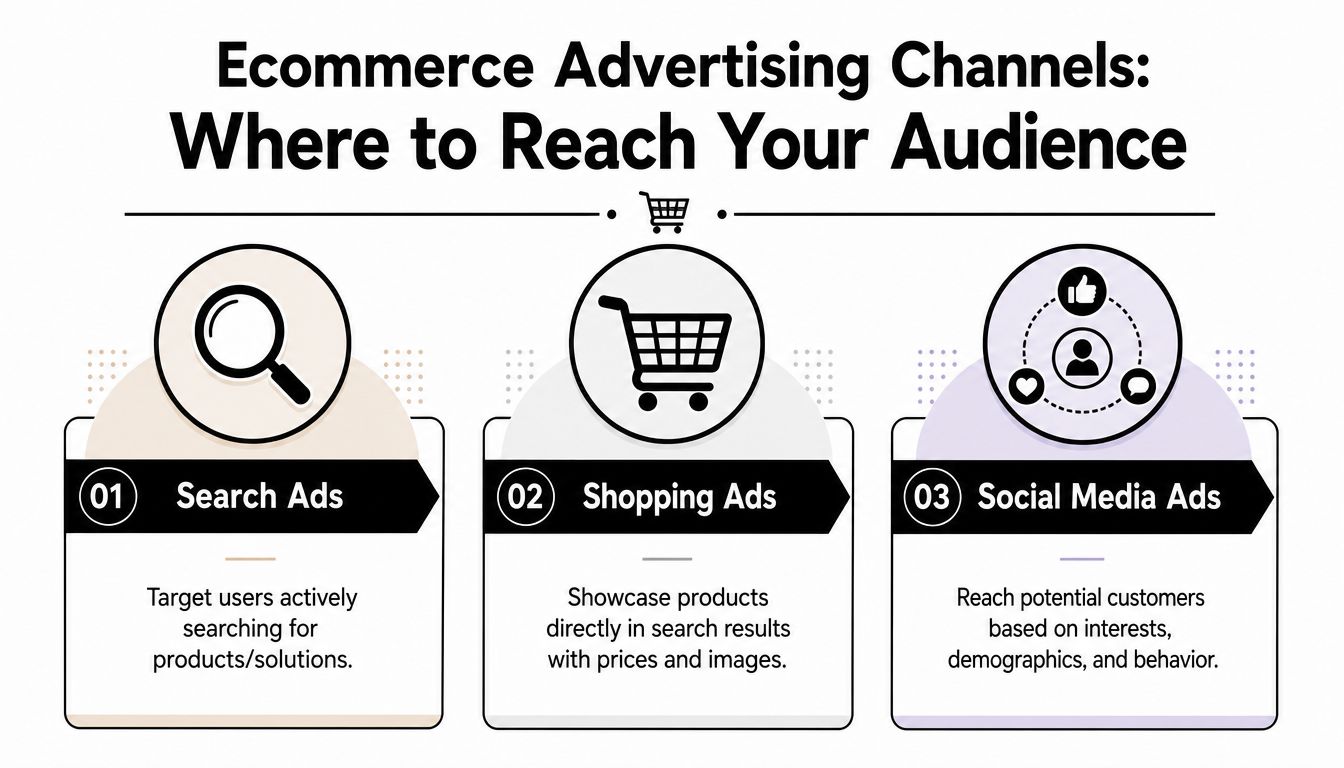
Search and Shopping for intent
Search ads work best when the customer already has a problem, product type, or brand in mind. Someone searches with intent, your ad shows up, and the click has a real chance to convert. That makes search one of the cleanest channels for demand capture.
Shopping ads are more visual and product-led. Instead of persuading from scratch, they put the item, price, and merchant in front of a shopper already comparing options. That's why feed quality matters so much. If titles, images, pricing, and categorization are weak, performance suffers before the click even happens.
If your team wants a practical breakdown of feed structure and setup choices, this guide on Google Shopping Ads for eCommerce is worth reviewing before you build out campaigns.
Social for discovery and persuasion
Social media ads are less about matching a search query and more about matching a person. You're reaching users based on interests, behaviors, demographics, and previous engagement. That changes the creative job. Search can win with relevance and offer clarity. Social usually needs a stronger hook.
Influencer marketing sits inside this broader social ecosystem, and it's not a niche tactic anymore. Influencer marketing has grown into a $21 billion industry, with over a third of marketing agencies dedicating more than a third of their total budgets to influencer partnerships according to Statista's overview of e-commerce advertising and marketing.
For teams working specifically on Meta placements, this walkthrough on how to advertise on Facebook and Instagram is a useful companion to channel planning.
Display, video, and affiliate support roles
Display rarely carries an account on its own for most stores, but it can help with reach, remarketing, and keeping your brand visible during longer buying cycles. The common mistake is expecting cold display traffic to convert like branded search. It won't.
Video gives you more room to demonstrate the product, show use cases, and build trust. It's especially useful when the item needs context, comparison, or education.
Affiliates can extend reach without forcing your team to build every promotion internally. But affiliate programs need guardrails. Without them, you end up paying commissions on conversions your brand likely would've won anyway.
Ecommerce Ad Channel Comparison
| Channel | Primary Goal | Key Metric | Common Cost Model |
|---|---|---|---|
| Search Ads | Capture existing demand | Conversion rate | CPC |
| Shopping Ads | Showcase products at high intent | ROAS | CPC |
| Social Media Ads | Create demand and retarget interest | CPA or ROAS | CPC or CPM |
| Display Ads | Reach and remarket audiences | Assisted conversions | CPM |
| Video Ads | Demonstrate product value | View-through engagement | CPM |
| Affiliate Marketing | Extend distribution through partners | Incremental revenue quality | Commission |
Good channel selection isn't about covering everything. It's about assigning each platform a job it can realistically do.
A healthy e commerce advertisement program usually starts with intent capture, adds paid social for demand creation and retargeting, and only then expands into supporting channels when the basics are stable.
Crafting Ad Creatives That Actually Convert
Most weak ecommerce ads fail before the audience decision matters. They're too polite, too generic, or too obsessed with product features. “Premium quality.” “Advanced design.” “Best-in-class.” That copy says almost nothing.
Creative has one job first. Stop the scroll. Then it has a second job. Move the buyer from vague interest to a clear next step.

Build around angles, not slogans
An ad angle is the lens you use to make the product matter. Not the tagline. Not the CTA button. The angle.
For the same product, you might run several angles:
- Problem-first: show what's frustrating now
- Outcome-first: focus on the end result
- Comparison-led: contrast against the usual alternative
- Use-case specific: match the product to a situation
- Trust-led: remove skepticism with proof, demo, or detail
That's why creative testing shouldn't mean swapping background colors and calling it strategy. Real testing compares arguments.
A lot of practical examples live in strong ad libraries and teardown collections. If your team needs inspiration, these ad copy examples are useful for spotting how angles change the same offer.
Friction beats fluff
One of the most useful creative concepts in ecommerce right now is friction-based vulnerability. Instead of jumping straight to aspiration, the ad names the inconvenience the customer is already dealing with. The message becomes sharper because it meets the buyer in the “before” state, not just the promised “after.”
Ads that explicitly highlight the inconvenience or friction of a customer's current situation have been shown in A/B tests to achieve 28% higher engagement than ads that only focus on positive product features according to Convert's breakdown of Shopify A/B testing and selling angles.
That doesn't mean every ad should be negative. It means specific pain often converts better than generic positivity.
If the customer instantly recognizes the problem in your ad, you've earned the right to present the product.
A practical creative workflow
Here's a simple operating rhythm that works:
Start with customer friction
Pull language from reviews, support tickets, product questions, and competitor comments. Look for repeated annoyances, not marketing language.Match one angle to one asset
Don't stuff five messages into one video or static ad. One ad should push one argument clearly.Keep visual proof close to the claim
If you say the product is easier, lighter, faster, cleaner, or simpler, show that immediately.Carry the same angle onto the landing page
If the ad leads with convenience, the page should open with convenience too. Message mismatch kills momentum.Refresh before fatigue becomes obvious
Strong creative rarely “dies” overnight. It usually weakens gradually. Watch for declining response quality, not just obvious collapse.
Creative that converts usually feels more specific than polished. That's a trade-off worth making.
Smart Targeting and Bidding Strategies
Targeting and bidding work like fishing gear. Your targeting is the net. Your bid strategy is the bait. If the net is too wide, you pull in junk. If the bait is wrong, you pay too much for low-quality attention.
A lot of campaign waste comes from confusing reach with relevance.
Targeting the right people
Start with buyer context, not platform options. The platform gives you demographics, interests, behaviors, lookalikes, remarketing pools, keyword intent, and customer lists. But those only work when they map to a real buying path.
Three audience buckets matter most:
Cold audiences
These are people who haven't engaged with your brand yet. On search, cold traffic may still have high intent because the query signals need. On paid social, cold traffic usually needs stronger education or interruption value.
Cold campaigns work better when you tighten the offer and simplify the ask. Don't ask a first-time viewer to make a giant mental leap.
Warm audiences
Warm users have visited, watched, clicked, or engaged. They know your brand exists. Message sequencing is important. The second touchpoint should answer the objection left unresolved by the first.
A warm audience ad can be more direct because the person already has context.
Hot audiences
These are cart visitors, checkout starters, repeat buyers, and branded searchers. You don't need theatrical copy here. You need clarity, reassurance, and a reason to finish.
Picking a bid strategy that fits the campaign
Bidding should match the objective. That sounds obvious, but teams still optimize awareness campaigns like direct response or force aggressive efficiency targets before enough data exists.
Here's the simple version:
- CPC: Useful when click quality is predictable and traffic intent matters most.
- CPM: Better for reach, visibility, and some upper-funnel social or video campaigns.
- CPA: Helpful when the platform has enough signal to optimize toward a defined acquisition event.
Field note: Don't pick a bidding strategy because the platform recommends it. Pick it because the campaign objective and conversion signal justify it.
Common trade-offs to accept
There's no universal “best” setup. You're always balancing trade-offs:
- Broader targeting can uncover new buyers, but it often needs stronger creative and cleaner exclusions.
- Narrow targeting can improve relevance, but it can also limit scale and drive frequency issues.
- Automated bidding can outperform manual control, but only when tracking quality is good enough to train it.
- Retargeting feels efficient, but an account can't grow if all budget sits at the bottom of the funnel.
A disciplined e commerce advertisement account usually starts by segmenting audience intent cleanly, then aligning bid logic to that intent. If targeting and bidding don't match the buying stage, the rest of the campaign has to work twice as hard.
Measuring Success With KPIs and Attribution
Only a slice of conversions is visible in-platform, and that gap is large enough to distort bidding, budget allocation, and creative decisions. Teams that measure ecommerce advertising well treat reporting as part of the system, not a cleanup task after launch.
ROAS is usually the first KPI to calculate because it ties spend to revenue fast. The math is simple: revenue divided by ad spend. If a campaign spends $1,000 and drives $5,000 in tracked sales, ROAS is 5:1. Growth Engines' performance marketing guide for ecommerce uses that same framing, and it is still the quickest way to judge channel efficiency.
The catch is attribution quality. A clean formula built on partial tracking still leads to bad decisions.
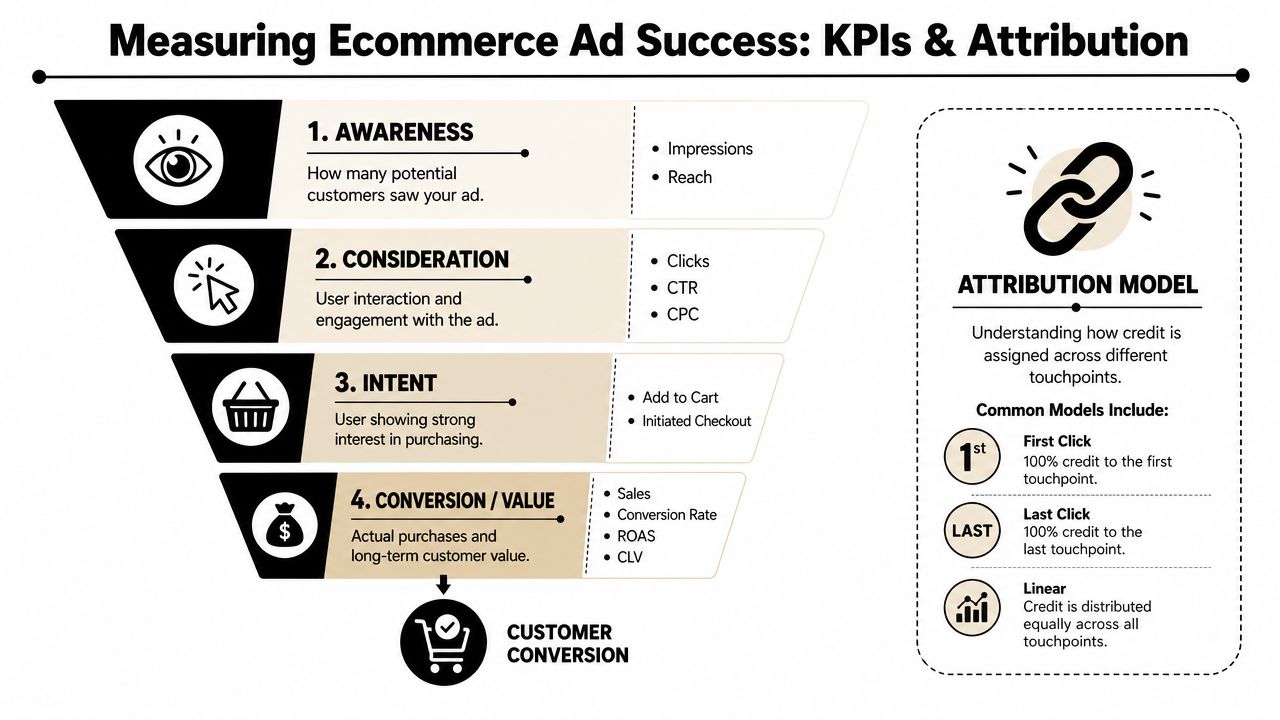
Metrics that deserve a permanent place on the dashboard
A healthy account does not run on click metrics alone. CTR, CPC, and impressions help diagnose delivery and message fit, but they do not tell you whether you are acquiring profitable customers or just buying traffic.
The scoreboard should stay tight:
- ROAS: Revenue efficiency by campaign, product set, or audience
- CAC: What you pay to acquire a new customer
- Conversion rate: How well sessions turn into orders
- AOV and repeat purchase rate: Whether the traffic is producing better buyers, not just more buyers
- Checkout and payment-step completion: Where friction is killing demand before the sale posts
If you want a practical benchmark list, this guide on 5 essential e-commerce metrics is a solid reference.
I also want one friction metric on every ecommerce dashboard: page speed by landing page. If a product page is slow, attribution gets noisier, conversion rate drops, and the ad platform learns from weaker signals. That is why measurement is not separate from performance. The site experience shapes the data quality the media account gets back.
Why attribution breaks in real accounts
Attribution usually fails through accumulation. Browser privacy changes limit cookie windows. Consent settings suppress events. Product catalogs pass incomplete values. Checkout apps interrupt session continuity. A slow page or broken thank-you page can wipe out conversion signals altogether.
That is why the tracking stack needs three parts working together:
- Platform pixels and tags
- Server-side event delivery
- One analytics view that reconciles orders, revenue, and customer status
Google's guidance on tagging and measurement makes the same point from a technical angle: weak tagging creates gaps that reduce optimization quality across campaigns and channels. In practice, that means the ad account starts favoring whatever it can still see, not necessarily what is driving profit.
Attribution is a decision framework
Attribution models are useful because they shape budget choices. Last-click reporting usually makes branded search and retargeting look stronger than they are. Platform-reported attribution can over-credit view-through conversions. Blended reporting from the store, analytics platform, and ad channels is slower, but it usually gives a better operating view.
Use one attribution approach for trend analysis, and keep it consistent long enough to compare periods fairly. Then pressure-test it against channel-specific reporting, new customer rate, and margin. That process matters more than chasing a perfect model.
For teams trying to connect paid social, search, email, and retention into one reporting system, this guide to cross-channel attribution is a useful next read.
Good measurement supports action. If reporting cannot tell you which audience, offer, page, or creative angle is producing profitable orders, the system is incomplete.
Your Ecommerce Campaign Setup Checklist
Campaign setup shouldn't feel creative. It should feel methodical. The teams that avoid expensive mistakes usually run the same pre-launch checks every time, even when the campaign is small.
This is the version I'd hand to a new media buyer before anything goes live.
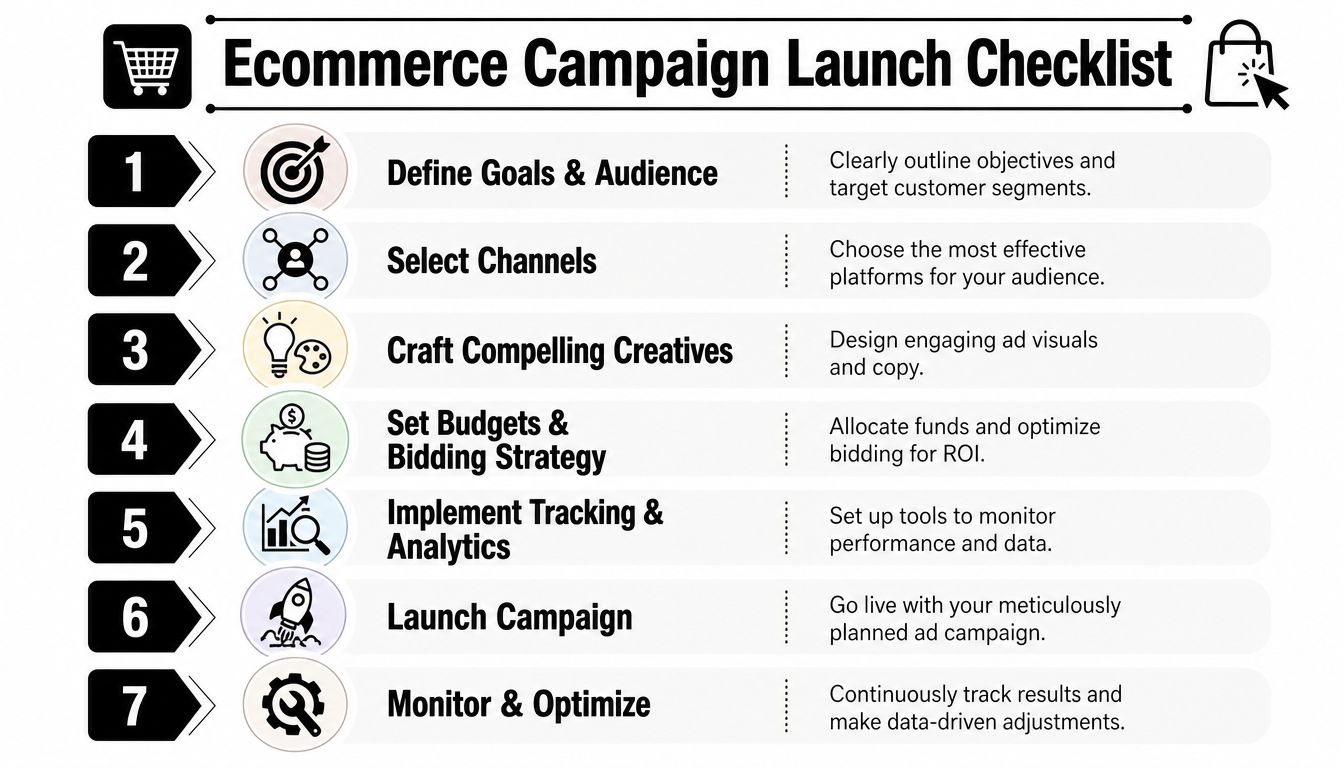
Pre-launch checks that matter
Define the business goal
Pick the primary objective first. New customer acquisition, product launch traction, margin-efficient revenue, repeat purchase growth, or stock clearance all need different campaign design.Choose the landing destination
Don't send every click to the homepage. Match the destination to the ad promise, search intent, and product decision stage.Lock the audience logic
Separate prospecting, retargeting, branded traffic, and customer retention. If those groups overlap heavily, reporting gets muddy fast.Build creatives by angle
Prepare multiple ads that argue different things. Test problem-led messaging, comparison-driven hooks, and use-case-specific variations.
A short walkthrough can help your team pressure-test the launch flow before spending starts:
Final verification before launch
Use this quick review before pushing campaigns live:
- Tracking check: Confirm purchase, add-to-cart, and checkout events fire correctly and carry revenue values where needed.
- Feed check: Verify titles, images, prices, availability, and product mapping for commerce-focused campaigns.
- Mobile review: Open the page on a phone and complete the path yourself.
- Offer clarity: Make sure shipping, returns, promotions, or exclusions aren't hidden until late in the path.
- Budget control: Set spend at a level the team can monitor closely during the first learning window.
- Naming conventions: Clean campaign names save hours when reporting gets complicated.
- QA pass: Check links, UTMs, promo codes, and on-page copy one more time.
A strong launch doesn't guarantee performance. It does prevent the dumb failures. That alone saves a lot of wasted spend in e commerce advertisement.
Common Pitfalls And Optimization Playbooks
A lot of marketers blame the platform when the issue sits after the click. They keep rewriting headlines, adjusting bids, and swapping audiences while the landing page leaks conversions.
That's why some of the biggest performance gains come from places media buyers don't always control.
Slow pages wreck good ads
Sites loading in over three seconds can see conversion rates drop by up to 40%, directly increasing customer acquisition costs and damaging ad ROI. Optimizing for Core Web Vitals is essential according to Cometly's ecommerce performance metrics guide.
If your traffic is solid but buyers disappear before product exploration or checkout, page speed belongs near the top of the troubleshooting list. A polished ad can't rescue a sluggish mobile experience.
Optimization playbook for message mismatch
One common failure is weak ad scent. The ad promises one thing, the landing page opens with something else.
Fix it like this:
- Repeat the hook: If the ad leads with convenience, price transparency, or a specific problem, the page headline should echo that message.
- Surface the product fast: Don't bury the item under oversized brand copy.
- Align visuals: The product, variant, or bundle shown in the ad should appear immediately after the click.
- Remove surprises: If there are shipping conditions or exclusions, put them in plain view.
Optimization playbook for audience fatigue
Fatigue rarely announces itself with one dramatic warning. It usually shows up as weaker engagement quality, less efficient spend, and stale responses.
A practical response:
- Rotate fresh angles: Don't just redesign the same ad. Change the argument.
- Split by audience temperature: A prospecting creative often tires faster than a branded or retargeting asset.
- Review frequency with context: High frequency isn't always bad in retargeting. It's more dangerous when cold audiences stop responding.
- Refresh the first frame: Especially for short-form video and social placements.
The fastest way to improve a weak campaign is often to fix the page, not the ad account.
Optimization playbook for poor mobile buying experience
Most ecommerce traffic arrives on mobile, but many stores still review campaigns from desktop and miss obvious friction.
Check these first:
- Thumb-speed navigation: Buttons should be immediate and easy to tap.
- Visible purchase path: Variant selectors, price, delivery details, and add-to-cart controls should appear without hunting.
- Checkout simplicity: Extra fields and awkward coupon behavior slow buyers down.
- Readable proof: Reviews, guarantees, and policies should be legible on small screens.
The biggest lesson here is simple. E commerce advertisement doesn't end at the impression or click. If the site experience is clumsy, the campaign is clumsy too.
Ecommerce Advertising FAQs
How much should a new store budget for ads?
Start with a budget you can monitor closely, not one that flatters your ambition. The first goal is learning. You need enough spend to test channels, angles, and audience segments without spreading the budget so thin that nothing gets a real signal. Most small stores do better with a narrower channel mix and sharper offers than with broad experimentation everywhere at once.
Which tools matter most for a small team?
A small team usually needs fewer tools than vendors suggest. The essentials are a solid ad platform setup, analytics you trust, product feed management where relevant, creative production workflow, and a place to track tests and results. If reporting is fragmented, fix that before adding more software.
How often should ad creatives be tested?
Test continuously, but not randomly. New creative should enter the account on a steady cadence tied to fatigue, seasonality, new offers, and audience expansion. Don't wait until performance collapses. Build creative testing into normal campaign operations.
Should a brand focus on acquisition or retargeting first?
If the store already has meaningful traffic, retargeting can produce quick wins. But it can't carry growth by itself. Acquisition builds the audience pool that retargeting later monetizes. Healthy accounts usually run both, with clear separation in budget and reporting.
What's the most overlooked part of ecommerce advertising?
Usually the post-click experience. Teams spend days refining audiences and copy, then send paid traffic to pages that are slow, cluttered, or vague. The ad account gets judged for a site problem.
How many channels should a brand run at once?
Fewer than most think. It's better to run a focused mix well than to operate five platforms badly. Add channels when the existing system is stable, tracking is reliable, and the team has enough creative and reporting discipline to manage the extra complexity.
If your team wants to clean up search term waste, tighten keyword targeting, and speed up Google Ads optimization without the usual spreadsheet mess, Keywordme is built for that job. It helps agencies, in-house teams, freelancers, and store owners move faster on keyword expansion, match types, and negative keyword management so paid search work gets done with less friction.
.svg)