Branded vs. Non-Branded Keywords in Google Ads
Branded vs. Non-Branded Keywords in Google Ads


Branded keywords include your company, product, or brand name, plus misspellings and close variants such as “Keywordme pricing.” They catch demand that already exists. Non-branded keywords cover category, problem, and comparison searches, so they put you in front of people who have not picked your brand yet and can help create demand for your business.
The Quick Answer on Branded vs. Non-Branded Keywords
The split matters because one account average can hide two different stories. A campaign that collects familiar customers and one that introduces your business to strangers should not automatically be held to the same efficiency bar.
Take “Keywordme” versus “Google Ads negative keyword tool.” The first shows brand awareness. The second shows a category need. Neither query promises a purchase, but each one starts your ad and landing page from a different place.
| Definition | Typical Intent Stage | Relative Efficiency | Main Account Job |
|---|---|---|---|
| Branded, includes your name | Aware, evaluating, or returning | Often cheaper conversions, though not always incremental | Capture existing demand |
| Non-branded, category or problem terms | Researching through purchase readiness | More variable, since acquisition can cost more | Reach potential new customers |

Separate the Jobs Before Comparing Results
Those efficiency notes are directional, not promises. No benchmark works as a universal target, because brand strength, competitors, and search intent all shape what a good result looks like.
Non-branded searches also do not create need out of thin air. They can connect existing category demand to your business and give someone a reason to consider you over a familiar alternative.
Judge each keyword group by the job it is meant to do, not by the cheapest conversion sitting elsewhere in the account.
The comparison ahead helps you pressure-test four things:
- Benchmark evidence, including how click and conversion patterns differ across keyword groups.
- Campaign structure choices, so budgets and bidding match each group’s purpose.
- Measurement traps, including attribution and conversions you might have gotten anyway.
- Situational recommendations, whether you are building awareness or protecting established demand.
For more context on overlapping traffic, see brand campaign cannibalization in Google Ads.
Start by splitting your search terms today. If you remember one thing, treat these keyword types as separate businesses, not one blended list.
Branded and non-branded keywords can sit side by side in the same list and still describe two very different searchers. One already knows the name. The other is still working out what the problem is.
Three Practical Buckets for Branded Queries
Bare brand names are the easiest to read. Someone types "Keywordme," a shop name, or a close misspelling, and they already have a specific company in mind.
They might be coming back, checking that you're still around, or picking up a visit they started somewhere else. The intent is narrow, even when the click doesn't turn into a sale.
Brand-plus-modifier terms take that name and attach a job to it. "Keywordme pricing," "shop name login," and "brand reviews" all rest on awareness you already earned, but the extra word tells you which page the person actually wants.
Keep those modifiers separate. Pricing, login, and reviews are three different visits, and lumping them into one brand ad group will blur the picture.
Competitor brand terms sit in an awkward middle ground. Searching for a rival isn't really your brand, and it isn't a clean category search either.
Plenty of accounts drop these into the branded or non-branded campaign and then misread the numbers. Giving them their own view keeps your defense and your conquest efforts honest.
| Bucket | Example | What the Searcher Wants |
|---|---|---|
| Bare brand | "Keywordme" | To find you or come back to you |
| Brand plus modifier | "Keywordme pricing" | A specific page or answer about you |
| Competitor brand | A rival's company name | To compare or consider switching |
Sort Non-Branded Queries by Intent Depth
Word count is a pretty unreliable way to sort non-branded keywords. A short phrase can be ready to buy, while a long one can be pure curiosity.
A better question is how close the searcher is to making a decision.
- High-intent commercial phrases name a product, a price, or a comparison, like "best negative keyword tool" or "buy linen sheets online."
- Research-oriented phrases explore options before anyone picks a vendor, like "how agencies structure Google Ads" or "cotton vs linen bedding."
- Purely informational phrases want an answer, not a shopping cart, like "what is a search term report" or "how often to wash linen."
A small online shop makes this easy to see. "Oak & Thread," "Oak & Thread sizing," and a rival boutique's name cover the three branded buckets. "Linen duvet cover queen," "best sheets for hot sleepers," and "how to wash a duvet cover" map to commercial, research, and informational depth.
An agency account works the same way. "Northline Digital," "Northline Digital case studies," and a rival agency's name make up the branded side. "Google Ads management for dentists," "PPC agency vs in-house," and "what is Quality Score" fill the non-branded side.
Branded traffic harvests awareness you already paid for, while non-branded traffic buys future customers at full price.
That's the real split in branded vs. non-branded keywords. One group protects demand you already built. The other costs more because you're meeting people who've never heard of you.
Let Match Types and Search Terms Decide
The keyword you add is really just a label. Match types determine which live queries can get in, and the search term report tells you which ones actually did.
Phrase and broad match can pull a category query into your brand ad group, or push a misspelled brand name into a generic one. Even exact match picks up close variants that wander off, so negatives still matter.
Classify each query after it lands rather than trusting the keyword list alone. If you want a wider look at how terms fit into a campaign, check out our guide on digital marketing keywords.
That habit sets you up for the performance data. A query sitting in the wrong bucket makes both sides look worse than they really are.
Branded searches tend to look stronger because the advertiser is capturing demand that already exists. Non-branded searches usually cost more, though they put the business in front of people who might never have found it otherwise.
One foundational search advertising study found a 13.68% CTR for branded keywords, versus 0.26% for generic searches. Conversion rates came in at 6.03% versus 1.05%, and average CPC was $0.18 versus $0.55. Explore the search advertising performance context.
That works out to roughly a 52.6-times CTR gap and a 5.7-times conversion gap. Still, branded traffic is easier to win because the searcher already knows the name.
What Branded Search Performance Indicates
A recent Malaysian SME benchmark covering 500+ accounts from 2024 through 2026 gives a useful view of how that efficiency plays out inside a real budget.
Bare brand terms used only 6% of spend but generated 21% of conversions, with a 24.8% median CTR. Brand-plus-modifier terms added another 5% of spend and 13% of conversions, with a 17.2% median CTR.
High-intent non-branded terms ate 54% of spend and produced 51% of conversions, while median CTR dropped to 6.1%. Research non-branded terms used 35% of spend for only 15% of conversions, with a 3.4% CTR.
| Keyword Group | Spend Share | Conversion Share | Median CTR | CPL Index |
|---|---|---|---|---|
| Bare Brand Terms | 6% | 21% | 24.8% | 29 |
| Brand-Plus-Modifier Terms | 5% | 13% | 17.2% | 41 |
| High-Intent Non-Brand | 54% | 51% | 6.1% | 112 |
| Research Non-Brand | 35% | 15% | 3.4% | 214 |
The spending imbalance is hard to miss. High-intent non-branded terms still pulled their weight, while research terms soaked up a meaningful budget for a much smaller return.
Comparing Cost Per Lead Efficiency
The cost-per-lead index uses the blended account median of 100 as the baseline. An index of 29 means bare brand terms cost about 71% less per lead than that midpoint.
Brand-plus-modifier terms scored 41, so they were still fairly efficient. High-intent non-branded terms scored 112, and research non-branded terms climbed to 214.
This infographic shows the cost-per-lead index for each keyword group next to the blended account median.
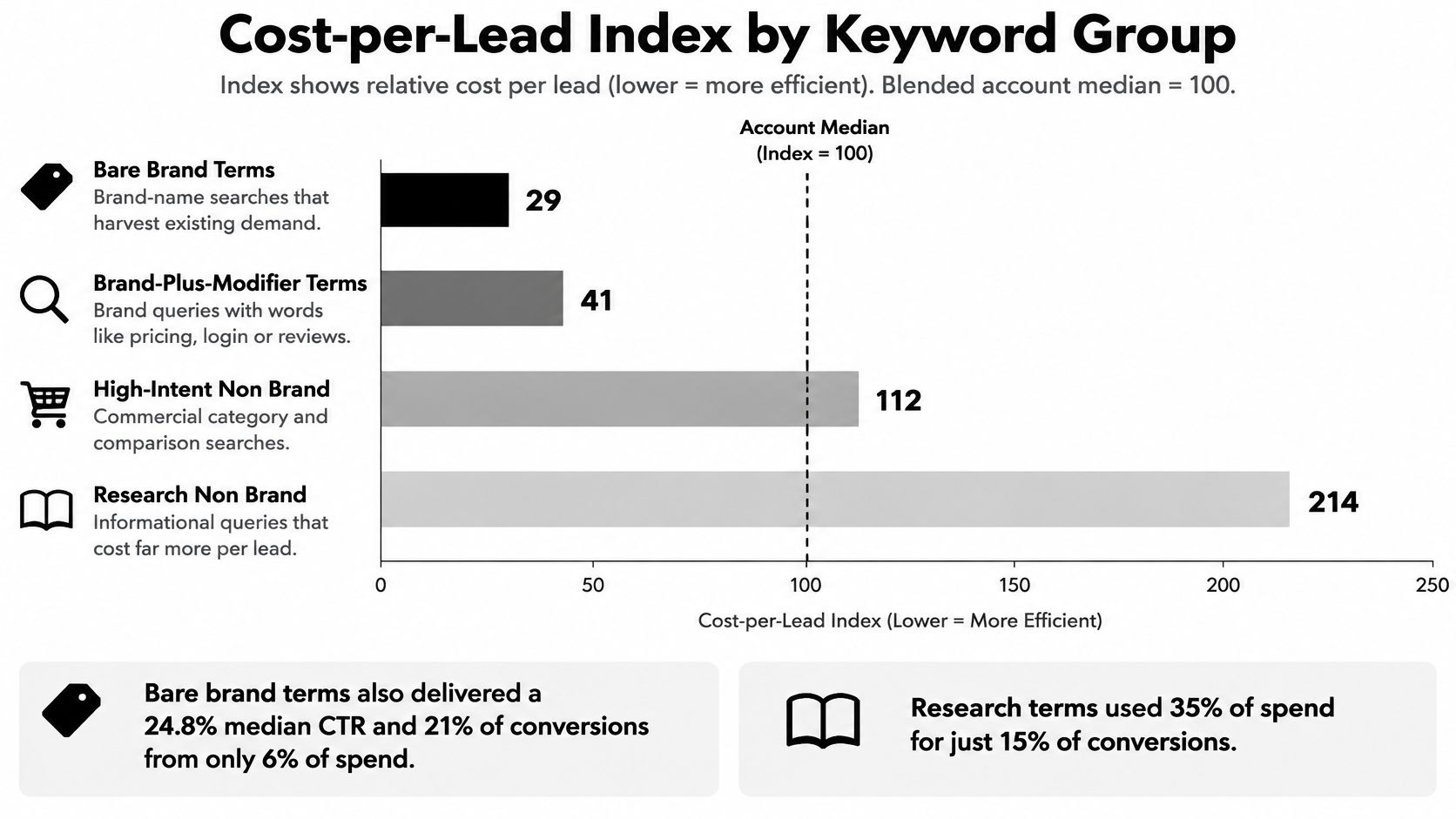
Bare brand terms delivered 21% of conversions from 6% of spend, while research terms used 35% of spend for 15% of conversions. That gap points to where budget pressure needs a closer look, rather than proving one group should get every dollar.
Using the Benchmarks Responsibly
NYU Stern’s keyword-level averages offer another reference point. The average keyword received 411 weekly impressions, about 46 clicks, 0.85 purchases, and an average CPC of roughly $0.25.
The research also found that brand-specific keywords respond more strongly to better ad position. That tracks with reality: when someone searches for a specific name, they are more likely to click the most relevant result near the top.
A blended CPA flatters branded performance and quietly punishes acquisition work. Separate branded and non-branded campaigns before deciding whether either group deserves more budget.
These gaps still shift with industry, device, geography, brand maturity, and attribution settings. A newer brand may have little branded demand, while a mature company may be dealing with pricey competitor bids and tougher organic competition.
Use the figures as directional benchmarks, then compare spend share with conversion share in your own account. Start by splitting branded and non-branded reports in Google Ads, calculate cost per lead for each group, and move budget only after checking search-term relevance, intent, and conversion quality.
Mixing branded and non-branded keywords in one campaign is the kind of mistake that doesn't announce itself. Performance just stays a little flat, and nobody can quite say why. Separate campaigns fix that by giving each group its own budget, its own bid strategy, and a report you can actually trust.
Budget control is the first payoff. Honest reporting is the second.

Building a Structure That Holds Up
Start with the tightest brand campaign you can build. Keep it to bare brand terms and the obvious misspellings, in exact and phrase match. Brand-plus-modifier searches get their own ad groups, sorted by what the person is after. Someone typing "pricing" wants something very different from someone typing "login," so they deserve different ads.
Then split the non-brand side into commercial and research sets. If everything sits in one big bucket, the bidding algorithm learns from mixed signals, and neither intent gets a fair shot at the budget.
- Bare brand campaign for name-only queries and close variants
- Brand modifier ad groups for pricing, login, reviews, and support
- Commercial non-brand campaign for category and comparison terms
- Research non-brand campaign for informational queries, held to a tighter cap
Match Type Discipline and Negative Coverage
Broad and phrase match will quietly pull unrelated queries into non-brand ad groups. That's usually how a category term ends up competing against your own brand ads, which is an expensive way to bid against yourself.
Even exact match needs a negative list behind it, since close variants have a habit of wandering. For more on keyword relevance and how it feeds into your overall account setup, check out this guide on Quality Score tips for Melbourne businesses.
A Repeatable Search Term Review Workflow
Run the same loop on a schedule, not whenever the numbers start looking scary.
- Scan the search term report for spend with no conversions
- Promote strong discovery queries into the right ad group
- Add recurring junk to a shared negative list
- Protect branded variants before cutting anything
Keywordme runs AI scans to pull out negative keywords, so cleanup doesn't depend on someone squinting at pages of query data. It's also worth reading our piece on brand campaign cannibalization in Google Ads.
Structure is the cheapest optimization in Google Ads. It costs an afternoon and pays off every month after.
Two Real Scenarios
A small shop with limited spend can't afford a research campaign that never converts. Every campaign has to earn its place, so brand defense plus a tight commercial set usually makes the most sense.
An agency running lots of accounts needs consistent naming across clients. Same campaign labels, same negative lists, same intent splits, so results stay comparable from one client to the next.
Structure Habits Worth Copying
- One campaign per intent group, never one blended bucket
- Exact and phrase match first, broad only when the data backs it up
- A shared negative list updated weekly
- Branded variants protected before any cut
A cheap conversion on a branded term can feel like a great result, but it often tells you less than it seems. Plenty of those people were already headed to your site. The ad just happened to be the last thing they clicked.
That's the incrementality problem. A $0.50 conversion isn't automatically $0.50 of new revenue, since the searcher might have typed your URL in anyway.
A branded conversion answers "did we catch them?" An incrementality question asks "would we have gotten them anyway?" Those are two very different questions.
Where Comparisons Get Distorted
Attribution windows can make this worse. Someone sees a non-branded ad on their phone, then searches your brand name on a laptop two days later. Cross-device journeys like that tend to hand the credit to the branded campaign.
Blended averages add to the problem. Lump both groups together and the cheap brand conversions pull the number down, which makes your acquisition work look weaker than it really is.
That doesn't mean brand campaigns should get cut. When competitors bid on your name, brand defense still matters, and the spend is usually small enough that it pays for itself.
Checks You Can Run This Week
- Report branded and non-branded conversion contribution separately, never as one combined number
- Watch the new versus returning customer mix behind each group's conversions
- Review search-term relevance before deciding whether a campaign is working or not
A quick note on tooling. Keywordme relies on Google and Cometly for analytics and ad measurement, and that setup shapes what the data can show you and how the reports should be read. If you want to dig deeper into the numbers, take a look at our guide on comparison of performance.
Reporting Habits That Keep Both Sides Honest
- Split the two keyword groups in every report, every time
- Tag new versus returning customers so incrementality stays visible
- Recheck search terms monthly, not only when spend spikes
Both sides of the split have a job to do. The aim is accountability without turning reporting into a second job.

Honestly, no two accounts look the same, so the right split between branded and non-branded keywords depends on where your business sits right now. Here are four common situations and what tends to work in each.
When You're a New Brand With Little Search Demand
Hardly anyone searches for your name yet, so branded volume is pretty thin. Your main job is discovery. Put your non-branded budget into category and problem searches so people run into you for the first time.
Your acquisition costs will look higher at this stage, and that's fine. You're paying to build awareness before branded demand exists. It's a bit like planting before harvest: you can't pick what hasn't grown yet.
When Your Brand Already Pulls Heavy Searches
Established brands tend to overspend on their own name. Cap your brand budget so it covers defense and modifier searches, then move the savings into high-intent non-branded terms.
Testing competitor brand terms can make sense here, but only if you can track them separately. If a rival's name brings in cheap clicks and no sales, cut it.
When You're a Small Shop on a Tight Budget
Spreading a few hundred dollars across research queries rarely pays off. Stick with brand defense and a narrow set of commercial non-branded terms.
Exclude research traffic outright. Those clicks feel like progress, but at your budget they rarely turn into orders.
Every dollar in a small account has to earn its keep, so cut the searches that only look like interest.
When You're an Agency Running Many Accounts
Multiple clients usually mean multiple naming habits, and that's where reporting starts to fall apart. Use consistent campaign labels, shared negative lists, and per-client intent splits so the results stay comparable.
Agencies often skip this step, and that's exactly how clients end up with apples-to-oranges reports. Keywordme Pro can help with one-click negative list building, instant match type configuration, and search term based campaign expansion. Most teams try the seven-day free trial on one real account first to see if the workflow fits.
A Decision Sequence You Can Use This Week
- Check how much of your spend goes to branded terms versus non-branded.
- If branded volume is thin, shift budget toward discovery non-branded terms first.
- If branded volume is heavy, cap brand spend and test competitor terms with a separate budget.
- Exclude research queries once you know which commercial terms convert.
- Set up shared negatives and naming before you add a second account.
Each step builds on the one before it, so don't skip ahead. Run it on one account first, then repeat it every month.
Should You Bid on Your Own Brand Name?
Yes, most of the time. If you skip it, a rival can bid on your name and land the paid spot right above your organic result, which means they get the click you should have won. Next move: open Auction Insights, and if a competitor shows up on your brand terms, keep a small defense campaign running.
How to Classify Competitor Brand Terms
These don't fit neatly into either bucket. They aren't your brand, and they aren't generic category searches either. Treat them as their own group.
Key differentiator: Competitor brand terms have their own intent. The person searching is comparing options, not necessarily looking for a generic solution.
Next move: give rival names a separate campaign with a capped budget, and report their conversions on their own line so they don't skew your branded or non-branded numbers.
How Much Budget Goes to Non-Branded Terms?
If you don't have any performance history yet, start small and test instead of guessing. Figuring out which keywords to target also depends on how you grow beyond the terms you already rank for, and this Claude keyword research workflow is a useful place to look. Next move: split your non-branded budget across two or three commercial ad groups, set a daily cap on each, and move money toward whichever one converts at a cost you can live with.
How Often Should You Review Search Terms?
Every two weeks is a solid default, and weekly works better during launches or big spend changes. Don't wait for the monthly report, because wasted spend adds up quickly. Next move: check the search terms report today, and treat any of these as an immediate red flag:
- A sudden spend spike you can't explain
- A new junk query eating into your budget
- A click-heavy term with zero conversions
Ready to finally clean up your search terms? Try Keywordme free for seven days at www.keywordme.io and see how quickly a clean negative list comes together.
