
AI Google Ads Keyword Management: Your 2026 Guide
AI Google Ads Keyword Management: Your 2026 Guide


SEO Title: AI Google Ads Keyword Management for 2026
Meta Description: AI Google Ads keyword management in 2026 means less manual work, smarter query control, better reporting habits, and tighter campaign guardrails.
A lot of PPC managers are in the same spot right now. You turn on Google's newer automation, broad match starts surfacing terms you never would have targeted manually, conversions come in from places you didn't expect, and then reporting gets murky fast.
That mix of progress and frustration is what defines AI Google Ads keyword management today.
The old workflow was simple, even when it was tedious. Build keyword lists. Split match types. Mine search terms. Add negatives. Repeat until your spreadsheet became a second operating system. The new workflow is less manual, but it isn't cleaner by default. Google gives the machine more freedom, and in return you get scale, speed, and a lot less line-by-line visibility.
That's the trade-off. If you want the upside without losing control, you need a different operating model.
The End of Keyword Spreadsheets
The classic Google Ads routine wore people down for a reason. You'd export a search terms report, sort by cost, hunt for junk, debate whether a phrase should live in exact match or phrase match, then rebuild the same logic in three more campaigns. By the next week, the account had changed again.
That work wasn't strategy. It was maintenance.
Where the old process breaks
Manual keyword management starts to crack when query volume expands faster than a person can review it. The account gets bigger, match types overlap, and negatives become reactive instead of deliberate. You stop shaping demand and start cleaning up after it.
Three things usually happen:
- Search term reviews turn into triage: You only catch the worst waste, not the subtle patterns.
- Keyword expansion slows down: Good converting queries sit buried in reports because nobody has time to structure them properly.
- Match type debates eat hours: Teams spend more time policing overlap than improving the offer, ad, or landing page.
If you've ever spent a Monday morning adding negatives one by one, you know the feeling. It doesn't matter how disciplined your naming conventions are. Past a certain scale, the spreadsheet becomes the bottleneck.
Practical rule: If your account management depends on someone manually spotting every bad query, the process is already too fragile.
What changes with AI
AI doesn't remove the need for judgment. It changes where judgment matters.
Instead of hand-picking every route into the account, you're giving Google stronger signals about what success looks like and letting the system explore more territory. That can be useful. It can also drift if your controls are weak.
This is the shift: Your job moves from keyword janitor to systems manager.
You still need search term discipline. You still need negatives. You still need structure. But you need them in service of steering automation, not replacing it. That's why workflows built around static keyword lists age badly now. If you still rely on giant exports and manual formatting, a tool like the Google Ads keyword list builder from Keywordme reflects where the work is heading. Less copy-paste, more fast decision-making.
What still matters
Some old-school habits are still worth keeping:
- High-intent thinking still wins: Broad vanity terms often waste spend unless the business can support huge catalog depth.
- Relevance still matters: Ad groups, landing pages, and exclusions still shape what the machine can do well.
- Human review still catches nonsense: Automation scales judgment only if you feed it sane inputs.
The spreadsheet era isn't ending because discipline no longer matters. It's ending because manual maintenance can't keep up with how Google now matches intent.
What Is AI Keyword Management Anyway
Most people hear "AI keyword management" and assume it means Google is just automating keyword suggestions. That's too small a definition.
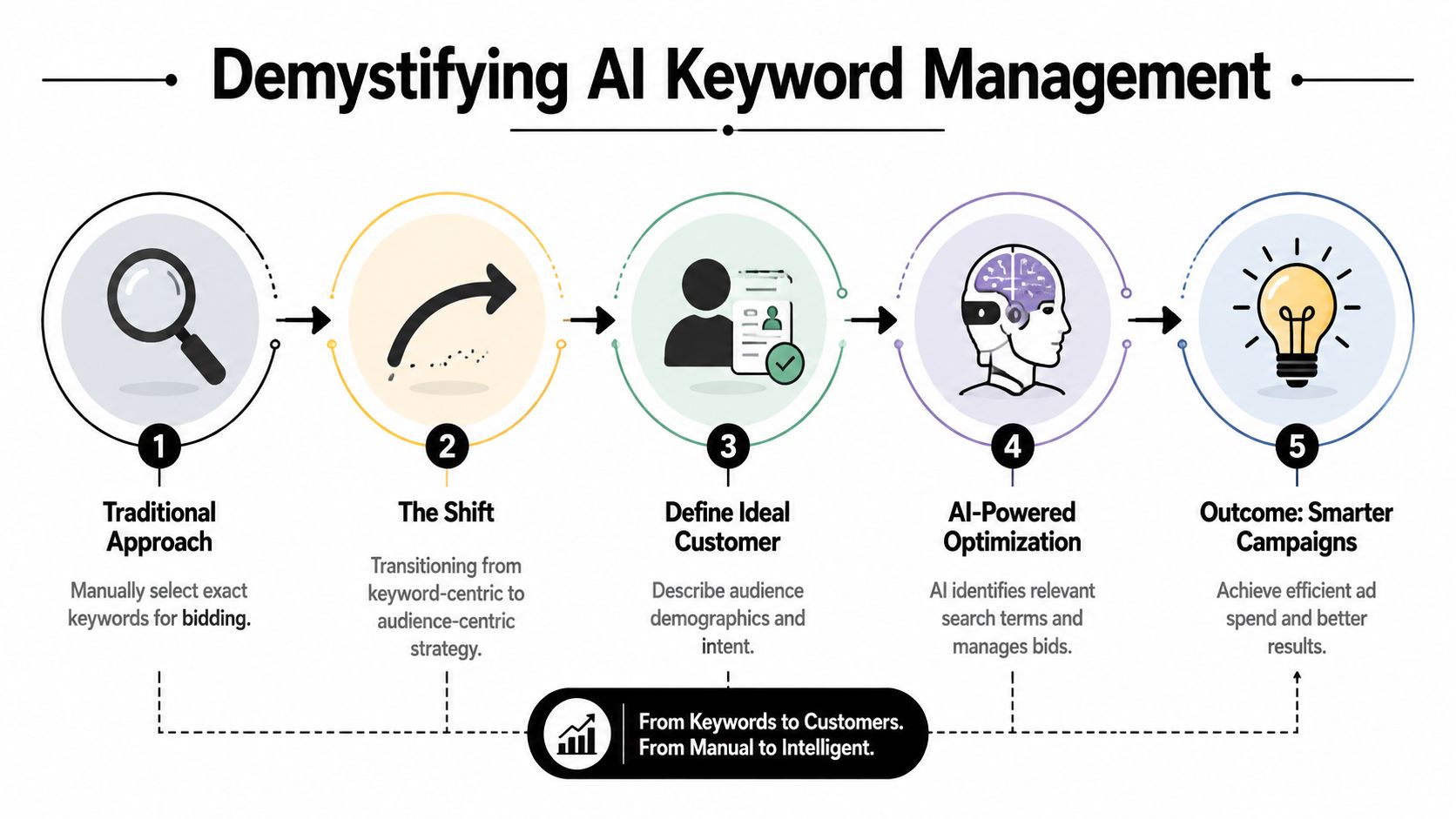
What's really happening is a shift from string matching to intent matching. Instead of telling Google, "show for this exact phrase and its close variations," you're giving it more room to infer what the searcher means and whether your offer is relevant.
The simplest way to think about it
The old model worked like a card catalog. You filed terms into neat buckets and hoped the right person searched with the right wording.
The newer model works more like a skilled librarian. You describe the topic, the need, and the likely user, and the system tries to connect intent with inventory.
That isn't just theory. Google states that AI Max for Search campaigns redefines keyword management by replacing rigid match type reliance with intent-based search term matching, and advertisers who activate AI Max in Search campaigns typically see a 14% increase in conversions or conversion value compared with those who don't, according to Google's product launch coverage and help documentation (Google AI Max product launch and AI Max support documentation).
What the machine is actually doing
When AI Max is active, Google can expand beyond your literal keyword wording and tailor ad assets and final URLs in real time. In practice, that means the system is trying to match commercial intent, not just keyword syntax.
That changes the marketer's input.
Instead of obsessing over whether one term belongs in exact or phrase, the stronger questions are:
- What counts as a qualified conversion
- Which searches are clearly off-limits
- What landing page best fits a cluster of related intent
- Which creative themes should the system emphasize
If you work across lead gen and ecommerce accounts, this starts to look a lot like broader PPC strategies for businesses rather than old-school keyword sculpting. Campaign goals, offer clarity, and conversion tracking become more important than micromanaging every match type edge case.
AI keyword management isn't "Google picks random queries for me." It's "Google explores meaning at scale, and I decide the rules, the signals, and the stop signs."
Where people get tripped up
The common mistake is turning on automation while keeping a manual mindset. Teams expect neat keyword-level accountability from a system that's optimizing around intent clusters. Then they get frustrated when the data no longer maps cleanly.
That's not because AI keyword management is fake. It's because the interface still looks more transparent than it really is.
The Good The Bad and The Automated
AI-driven keyword management has genuine upside. It also creates headaches that are very real once you're inside live accounts.
The good part is obvious fast
The best thing automation does is remove repetitive labor. One source focused on AI tools for Google Ads reports that AI-driven keyword management can reduce manual negative keyword handling by 80% while improving ROAS by 2–4x, transforming traditional 15–20 hour weekly workflows into 3–4 hour optimized processes by automating analysis of user intent and search query data (Ryze on Google Ads specialist AI tools).
Even if your own results vary, the direction is familiar. The machine is better than a human at scanning huge query sets, spotting semantic variants, and reacting faster than a weekly optimization cadence.
What AI tends to do well
A strong account usually sees benefits in a few specific areas:
- Coverage improves: The system finds relevant searches your manual build probably missed.
- Testing speed increases: New query patterns surface faster than a human researcher could build them.
- Routine cleanup shrinks: You spend less time formatting negatives and more time judging patterns.
That part is easy to like.
The bad part shows up in reporting
The mess starts when you try to explain performance cleanly.
A real problem with AI Max is the reporting mismatch between what happened at the campaign level and what you can confidently isolate at the keyword or query level. PPC managers have been vocal about this. Once AI-driven expansion enters the mix, ad group and keyword-level reporting no longer lines up in the tidy way many teams expect.
Here's the practical consequence. You may know the campaign improved, but you often can't cleanly split "this came from my hand-built exact terms" from "this came from AI expansion." That makes optimization less precise than Google marketing pages imply.
You aren't failing when the data feels blurry. The platform is giving you blended outcomes from blended matching logic.
What doesn't work anymore
Some habits become actively misleading in AI-heavy accounts.
| Old habit | Why it breaks now |
|---|---|
| Judging success by a tiny set of hand-picked keywords | AI can generate value outside your original list |
| Assuming keyword reports mirror campaign truth | AI Max introduces structural opacity |
| Waiting for perfect attribution before acting | You'll stall while the account keeps moving |
The biggest mistake is pretending this opacity doesn't exist. It does. And no third-party workflow can fully restore data Google doesn't expose.
That doesn't mean you should avoid automation. It means you need a management process built around inference, guardrails, and faster human review.
A Practical Workflow for AI-Powered Campaigns
The cleanest AI workflow is not "turn everything on and trust the machine." It's a hygiene routine. You set constraints first, then let Google explore inside them.
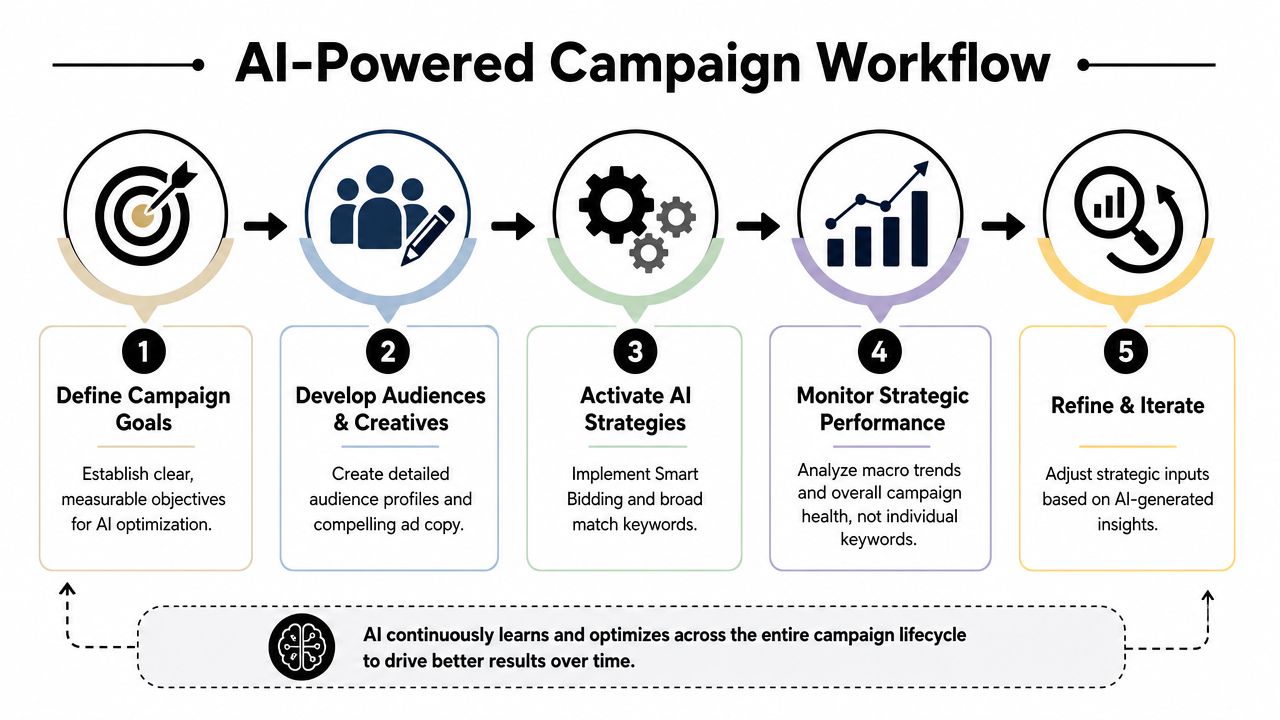
Start with guardrails, not keywords
One of the more important shifts in current practice is account-level exclusions. A 2026 best-practice source notes that Google Ads now requires using Account-Level Negative Keyword Lists to block thematic categories like "free" or "jobs" across campaigns, so AI-driven expansion doesn't wander into obviously irrelevant traffic (Google Ads best practices for 2026).
That's the right framing. Don't try to block every individual bad term one by one. Block themes that should never enter the account.
Your first pass should cover:
- Low-buying-intent themes: Free, cheap, sample, template, meaning, definition
- Wrong-audience themes: Jobs, careers, salary, internship, course
- Irrelevant use cases: DIY, used, second hand, troubleshooting, support, depending on the business
By doing this, broad intent matching stays productive. You leave room for discovery, but you fence off whole neighborhoods of bad traffic.
For a small business account, an expert guide to Google Ads campaigns can be useful context for deciding how much control to keep versus how much automation to allow. The principle is the same either way. Strong inputs beat constant cleanup.
Review search terms like a detective
The weekly search term review still matters. The purpose changes.
You're no longer just asking, "Which exact words should I negate?" You're asking:
- Which themes are wasting spend
- Which new commercial intents are showing up
- Which landing pages need to align better with what the machine found
A strong review cadence often looks like this:
- Pull the search terms
- Group by semantic theme
- Mark obvious junk for exclusion
- Promote high-value patterns into structured campaign elements
- Feed insights back into ads and landing pages
That last step gets skipped too often. If AI keeps finding a subtopic that converts, don't leave it buried in the report. Build for it.
Operational advice: Search term reviews are no longer just a negative keyword task. They're market research hiding inside campaign data.
Keep one workflow for the team
Most accounts fall apart when one manager uses broad match loosely, another uses it cautiously, and a third relies on Google's recommendations without a filter.
A shared system helps. That includes naming conventions, clear exclusion policies, and a standard process for turning search term findings into action. If your team needs a repeatable method, this AI workflow for finding negative keywords is aligned with how modern accounts need to be maintained.
A useful refresher before team reviews:
The point isn't to outwork the machine. It's to make sure the machine is working inside boundaries you chose.
How Keywordme Streamlines Your AI Strategy
The hard part of AI Google Ads keyword management isn't activation. It's cleanup and interpretation.
Once Google's systems start expanding query coverage, you're dealing with more blended search term data, more semantic variation, and more hidden value mixed in with more junk. That's where manual exports start becoming a drag again.
Why weak data volume makes everything harder
Before any tool can help, the account has to give Google's automation enough signal to learn. AI-based Google Ads management generally needs 30 to 50 conversions per month per campaign to function optimally, and below that threshold bid optimization becomes less effective because the system doesn't have enough conversion data to learn user intent accurately (AI Google Ads management guide from Gomega).
That matters because low-volume accounts often get hit from both sides. Google automation is less stable, and manual review becomes more important at the exact moment the data is thinnest.
Where a focused workflow helps most
The practical bottleneck is not usually "finding more keywords." It's handling the messy middle.
You need to:
- Remove junk fast: Irrelevant themes need to be identified without endless spreadsheet filtering.
- Spot winners faster: Converting queries should be easy to group and act on.
- Apply structure quickly: Good terms often need match type decisions, ad group placement, and negative handling right away.
That's where Keywordme fits naturally into the modern PPC workflow. It isn't trying to replace strategy. It helps reduce the mechanical work around search term cleanup, match type assignment, and campaign expansion so you can spend more time on interpretation.
What this solves in real life
A lot of AI account frustration comes from context switching. You're jumping between reports, bulk sheets, manual formatting, and ad platform edits just to turn one insight into one action.
A tighter workflow changes that.
Instead of exporting, sorting, and re-importing constantly, you can work from the actual search term signal. Clean the junk. Group the useful terms. Push clear winners into exact, phrase, or broader structures when they deserve dedicated treatment. The value isn't flashy. It's that less of your time gets burned on formatting tasks that don't improve the campaign by themselves.
Good AI account management still depends on humans. The difference is that the human should be choosing actions, not wrestling with copy-paste work all afternoon.
For teams managing multiple clients or business units, that distinction is huge. It keeps the account review process strategic instead of clerical.
Key Metrics and Proving AI ROI
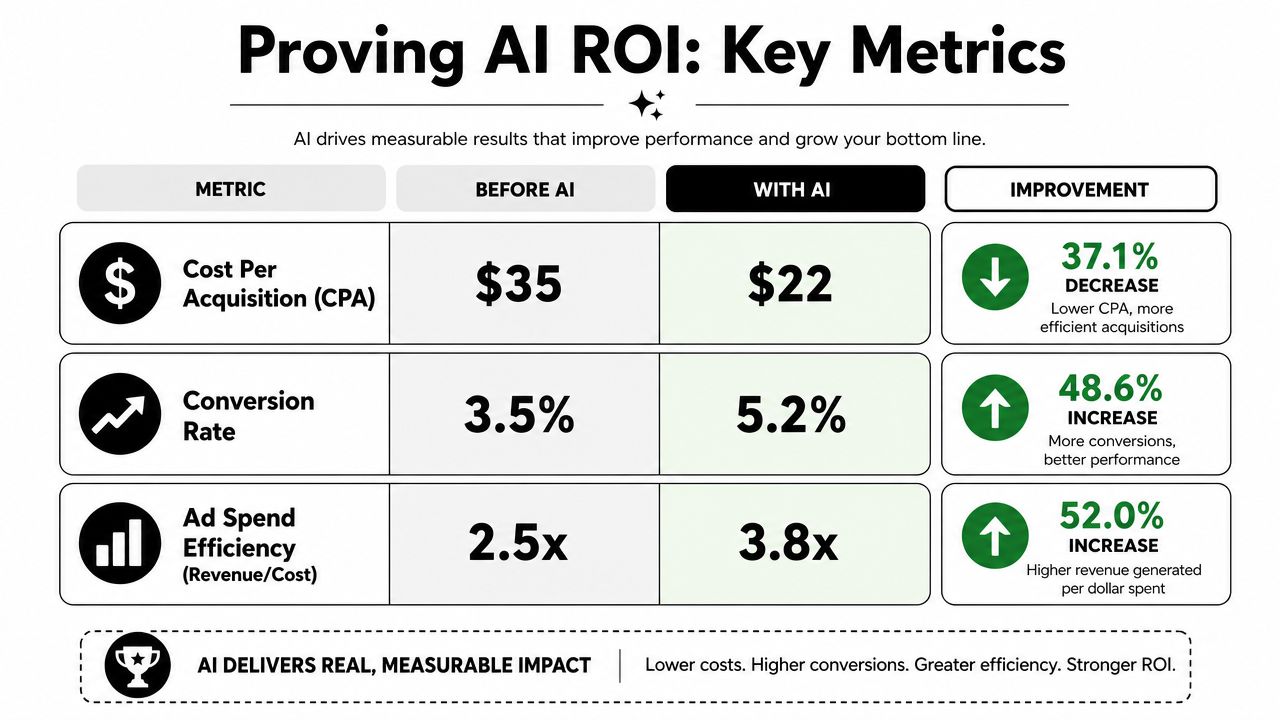
One of the biggest blind spots in AI-heavy Google Ads management is reporting. Everyone wants a clean "AI did this" column. Google doesn't really give you one.
Accept the reporting gap first
A useful industry observation here is that Google doesn't clearly separate AI Max impressions in standard reports, so advertisers often have to use query theme segmentation and channel performance data within Performance Max to infer AI-driven traffic growth rather than measure it directly (analysis of AI Mode and AI reporting gaps).
That's the reality. If you keep waiting for perfect native reporting, you'll never build a useful narrative for stakeholders.
What to measure instead
The better approach is comparative and theme-based. Look for changes that happened after AI features were enabled, then map those changes to search behavior and business outcomes.
Focus on:
- New query themes: What semantic clusters started appearing after activation?
- Net account efficiency: Did blended performance move in the right direction at the campaign level?
- Landing page alignment: Are newly surfaced themes converting because the destination matches intent?
- Search term quality: Are you seeing more commercially relevant variations or more noise?
A simple working table helps.
| Signal | What you look for |
|---|---|
| Query theme growth | New commercial intent clusters showing up consistently |
| Search quality drift | More qualified searches, or more irrelevant expansion |
| Conversion pattern changes | Better conversion mix from broader intent pools |
| Stakeholder clarity | A narrative that explains why blended growth happened |
Build an inference-based report
A useful monthly reporting rhythm looks like this:
- Mark the date AI features were enabled
- Segment search terms by theme
- Compare pre-change and post-change theme mix
- Tie those shifts back to conversion quality and business relevance
- Document what the machine discovered that your old keyword list missed
This is more work than checking a native report column, but it reflects the platform you have.
If you're trying to translate that into business language, a tool like the Google Ads ROI calculator from Keywordme helps frame outcomes in terms stakeholders care about rather than platform jargon.
The reporting trick in the AI era is simple. Stop trying to prove every click's origin with impossible precision. Prove that the account found better demand, handled it efficiently, and turned it into measurable business value.
Your New Role as an AI Strategist
The PPC manager who wins with automation is not the one who gives up control. It's the one who moves control upstream.
That means better conversion tracking, stronger exclusions, cleaner campaign intent, sharper landing pages, and a tighter review process for whatever the machine uncovers. The job is less about assembling giant keyword lists by hand and more about building a system that can learn without drifting into garbage.
That's a better role.
You still need skepticism. Google's automation is good at scale and weak at explanation. It can discover valuable intent, but it won't always tell you clearly how it got there. That's why human judgment still matters most in the messy parts. Defining the offer, spotting irrelevant themes, deciding what deserves its own structure, and explaining results to the business.
If you're thinking more broadly about how search behavior is changing beyond paid media, these AI search engine optimization strategies are also worth reading. Paid search and organic search are both moving toward intent interpretation, not rigid keyword matching.
The old keyword manager optimized rows. The modern PPC strategist manages a decision system.
That shift can feel uncomfortable at first. It's also where the advantage lies.
If you want a faster way to clean search terms, build negatives, expand winning queries, and keep your Google Ads workflow out of spreadsheet hell, take a look at Keywordme. It gives PPC teams a practical control layer for the parts of AI-driven keyword management that Google still leaves messy.
.svg)