
Advertising for Sports: A Practical Playbook for 2026
Advertising for Sports: A Practical Playbook for 2026


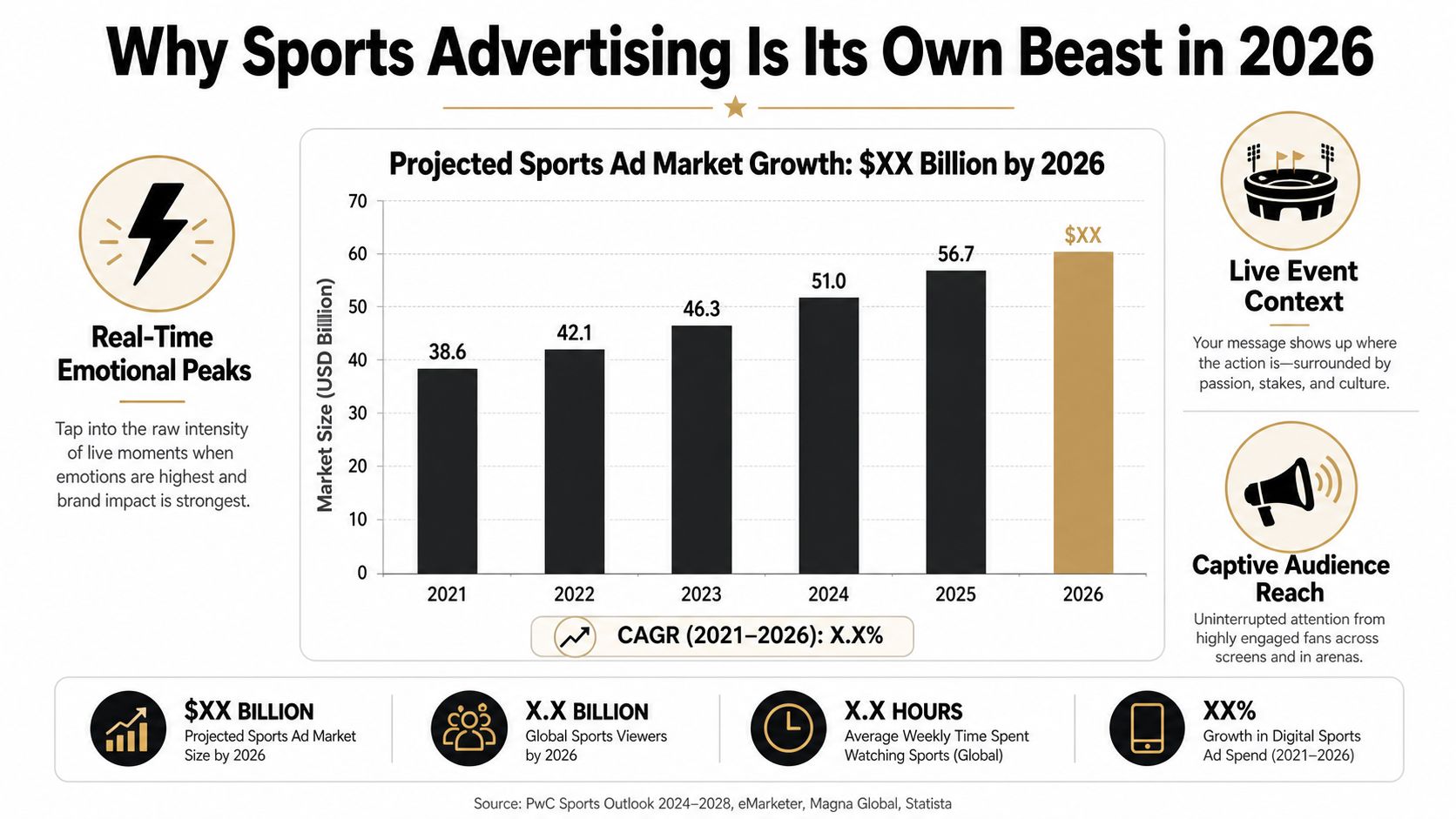
A 30-second Super Bowl spot hit $7 million in 2024 and more than 123 million viewers watched Super Bowl LVIII, which tells you everything about why advertising for sports sits in a category of its own. It's one of the few media environments where brands still pay for live attention at true mass scale, but that scale comes with brutal competition, tight creative windows, and a planning job that's closer to live event orchestration than ordinary digital buying. Sports advertising pricing and audience scale make the stakes obvious, and the broader market backs it up too, with the global sports advertising market valued at $62.3 billion in 2025 and projected to reach $118.7 billion by 2034 according to DataIntelo's market report.
If you treat sports like a sponsorship problem, you'll miss most of the buying opportunities. The smarter move is to treat it like a full-funnel media problem, where live TV, CTV, social, search, creator content, podcasts, and in-venue placements each play a different role in the fan journey.
Why Sports Advertising Is Its Own Beast in 2026
A sports buy can look simple from the outside, then turn messy fast once you're in the plan. Fans arrive with intent, memory, identity, and emotion already loaded, so timing matters in a way that most digital campaigns never have to respect. The market is still large enough to justify the effort, with television holding the biggest share at 38.6% in 2025 and North America accounting for 36.2% of revenue in the same year, according to DataIntelo's sports advertising market data.
Live attention changes the economics
The old media-buying rule, buy cheap reach and clean it up later, breaks down quickly in sports. Premium live inventory is limited, and the price reflects that scarcity. In live sports CTV, placements around NFL, NBA, and Premier League inventory can command $30–65 CPMs, and interactive or event-triggered formats can carry 20–50% premiums, according to Streamlayer's live sports CTV guide.
That premium exists for a reason. Live sports still deliver the kind of attention that pulls people in together and holds them through emotional swings and short ad breaks. Sports buys get expensive when they are broad, but they can work hard when the audience, the timing, and the message line up.
Practical rule: buy sports when the live context adds value, not just when you want a large audience.
When sports is the right buy
Sports advertising makes the most sense when you need brand memory, live reach, or a clear connection to fan identity. It also fits categories that benefit from excitement, competition, or shared viewing. Smaller brands can still compete if they choose the right lane, especially around local teams, women's sports, or adjacent fan communities where media costs are less punishing and attention is easier to earn.
For a practical look at how fast-moving game footage gets turned into usable clips across channels, BlitzReels smarter sports reel tips is worth a look because it shows how quickly sports attention gets repackaged once the live moment ends.
The trade-off is straightforward. If your offer needs a long education cycle, relies on private intent, or has no real tie to sports culture, another channel may work better. Sports can be powerful, but it is not the right answer for every brief.
The Full Channel Map for Sports Campaigns
The best sports media plans don't start with a channel. They start with a fan moment. Broadcast still owns mass reach, but CTV, social, search, programmatic, OOH, sponsorships, creators, and podcasts each solve a different piece of the journey. If you buy them as one blob, you waste money. If you assign each channel a job, the whole plan starts to make sense.
Match the channel to the moment
Broadcast is still the cleanest fit for tentpole reach, especially when a brand wants broad awareness around a marquee game. CTV works well for households that are already leaning into streaming, and it lets you get more selective without giving up scale. Search captures the aftershock, the moment fans look up the brand they just saw or the product tied to a game-day conversation.
Social is where hype, commentary, and clips travel fastest. Programmatic display and video are better for reinforcement than for first-touch fame, while OOH works best around watch-party corridors, transit routes, and venues. Sponsorships sit differently, they're strongest when the brand wants repeated presence inside the sport itself rather than one-off impressions.
The more interesting layer is the adjacent media most brands still ignore. Athlete podcasts, YouTube creators, fantasy content, gambling-adjacent environments where appropriate, app sponsorships, and in-venue digital screens can all reach sports audiences more efficiently than a giant generic buy. That's often where smaller brands can outmaneuver incumbents, not by outspending them, but by being more precise.
| Sports advertising channels at a glance | Best fan moment | Typical cost band | Primary KPI |
|---|---|---|---|
| Broadcast | Live tentpoles and broad reach | Premium | Reach |
| CTV | Streamed games and second-screen households | Mid to premium | Completed views |
| Social | Pre-game hype, highlights, and reactions | Flexible | Engagement |
| Programmatic display and video | Post-game reinforcement | Flexible | Site visits |
| Search | Post-exposure curiosity | Flexible | Branded search |
| OOH | Watch-party travel and venue zones | Mid | Footfall |
| Sponsorships | Ongoing brand association | Varies widely | Recall |
| Creator and podcast integrations | Niche fan trust | Flexible | Engaged listens or views |
If you want a practical paid-social companion to this map, the channel logic in how to advertise on Facebook and Instagram transfers well to sports, especially when you're trying to catch fans during the scroll between live moments.
Segmenting Sports Audiences Beyond the Jersey
A campaign cannot win if it treats every sports fan the same. The die-hard who watches pregame analysis, the casual viewer who only shows up for rivalry games, the fantasy player, the betting participant, the women's sports fan, and the local loyalist all consume different content and respond to different cues. The smart move is to segment by behavior, not by a generic love of sports.
A practical fan worksheet
Start by asking three questions for each audience bucket, what do they watch, what do they trust, and what do they do after the game? That framing matters because it pushes you away from stereotypes and toward channels that fit the person behind the screen.
Practical rule: if you cannot name the content environment a fan already trusts, you probably do not know the segment well enough to buy it.
A useful way to work through this is with a few real buyer questions:
- Die-hard fans: They focus on analysis, lineups, stats, and pregame chatter, so they are more likely to respond to deep sports coverage, expert creators, and commentary-heavy audio.
- Casual viewers: They usually show up around big moments, so shorter creative and broader social placements usually make more sense.
- Fantasy and betting participants: They respond to timely information, app environments, and content tied to odds, lineups, and game context where legally appropriate.
- Women's sports fans: They often move across streaming, mobile, social, and post-game content, which makes format continuity matter a lot.
- Local loyalists: They care about teams, neighborhoods, and community identity, which makes local media, regional creators, and venue-adjacent inventory unusually effective.
For women's sports specifically, a useful resource is the WNBA game streaming guide, because it reflects how fans often move through streaming-first environments rather than a single broadcast destination.
The point is not to chase every segment. It is to pick the one that matches the business goal, then buy the channels where that audience already pays attention. Smaller brands usually win here by being precise in local media, athlete podcasts, and women's sports placements, while incumbents keep paying for broad inventory that looks impressive but wastes reach. That is the difference between broad fan awareness and efficient reach.
Creative and Messaging That Actually Land
Most sports campaigns don't fail because the audience is wrong. They fail because the creative feels bolted on. Fans can tell in a second when a brand is trying to borrow excitement without understanding the sport's rhythm, and they can tell just as fast when the message is tuned to the moment.
Build around the emotional peak
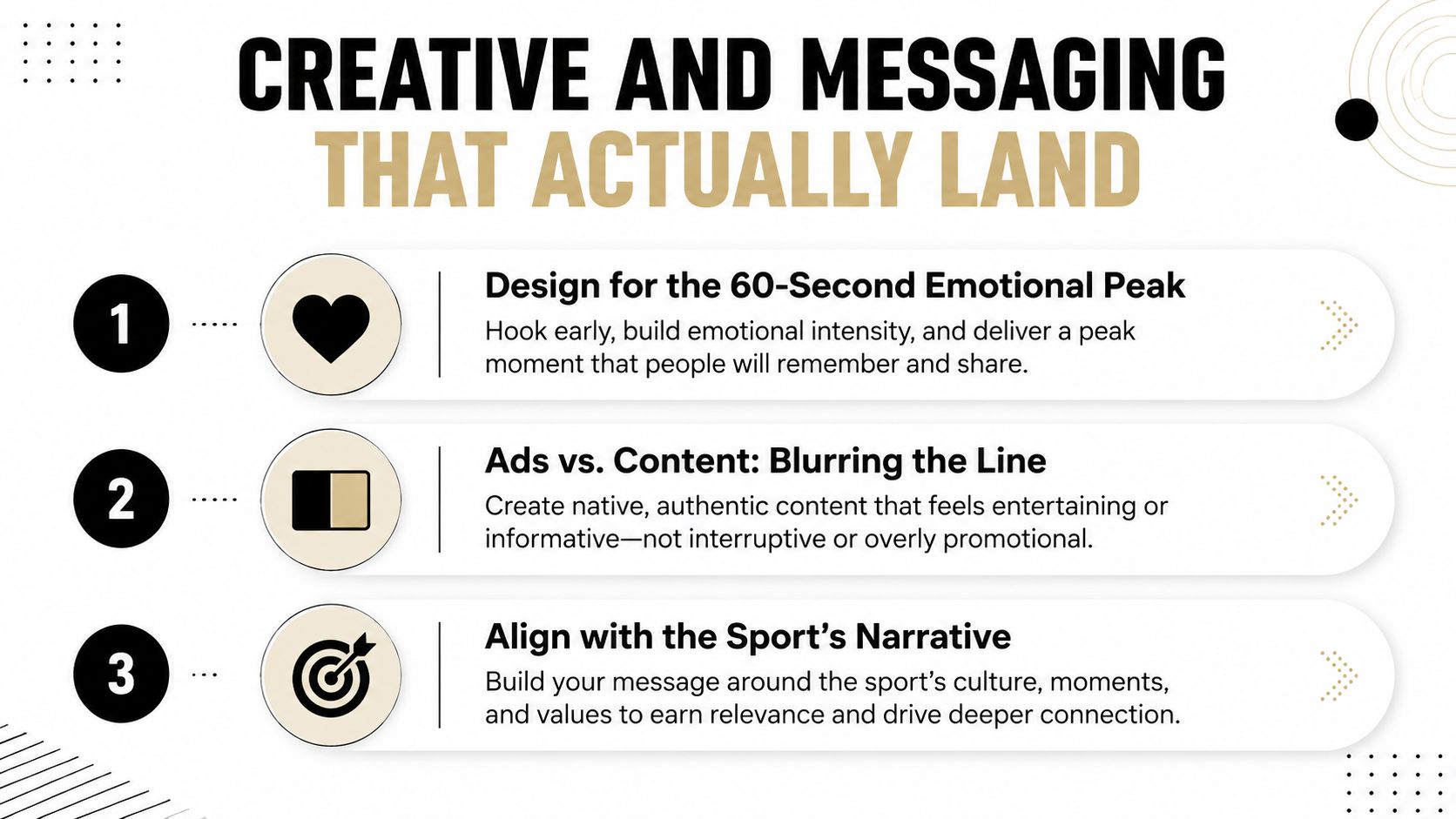
Ads aired immediately after emotionally heightened live sports moments can produce double the unaided brand recall versus baseline conditions, and the 60 seconds after a high-impact play is the peak efficiency window, according to the live sports inflection points study. That doesn't mean every ad must scream for attention. It means the creative should respect the emotional temperature of the break.
The best sports ads in 2026 usually do three things well. They feel native to the sport, they avoid overexplaining the brand in the first second, and they leave room for the viewer to connect the dots. Generic brand ads often do the opposite, they front-load product language, ignore the game state, and sound like they were built for a focus group instead of a live audience.
Talent, tone, and disclosure
Athlete endorsements and creator integrations can work, but only when the fit is believable. The disclosure piece matters too. U.S. guidance says athletes or influencers must clearly disclose any material connection that consumers wouldn't expect, and the disclosure has to be early and conspicuous, with examples like #ad, #paid, #free, or #[Brand]Ambassador in compliant posts, according to Venable's sports advertising legal trends presentation.
Use that as a creative filter. If the talent can't speak naturally about the brand, or the disclosure looks hidden, the ad loses trust before it has a chance to perform. If you need a sharper copy framework for those placements, ad copy examples can help you structure the message without flattening the energy.
Budgeting Models and Allocation Logic
Sports budgets get messy fast because everyone wants the prestige of the big game, but not every brand can justify paying for it. The right answer depends on the job the campaign is supposed to do. Awareness, mid-funnel consideration, and direct-response demand different mixes, and a good media buyer doesn't pretend they're interchangeable.
Three ways to split the money
An awareness-heavy model leans into reach first. That usually means putting most of the budget into high-visibility channels, with smaller supporting layers in digital and search to catch curiosity after exposure. This model fits launches, category-building, and brands that need broad memory more than immediate conversions.
A balanced model spreads spend across broadcast or CTV, digital reinforcement, and sponsorship or creator support. It's often the safest option for brands that want measurable lift without betting the whole quarter on one tentpole placement. The trade-off is that you'll rarely dominate any one channel, but you'll cover more of the fan journey.
A performance-led model works best when the business goal is action, not mass fame. In that setup, paid search, retargeting, and social do more of the heavy lifting, while sports media acts as the trigger that creates demand. Smaller brands often win, because they can buy relevance instead of chasing the biggest screen.
Practical rule: budget for the fan journey you can measure, not the one that looks best in a deck.
Defending the spend
Leadership usually asks the same question, why sports, and why now? The answer is easier when the budget is tied to a clear objective. If the goal is awareness, explain why live attention matters. If the goal is efficiency, explain which adjacent channels will catch the spillover and why search or social will convert it.
A clean budgeting model also helps you compare sports against non-sports media without getting trapped in vanity metrics. The conversation gets much easier when you frame the plan around reach, frequency, and cost per engaged fan rather than around impressions alone. That's the language finance teams understand, and it's the one that keeps your sports budget from becoming a line item everyone loves but nobody can defend.
Measuring What Matters Across the Funnel
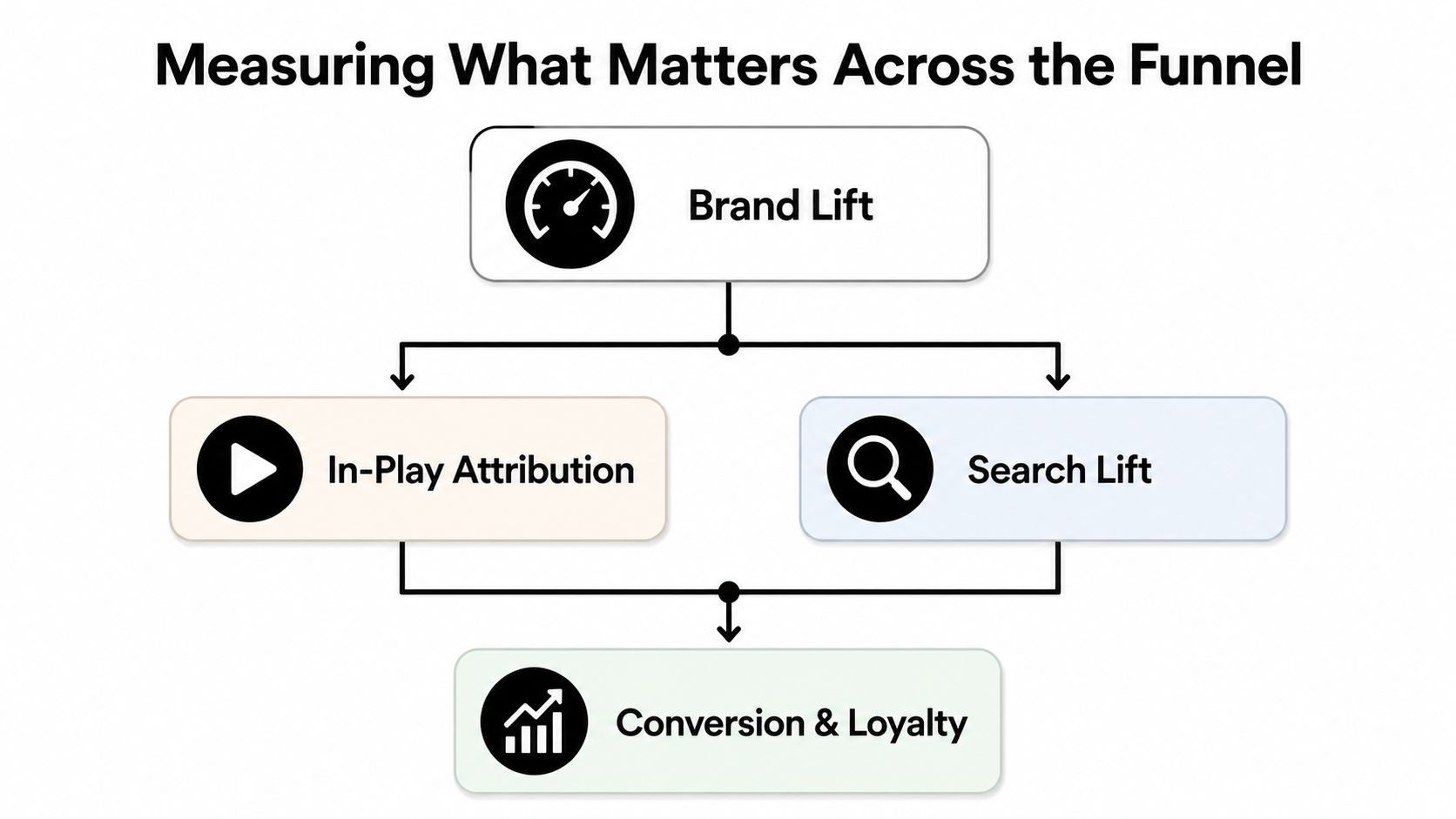
Measurement is where a lot of sports plans break. A campaign can look huge on paper and still fail if nobody agreed on what success meant before launch. The stack has to match the job, brand lift for awareness, in-play signals for timing, search lift for curiosity, and conversion or loyalty for downstream proof.
Pick the right measurement tool for the job
Brand-lift studies are the cleanest fit when the question is whether sports exposure changed awareness, recall, or consideration. They're especially useful when the media mix includes CTV, broadcast, or other channels that don't drive immediate clicks. In-play attribution is better when the plan is built around moments, because it lets you connect exposure to rapid response.
Search lift sits in the middle. It's one of the clearest signs that sports creative sparked curiosity, especially when a brand shows up in a live context and people start looking it up right after. Conversion and loyalty metrics matter later in the funnel, but they shouldn't be the only proof of performance if the campaign was built to create memory first.
Compliance is part of measurement
The FTC says ads must be truthful and non-deceptive, and advertisers need evidence before the ad runs, with a reasonable basis for claims and competent and reliable scientific evidence for health or safety claims, according to FTC advertising guidance. Canadian guidance draws a sharper line between puffery and substantiated claims, especially for performance and superiority claims, which must be backed by adequate and proper tests, as noted in Canadian sports advertising guidance. Australia's parliamentary report on gambling promotion in sport goes even further on timing, proposing that all promotion of live odds during live sports broadcasts be prohibited, according to the Australian Senate committee report.
That means creative, claims, and timing all need a legal review, not just a media plan. If you need a framework for comparing channels, cross-channel attribution is the right place to pressure-test the measurement logic before launch.
Real-World Plays That Worked and Why
The brands that win in sports usually don't win by doing the loudest thing. They win by matching the right channel to the right fan behavior. One women's sports activation worked because the brand showed up where viewers were already following the action across streaming and social, instead of treating the audience like a generic sponsorship bucket. The point wasn't just visibility, it was continuity.
A local brand can do the same thing with an athlete podcast. Instead of buying a stadium sign and hoping the right people notice, the brand builds frequency around a voice fans already trust. That tends to produce a more durable relationship, especially when the podcast audience overlaps with local loyalty or a niche sport community.
Creator integrations can outperform bigger competitors on social when the content feels lived-in rather than scripted. The strongest versions don't try to mimic a TV spot. They lean into the creator's own cadence, keep the brand simple, and give the audience a reason to care beyond the product shot. That's what makes smaller budgets competitive, precision beats size more often than people admit.
Quick-Start Checklist and PPC Workflow
Before you spend a dollar, make sure the claim is defensible, the disclosure is visible, and the measurement plan is written down. Build the stack around one primary KPI, one backup metric, and one compliance review step, so you don't end up arguing about the basics after launch.
For PPC, start by cleaning up junk search terms, expanding high-converting keywords, and applying match types fast enough to keep up with live-event demand. If search spikes during a game, use a tool built for speed so you can build negative keyword lists and reorganize ad groups without wasting hours on manual formatting. That's where Keywordme fits, it helps you move from messy search data to a tighter, faster paid-search workflow.
If you're planning sports campaigns and want cleaner PPC execution, Keywordme can help you cut wasted search spend, tighten match types, and build negative keyword lists faster. Visit Keywordme to streamline the grunt work so your sports budget goes into the queries that matter.
.svg)