
Mastering YouTube PPC Ads for Better ROI
Mastering YouTube PPC Ads for Better ROI


You launch a YouTube campaign with a polished video, choose a broad audience, and watch the budget leave faster than expected. The problem usually isn't the video alone. YouTube PPC ads operate through different formats, bidding models, placements, and measurement signals, so a campaign can generate views while giving you very little confidence about sales.
The practical approach is to treat YouTube like a serious performance channel, not a video billboard. That means matching the format to the action you want, controlling placement pressure, building creative for the screen where it will appear, and measuring outcomes beyond CPV or CTR.
The New Reality of YouTube Advertising
A YouTube campaign can spend efficiently on views and still fail commercially. The platform's scale is real: Alphabet reported $40.37 billion in YouTube advertising revenue for FY2025, up from $36.15 billion in FY2024, an 11.7% year-over-year increase (YouTube advertising revenue data and market benchmarks). That growth reflects sustained demand from brand and direct-response advertisers, so auction pressure deserves attention from the first budget plan.
Independent 2026 marketing data places YouTube's global advertising reach at 2.53 billion people, representing about 45.5% of internet users worldwide. For a PPC team, that reach supports broad prospecting, retargeting pools, and conversion campaigns across major markets. It also creates a measurement problem: large delivery does not prove that the audience has buyer intent.
Why auction discipline matters
YouTube PPC ads depend on more than video quality. Google Ads determines eligible placements, auction competition, and the applicable billing model. Popular videos and high-demand placements may require higher bids to win impressions, as Google explains in its guidance on placement targeting (Google placement bid guidance).
A large placement can look efficient in planning tools while attracting aggressive competition from advertisers targeting the same viewers. Paying more for that inventory makes sense only when the traffic supports the campaign's intended outcome. Otherwise, high view volume can conceal weak lead quality, poor post-click engagement, or sales that never materialize.
Give each campaign a defined job, set the outcome before launch, and judge performance by conversion lift rather than views alone. CTR still matters, but its meaning changes by format, placement, and audience intent.
Short-form inventory adds another decision layer. Vertical creative must fit the viewing environment, while distribution choices determine whether the asset reaches people likely to act. This guide on how to grow Shorts reach can inform the organic and paid content plan. For budget planning, how much YouTube advertising costs helps frame bids, testing budgets, and auction pressure without assuming identical economics across campaigns.
Choosing the Right Ad Formats for Your Goals
Format changes both viewer intent and the action you can reasonably expect. In-feed viewers actively choose a video, while in-stream viewers encounter an ad before the content they requested. Reported CTR varies by format, with Shorts ads generally attracting stronger click rates than non-skippable placements, but the benchmark alone does not determine customer quality.
| Ad Format | Relative CTR Pattern | Best Use Case |
|---|---|---|
| Shorts ads | Typically highest | Fast mobile engagement and concise direct-response creative |
| Discovery ads | Stronger intent | Video discovery and content selection |
| Skippable in-stream ads | Mid-range | Storytelling, retargeting, and conversion-focused video |
| Non-skippable ads | Typically lowest | Broad message delivery where completion matters more than clicks |
Shorts ads suit offers that make sense without a long introduction. Vertical framing, quick visual movement, and a direct call to action fit the swipe-based environment. Strong CTR can still hide weak economics if clicks do not match the landing page, audience intent, or qualified-customer profile.
Discovery ads, now associated with Demand Gen campaign structures, reach users while they choose what to watch instead of interrupting another video. Use them for product education, content-led acquisition, and audiences already researching a topic. The thumbnail and headline carry more responsibility because the viewer must select the ad.
Match the format to the decision
Skippable in-stream gives advertisers room to explain a product, address objections, and request a conversion. Viewers can skip after 5 seconds, so the opening must establish relevance immediately. Longer storytelling can work, but only when those first moments earn continued attention.
Non-skippable ads serve a different job. Viewers cannot skip, so a lower CTR does not automatically indicate failure. If the business needs consistent message exposure, completed delivery and later action may matter more than direct clicks.
Use a test matrix that separates format from objective:
- Awareness: Keep the message concise and assess reach, completed exposure, and later action.
- Consideration: Provide enough context for viewers to understand the offer before requesting a click.
- Conversion: Lead with the problem, proof, and next step. Send traffic to a page that repeats the ad's promise.
Format-specific creative prevents wasted impressions. A Shorts cut should respect vertical, swipe-driven viewing. An in-stream version can develop the explanation. An in-feed asset needs a thumbnail and headline that earn the click. These should be related assets, not one resized commercial forced into every placement. Judge each version by the conversion lift it creates, not by CTR in isolation.
Bidding Strategies and Placement Targeting
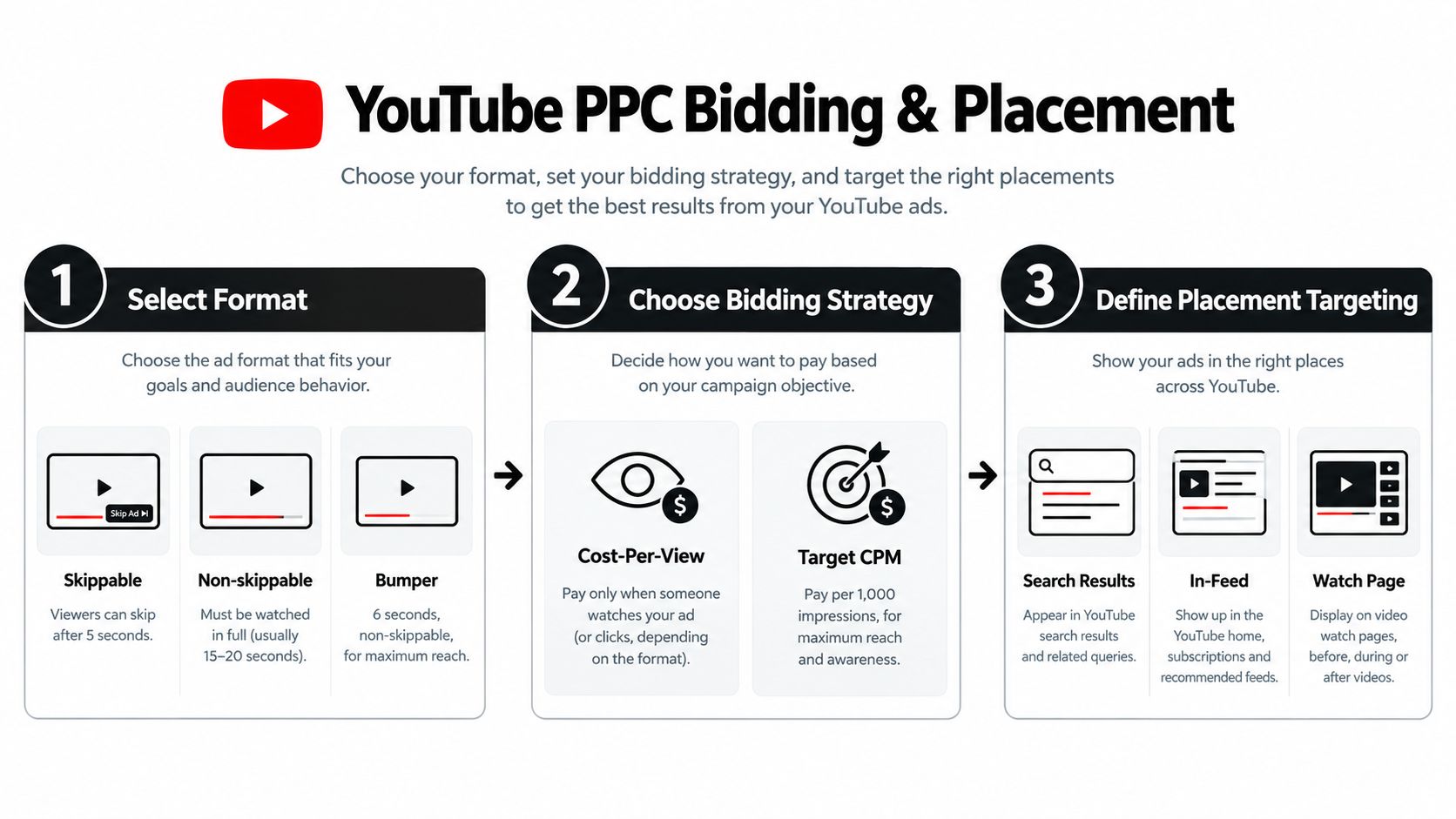
A low CPV can still produce weak business results if the campaign buys views from the wrong audience. Start by defining what the platform should pay for and what outcome the campaign must create. Under CPV bidding, Google charges when a viewer watches 30 seconds, watches the full ad if it is shorter than 30 seconds, or interacts with it. Under Target CPM, Target CPA, and Maximize conversions, billing is impression-based, according to Google's YouTube ad billing documentation.
That billing difference changes performance analysis. A view-focused campaign should not face the same immediate click expectations as an impression-based conversion campaign. Google offers CPV bidding for Video views and Ad sequence campaigns under the YouTube reach, views, and engagements objective. CPV also includes interactions with call-to-action overlays, cards, and companion banners, as explained in Google CPV bidding guidance.
A practical setup sequence
Select the format first. Choose skippable in-stream, non-skippable, Shorts, or an in-feed experience based on the campaign objective. Each format changes the available viewer action, the likely CTR, and the job the creative must perform.
Choose the bidding strategy second. Use CPV when qualified views or interactions are the immediate goal. Use an impression-based approach for conversion signals, reach, or controlled exposure. A lower headline cost does not make a bidding model more profitable.
Define placements with intent. Google Ads can target YouTube channels, individual videos, apps, websites, and specific placements within websites. With the “Targeting” setting, an ad group shows only on placements explicitly added as criteria, as described in Google's placement targeting documentation.
Placement targeting creates bid pressure. Popular channels and videos may attract stronger competition, so a modest bid can limit delivery. Raising the bid can restore impression volume, but it can also buy expensive exposure from viewers who never had a realistic chance of converting.
Build placement lists around audience relevance, then inspect delivery and conversion quality. Start with a focused group of related channels or videos. Separate different themes into distinct ad groups so you can identify whether weak results come from the bid, placement, or creative. For a broader examination of account-level options, review these practical PPC bidding strategies. Judge placements by conversion lift and qualified actions, not CTR alone.
Creative Best Practices for Modern Viewers
A viewer deciding whether to skip gives the opening very little time to prove its relevance. Skippable in-stream viewers can leave after 5 seconds, so show the audience, problem, or payoff before the skip option becomes the obvious choice. The first seconds should also match the campaign's job. A video optimized for qualified views can invite continued viewing, while a conversion-focused ad should make the next action clear early.
Strong openings do not need elaborate production. A product demonstration, recognizable pain point, surprising visual, or direct question can outperform a slow logo animation because the viewer understands the reason to continue. Brand identity still matters, but it should support the message rather than delay it.

Design for the screen, not the asset library
Mobile Shorts creative needs a different rhythm from connected TV creative. Mobile viewers scan quickly and may swipe before a detailed explanation lands. Use tight framing, readable captions, visible product movement, and one dominant message. On a living-room screen, viewers may sit farther away, making tiny interface-style text and crowded layouts difficult to process.
Format also changes how creative performance should be read. A high CTR on a direct-response placement may reflect a clear offer, while a lower CTR on broader-screen inventory may still contribute to later conversions. Compare each format against its intended outcome instead of forcing every asset into the same CTR benchmark.
Expanded non-skippable inventory, mid-roll placements, Connected TV, and pause-screen advertising make context part of the creative brief. A message designed as an interruption before a video may feel awkward on a larger screen during a pause. Build variations for each environment rather than treating every impression as interchangeable.
Creative test: Change one major variable at a time, such as the opening hook, proof point, offer, or call to action. Otherwise, you will not know which edit changed the result.
Keep the call to action specific. “Learn more” can suit an education campaign, while a conversion campaign may need an action tied directly to the landing page. The destination must continue the same argument. If the video promises a calculator, demo, or discount and the page hides it, the click has already lost value.
Teams without an internal production workflow can review the capabilities and specializations of top video production companies before choosing between in-house production, freelancers, or an external studio. The production route matters less than the result: earn attention quickly, communicate without excessive explanation, and make the next step unmistakable.
Optimizing Search Terms and Tracking Conversions
A YouTube campaign can look healthy in the platform while wasting money through weak relevance. Placement reports may reveal videos, channels, apps, or websites that attract impressions without producing useful actions. Search-related campaign surfaces can create a similar issue, especially when broad targeting matches queries that are adjacent to your offer but commercially irrelevant.
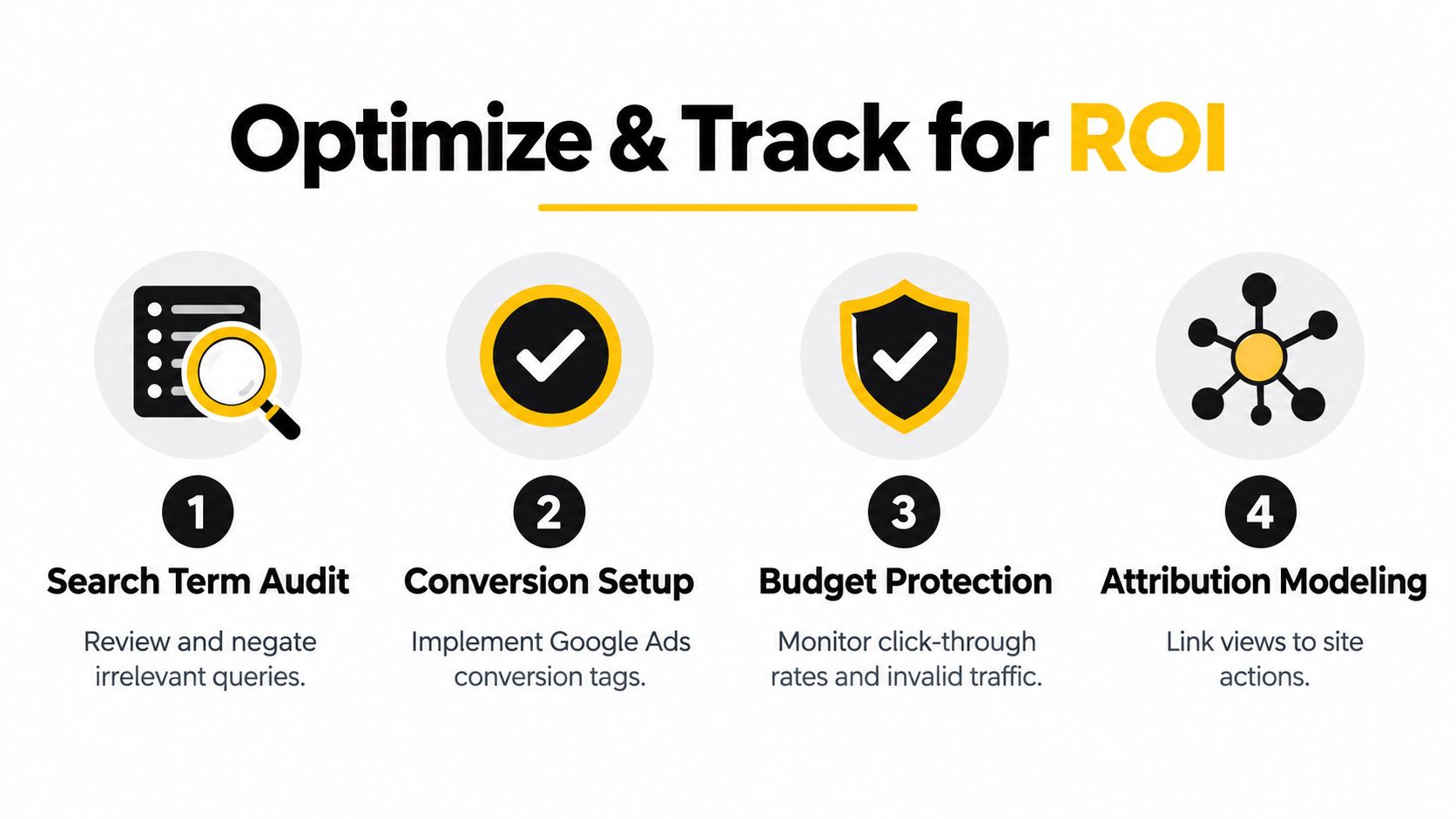
Start with an audit rhythm rather than a one-time cleanup. Review the search terms and placement reports, group irrelevant themes, and add negatives at the right level. A single irrelevant query may be noise. A repeated theme usually signals a targeting or exclusions problem that deserves a structural fix.
Connect hygiene to measurement
Negative keyword work protects the budget, but conversion tracking tells you whether the remaining traffic has value. Install and test Google Ads conversion tags for the actions that matter to the business, such as qualified lead submissions, purchases, booked calls, or meaningful signup events. A view or click can be useful evidence, but it isn't the business outcome.
Use Google Ads conversion tracking guidance to verify the setup, then check whether conversions are being counted consistently across the landing page, analytics system, and CRM. If a campaign optimizes toward a shallow event, its delivery can follow that signal instead of the sale you want.
Keywordme can be used inside Google Ads to clean up junk search terms, add negative keywords, assign match types, and handle search-term work in bulk. That makes it one practical option for teams that want to connect search-term hygiene with a repeatable optimization process rather than relying on manual copy and paste.
Measure beyond immediate clicks
YouTube's measurement direction is moving toward conversion lift and sales outcomes, including comparisons across formats and screens (emerging YouTube advertising measurement trends). That shift matters because video can influence a later branded search, direct visit, or assisted conversion without producing an immediate click.
Use a layered measurement model:
- Delivery: Check impressions, views, view rate, and placements to confirm the campaign is serving where expected.
- Engagement: Review CTR, interactions, and audience behavior by format.
- Business action: Track leads, purchases, qualified pipeline, or revenue in the systems that record those outcomes.
- Incrementality: Where available, compare exposed and unexposed audiences or use lift-oriented reporting to test whether the campaign caused additional demand.
Avoid treating every signal as equally valuable. A high CTR from a low-intent placement may be less useful than a quieter campaign that produces qualified customers. The right question is not whether the video attracted attention. It's whether the attention changed what people did next.
Scaling Your Campaigns with Confidence
Scaling YouTube PPC ads isn't a matter of raising the budget on the campaign with the most views. That approach can amplify weak placements, shallow conversion signals, or a creative that works only with a narrow audience. Before increasing spend, confirm that the campaign can explain where the money goes and which actions follow.
Use a simple account review:
- Audit placement quality: Remove or isolate placements that generate attention without meaningful actions.
- Check format fit: Compare Shorts, in-stream, and in-feed campaigns against their intended objectives, not against one universal CTR target.
- Validate conversion signals: Confirm that primary conversions represent revenue or qualified business value.
- Test audiences carefully: Expand into related segments one variable at a time so the account retains a clear performance baseline.
- Automate guardrails: Use rules and alerts to catch sudden spend changes, tracking failures, or deteriorating placement quality.
The common assumption is that CPV is the clearest measure of efficiency because it appears early and updates quickly. It isn't enough on its own. A cheap view can be valuable for awareness, but it can also conceal poor attention quality, weak intent, or no relationship to sales.
Scale only what you can explain. If you can't connect format, placement, bid, creative, and conversion data, you aren't scaling performance. You're scaling uncertainty.
Audit the measurement setup before you expand the budget. Once the account can distinguish exposure from engagement and engagement from business results, YouTube can earn a stable role in the media mix instead of remaining an expensive experiment.
Keywordme helps PPC teams manage search-term cleanup, negative keyword handling, match-type assignment, and campaign expansion directly within Google Ads workflows. Visit Keywordme to explore the platform and use its seven-day free trial to bring a more disciplined optimization process to your YouTube and broader Google Ads strategy.
.svg)