
When to Use Broad Match vs Phrase Match Google Ads
When to Use Broad Match vs Phrase Match Google Ads


SEO Title: When to Use Broad Match vs Phrase Match in Google Ads
Meta Description: When to use broad match vs phrase match Google Ads depends on cost, control, and Smart Bidding maturity. Learn the practical trade-offs.
The most common advice on this topic is too neat to be useful.
You'll hear that broad match is for reach and phrase match is for control. That used to be a decent shortcut. It's not enough anymore. If you run Google Ads today and make match type decisions with that old rule alone, you can waste a lot of money while thinking you're being “modern.”
Google is pushing broad match hard because it fits the direction of the platform. Broad match is the default match type in Google Ads, and Google describes it as the option that reaches more related searches than phrase or exact match through meaning-based matching and automation support, as covered in Google's keyword matching documentation. That's the official story.
The practical story is messier. Broad match can be excellent when the account has enough conversion signal and the campaign is built to feed Smart Bidding useful data. It can also be a budget leak when the account is thin on conversions, the negatives are weak, or the business needs tighter intent control.
Phrase match hasn't disappeared. It just has a different job now. If you're trying to figure out when to use broad match vs phrase match Google Ads, the key question isn't reach versus control. It's whether your bidding system is mature enough to turn loose query matching into profitable traffic, or whether you still need the guardrails.
The Big Match Type Misconception
The bad advice goes like this: broad match is smart now, so use it everywhere.
That sounds efficient. It also sounds like something Google would love you to believe. And sometimes Google is right, just not nearly as often or as broadly as the recommendations tab suggests.
The old rule broke
Years ago, you could treat match types like a simple ladder. Exact for precision. Phrase for a bit more room. Broad for chaos. That model doesn't reflect how campaigns behave now.
Broad match is no longer just a bigger net. It's tied to how Google interprets intent, context, and auction signals. Phrase match is no longer the old quote-mark setting people learned a decade ago either. Both have drifted toward meaning-based matching, which is exactly why the choice now has more to do with account maturity than with textbook definitions.
Practical rule: Match type is not a targeting preference anymore. It's a risk management choice.
A junior PPC manager usually asks the wrong first question. They ask, “Which match type performs better?” The better question is, “Which match type can this account support without setting money on fire?”
What actually matters
Before choosing broad or phrase, look at the conditions around the keyword:
- Conversion signal quality: Smart Bidding needs enough real feedback to separate useful clicks from junk.
- Budget tolerance: Broad match can explore. Exploration costs money.
- Business specificity: The tighter the offer, the more expensive irrelevant traffic becomes.
- Query review discipline: If nobody is checking search terms regularly, broad match gets sloppy fast.
Phrase match is often the safer default for campaigns that need relevance first. Broad match is often the better scaling lever once the account has earned the right to use it.
That's the practical frame. Not reach versus control. Not Google's defaults. Just money in, revenue out, and how much ambiguity your campaign can survive.
Why This Google Ads Debate Matters Now More Than Ever
This debate matters more now because the financial trade-off has changed.
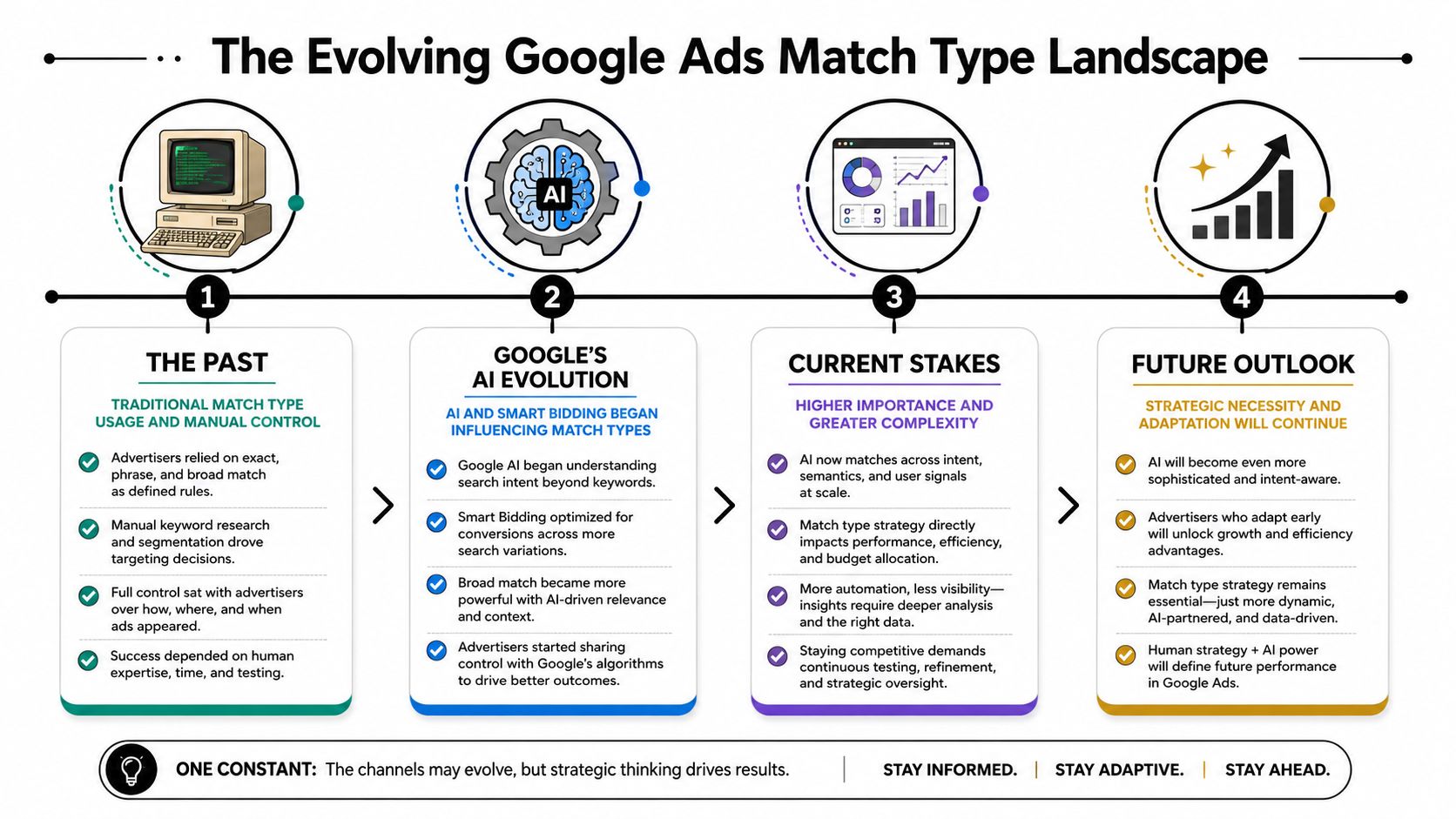
Broad match used to be easy to dismiss as noisy traffic. Phrase match used to feel like the sensible middle ground. That middle ground has become less comfortable. According to Search Engine Land's analysis of CPC trends, between June 2023 and June 2025, broad match CPCs rose 29% while phrase match CPCs rose 43%. That's the part too many advertisers miss.
Cost changed the argument
A lot of match type conversations still sound like they're happening in an older version of Google Ads. People argue about control, relevance, and search term quality as if cost is just a side note. It isn't.
If phrase match gets more expensive faster, then “safer” traffic can become overpriced traffic. That doesn't mean broad match automatically wins. It means the decision got more financial and less philosophical.
Here's the uncomfortable version:
- Phrase match can protect intent, but that protection may cost more than it used to.
- Broad match can lower friction for scaling, but only if Smart Bidding knows what good traffic looks like.
- Bad account structure gets punished either way, just in different places.
Smart Bidding changed who should use what
Google's broad match push makes sense from Google's side. Broad match gives the system more query variation. More variation gives Smart Bidding more opportunities to find patterns. That's useful when the account has enough good conversion data.
It's a problem when the account doesn't.
If the system is learning from weak signals, junk lead forms, poor CRM feedback, or tiny conversion volume, broad match doesn't become “AI-powered efficiency.” It becomes expensive confusion. The machine still optimizes. It just optimizes around bad inputs.
Broad match is strongest when the machine already knows what a valuable user looks like. Before that, phrase match usually carries the account.
That's why this is not a cosmetic setting. It changes how aggressively Google is allowed to spend your budget in exchange for potential discovery. For mature accounts, that trade can be worth it. For shaky ones, it usually isn't.
Broad Match The AI Data Harvester
The best way to think about broad match now is not as a keyword setting, but as a data harvester.
Google says broad match can surface related searches based on meaning and reach more queries than phrase match. That tells you what it's for. It's not there to give you a tidy list of tightly aligned searches. It's there to feed the machine more possibilities.
What broad match is good at
Broad match is useful when you need discovery.
It can uncover search terms you didn't build manually, and that matters in messy markets where people describe the same need in a dozen different ways. Contractors, local services, B2B niches, and mixed-intent categories often fall into this bucket. If you work with trades or home service clients, some of the newer AI tools for contractors also show how fast service businesses are moving toward automation generally, which is part of why Google keeps leaning into machine-led targeting.
Broad match also reduces the need to build giant keyword lists upfront. That's attractive. It saves time in setup, and in the right account it can help Smart Bidding find pockets of demand faster than a human keyword planner will.
For a deeper breakdown of how practitioners use this setting, keyword structure, negatives, and search term mining, see this guide to broad match keywords.
What broad match is bad at
Broad match has one recurring flaw. It assumes the algorithm can interpret intent well enough to spend profitably before you've fully shaped the traffic. Sometimes it can. Sometimes it absolutely can't.
The usual failure modes are familiar:
- Loose relevance: The query is related, but not commercially useful.
- Weak ad alignment: The user's wording and the ad message drift apart.
- Landing page mismatch: The search term hints at a need your page only partially answers.
- Slow negative management: Bad traffic hangs around because nobody cleans it up fast enough.
Broad match is like handing Google a bigger hunting area. If your conversion data is solid, that can work. If your signals are weak, Google just finds more ways to be wrong.
When broad match earns its keep
Broad match works best when you treat it as a mining tool, not a trust fall.
Use it when the account already has reliable conversion tracking, Smart Bidding is in place, and someone is reviewing search terms consistently. Then pull good discoveries out of broad traffic and tighten them into more controlled keyword structures later.
That last part is where a lot of accounts fail. Teams launch broad match, see some volume, then stop doing the boring work. The boring work is the whole point.
Phrase Match The Precision Instrument
Phrase match is still the workhorse for advertisers who care about intent quality.
Not because it's old-school. Not because it feels safer. Because there are many campaigns where a narrow band of relevance matters more than discovery, especially when every wasted click carries a real cost.
Why phrase match still matters
Phrase match is the better instrument when the campaign has a clear commercial lane. Brand terms. Specific service lines. Competitor campaigns. Location-based services. Those aren't places where you usually want Google improvising too much.
The value of phrase match is simple. It keeps your traffic closer to the meaning you intended. That usually leads to cleaner messaging, tighter landing page alignment, and fewer nonsense queries to clean up later.
When a junior buyer asks why phrase match still deserves budget, the answer is that it protects expensive intent. Some clicks are too valuable to hand over to a looser matching system just because Google says automation prefers more freedom.
If you want a focused tactical breakdown, this phrase match guide for Google Ads is a useful companion.
Where phrase match shines
Phrase match is usually the right tool in situations like these:
- Brand protection: You want tight control over who sees your ad and on what wording.
- Specific service offers: The business sells a narrow service, not a broad category.
- Competitor targeting: Relevance and message control matter more than volume.
- Local campaigns: Geographic intent can get messy fast if query matching opens too wide.
Phrase match is what you use when the account can't afford curiosity.
The trade-off nobody should ignore
Phrase match is not the “good” match type and broad match the “bad” one. That's lazy thinking.
Phrase match can miss useful variants. It can also become expensive in competitive auctions. If the account is mature and Smart Bidding has enough quality feedback, sticking too hard to phrase match can limit growth while you pay more for the traffic you do buy.
That's why phrase match should be treated like a precision instrument. Use it when precision pays. Don't use it as a security blanket when the account is ready to scale broader.
Head to Head Broad vs Phrase Match Criteria
Most match type decisions get muddled because people talk in abstractions. “Control.” “Scale.” “Intent.” Fine. But what matters is how those ideas hit cost, workflow, and bidding performance.
Here's the clean comparison.
| Criterion | Broad Match | Phrase Match |
|---|---|---|
| Primary role | Discovery and query expansion | Intent control and relevance |
| Best fit | Mature campaigns using Smart Bidding with enough data | Newer, tighter, or precision-first campaigns |
| Traffic quality risk | Higher risk of irrelevant searches | Lower risk than broad |
| Management load | Requires frequent search term review and negatives | Easier to keep tight, though still needs review |
| Scaling potential | Stronger when the algorithm has good conversion feedback | Strong for core terms, weaker for exploratory growth |
| Budget behavior | Can waste spend quickly if signals are weak | More controlled, but can be less flexible |
| Typical use cases | Expansion, query mining, broader discovery | Brand, service lines, competitors, local intent |
The conversion threshold matters
Independent guidance for 2026 says broad match is typically worth testing when an account has 30+ conversions in the past 30 days and a strong negative keyword list, based on this 2026 match type guide. That's one of the few practical thresholds that's useful.
It's not magic. It's a signal that the account may have enough recent conversion data for Smart Bidding to learn from without flying blind.
If you're below that level, broad match can still work in some cases, but the margin for error gets thinner. In most accounts, phrase match is the more conservative call until the campaign has enough recent performance history.
Use this decision filter
If I'm deciding match type with a junior PPC manager, I usually reduce it to this:
- Low data, tight budget, high specificity: Start with phrase match.
- Brand or competitor campaigns: Stay with phrase match unless there's a very good reason not to.
- Strong conversion flow and active search term cleanup: Test broad match.
- Need new query discovery: Use broad match selectively, not everywhere at once.
- Weak negatives or sloppy tracking: Do not give broad match more room.
The broad versus phrase match discussion arrives at its practical application. Broad match asks for trust in automation. Phrase match asks for patience and tighter management. One buys flexibility. The other buys control.
Neither is cheap if the account itself is poorly run.
Your Strategic Playbook for Match Types
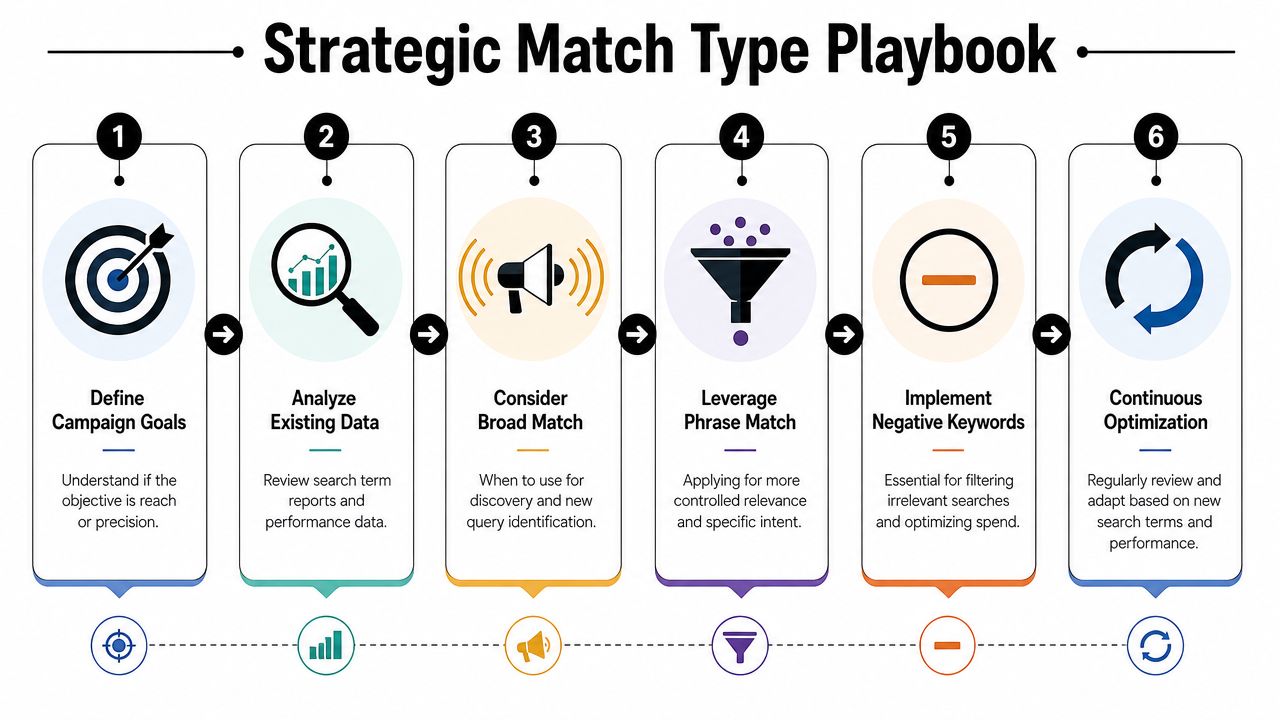
A good match type strategy usually looks less like a rule and more like a progression.
New accounts rarely need broad match first. They need clean intent, stable tracking, and enough search term history to understand what buyers are typing. Mature accounts often need the opposite. They already know the basics and need a way to uncover additional demand without building endless keyword lists by hand.
Scenario one
A local service business launches a new campaign for a high-value service. The budget is limited. The sales team wants qualified leads, not “interest.” This is a phrase match account until proven otherwise.
You want the search terms to stay close to the offer, the geography, and the service language that converts. Broad match here often creates cleanup work before it creates value.
Scenario two
An account has solid conversion tracking, Smart Bidding is stable, and the search terms from tighter match types are getting repetitive. In this scenario, broad match becomes useful, not as a replacement for everything else, but as a discovery layer.
Google's own documentation says broad match can reach more related queries based on meaning. Used properly, that makes it a research engine inside the campaign. Then you mine the Search Terms report, add negatives, and move the good discoveries into tighter structures. If you're doing that handoff process, this broad-to-phrase workflow is the right way to think about it.
Don't leave winning broad match queries where you found them. Graduate them into tighter control once they prove themselves.
Scenario three
A brand campaign or competitor campaign needs message discipline. Here, phrase match stays in charge. You care about what the user meant, what ad they saw, and where they landed. Query exploration is not the priority.
That's the broader playbook in plain English:
- Start tight when the account is young, expensive, or strategically sensitive.
- Open carefully once conversion quality is reliable.
- Mine broad traffic for useful search terms.
- Promote proven queries into phrase match or other tighter structures.
- Keep negatives current so discovery does not become drift.
That cycle tends to work because it respects both sides of the problem. Broad match finds possibilities. Phrase match protects profit.
Optimize Your Match Types Without Losing Your Mind
The strategy sounds manageable until you have to execute it across real accounts.
Search term reviews get tedious. Negative keyword cleanup gets repetitive. Match type testing gets messy when you're copying terms between ad groups, adjusting lists, and trying not to break something in the process. That's where discipline is often lost. Not because they don't know what to do, but because the workflow is annoying enough to delay.
Manual optimization is where good strategy dies
A lot of PPC waste comes from operational lag.
You spot bad queries but don't add negatives quickly enough. You find a promising broad match search term but leave it floating in the wrong ad group. You mean to tighten phrase coverage around winning terms, but it turns into a spreadsheet task that keeps getting pushed to next week.
That's why workflow matters just as much as theory. If the team can't process search terms fast, broad match becomes dangerous and phrase match becomes underbuilt. Neither side of the strategy gets the attention it needs.
A simpler operating model helps:
- Review junk terms fast so waste doesn't linger.
- Promote good terms quickly while intent is obvious.
- Apply match types in bulk instead of one-by-one account surgery.
- Keep negative list building organized so campaigns don't drift apart.
Better tools make better habits possible
This is also where tooling earns its keep. If your process for match type management depends on manual exports, formatting, and copying items between Google Ads views, you'll eventually cut corners.
The short demo below shows the kind of workflow that makes ongoing cleanup and keyword promotion much less painful.
The goal isn't to obsess over every search term forever. It's to build a repeatable system where broad match can explore without roaming freely, and phrase match can lock in value without turning the account into a maintenance project.
If you want a simpler way to clean search terms, build negative lists, and move winning queries into the right match types without the usual copy-paste mess, Keywordme is built for exactly that.
.svg)