
Whats a Good CTR? Quick Guide to Boost Ad Performance
Whats a Good CTR? Quick Guide to Boost Ad Performance


So, what's a "good" Click-Through Rate? The honest answer is: it depends. If you've been around the marketing block, you've probably heard someone throw out 3% as the magic number. But treating that as a universal standard is a quick way to misjudge your own performance.
A truly good CTR is one that consistently outpaces the average for your specific industry, the channel you're advertising on, and what you're trying to achieve with your campaign.
How to Define a Good CTR
Think of your CTR as the first impression your ad makes—like a compelling storefront window in a busy mall. A high CTR tells you that your window display is grabbing attention, showing people something relevant, and making them want to step inside. Chasing a generic percentage without considering the context is like trying to sell winter coats on a beach in July.
Here's what really shapes what a "good" CTR looks like for you:
- Your Industry: Some industries are just more competitive or have broader appeal. A local plumber might see a different CTR than a national e-commerce brand.
- Ad Channel: People behave differently on different platforms. Someone actively searching on Google has a much higher intent to click than someone scrolling through their social media feed.
- Campaign Goals: Are you just trying to get your name out there (awareness), or are you driving sign-ups for a webinar (conversions)? Your goal will naturally influence your expected CTR.
For instance, a display ad running across a wide network of websites might get a 0.5% CTR and still be wildly successful if it's driving cheap, high-quality traffic. On the other hand, a Google Search ad pulling in a 3% CTR could be a serious red flag if your direct competitors are hitting 5% or more for the same keywords.
Quick CTR Benchmarks at a Glance
To give you a starting point, here’s a quick look at how wildly CTRs can vary across different platforms. Notice how user intent plays a huge role—active searchers are just far more likely to click than passive viewers.
As you can see, the bar is set much higher for search ads, which capture people actively looking for a solution. Display and social ads have to work a lot harder to interrupt someone's browsing and earn that click.
Why One-Size-Fits-All CTR Is Misleading
A 3% CTR might be a massive win for one advertiser but a sign of a failing campaign for another. That's why industry benchmarks should be treated as a guide, not gospel.
Your most important benchmark? Your own past performance.
Treat your CTR benchmarks like personal fitness goals—it’s useful to know what others are lifting, but your real progress comes from beating your own personal best.
By focusing on your own historical data, you can set realistic goals and track meaningful improvements over time, which is what actually drives growth.
Key Steps to Set Your CTR Benchmark
Ready to find your number? It's pretty straightforward.
- Start by pulling your historical CTR data. Look at it by channel, campaign type, and even ad group.
- Identify your average and peak performance over the last few months or a similar season.
- Set your new target slightly above that baseline, factoring in any new strategies or market changes.
This personalized approach is what separates the pros from the amateurs. It’s all about continuous, incremental improvement.
For a deeper dive into the fundamentals and how the calculation works, check out our complete guide on what click-through rate is.
Now that we've got a handle on what makes a CTR "good," let's dig into the specific benchmarks for different industries on Google Ads so you can set even more precise targets.
Google Ads CTR Benchmarks by Industry
Okay, let's get into the nitty-gritty. A “good” CTR isn't a one-size-fits-all number. What’s considered a home run for a local law firm would be a total strikeout for an online t-shirt shop. Context is king, and knowing your industry's benchmarks is the only way to set realistic goals and figure out if you're actually ahead of the curve.
A huge piece of this puzzle is search intent. Industries like Arts & Entertainment can pull in search CTRs over 13%. Why? Because people are actively hunting for something fun and engaging—they want to click. On the flip side, someone looking for B2B software is in research mode, not impulse-buy mode, so you'll naturally see lower click-through rates there.
Why Your Industry Matters
The competition level and the emotional pull of what you're selling make a massive difference. High-ticket items or services that require a lot of thought often have a ton of advertisers fighting over the same keywords, which can drag down the average CTR for everyone.
Think about it: selling concert tickets is an emotional, "I want it now" purchase. Offering enterprise-level accounting software is a logical, "Let's schedule six demos" decision. The user's mindset completely changes how likely they are to click on an ad.
The chart below gives you a quick visual on how this plays out across different channels.
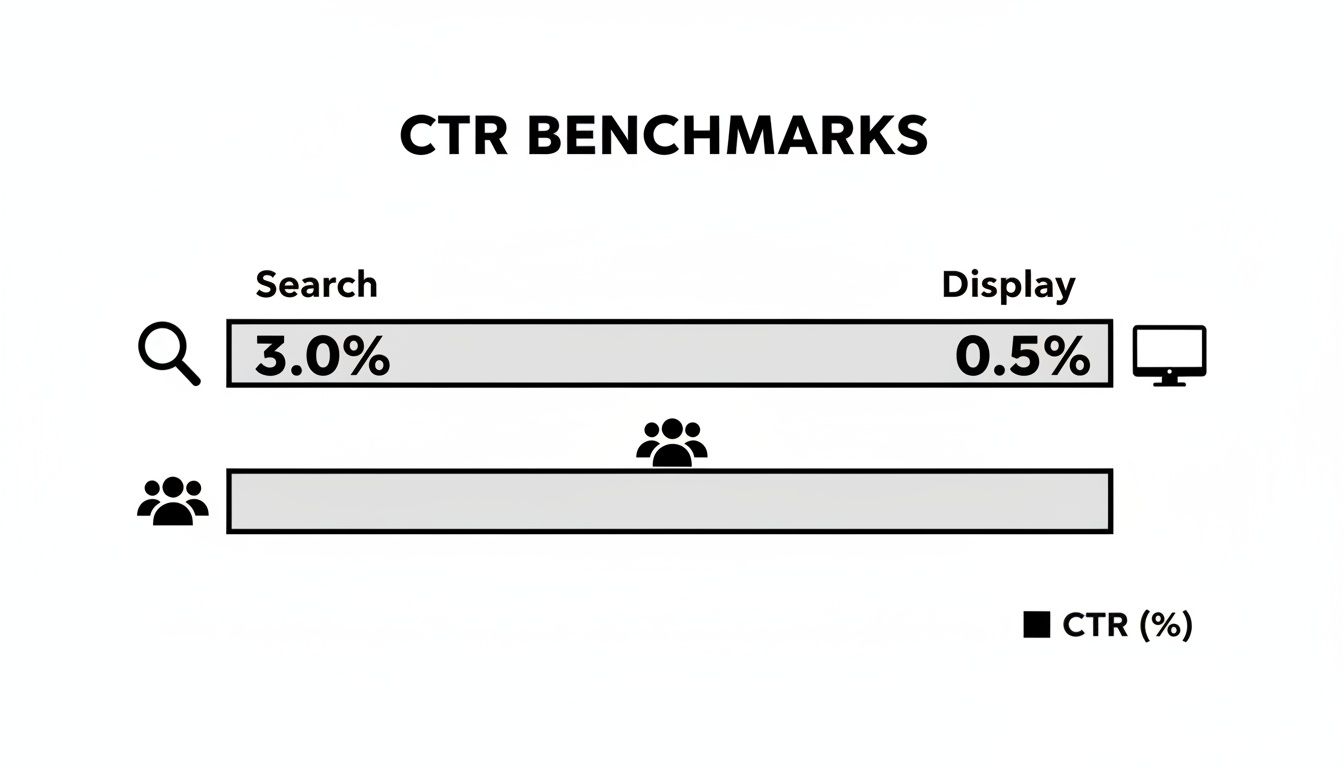
You can immediately see the huge gap driven by user intent. People on Google Search are on a mission, which is why those ads get so many more clicks than a passive display ad someone just happens to see on a blog.
A Look at the Numbers
So, what should you actually be aiming for? These numbers can shift a bit, but here are some solid industry-specific benchmarks for Google Search Ads to give you a starting point:
- Arts & Entertainment: An incredible 13.1%
- Travel & Hospitality: Also flying high at 10.0%
- Shopping (eCommerce): A very respectable 8.92%
These top performers are a world away from more crowded or niche industries, where getting a 4-6% CTR is a hard-fought battle. Knowing what’s realistic in your field is half the job. For a deeper dive into more sectors, check out our complete guide on Google Ads industry benchmarks.
Lately, the average Google Search CTR hovers around 3.17%, but the best advertisers are smashing that with numbers over 5.8%. That gap between average and awesome is all about smart optimization. For example, ads in the #1 spot can hit a CTR of 7.94%, and if they also have a high Quality Score, that can jump to 9.8%. This is exactly where tools like Keywordme come in, helping you filter out junk search terms and dial in your keyword match types to skyrocket your relevance and start hitting those top-tier numbers.
The Key Factors That Influence Your CTR
Ever scrolled past an ad that felt invisible? Then clicked on one that practically jumped off the page? That difference boils down to a few key factors controlling your click-through rate—and once you know them, you can nudge your ads from wallflower to head-turner.
Think of your ad as a storefront in a busy mall. It needs the right spot, an eye-catching sign, and products people actually want. Tweak any of those elements and you’ll watch your CTR climb—or collapse.
Ad Position And Placement
Location, location, location. Ads in the #1 position command attention, much like a corner shop on the main street.
Data shows that the top three ad positions capture the lion’s share of clicks. Drift to the second page and your CTR can nosedive, no matter how clever your copy is.
Keyword Relevance And Match Types
Keywords are the roadmap users follow. When your terms line up with their search, your ad feels like a natural next step.
Match types shape that map:
- Broad Match: Casts a wide net but often reels in irrelevant searches, dragging down your CTR.
- Phrase Match: Strikes a balance, showing your ad when a query contains your key phrase.
- Exact Match: Tightest control—your ad only pops up for near-identical searches, boosting CTR.
Lean on Broad Match without a solid negative keyword strategy and you’ll flood your campaign with unqualified clicks.
The Power Of Ad Copy And Creatives
Your headline and description are your elevator pitch. A generic “Business Software” line is like yelling “Food for sale!” in a grocery aisle. But “Save 10 Hours a Week on Invoicing” feels targeted—and click-worthy.
Your copy should echo real user language, directly answer their question, and offer a clear next step.
Device Targeting
Mobile users and desktop browsers don’t behave the same. Someone on a phone often wants quick info or local results, while desktop searches might mean deeper research.
If your ad or landing page is cluttered on mobile, people swipe past. Optimize for each device’s experience and you’ll keep that CTR humming along.
Ready to Improve Your Google Ads CTR? Here's How.
So, you've figured out your CTR is lower than you'd like. That's the easy part. Now for the real work: actually fixing it. Boosting your click-through rate isn't about some secret hack or magic bullet; it's about a methodical process of improving every moving part of your campaign.
Let’s get into the practical, actionable steps you can take to make your ads impossible to ignore.

The best part? You don't need a massive overhaul. Even small, consistent tweaks can lead to some seriously impressive gains. When you start focusing on relevance and what the user actually wants, you're sending all the right signals to Google, which rewards you with more visibility.
Write Ad Copy That Demands a Click
Think of your ad copy as your first handshake. It has to be firm, confident, and perfectly in sync with what the searcher is looking for. Generic, bland copy is the digital equivalent of a limp handshake—it gets forgotten instantly. Specific, benefit-focused copy, on the other hand, gets the click.
The single biggest lever you can pull is optimizing your ad creatives. Nailing your powerful headlines and descriptions is where the magic happens. Make sure your copy checks these boxes:
- Mirror the Searcher's Language: Does your headline use the keyword they just typed? This is the fastest way to signal, "Yes, you're in the right place."
- Talk Benefits, Not Just Features: Instead of a snooze-fest like "Durable Hiking Boots," try something that paints a picture, like "Boots Built for a Lifetime of Trails." See the difference?
- Have a Crystal-Clear Call-to-Action (CTA): Don't make them guess. Tell them exactly what you want them to do next. "Shop Now," "Get Your Free Quote," and "Download the Guide" are all direct and effective.
Need a little inspiration to get the words flowing? We put together a guide filled with high-performing ad copy examples to help you out.
Dial In Your Keyword Targeting and Match Types
Your keywords are the very foundation of your campaign. If that foundation is cracked, the whole structure will crumble. One of the most common CTR killers? Keywords that are way too broad, causing your ads to show up for all sorts of irrelevant searches.
Remember, the goal isn't just to get any clicks—it's to get the right clicks. Tightening up your keyword strategy is the quickest path to better relevance and stops the financial bleed from unqualified traffic.
Your first stop should be your Search Terms Report. This thing is a goldmine. It shows you the exact phrases people typed right before seeing your ad. Look for patterns, find the irrelevant queries, and see where your budget is being wasted.
Master Your Negative Keyword List
A well-maintained negative keyword list is your campaign's unsung hero. It works like a bouncer at a club, keeping out all the search terms that have no intention of converting. Every irrelevant search that triggers your ad is a small leak in your budget; negatives are how you plug those leaks for good.
For instance, if you sell premium "men's leather shoes," you'll want to immediately block terms containing:
freecheaprepairused
Doing this makes sure your ad spend is saved for people who are actually ready to buy. Regularly combing through your search term report to find these is non-negotiable, and this is where a good tool becomes invaluable.
With a platform like Keywordme, for example, you can scan your report and add dozens of negative keywords with a single click. It automates a tedious—but absolutely essential—process. It helps you manage negatives and apply the right match types, saving you hours of manual work and directly bumping up your CTR by making your ads hyper-relevant.
Looking Beyond CTR to What Really Matters
A high CTR feels good, doesn't it? It's easy to get excited and chase that number higher and higher. But on its own, a high CTR can be a classic vanity metric—it looks impressive but doesn't actually mean your business is growing.
Think of it this way: a flood of clicks without conversions is like having a store packed with people who are just browsing. The foot traffic is great, but if no one's buying, you're not paying the bills. The real magic happens when you connect those clicks to your bottom line.
That's why we need to look at the relationship between your CTR, your conversion rate, and your Return on Investment (ROI). These three tell the full story.
From Clicks to Conversions
Your CTR is basically the bouncer at the door of your sales funnel. A solid CTR means your ad is doing its job—it’s grabbing attention and compelling people to step inside. But what happens after they click? If they walk in and immediately walk back out, something's broken.
This is where your conversion rate enters the picture. It tells you what percentage of those clickers actually did what you wanted them to do, whether that’s buying a product, filling out a form, or signing up for your email list.
The harmony between CTR and conversion rate is where profitable campaigns are born. A high CTR signals you've captured attention; a strong conversion rate proves you've captured the right attention.
If you're seeing a really high CTR but your conversion rate is in the gutter, that's a huge red flag. It’s a classic sign of a mismatch. Your ad might be making a promise that your landing page isn't delivering on, or you’re simply attracting the wrong crowd.
The Profitability Puzzle
So, how do you know if you're paying for the right clicks? Let’s walk through a couple of scenarios. It's a perfect illustration of why a lower CTR can sometimes be way more profitable.
Scenario A: The Budget Burner
- Ad Copy: "Free Design Software – Download Now!"
- CTR: An incredible 15%. Of course! Who doesn't love free?
- Conversion Rate: A measly 0.5%. Most people bail when they realize it’s just a free trial for a paid tool.
- Outcome: You're burning through your budget paying for clicks from people who were never going to buy in the first place.
Scenario B: The Money Maker
- Ad Copy: "Pro Design Software for Teams – Starts at $49/mo"
- CTR: A much lower 3%. The price tag filters out all the freebie-seekers.
- Conversion Rate: A fantastic 10%. The people clicking are serious, pre-qualified buyers.
- Outcome: You get way fewer clicks, but the ones you do get are from your ideal customers, leading to a much healthier ROI.
This is what smart advertising is all about. The real answer to "what's a good CTR?" is "one that leads to profitable customers." It's about getting past the vanity metrics and making decisions that actually grow your business.
Got Questions About CTR? Let's Get Them Answered.
Let's dive into some of the questions that pop up all the time when talking about Click-Through Rate. I'll give you the straight-up, no-fluff answers to help you get a better grip on this metric and handle your campaigns with more confidence.
Think of this as clearing the fog so you can stop second-guessing and start making smart, effective moves.
Is a High CTR Always a Good Thing?
Nope, not always. It's a classic "it depends" situation. A high CTR is awesome because it tells you your ad is grabbing eyeballs and people find it compelling. But if those clicks aren't turning into sales or leads, it can be a major red flag.
Imagine your ad is a flashy storefront drawing in huge crowds, but nobody ever buys anything. That's a high CTR with a low conversion rate. This often happens when your keywords are too broad, attracting a bunch of curious-but-not-serious clicks that just burn through your budget. The real win isn't just getting clicks; it's getting clicks from the right people.
The sweet spot is a strong CTR paired with a healthy conversion rate. Always look at your CTR next to your cost-per-acquisition to see the real story of your profitability.
This keeps you from chasing vanity metrics and helps you focus on what actually moves the needle for your business.
How Long Should I Wait Before Judging My CTR?
You’ve got to be patient with this one. Making a call on a new campaign after just 50 or 100 impressions is like judging a cake before it's even finished baking—you just don't have enough information.
As a rule of thumb, give it at least a few hundred impressions, but I really prefer to wait for 1,000+ before I start making any serious judgments. For a brand new campaign, let it run for at least a full week.
This gives the platform's algorithm enough time to do its thing and find its groove. It also helps average out the random daily ups and downs, giving you a much clearer picture of how your ad is actually performing.
What's the Difference Between Search and Display Ad CTRs?
They are worlds apart, and it all boils down to one thing: user intent.
- Search Ads: When someone is on Google, they're on a mission. They are actively looking for an answer or a product right now. Because their intent is so high, a good search CTR can easily be in the 4-6% range, or sometimes way higher.
- Display Ads: These are the banner ads you see on blogs or news sites. People are just browsing, and your ad interrupts them. It’s a much more passive experience, so the average CTR is dramatically lower—often well under 1%.
A "good" CTR on the Display Network might be just 0.5% to 1%. You absolutely have to set different expectations for each network and measure them against their own unique benchmarks. It’s an apples-to-oranges comparison.
Can I Get a 100% CTR?
Theoretically? Yes, if your ad was shown once and that one person clicked it. But in the real world, in a campaign with any meaningful traffic, hitting a 100% CTR is pretty much impossible.
Even with hyper-specific branded keywords where you might see CTRs jump over 50%, you'll never hit that perfect score. There are always things that get in the way—accidental searches, bot traffic, or even people who get the answer they need from your ad copy and don't bother clicking.
Instead of chasing a unicorn, focus on hitting a realistic, best-in-class CTR for your industry that actually drives profitable results. That's a far healthier and more productive goal to have.
Ready to stop guessing and start optimizing? Keywordme helps you clean up junk search terms, manage negative keywords, and apply the right match types in just a few clicks. Stop wasting ad spend and start boosting your CTR and ROI today. Start your free 7-day trial at Keywordme.
.svg)