
What Is Referring Domain? the Complete SEO Guide
What Is Referring Domain? the Complete SEO Guide


Pages without any referring domains generally receive zero Google organic traffic, while pages with more unique referring domains tend to attract more search traffic. A referring domain is a unique external website that links to your site.
That finding changes how you should read a backlink report. A long list of links can look impressive, but it may hide a narrow link profile built around only a few websites. The more useful question is often not, “How many backlinks do I have?” but, “How many independent websites consider my content worth referencing?”
Why Your Link Profile Looks Strong but Your Rankings Do Not
A marketer opens an SEO tool and sees hundreds of backlinks pointing to a product page. The report looks healthy at first glance. Yet the page still struggles to appear for valuable searches, and organic traffic remains disappointing.
The missing context is often link concentration. A sitewide navigation link, footer link, repeated coverage from one publication, or several placements on the same domain can create a large backlink total. These links remain individual placements, but they do not provide the same breadth of recognition as references from many independent websites.
Research summarized by Ahrefs examined roughly one billion pages and found that pages without referring domains generally received no Google traffic. The summary also reported a positive relationship between unique referring domains and search traffic. That relationship does not establish a fixed domain count for every ranking. It does show why domain diversity deserves attention, especially in competitive niches where pages compete for the same valuable searches.
The misleading backlink total
Suppose two competing pages each have the same number of backlinks. One received them from a small group of domains. The other earned links from a much broader set of relevant websites. Their reports show similar link volume, but their profiles indicate different levels of reach and independent recognition.
Raw backlink totals can therefore distract a team from the more useful link-building question: how widely is the page referenced? Before starting another outreach campaign, review whether existing links come from distinct, relevant sites. The keyword difficulty guide helps put competition into context, while referring-domain analysis shows how broadly competing pages are cited.
A high-difficulty topic may require references from many credible domains, while a less competitive query may need fewer. There is no universal target. Compare your page with the domains linking to pages that already perform well, then judge whether your profile has similar breadth and relevance.
Practical rule: Treat backlink count as a volume measure and referring-domain count as a breadth measure. You need both, but they answer different questions.
Evaluate each new link by the independent value it adds, not only by the number displayed in the report.
What Is a Referring Domain and How Is It Counted
So, what is referring domain in practical SEO terms? It's a unique external website that points to your domain, a specific URL, or a subfolder through one or more backlinks. The word unique does most of the work in that definition.
Think of a referring domain as a newspaper, not an individual article citation. If one newspaper mentions your company in several articles, you can count several citations, but you still have one publication supporting your visibility. SEO tools apply a similar domain-level rule.
The one-domain rule
Use this simple sequence:
- Find the source website. Identify the external domain where the link appears.
- Group links by source. Put every link from that same website into one group.
- Count the groups. Each unique external website contributes one referring domain.
If Site A links to your homepage from five different pages, those placements create multiple backlinks but still count as one referring domain. If Site B links once, it adds another referring domain. Your report would therefore show multiple backlinks from two referring domains.
This normalization prevents link totals from becoming inflated by repeated placements. The referring domain glossary from The STACC describes the same principle, one domain can link multiple times while remaining a single referring domain.
What the metric tells you
Backlinks answer, “How many link placements point to my site?” Referring domains answer, “How many distinct websites contribute those placements?” The second question gives you a clearer view of link-profile breadth.
A referring domain can point to your homepage, a product page, and a research article. It may also link to one URL repeatedly. Those details remain useful for an audit, but they don't change the unique-domain count.
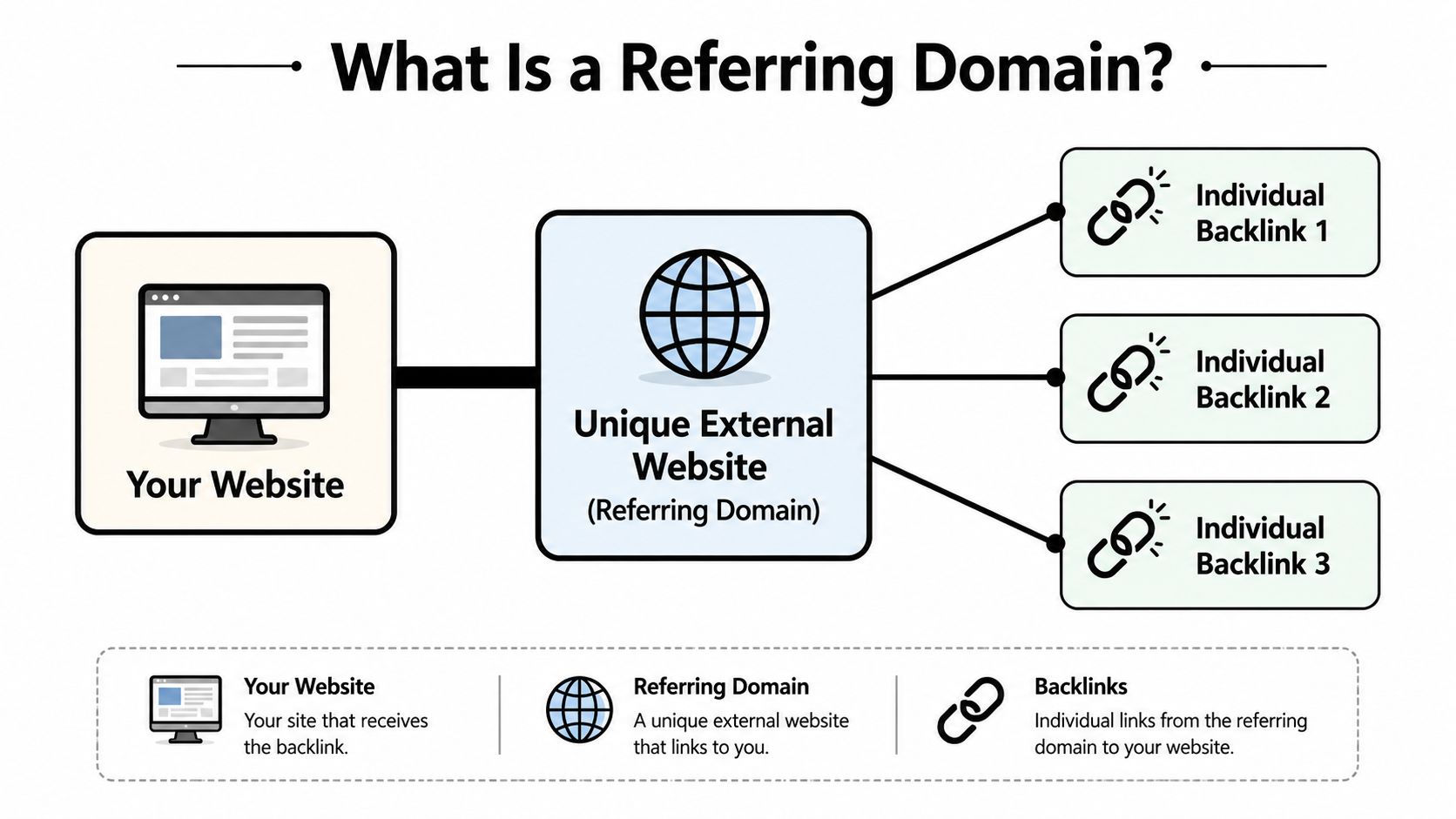
The metric also applies to domains, URLs, and subfolders, so always check what your tool is measuring. A report for an entire domain can look very different from one limited to a particular folder or page.
Referring Domains Versus Backlinks and Root Domains
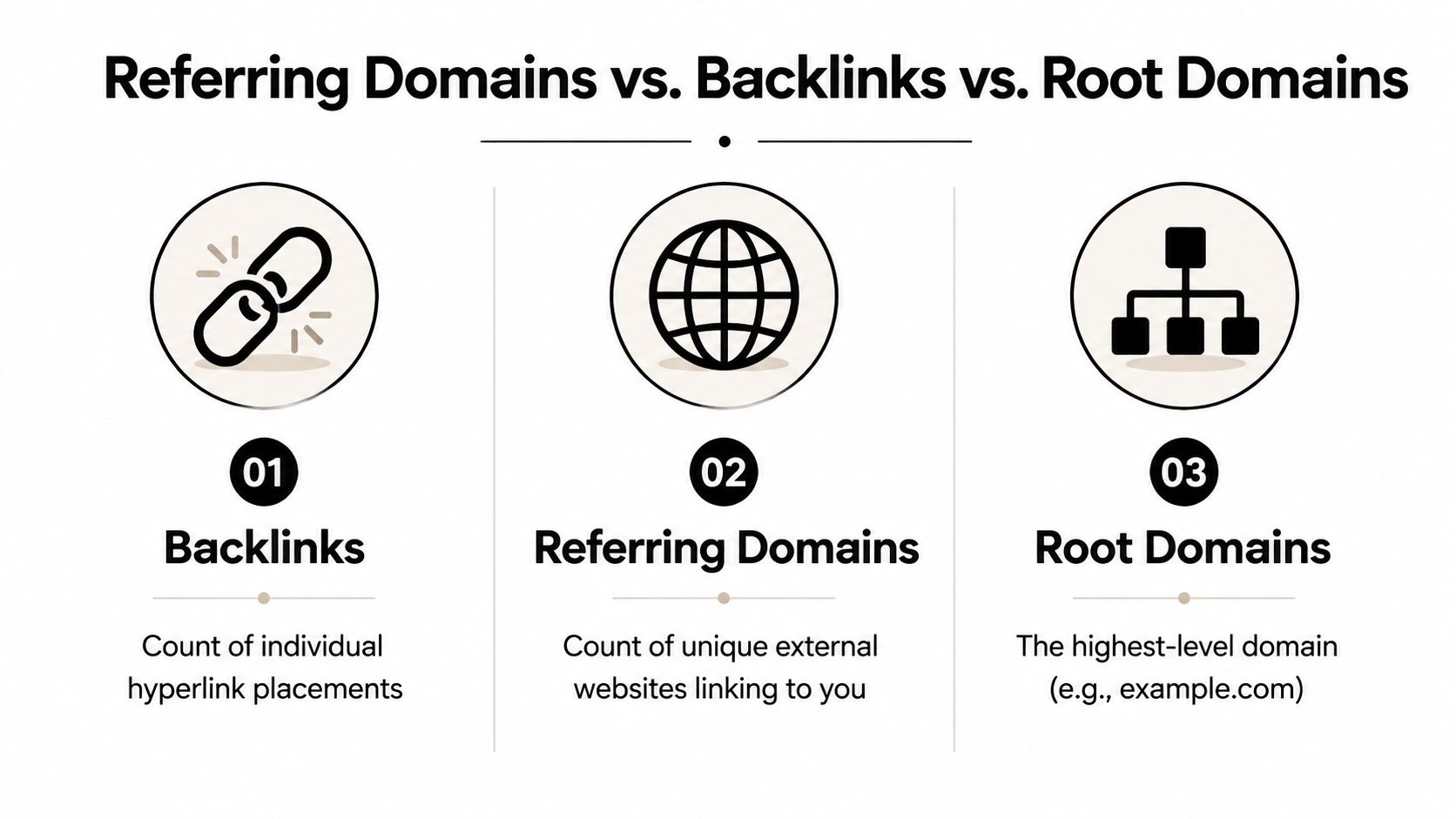
These terms overlap, but they aren't interchangeable. A backlink is an individual hyperlink placement. A referring domain is the unique external website behind one or more of those placements. A root domain is a higher-level domain used to identify the main domain structure, such as example.com, rather than a particular subdomain.
Consider a simple comparison:
| Metric | What it counts | Question it answers |
|---|---|---|
| Backlinks | Individual hyperlink placements | How many links point to the site? |
| Referring domains | Unique external websites | How many independent sites link to it? |
| Root domains | The highest-level domain structure | Which main domain does the source belong to? |
A blog might link to your guide from several pages. Your backlink total rises with each placement, but the referring-domain count rises only when a new external website links to you. Root-domain handling adds a technical distinction because tools may treat subdomains or regional versions differently when grouping sources.
Why equal backlink totals can mislead
Page A has many links from a narrow collection of websites. Page B has the same number of links distributed across a wider group of domains. Their backlink totals match, yet Page B has greater linking-site diversity.
That difference matters during competitor research. If you compare only backlinks, you might conclude that both competitors have equally strong authority. Add referring domains, and you can see whether one competitor has built broader recognition across its market.
For a more detailed view of individual placements, anchors, and link sources, Keyword Kick for backlinks can provide useful backlink-focused context. Keep the reporting roles separate, though. Backlinks show depth from sources, while referring domains show breadth across sources.
Why Referring Domains Drive Organic Search Performance
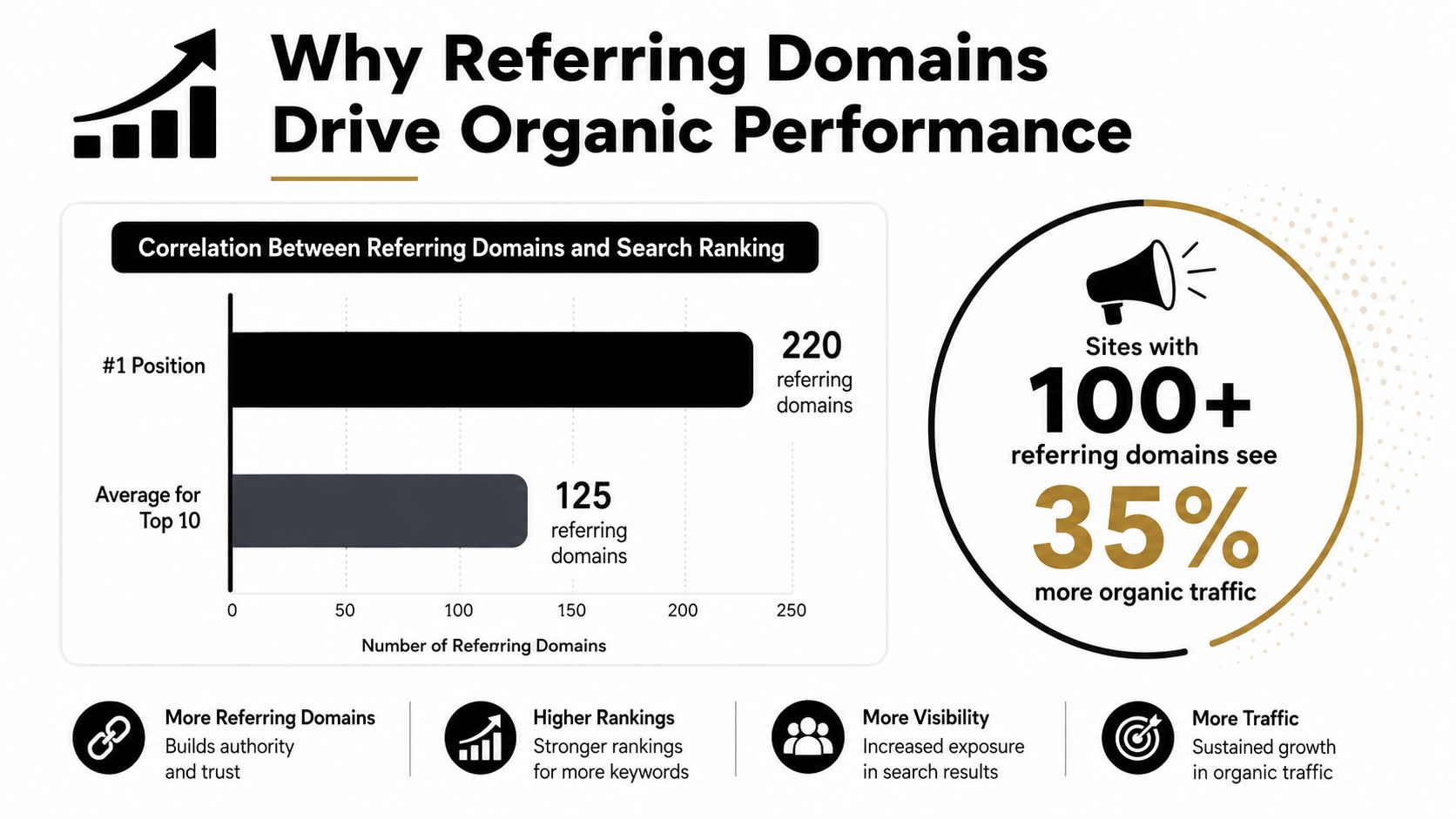
Search performance depends on more than one metric, yet referring-domain diversity gives SEO professionals a useful view of how widely a site is recognized. A high count does not guarantee rankings. It shows that links come from a broader set of publishers, which can support stronger authority signals than repeated placements from one source.
A 2016 analysis covered by Search Engine Journal examined 500,000 backlinks from 100,000 top websites and found that referring domains had the strongest correlation with traffic among the backlink factors tested. The practical lesson is narrower than “more domains always win.” Links from independent websites can provide broader evidence that different audiences and publishers find a resource useful.
A footer link repeated across many pages may produce a large backlink total without adding equivalent evidence of new editorial recognition. Ten placements from one publisher show repeated exposure within that site. Ten independent websites referencing the same resource show participation from a wider group. The links may serve different purposes, even when the totals match.
Track the direction, not only the snapshot
A current referring-domain total shows the profile at one point in time. Its movement reveals whether the site is earning new sources, losing previous ones, or relying on the same small group. That distinction helps separate sustained interest from link volume created by a few recurring placements.
Historical reporting also clarifies how long a platform can compare changes. Ahrefs' 2021 Referring domains 2.0 update described six months of history for Lite plans, two years for Standard plans, and full history for Advanced and Agency plans, as documented in its referring-domain reference. Those plan-specific windows determine how far back a trend review can reach.
Use the trend to identify:
- Steady acquisition: New websites continue to discover and reference your content.
- Concentration: A large share of links comes from a small source group.
- Loss: Previously linking domains disappear from the profile.
- Content pull: Certain pages attract references while others receive little attention.
For related authority-building guidance, see GetIntel on How to Increase Domain Rating. Domain-level metrics become more informative when reviewed alongside page relevance, source quality, and the history of link acquisition.
How to Track and Measure Your Referring Domains
Start with the report, then interpret the pattern. In Ahrefs, the Referring domains report shows which unique websites point to a domain, URL, or subfolder. Other SEO platforms use similar labels, although filters, grouping rules, and historical access can differ.
Google Search Console is useful for checking linking sites visible in its Links report, but a dedicated backlink platform generally gives you more detail for source comparison, lost links, target pages, and historical movement.
A practical review process
- Choose the right scope. Decide whether you're reviewing the whole domain, one URL, or a subfolder. Mixing scopes can make comparisons unreliable.
- Review new and lost domains. Look for sources gained during the period and sources that no longer link to you.
- Compare competitors. Check whether their link profiles show broad participation or heavy dependence on a small set of domains.
- Inspect the linked pages. A new referring domain pointing to a useful commercial page may have a different strategic value from one pointing to an abandoned URL.
- Record the trend. Keep a regular view of cumulative growth or decline instead of treating one report snapshot as the complete story.
Ahrefs' documentation distinguishes referring domains from backlinks and emphasizes that historical data helps marketers measure link acquisition and loss over time. That distinction matters for reporting because a flat total could hide both new wins and lost sources occurring within the same period.
Keep analytics terminology separate from SEO terminology. The Google Analytics organic search guide can help with traffic reporting, but an analytics referral domain describes a source of referral traffic. An SEO referring domain describes a unique website linking to your site. One domain may appear in both reports, yet the metrics measure different actions.
Auditing Referring Domain Quality and Diversity
A unique-domain count is a starting point, not a quality score. One relevant, trusted publisher can be more useful than a collection of weak or unrelated sites, because the value of a link depends on context, credibility, placement, and the audience it reaches.
That doesn't make quantity irrelevant. Competitive markets often require broader recognition, and you shouldn't choose an arbitrary “enough” number without looking at the pages that already perform well for the query. Benchmark the quality and distribution of competing referring domains, then set a goal to build a stronger, more relevant profile rather than copying a raw total.
Four checks for every important source
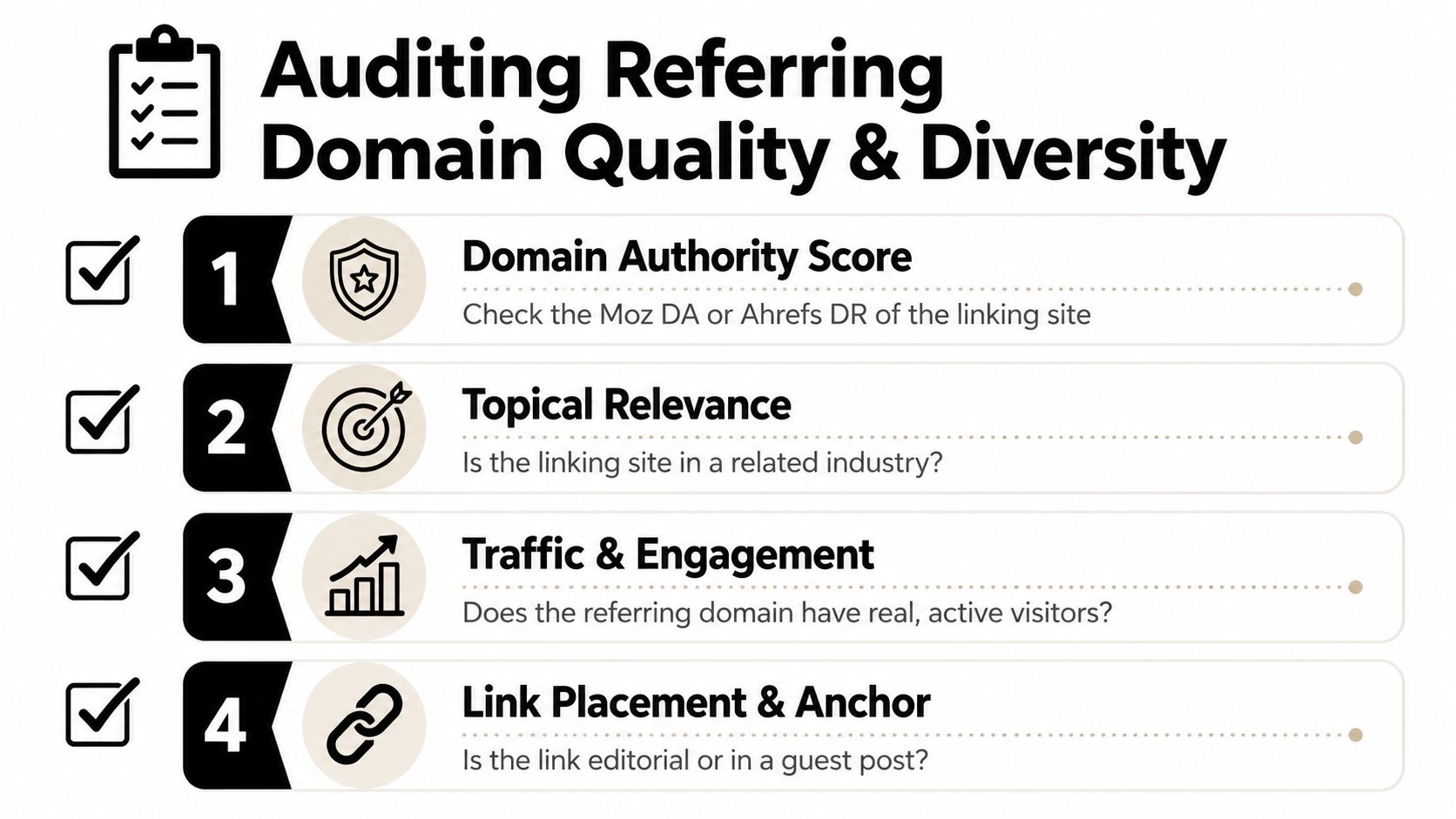
- Authority: Review the linking site's authority metric in tools such as Ahrefs or Moz, but don't treat a score as a final verdict.
- Relevance: Ask whether the site serves an audience connected to your subject, product, or market.
- Audience activity: Check whether the publication appears maintained and useful to real readers.
- Placement: Inspect whether the link sits naturally within editorial content or appears in a templated, low-context area.
The source quality question is especially important when reviewing directories, guest posts, and niche edits. A directory that exists only to host links offers a weaker signal than a respected industry resource that references your page because it helps its readers.
How many domains are enough?
There's no universal threshold. A local service, specialist publication, and global software company face different competitive environments, and even pages within the same site can attract very different levels of independent attention.
Use a comparative process:
- Review the referring domains of pages competing for the same search intent.
- Separate relevant and credible domains from low-value sources.
- Look for gaps in topics, publications, communities, and partner ecosystems.
- Build assets that answer those gaps better than existing resources.
- Track whether new links expand diversity instead of repeatedly coming from familiar sources.
For competitor discovery, this guide to finding competitor websites can support the research phase. The objective isn't to imitate every link. It's to identify credible places where your content could add value.
Audit principle: A broader profile of relevant sources is usually healthier than a concentrated profile built on repeated links from a few sites.
Putting It All Together for Smarter Link Building
The clearest mental model is simple: backlinks measure placements, referring domains measure independent sources, and root domains describe the highest-level domain structure. Use each metric for the question it can answer, and don't let a large backlink total conceal a narrow source base.
For your next audit, check the referring-domain trend, inspect the quality of the newest sources, compare domain diversity with direct competitors, and investigate lost domains. Then prioritize content and outreach that can earn genuine references from relevant websites.
Don't chase a magic number. In competitive niches, “enough” means having a credible, diversified profile that compares well with the pages earning visibility for the same intent.
Review your site's referring-domain report, separate unique sources from repeated backlink placements, and turn the findings into a focused link-building plan. Visit Keywordme to streamline the keyword research and Google Ads optimization work that supports a more disciplined search strategy.
.svg)