
What Is Implementation Plan: A Complete Guide for 2026
What Is Implementation Plan: A Complete Guide for 2026


An implementation plan is the execution roadmap that breaks an approved strategy into specific tasks, owners, timelines, resources, and KPIs. Your PPC campaign may already have a budget and audience, yet launch work still stalls when nobody knows who builds the ad groups, reviews the landing page, checks tracking, or signs off on the final changes.
That's the frustrating gap between a smart strategy and shipped work. A kickoff deck can explain the opportunity, but it rarely governs the messy middle where briefs become tasks, tasks depend on other tasks, and risks force uncomfortable decisions. In project-management guidance, an implementation plan is the document that turns strategy into action by defining steps, timelines, roles, deliverables, and resources, making it more detailed than a high-level project plan and useful during execution rather than strategy formation. ProjectManager's implementation plan guidance frames it as the bridge between approval and delivery.
Why Smart Strategies Still Fail at Execution
The campaign looked ready. The channel mix had approval, the budget was allocated, and the team left the kickoff meeting feeling productive. Then the work scattered. The PPC specialist waited for keyword inputs, the copywriter lacked a final offer, the designer built a landing page around an outdated message, and the analyst could not confirm whether conversion tracking was ready.
Nobody had made a poor strategic decision. The team lacked a clear layer for turning approval into coordinated delivery.
Understanding what an implementation plan is becomes practical at this point. It is the operating document people use to move from strategy to shipped work, translating an approved direction into owned tasks with timing, resources, dependencies, risks, deliverables, and completion measures.
Practical rule: If a task has no owner, deadline, or acceptance condition, it is not ready to enter execution.
The expensive gap between approval and delivery
Marketing teams often mistake alignment for readiness. Everyone may agree that a campaign should launch, but agreement leaves several operational questions unanswered:
- What happens first: Should conversion tracking be finalized before ad production, or can both streams proceed safely?
- Who decides: Does the channel lead approve match types, or does the client need to review them?
- What counts as complete: Is an ad group finished when ads are drafted, uploaded, reviewed, or actively serving?
- What changes the plan: What happens if the landing page misses its review date or budget pacing becomes unsafe?
Without explicit answers, people fill the gaps with assumptions. Those assumptions create rework, missed handoffs, duplicated effort, and quiet delays that become difficult to diagnose after launch. A campaign can appear aligned in a meeting while remaining operationally blocked.
Why strong teams treat the plan as governance
An implementation plan earns its place by governing the work between approval and delivery. It gives cross-functional teams a shared source of truth, so people do not have to reconstruct decisions from chat threads and disconnected task lists. It makes accountability visible, helping managers resolve ownership conflicts before deadlines pass. It also establishes control points for reviewing progress, risks, and adoption while the work is still changing.
The plan exposes trade-offs early. A team might want a broad campaign expansion, a new landing-page test, and a complete negative-keyword cleanup in the same window. Documenting dependencies may show that the available reviewers cannot support all three safely. The team then has a choice: narrow the scope, extend the timing, or add capacity.
That is governance, not paperwork. It creates a decision before execution turns the conflict into a fire drill. In PPC work, the value is especially clear because launch readiness depends on connected tasks. A missed tracking check or unclear approval can undermine the measurement needed to judge the strategy itself.
The Core Components Every Plan Needs
A useful implementation plan doesn't need to be elaborate, but it does need enough structure to make decisions executable. Guidance from Atlassian on implementation plans describes the execution layer as more than a task list, with goals, scope, milestones, owners, resources, dependencies, risks, and acceptance criteria working together across delivery.
The following table gives each component a practical marketing or PPC application.
The eight building blocks
| Component | Purpose | PPC or marketing example |
|---|---|---|
| Scope | Define what the initiative includes and excludes. | “Launch the new non-brand search ad group for approved service terms. Exclude display, remarketing, and landing-page redesign.” |
| Objectives | State the business or campaign outcome the work supports. | “Create a qualified search path for the new service offer and establish a clean review process for search terms.” |
| Tasks | Break the objective into actions someone can complete. | “Cluster approved terms, assign match types, draft ads, build negative keywords, configure tracking, and submit for review.” |
| Timeline | Show sequence, milestones, and decision points. | “Keyword structure review precedes ad upload. Tracking validation must occur before launch approval.” |
| Roles | Assign responsibility for doing, reviewing, approving, and being consulted. | “PPC specialist builds the campaign. Analyst validates events. Account lead gives final approval.” |
| Resources | Identify the people, tools, access, budget, and inputs required. | “Requires Google Ads access, approved landing-page copy, conversion definitions, keyword data, and reviewer availability.” |
| Risks and dependencies | Surface conditions that could delay or weaken delivery. | “Landing-page approval may delay launch. Broad matching may create irrelevant traffic if negative-keyword coverage is incomplete.” |
| KPIs and acceptance criteria | Define how the team will judge progress and completion. | “Campaign is accepted when tracking passes, required ads are approved, naming is consistent, and launch checks are documented.” |
The common mistake is writing these as vague labels. “Improve PPC performance” is an objective-shaped phrase, not an execution objective. “Review keywords” is a task, but it doesn't identify the reviewer, the input, or the condition that makes the review complete.
Turn each field into a decision
Use fill-in-the-blank language to force precision:
- Scope: “This plan includes ___ and excludes ___.”
- Objective: “We're doing this to ___ for ___.”
- Task: “___ will complete ___ using ___.”
- Timeline: “___ must happen before ___ because ___.”
- Role: “___ owns the work, while ___ approves the result.”
- Resource: “The team needs ___ before task ___ can start.”
- Risk: “If ___ happens, the owner will ___ by ___.”
- Acceptance: “The work is complete when ___ is verified by ___.”
A plan becomes useful when another person can read a line and act without scheduling a clarification meeting. That standard also keeps the document lightweight. You're not trying to document every conversation, only the information that protects execution.
Match detail to operational risk
A small landing-page test may need a short plan with scope, owner, launch date, tracking check, and decision rule. A new client account or multi-channel rollout needs more detail because the cost of a missed dependency is higher.
The right level of detail isn't the level that looks most professional. It's the level that gives the team enough control to deliver without hiding important uncertainty.
How the Pieces Work Together as a Workflow
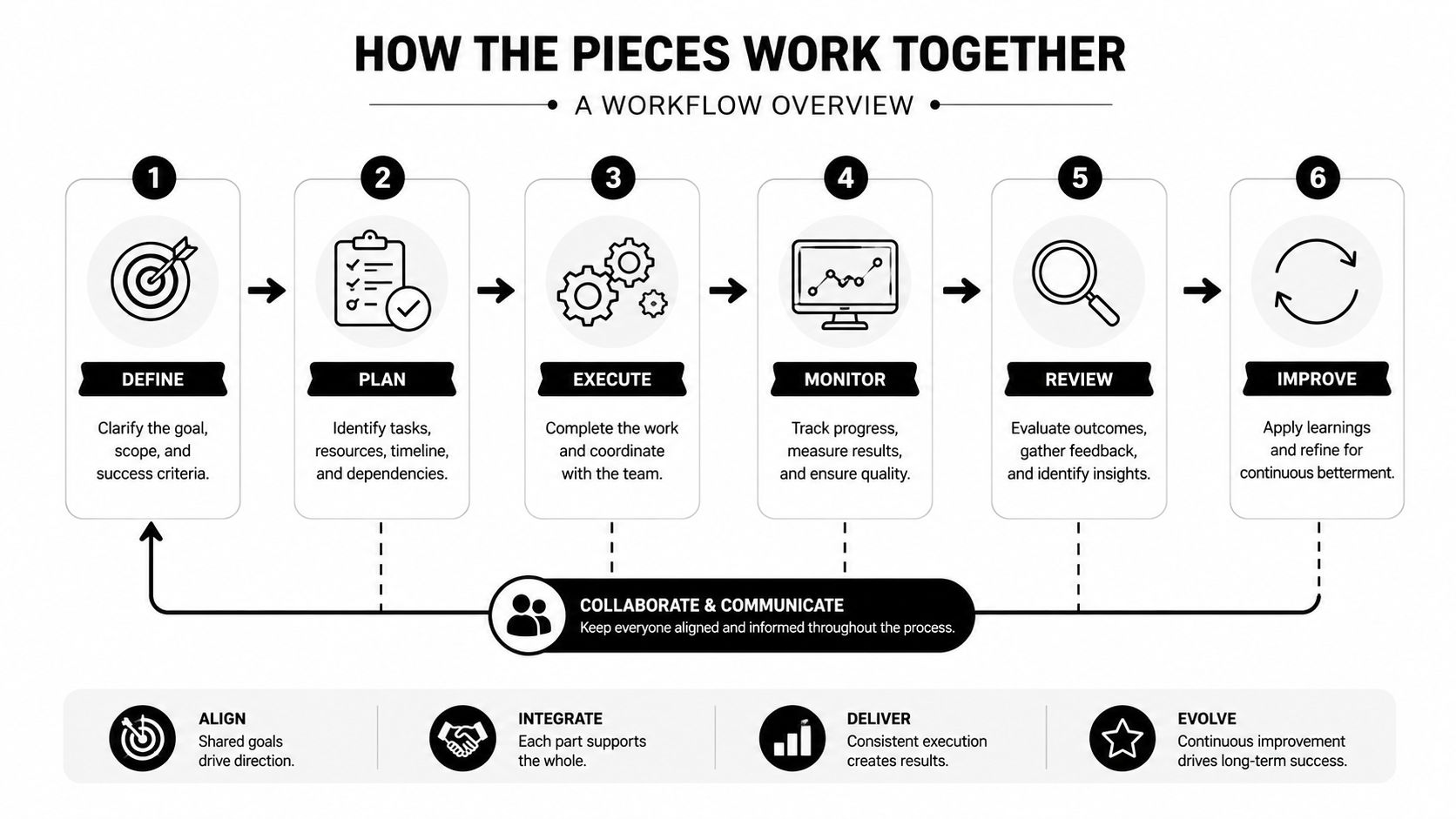
The components matter because they interact. A scope decision determines the task list. The task list reveals resource needs. Resource limits change sequencing. Dependencies reshape the timeline, while risks determine which control points deserve attention. KPIs then provide feedback that may force a scope adjustment rather than decorate a dashboard.
This is why an implementation plan should behave like a feedback loop, not a static PDF. A useful workflow starts with the desired outcome, maps the gap between the current state and that outcome, assigns work to close the gap, and revisits the assumptions as evidence arrives. PMI's discussion of implementation planning emphasizes working backward from the desired future through a gap statement, while also highlighting progress measures and buy-in criteria in assessing whether a plan can operate under real constraints. PMI's implementation planning discussion provides that useful shift from activity lists to adoption readiness.
Use staged rollout instead of one giant launch
Implementation-practice guidance describes four stages, exploration, installation, initial implementation, and full implementation, with strategies, owners, timelines, and progress benchmarks matched to each stage. The implementation practice guide is particularly useful because it treats rollout as a sequence of readiness decisions rather than a single launch event.
For a PPC initiative, the stages might look like this:
- Exploration: Confirm the business problem, audience, offer, data availability, and decision criteria.
- Installation: Prepare account access, tracking, naming conventions, keyword structure, creative inputs, and review capacity.
- Initial implementation: Launch a controlled portion of the work, inspect quality, and record issues.
- Full implementation: Expand the approved structure, monitor performance, and adjust based on the agreed measures.
The plan should show what evidence allows the team to move forward. If initial implementation reveals poor query relevance, the response may be a stronger negative-keyword process or a narrower scope, not an automatic expansion.
Keep the document alive
Set a regular owner review, update risks when conditions change, and record decisions where the team can find them. A plan nobody opens after kickoff has become documentation theater.
Teams handling recurring paid-media work can also use this guide to streamlining PPC workflows to connect repeatable operational steps with the broader governance process.
A PPC Implementation Plan Walkthrough
Consider an agency preparing a Google Ads account for a client expanding into a new service category. The strategy calls for new ad groups built from high-converting search terms, structured negative-keyword cleanup, and match-type assignments across a large keyword set. The implementation plan's job is to turn that direction into controlled work.
The first decision is scope. The plan might include keyword clustering, ad-group architecture, negative-keyword review, ad drafting, tracking validation, and launch checks. It should explicitly exclude unrelated account restructuring, creative testing outside the new service, and any landing-page changes that haven't been approved.
From inputs to owned tasks
The PPC specialist starts with search-term data and separates relevant themes from queries that belong elsewhere. A second reviewer checks the clusters, because the person building the structure shouldn't be the only person deciding whether terms belong together. The account lead resolves ambiguous cases and confirms that the proposed structure matches the client's commercial priorities.
A task-level plan could look like this:
- Build keyword clusters: PPC specialist groups approved terms by intent and proposed ad group.
- Assign match types: PPC specialist documents the reasoning for exact, phrase, or broad treatment.
- Create negative keywords: PPC specialist identifies irrelevant themes and prepares a shared review list.
- Draft ads: Copywriter produces messages aligned with each ad group and the approved offer.
- Validate tracking: Analyst checks the conversion events and confirms that the reporting view will support launch review.
- Run policy and quality checks: Account lead reviews destination URLs, ad content, naming, settings, and budget controls.
- Approve launch: Client or designated approver signs off on the defined acceptance criteria.
The trade-off is speed versus control. Uploading everything immediately may feel efficient, but it makes errors harder to isolate. A staged review of structure, relevance, tracking, and policy creates more visible checkpoints and gives the team a cleaner rollback path.
Define risks before they become incidents
Budget pacing belongs in the plan because an expanded structure can change how spend distributes across themes. Irrelevant traffic is another risk, particularly when match-type decisions are made without a clear negative-keyword process. Ad policy and destination-page issues also need named owners, not a generic note saying “monitor compliance.”
For teams comparing channel practices, this Facebook Ads best practices guide offers a useful reminder that implementation details vary by platform, even though the governance principles remain similar. The plan should preserve the platform-specific checks rather than pretending one launch checklist fits every channel.
A practical acceptance statement might say that the campaign is ready when the approved keyword structure is uploaded, negative keywords have been reviewed, tracking has passed validation, required ads and destinations are checked, and the designated approver has recorded the decision. The Google Ads campaign setup guide can support the operational setup, but it shouldn't replace ownership and acceptance criteria in the plan.
Your Reusable Implementation Plan Template
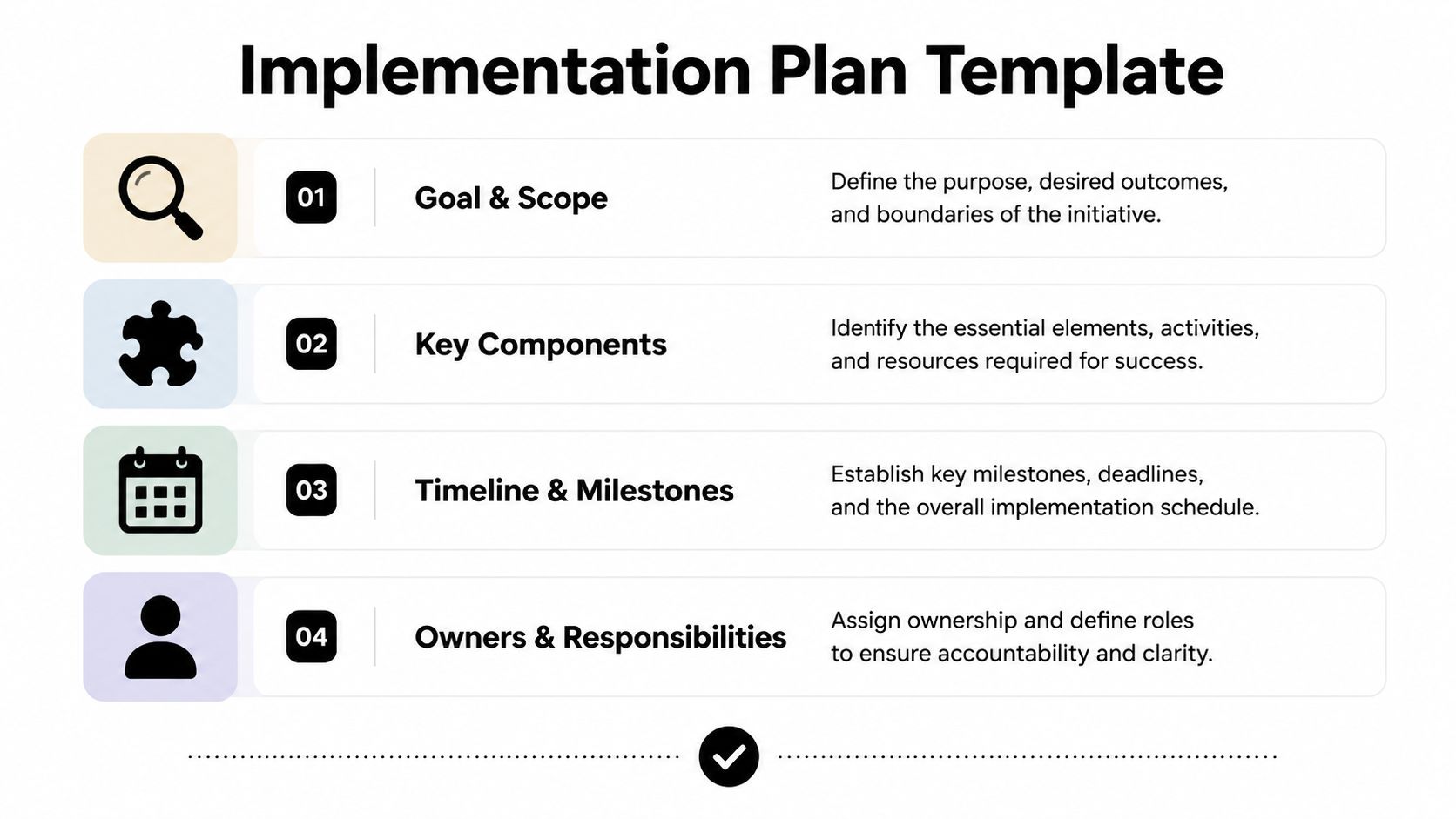
A reusable template should make the first draft easier without turning planning into paperwork. Start with the smallest version that protects the work, then add detail when dependencies, risk, or stakeholder involvement justify it.
Quick-start version for a focused campaign
Copy this structure into your project tool or shared document:
- Initiative: ___
- Business objective: ___
- In scope: ___
- Out of scope: ___
- Primary owner: ___
- Approver: ___
- Key tasks: ___
- Dependencies: ___
- Resources required: ___
- Milestones: ___
- Risks and responses: ___
- KPI or acceptance condition: ___
- Review cadence: ___
For a tightly bounded campaign, each line can be short. The important part is that the team can identify the work, the owner, the order, and the condition for completion.
Fuller version for a complex rollout
Use a more detailed structure when multiple teams, markets, channels, or approvals are involved:
- Context and desired future: Describe the current state, the approved strategy, and the outcome the implementation must create.
- Gap statement: State the distance between current capability and the target state.
- Scope boundaries: Name included work, excluded work, assumptions, and change-control rules.
- Work breakdown: List tasks, subtasks, deliverables, dependencies, and acceptance criteria.
- Ownership model: Assign contributors, reviewers, approvers, and escalation points.
- Capacity and resources: Record people, tools, access, budget constraints, source data, and required inputs.
- Rollout stages: Define exploration, installation, initial implementation, and full implementation activities.
- Measurement and governance: Specify KPIs, review points, risk updates, decision logs, and re-baselining rules.
Before kickoff, run the plan through a readiness check:
- Ownership: Can every important deliverable be traced to one accountable person?
- Sequence: Are prerequisites visible, or are tasks arranged by preference?
- Capacity: Have reviewers and approvers confirmed they can support the timing?
- Risk: Does each material risk have a trigger and response?
- Acceptance: Can someone verify completion without relying on personal judgment?
- Adoption: Will the people doing the work update and use the plan?
For PPC teams, a PPC audit checklist template can help identify operational inputs that belong in the resource, task, or risk portions of the document.
Common Mistakes That Kill Implementation Plans
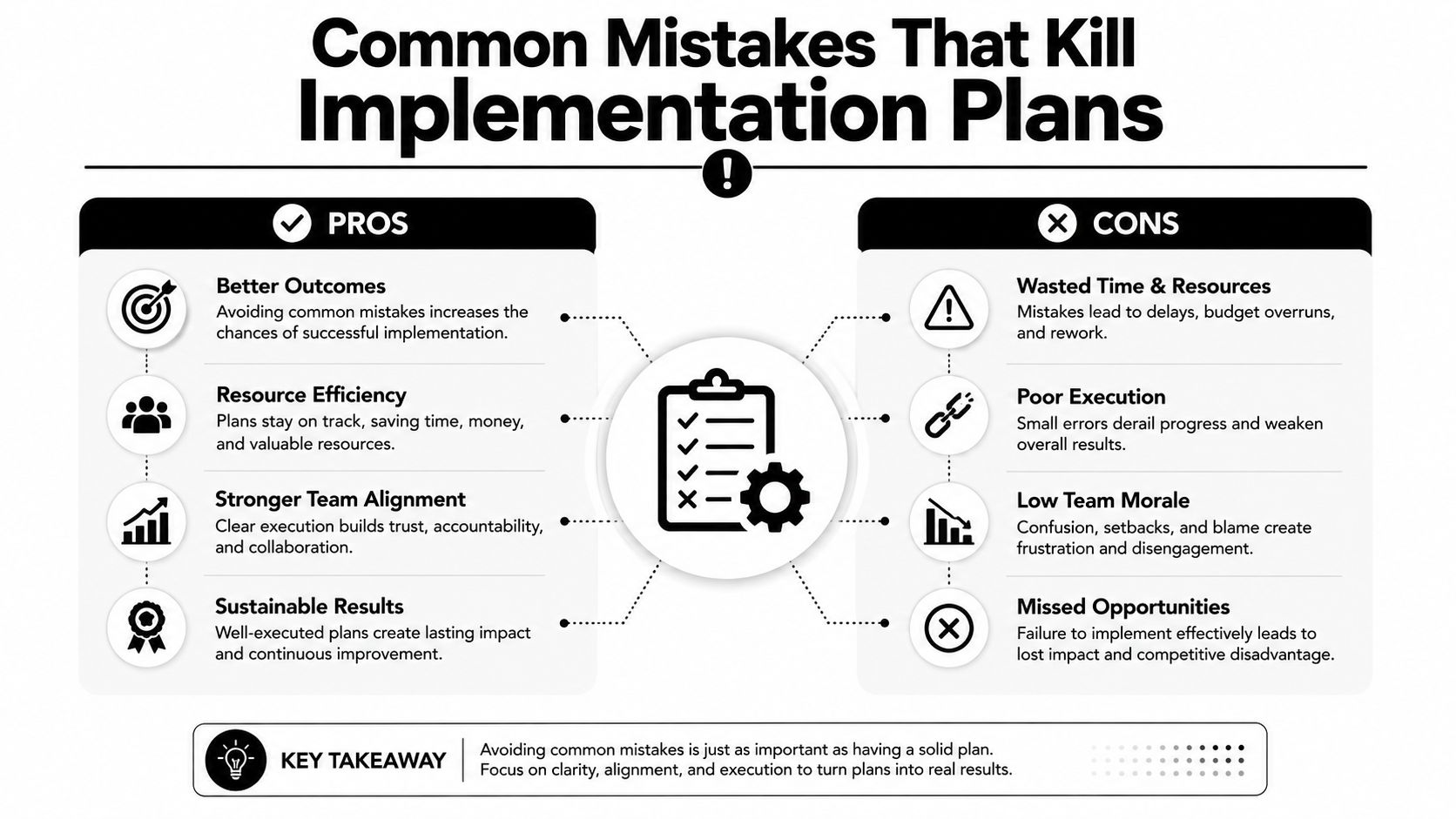
Most implementation plans don't fail because the template is wrong. They fail because the team uses the document to create the appearance of control instead of making real decisions.
The plan was written without the people doing the work
Leadership may define the objective, then hand a finished plan to practitioners who discover that the sequence is impossible. Ask the PPC specialist, analyst, copywriter, designer, and approver to challenge the task order before the plan becomes a commitment. They'll spot missing access, review bottlenecks, and hidden dependencies faster than a polished planning meeting will.
Owners are groups instead of people
“Marketing owns landing pages” isn't accountability. Write the responsible individual, the deliverable, the due point, and the reviewer. If two people share responsibility, state who makes the final call so the task doesn't sit between roles.
The timeline reflects hope, not capacity
A date copied from a launch calendar isn't a schedule. Trace the critical path, ask which tasks can run in parallel safely, and identify what happens when an approval slips. A credible plan can include uncertainty. A falsely precise plan only hides it.
Risks are listed but not managed
A risk register full of phrases like “budget issues” and “tracking problems” won't change behavior. Define the trigger, owner, response, and escalation path. Guidance on CRM implementation challenges is useful here because system rollouts often expose the same issues as campaign launches, including unclear ownership, adoption friction, data concerns, and integration dependencies.
KPIs are reported but never used
A metric belongs in the plan only if it can trigger a decision. If a measure changes, what will the team do differently? A PPC plan might use relevance, tracking validity, pacing, or lead quality as decision inputs, rather than filling a dashboard with figures nobody reviews.
Watch the video below for another perspective on implementation planning and execution discipline.
Turning Your Plan Into Real Adoption
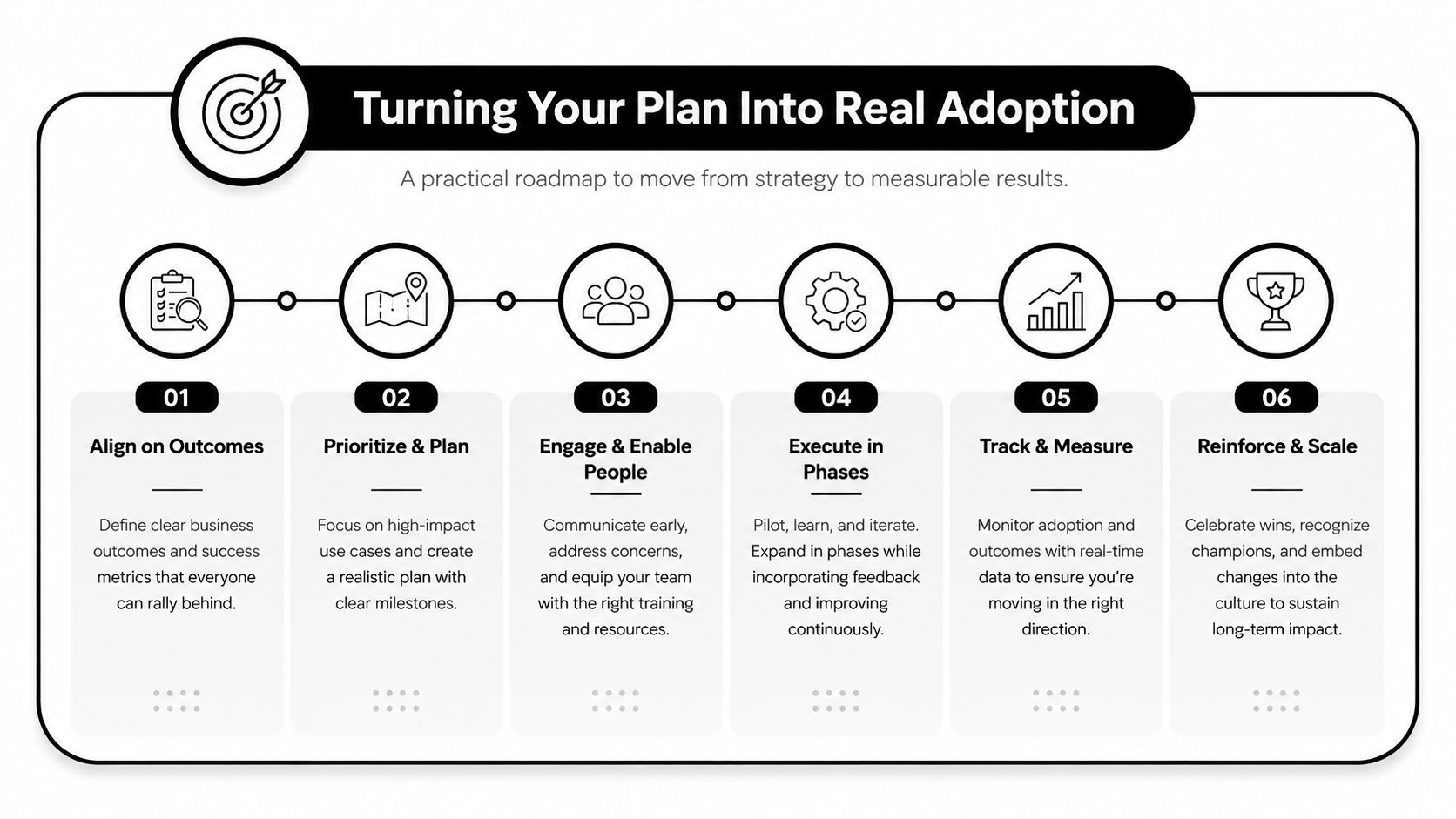
A documented plan isn't necessarily an implemented plan. The test is whether people use it to coordinate work, update ownership, surface risks, and make decisions when conditions change. Adoption readiness matters because a plan must survive limited capacity, shifting priorities, incomplete information, and the ordinary interruptions that affect marketing teams.
Signs the plan is alive
Look for behaviors, not compliments about the document:
- Owners update status: People record progress and blockers where the team expects to find them.
- Risks change over time: The register shows new information, mitigations, and escalation decisions.
- Milestones prompt review: The team uses checkpoints to approve, revise, or pause the next stage.
- KPIs influence action: Performance or quality signals lead to a documented decision.
- Scope stays governed: New requests are accepted, rejected, or traded against existing work.
The warning signs are just as clear. A milestone slips without a new owner or decision. Stakeholders receive KPI reports but never discuss them. New requests enter the workload without changing scope, resources, or timing. These patterns show that the plan has become a record of activity rather than a governance mechanism.
A practical adoption check
At the next team meeting, ask each owner to state the next deliverable, the dependency blocking it, the risk that could change the sequence, and the evidence needed to mark it complete. If answers differ, the plan needs clarification before more work begins.
Then review the plan against the desired future. Is the current scope still capable of closing the gap? Do the available people and tools match the work? Has any assumption changed enough to require a new baseline? These questions keep the document connected to execution instead of allowing it to drift into archive material.
A strong implementation plan doesn't win awards for formatting. It gives the right person enough clarity to do the right work, at the right time, with a visible way to respond when reality changes. That's how an approved strategy becomes delivery that ships and sticks.
Keywordme helps PPC teams turn keyword research, search-term cleanup, negative-keyword handling, match-type assignment, and campaign expansion into a more manageable operating workflow. Visit Keywordme to see how it can support the execution layer behind your Google Ads plans, from focused account work to large-scale campaign operations.
.svg)