
What Is an Ad Campaign? Your Complete Guide
What Is an Ad Campaign? Your Complete Guide


So, what is an ad campaign, really?
At its heart, it’s a coordinated set of ads all working together to hit one specific business goal. Think of it less like shouting into the void and more like a carefully planned operation to get your message in front of the right people, at the right time. This strategic approach is what separates just "running ads" from getting real, measurable results.
What an Ad Campaign Really Means
Let's break it down with an analogy I love: planning a road trip.
You wouldn't just hop in the car and start driving aimlessly, right? Of course not. You'd have a destination in mind. An ad campaign is your marketing road trip plan. It maps out your final destination (your goal), the roads you'll take (your channels), and how much you'll spend on gas and snacks (your budget).
This coordinated strategy is the secret sauce. It makes sure all your marketing efforts are rowing in the same direction. Instead of a bunch of disconnected ads that feel random, a campaign pulls them all together under one clear objective. Whether you're trying to generate new leads, get your brand name out there, or drive immediate sales, the campaign is the framework that holds it all together.
The Core Components of a Campaign
The whole point is to move past one-off ads and think bigger. A campaign weaves multiple pieces—ads, keywords, landing pages—into a single, cohesive story aimed at a specific audience over a set period. It’s this structure that turns your ad spend from a simple expense into a smart, trackable investment.
And it's a massive investment for businesses worldwide. In fact, global ad spending is projected to blow past $1 trillion for the first time ever in 2025.
Ad Campaign Core Components at a Glance
Here's a quick summary of the essential parts of any ad campaign. We'll explore each of these in more detail throughout the guide.
Getting a handle on these building blocks is the first step. To really see how they fit together, it helps to look at the different kinds of paid advertising services that bring a campaign to life.
The Building Blocks of a Modern Ad Campaign
So, what does an ad campaign actually look like under the hood? Let's pull back the curtain on the classic structure used by platforms like Google Ads. Once you get how the pieces fit together, it’s all surprisingly logical.
Think of it like building with LEGOs. At the very top, you have the entire project—that’s your Campaign. This is where you decide the big-picture stuff, like your total budget and the main goal you're gunning for. Are you trying to drive sales, generate leads, or just get your name out there?
From Broad Goals to Specific Messages
Next up, you have your Ad Groups, which are like smaller, themed sets within your main project. Each ad group narrows the focus to one specific product, service, or theme.
For instance, a local bakery might have a "Wedding Cakes" ad group and a totally separate "Birthday Cookies" ad group. This keeps everything tidy and super relevant.
Finally, you have the individual bricks: your Ads and Keywords. These are the nitty-gritty details. Inside the "Wedding Cakes" ad group, you’d have ads with headlines like “Custom 3-Tier Wedding Cakes” and the keywords that trigger them, such as “local wedding cake designer.”
This hierarchy—Campaign > Ad Group > Ad—is the secret to staying organized. It’s what ensures you’re showing the perfect ad to the right person at just the right moment.
This structure is what stops your marketing from becoming a jumbled mess. It also dictates where people go after they click. A well-built campaign sends users to a page that perfectly matches their search, which is why effective landing page design is so critical for turning that click into a customer.
Getting this structure right is the foundation for everything else. To make sure you nail every detail from the start, our complete PPC campaign checklist walks you through the entire process.
Why Every Ad Campaign Needs a Clear Goal
Ever jumped in the car without knowing where you're going? That's what running an ad campaign without a clear goal feels like. You'll definitely burn through your budget (gas), but you won't end up anywhere useful. Your goal is the North Star for every single decision you make—from the words you write to the folks you target.
So, what are you actually trying to do? Get more eyes on your brand (awareness)? Find new potential customers (lead generation)? Or get people to pull out their wallets and buy something right now (sales)? Each of these goals requires a totally different game plan.
Think about it: an awareness campaign might rely on splashy, memorable video ads on social media. A sales campaign, however, would be all about super-specific search ads that pop up the exact moment a customer is ready to buy.
Aligning Strategy with Your Objective
The goal you set dictates everything, especially how you measure success. Without one, you're just guessing. You have no real way of knowing if your ad spend is actually working or just disappearing into the digital ether. It makes figuring out profit and loss a complete shot in the dark.
This is why ad platforms are structured so methodically. They're built to align every piece of the puzzle with your main objective.
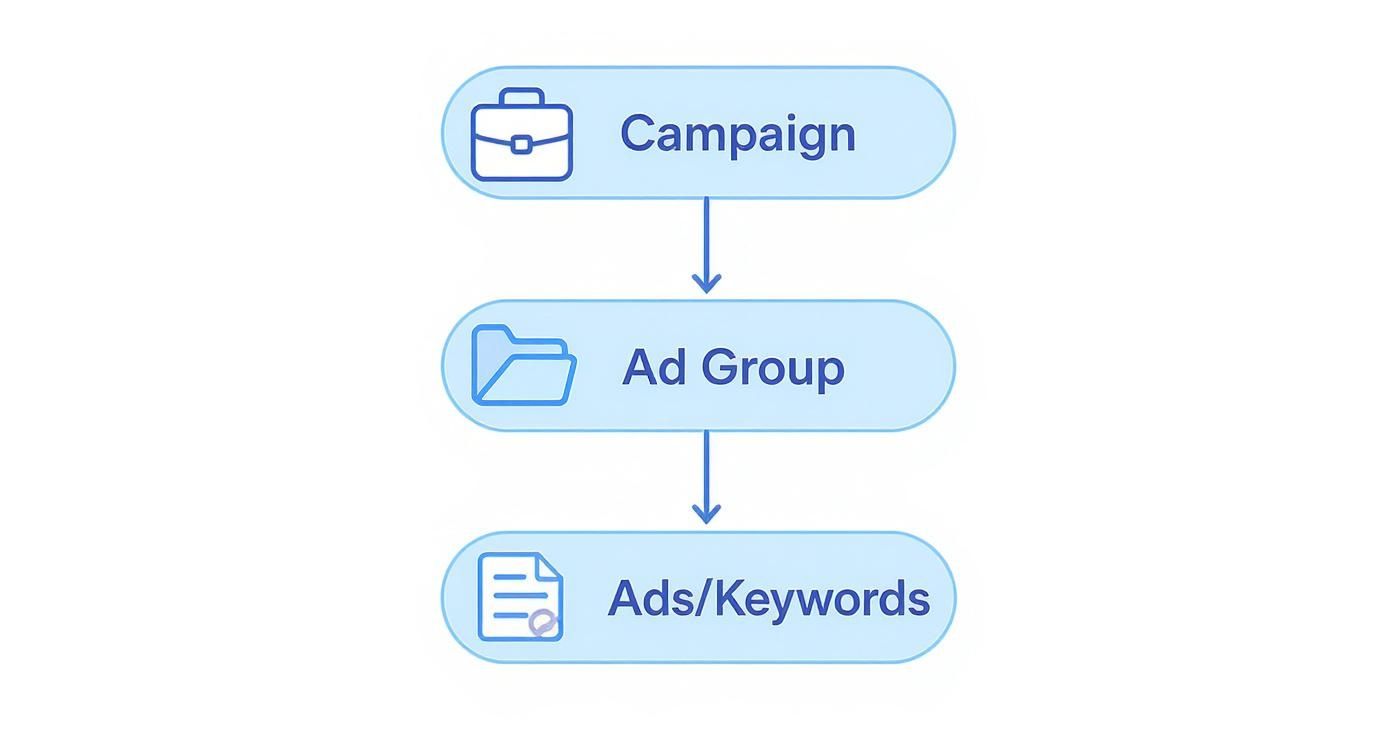
This structure forces you to keep everything—from the top-level campaign settings down to the individual keywords—all pointed in the same direction, working toward that one goal.
Some of the most common campaign goals are:
- Brand Awareness: Simply getting your name out there so people know you exist.
- Lead Generation: Gathering contact info (like emails or phone numbers) from people who are interested in what you offer.
- Sales or Conversions: Pushing for the final action, whether it's a purchase, a sign-up, or a download.
- Website Traffic: Funneling more visitors to your website or a specific landing page to learn more.
At the end of the day, setting a clear goal is the first and most critical step. It’s the only way to know if you're winning or losing. This clarity is absolutely essential when you want to understand what is return on investment and make sure every dollar you spend is pulling its weight.
Choosing Where Your Ad Campaign Will Run
https://www.youtube.com/embed/MHh4mDh3kHk
Alright, you’ve got your goals figured out and a solid campaign structure in mind. Now for the million-dollar question: where are you actually going to run these ads?
You need to show up where your audience hangs out. Think of it like opening a food truck—you wouldn't park it on a deserted street. You'd go to the busy downtown square where everyone's already hungry. The same logic applies here.
Search ads, like the ones you see on Google, are your go-to for problem-solving. They pop up the second someone types in a query looking for exactly what you offer. This is all about capturing intent, and it's incredibly powerful because you’re meeting a need that already exists.
Then you’ve got Social Media ads. This is less about answering a direct question and more about joining the party. Platforms like Instagram, Facebook, and LinkedIn let you get in front of people based on who they are and what they love. You're not waiting for them to come to you; you're sparking their interest while they're scrolling through their feed.
Expanding Your Digital Footprint
Beyond search and social, a couple of other heavy hitters can round out your strategy. Each one has a totally different job to do.
Display Ads: Ever see those banner ads on your favorite news site or blog? Those are display ads. Think of them as the billboards of the internet. They’re fantastic for getting your brand name out there and staying top-of-mind.
Video Ads: These are your storytelling workhorses, popping up on platforms like YouTube. Nothing beats a video for showing off a product in action, sharing a powerful customer story, or just building an emotional connection with your viewers.
The right mix of these channels comes down to what you’re trying to achieve. Want to catch someone right when they’re ready to buy? Search is your best friend. Looking to build a loyal following and show off your brand’s personality? That’s where social and video really shine.
The shift toward these digital channels is massive. By 2025, digital advertising is projected to grab 62.7% of all global ad spend, which is a mind-blowing $513 billion. What’s driving that? A lot of it is AI-powered ad placements, which are on track to account for 79% of total ad spend by 2027. You can dig deeper into these numbers by checking out the global ad spend forecasts on dentsu.com. This just goes to show how crucial it is to get your channel strategy right from the start.
How Much Do Ad Campaigns Actually Cost
Let's get right to the question on everyone's mind: what's this going to cost me? The good news is, you're in the driver's seat. You don’t need a massive marketing budget to get started—what you need is a smart approach.
The cost of an ad campaign isn't a fixed price. Think of it more like a "choose your own adventure" for your budget. You decide how much to spend and how you want to pay for the results, which is exactly what makes digital advertising so powerful for businesses of all sizes.
Common Ad Campaign Bidding Models
So, how do you actually pay for these ads? There are a few different ways, but most of them boil down to a handful of core models. Understanding these is key to managing your budget effectively.
Here’s a quick look at the most common ways advertisers pay for their campaigns:
Ultimately, the best model depends entirely on what you’re trying to achieve. Are you hunting for leads or just trying to get your name out there? Your answer will point you to the right bidding strategy.
What to Expect in 2025
Of course, costs can swing wildly depending on your industry. A click for a local coffee shop might be a buck or two, while a click for a competitive term in the legal or insurance space could be ten times that. It all comes down to competition.
In 2025, the average CPC across all industries on Google Ads is projected to hit $5.26. Some hyper-competitive sectors, like legal services, are expected to see averages as high as $8.58 per click. You can dive deeper into the numbers with the full 2025 Google Ads benchmarks on wordstream.com.
The most important takeaway is this: A smart, targeted strategy will always outperform a giant, unfocused budget. It’s not about how much you spend, but how wisely you spend it.
Want a better sense of what your specific campaign might cost? Play around with our interactive Google Ads cost calculator to get a ballpark estimate of your potential spend.
Alright, theory is one thing, but let's see how this all clicks together in the real world. Nothing makes these concepts stick quite like a concrete example.

Let's imagine a local coffee shop called "The Daily Grind." They're rolling out a new seasonal drink—the "Maple Pecan Latte"—and they want to get the word out and people in the door.
Their goal is simple and specific: drive in-store sales of the new latte over the next 30 days. That's the mission.
Designing the Campaign Structure
With that clear objective, they can start building the campaign. It doesn't need to be complicated, just smart and focused so every ad dollar pulls its weight.
Here’s a simple way they could structure it in Google Ads:
Campaign: They'd create one main campaign, maybe called "Fall Seasonal Latte Launch." The objective would be set to "Store Visits," and they’d start with a daily budget of, say, $25.
Ad Group 1 (Local Search): This ad group is for people who are actively looking for a coffee fix right now. The ads might have headlines like "New Maple Pecan Latte Here" or "Cozy Coffee Shop Downtown." These would pop up for keywords like coffee shops near me or best local coffee.
Ad Group 2 (Social Interest): This one would target a different audience over on Instagram. They'd aim for users who've shown interest in things like pumpkin spice, fall flavors, or even other local cafes. The ads here are all about visuals—a short, drool-worthy video of the latte being made.
This two-pronged attack is brilliant. The first ad group catches people who are already on the hunt, while the second introduces the new drink to folks who are just scrolling but are probably the right crowd.
This simple setup is the perfect illustration of an ad campaign: a planned effort with a single goal, a clear structure, and a targeted message. It’s all about getting the right ads in front of the right people to make something happen. It’s a plan in action.
Got Questions? We've Got Answers.
Still wrestling with a few questions about how ad campaigns really work? It's a common feeling. Let's clear up some of the most frequent head-scratchers with simple, straight-to-the-point answers.
How Long Should an Ad Campaign Run?
Honestly, there’s no magic number here. Think about it this way: a campaign for a Black Friday sale might only run for a week, while a campaign to get people to sign up for your newsletter could run for years.
These longer-running efforts are often called evergreen campaigns because they're always relevant. The bottom line is your campaign's timeline should directly mirror its goal. A short-term goal gets a short-term campaign; a long-term goal needs a long-term strategy. Simple as that.
How Do You Measure the Success of a Campaign?
Success all comes down to hitting the numbers you care about—your Key Performance Indicators (KPIs). But the right KPIs depend entirely on what you're trying to achieve.
- If you're chasing sales: You'll live and die by your Return on Ad Spend (ROAS) and Conversion Rate.
- If you need more leads: Your focus will be on Cost Per Lead (CPL) and the raw number of leads you're bringing in.
- If you just want to get your name out there: You’ll be watching impressions (views) and reach (unique viewers).
The most important takeaway? Decide what success looks like before you even think about hitting the "launch" button. Otherwise, you're just staring at a spreadsheet full of data with no story to tell.
What’s the Difference Between a Campaign and an Ad Group?
Let's use an analogy. Imagine your entire advertising account is a big filing cabinet.
The campaign is the whole cabinet. It’s where you set the big-picture stuff, like your total budget and the main objective (e.g., "Drive Q4 Online Sales").
An ad group is one specific drawer inside that cabinet, organized around a single theme (e.g., "Women's Winter Boots"). Inside that drawer, you have all the individual files—the specific keywords and ads related to those boots. This structure is what keeps your account from becoming a disorganized mess and ensures the right people see the right ads.
Ready to stop wasting ad spend and optimize your campaigns up to 10 times faster? Keywordme gives you the tools to clean up junk keywords, expand winning ad groups, and manage your entire keyword workflow in one place. Start your free 7-day trial today!
.svg)