
9 Top-Rated PPC Optimization Platforms for Google Ads in 2026
This guide reviews 9 top rated PPC optimization platforms actively used by Google Ads managers, freelancers, and agencies in 2026, evaluating each on workflow fit, core features, and pricing. Whether you need a lightweight in-interface tool like Keywordme or a full-scale automation suite like Optmyzr or SA360, this breakdown helps you find the right fit without the sales-page noise.


TL;DR: The best PPC optimization platforms in 2026 range from in-interface Chrome extensions like Keywordme to full-scale automation suites like Optmyzr and SA360. The right pick depends on your team size, budget, and how deep into automation you want to go.
If you're managing Google Ads campaigns and still copy-pasting search terms into spreadsheets, you're leaving time and money on the table. The PPC optimization platform landscape has matured significantly—today's top tools do everything from automated bid management and negative keyword pruning to keyword clustering and cross-account reporting.
This list covers the top-rated PPC optimization platforms actively used by marketers, freelancers, and agency owners in 2026. Each tool is evaluated on workflow fit, core features, and pricing so you can find the right match without wading through sales pages. Whether you need something lightweight and frictionless or a full enterprise automation stack, there's a tool here for you.
1. Keywordme
Best for: Google Ads users who want fast, in-interface search term optimization without spreadsheets
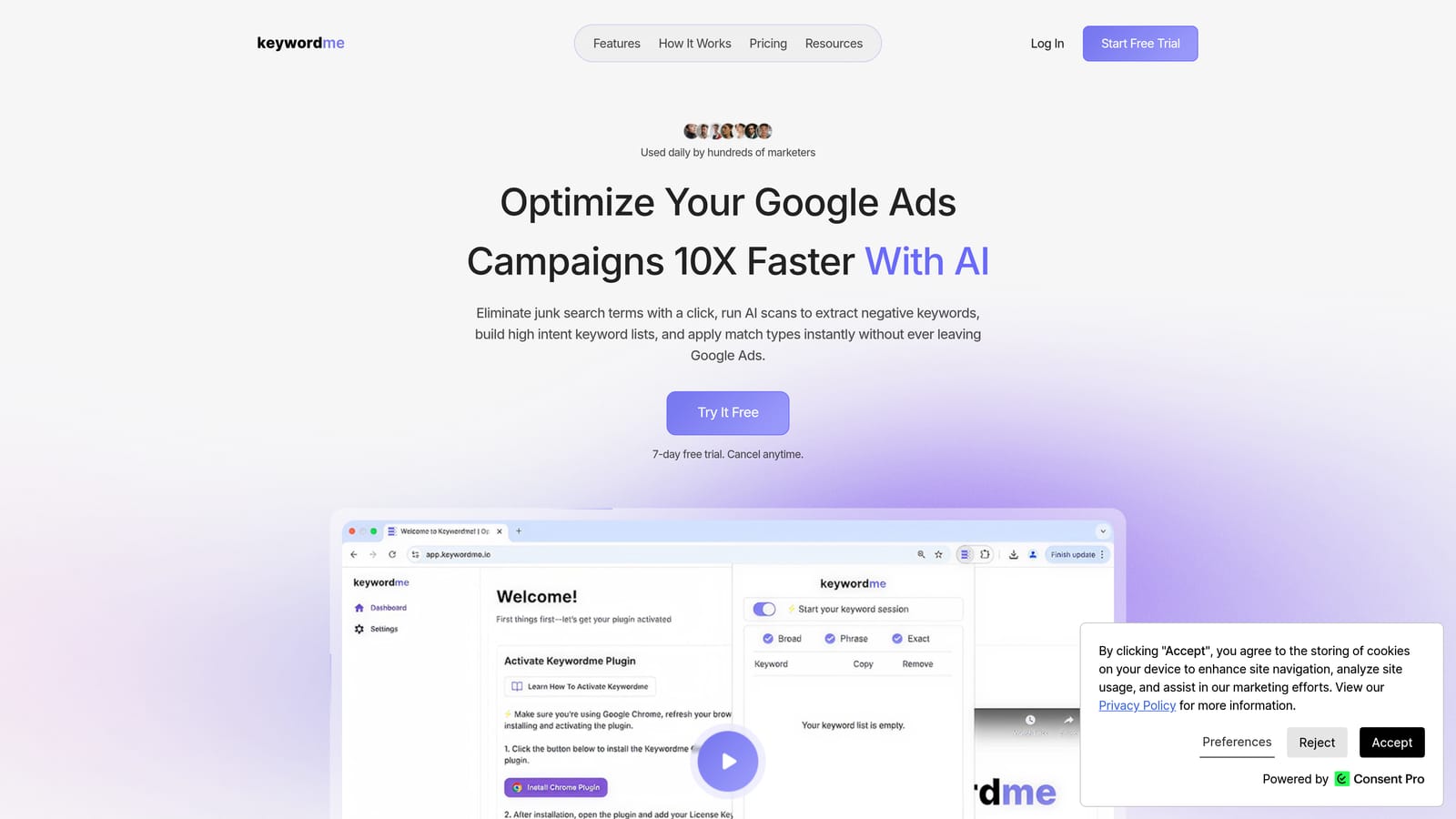
Keywordme is a Chrome extension that plugs directly into the Google Ads Search Terms Report, letting you manage keywords and negatives without ever leaving the native interface.
Where This Tool Shines
In most accounts I audit, the single biggest source of wasted spend is the search terms report—and the reason it doesn't get cleaned up regularly is that the workflow is painful. Export to CSV, open a spreadsheet, tag negatives, re-upload. Keywordme eliminates all of that by letting you take action directly inside Google Ads with a single click.
What makes it genuinely different from most tools on this list is the zero context-switching approach. You're already in your account. You're already looking at the search terms report. Keywordme just makes every action you'd normally do manually instant. For freelancers managing a handful of accounts or agencies running dozens, that adds up fast.
Key Features
One-Click Negative Keyword Additions: Flag and add negative keywords directly in the Search Terms Report without exporting anything.
Instant Match Type Application: Apply broad, phrase, or exact match to keywords in real time, right inside the Google Ads UI.
Keyword Clustering: Group related search terms into ad groups to build tighter, more relevant campaign structure.
Bulk Editing and Multi-Account Support: Handle large volumes of changes across multiple client accounts without switching tabs or tools.
Team Collaboration: Shared account management features make it practical for agency teams working on the same clients.
Best For
Freelancers, solo advertisers, and agency teams who live inside Google Ads and want to cut the time spent on search term hygiene without adopting a whole new platform. Especially useful for anyone managing five or more accounts where manual cleanup is a recurring bottleneck.
Pricing
$12/month per user. A 7-day free trial is available. No per-spend tiers or percentage-of-spend fees—just a flat rate that scales predictably.
2. Optmyzr
Best for: Agencies and in-house teams managing Google and Microsoft Ads at scale with automation rules
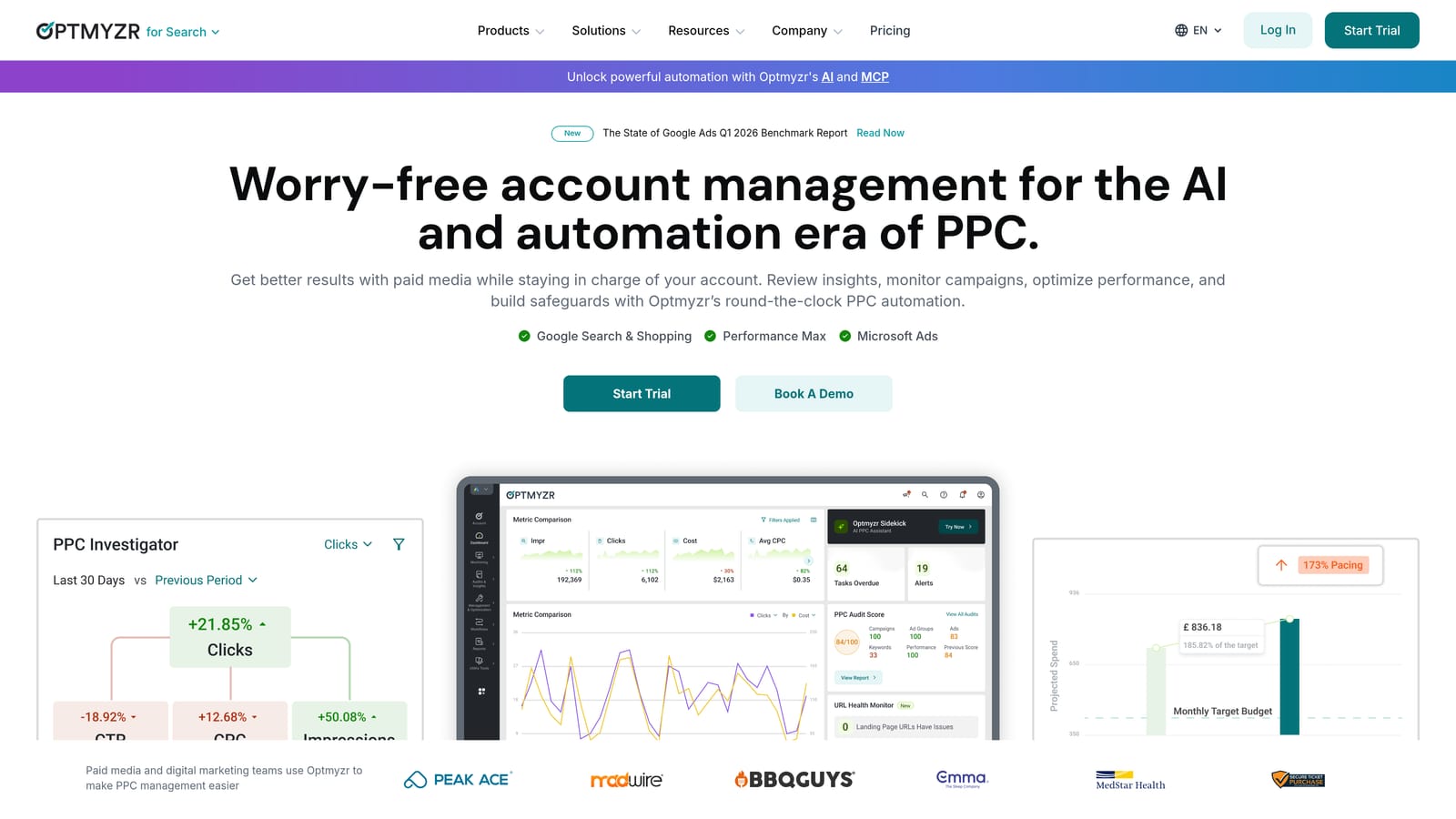
Optmyzr is a rule-based PPC automation platform with deep support for Google Ads and Microsoft Ads management across large account portfolios.
Where This Tool Shines
Optmyzr's Rule Engine is where most agencies get their money's worth. You can set up automated actions—bid adjustments, budget changes, keyword pausing—triggered by performance thresholds, without writing a single script. That's a big deal for teams that want automation without needing a developer.
The PPC Investigator feature is genuinely useful for diagnosing performance drops. Instead of manually digging through layers of data to figure out why conversions fell off this week, the tool surfaces likely causes with supporting data. It's the kind of feature that saves a lot of uncomfortable client calls.
Key Features
Rule Engine: Automate bid, budget, and keyword actions based on custom performance triggers without scripts.
One-Click Optimizations: Surface prioritized recommendations that can be applied with a single click across accounts.
PPC Investigator: Diagnose performance drops by automatically analyzing what changed and when.
Shopping Campaign Management: Feed-based automation and management for Google Shopping campaigns.
Multi-Account Reporting: Consolidated dashboards for reporting across multiple clients or accounts.
Best For
Growing agencies and in-house PPC teams managing multiple accounts who want to automate repetitive optimization tasks without relying on custom scripts. Particularly strong for teams already comfortable with Google Ads who want to scale their workflow.
Pricing
Starts around $208/month based on publicly available pricing—verify current tiers at optmyzr.com, as pricing changes frequently.
3. Search Ads 360 (SA360)
Best for: Enterprise brands running cross-engine paid search campaigns across Google, Microsoft, and beyond
Search Ads 360 is Google's enterprise-grade cross-channel search management platform, built for large organizations managing significant paid search budgets across multiple engines.
Where This Tool Shines
SA360 is the industry standard when you're running campaigns across Google Ads, Microsoft Ads, Yahoo Japan, and Baidu simultaneously and need a single source of truth for attribution and bidding. The Floodlight conversion tracking system gives you unified cross-channel attribution that native platform reporting simply can't replicate.
The automated bidding strategies in SA360 pull in cross-channel signals that individual platform bidding can't see. If you're spending at enterprise scale and need your bidding strategy to account for the full customer journey across engines, this is where SA360 earns its complexity.
Key Features
Cross-Engine Campaign Management: Manage Google Ads, Microsoft Ads, Yahoo Japan, Baidu, and others from a single interface.
Floodlight Conversion Tracking: Unified attribution across channels for accurate cross-engine performance measurement.
Automated Cross-Channel Bidding: Bidding strategies that incorporate signals from multiple engines simultaneously.
Google Marketing Platform Integration: Native connections to Display & Video 360 and Campaign Manager for full-funnel coordination.
Enterprise Reporting and Audience Management: Advanced segmentation, reporting, and audience tools built for large teams.
Best For
Large brands, enterprise in-house teams, and large agencies managing multi-million dollar budgets across multiple search engines. Not the right fit for most SMBs or smaller agencies—the complexity and cost require dedicated resources to justify.
Pricing
Enterprise custom pricing. Requires direct engagement with the Google sales team—there's no self-serve signup or publicly listed rate card.
4. WordStream Advisor
Best for: SMBs and less technical advertisers who want guided weekly optimization recommendations
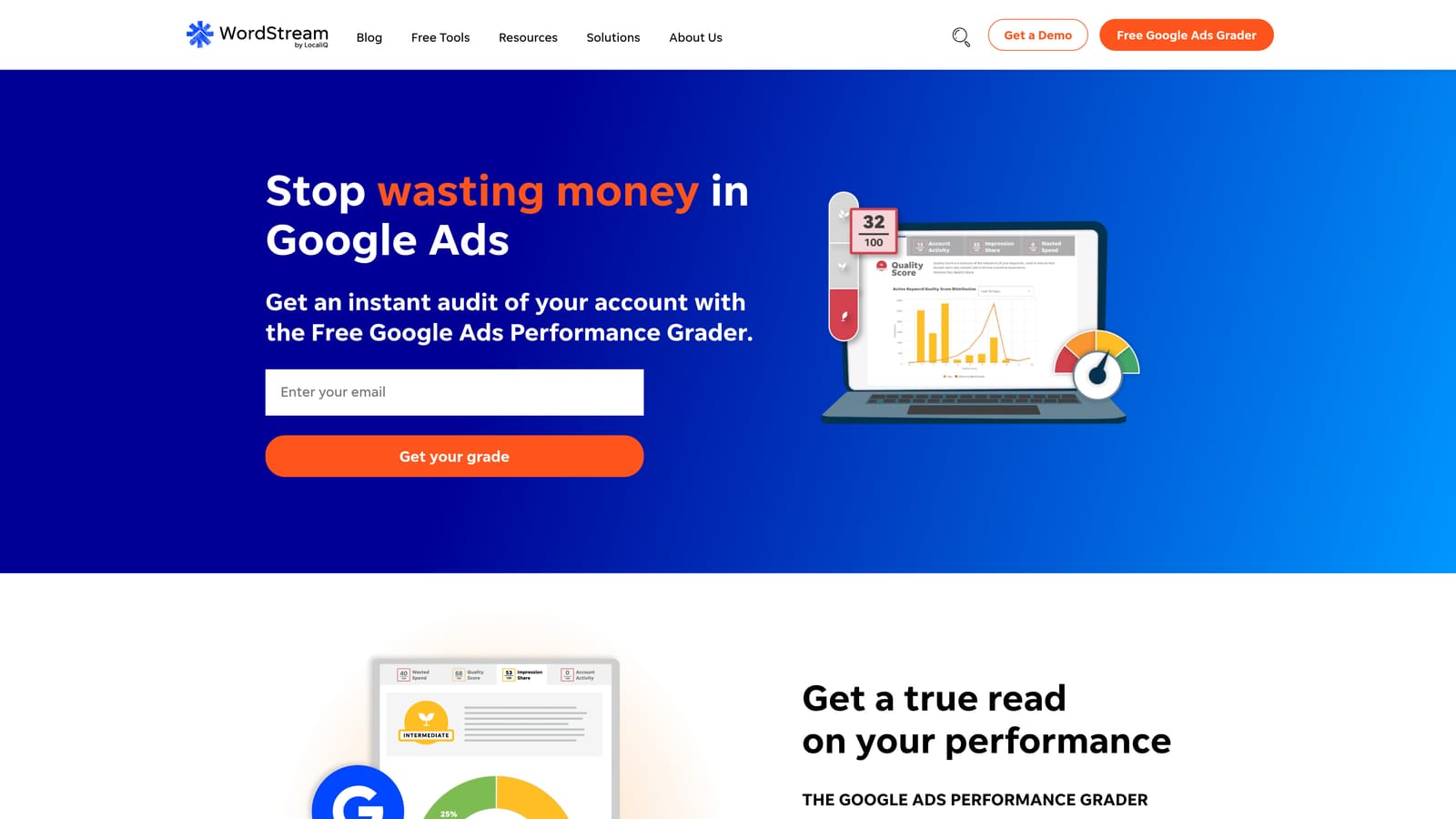
WordStream Advisor is a guided PPC management platform designed to surface the most impactful weekly optimization tasks for Google and Microsoft Ads users.
Where This Tool Shines
WordStream's "20-Minute Work Week" concept is the core value proposition here. The platform analyzes your accounts and tells you exactly what to do each week, prioritized by impact. For business owners managing their own ads without a dedicated PPC background, that kind of guided workflow removes a lot of the guesswork.
The mistake most agencies make is recommending WordStream to sophisticated advertisers who already know what they're doing. It's not built for that. It's built for people who need the platform to tell them what matters—and for that audience, it does the job well.
Key Features
20-Minute Work Week: Prioritized weekly action recommendations based on account performance analysis.
Unified Google and Microsoft Ads Management: Manage both platforms from a single interface without switching accounts.
Performance Grader: Account health scoring tool that benchmarks your account against industry averages.
Keyword and Negative Keyword Tools: Built-in keyword research and negative keyword management features.
Client Reporting Templates: Pre-built reporting formats for communicating results to clients or stakeholders.
Best For
Small business owners managing their own ads, marketing generalists who handle PPC as part of a broader role, and smaller agencies serving SMB clients who need a simplified management experience.
Pricing
Custom/quote-based pricing. Verify current plans and pricing at wordstream.com, as the platform has evolved since its acquisition by LOCALiQ.
5. Adalysis
Best for: Data-driven PPC specialists focused on systematic ad testing and quality score management
Adalysis is a Google Ads and Microsoft Ads optimization platform with a strong focus on automated ad testing, quality score monitoring, and search term analysis.
Where This Tool Shines
If you're serious about ad copy testing—and I mean running structured A/B and multivariate tests with actual statistical discipline rather than just swapping headlines and eyeballing results—Adalysis is one of the few tools that handles this well. The automated testing framework takes the manual tracking out of what's otherwise a tedious process.
The negative keyword conflict detection is a feature most tools skip entirely. What usually happens is advertisers add negatives reactively and eventually create conflicts that block their own ads. Adalysis flags these before they become a problem, which is the kind of proactive alerting that saves real money.
Key Features
Automated Ad Testing Framework: Structured A/B and multivariate testing with automated winner detection and rotation management.
Quality Score Tracking: Historical quality score trend analysis to monitor and improve account health over time.
Search Term Analysis with Conflict Detection: Identifies negative keyword conflicts that may be inadvertently blocking your own ads.
Automated Performance Alerts: Proactive notifications when key metrics move outside expected ranges.
Bulk Ad Creation and Management: Tools for creating and managing large volumes of ads across campaigns efficiently.
Best For
Performance-focused PPC specialists and agencies that run systematic ad testing programs and want deeper quality score and search term analysis than native Google Ads provides.
Pricing
Tiered by ad spend managed, starting around $99/month. Verify current tiers at adalysis.com before committing.
6. PPC Samurai
Best for: Agencies managing large volumes of search terms across multiple SMB client accounts
PPC Samurai is an agency-focused PPC tool that uses AI-driven categorization to automate search term analysis and negative keyword list building at scale.
Where This Tool Shines
PPC Samurai is built for a specific, painful problem: when you're managing 20 or 30 SMB accounts and each one has hundreds of search terms to review every week, manual analysis doesn't scale. The AI categorization engine processes large search term volumes and flags likely negatives automatically, which cuts down review time significantly.
It's not the most well-known tool on this list, but it has a loyal following in agency circles for exactly this reason. The search term overlap detection across campaigns is also worth noting—it catches cross-campaign cannibalization that most advertisers don't even know is happening.
Key Features
AI-Powered Search Term Categorization: Automatically categorizes large volumes of search terms to identify negative keyword candidates.
Automated Negative Keyword List Building: Generates and applies negative keyword lists based on categorization results.
Multi-Client Management Dashboard: Centralized view across all client accounts for agency-scale oversight.
Search Term Overlap Detection: Identifies search terms triggering across multiple campaigns, flagging potential cannibalization.
Bulk Negative Keyword Application: Apply negatives across campaigns and accounts in bulk without manual repetition.
Best For
Agencies managing large numbers of SMB accounts where search term volume makes manual review impractical. Less suited to solo advertisers or accounts with lower search term volume where the AI categorization provides less incremental value.
Pricing
Tiered by number of accounts managed. Verify current pricing at ppcsamurai.com as tiers and rates change.
7. Semrush PPC Toolkit
Best for: Competitive research and keyword planning before and during Google Ads campaigns
Semrush PPC Toolkit is the PPC-specific feature set within the broader Semrush platform, focused on competitive intelligence, keyword research, and ad copy analysis.
Where This Tool Shines
Semrush isn't an in-campaign optimization tool in the traditional sense—it's a research and intelligence layer that makes your campaigns smarter before and during execution. The Advertising Research feature lets you see what keywords competitors are bidding on, what their ad copy looks like, and roughly how their spend is trending. That's genuinely useful context that you can't get from inside Google Ads alone.
Most PPC managers I know use Semrush alongside a dedicated optimization tool rather than as a replacement for one. It fills the competitive intelligence gap that tools like Optmyzr or Keywordme aren't designed to address.
Key Features
Advertising Research: See competitors' keywords, ad copy, and estimated spend trends across paid search.
Keyword Magic Tool: Keyword discovery with CPC estimates, competition levels, and search volume data.
PLA Research: Competitive analysis for Google Shopping campaigns including product listing ad data.
Ad Builder: Draft, organize, and export ad copy before pushing it live in Google Ads.
Keyword Gap Tool: Identify keywords competitors are bidding on that you're missing entirely.
Best For
PPC managers who want competitive intelligence to inform keyword strategy and ad copy decisions. Also useful for agencies that need to benchmark client accounts against competitors as part of onboarding or quarterly reviews.
Pricing
Included in Semrush Pro plan at approximately $139.95/month and above. Verify current plan pricing at semrush.com.
8. Microsoft Advertising Intelligence
Best for: Microsoft Ads users who need free keyword research and bid estimation without a third-party tool
Microsoft Advertising Intelligence is Microsoft's free native keyword research and bid optimization tool, available as an Excel add-in and within the Microsoft Ads platform.
Where This Tool Shines
It's free. That's the starting point. For any advertiser running or considering Microsoft Ads, there's no reason not to use this tool for keyword research and bid landscape data—it pulls directly from Microsoft's own search data, which makes the volume and CPC estimates more accurate for the Bing ecosystem than any third-party tool can offer.
The Excel integration is either a feature or a limitation depending on your workflow. If your team lives in spreadsheets, the add-in is genuinely convenient. If you're trying to move away from spreadsheet-based workflows, it might feel like a step backward.
Key Features
Keyword Research with Native Data: Search volume and bid estimates pulled directly from Microsoft's search ecosystem.
Bid Landscape Data: See how bid changes affect estimated impressions and clicks before committing.
Search Volume Trend Analysis: Historical trend data to identify seasonal patterns in Microsoft Ads.
Keyword Suggestions: Recommendations based on your existing campaign keywords and landing pages.
Direct Microsoft Ads Integration: Data connects directly to your Microsoft Advertising account without third-party authentication.
Best For
Any advertiser running Microsoft Ads who wants accurate keyword and bid data without paying for a separate research tool. Especially useful as a complement to Google-focused tools when expanding campaigns to the Microsoft network.
Pricing
Free for all Microsoft Advertising users. No subscription or additional cost beyond having an active Microsoft Ads account.
9. Acquisio
Best for: Agencies managing large portfolios of SMB clients who need ML-driven bid and budget automation
Acquisio is a machine learning-driven bid and budget management platform built specifically for agencies managing large numbers of SMB client accounts across multiple publishers.
Where This Tool Shines
The core problem Acquisio solves is ML-based bidding for accounts that don't have enough conversion data to make Smart Bidding work well. Most SMB accounts fall into this category—low monthly conversions, limited historical data, and Google's own automated bidding strategies struggling to find a signal. Acquisio's ML engine is specifically designed to operate in this environment.
The automated budget pacing is another standout feature for agencies. Manually tracking budget utilization across 50 SMB clients is a full-time job. Acquisio handles this automatically, which frees account managers to focus on strategy rather than budget babysitting.
Key Features
ML-Based Bid Management: Automated bidding optimized for accounts with limited conversion volume where standard Smart Bidding underperforms.
Automated Budget Pacing: Ensures campaign budgets are utilized efficiently across the month without overspending or underspending.
Cross-Publisher Reporting: Consolidated reporting across Google Ads, Microsoft Ads, and Facebook in a single dashboard.
Client-Facing Dashboards: Reporting views designed for client communication without exposing internal account details.
White-Label Options: Agency resellers can brand the platform under their own name for client-facing use.
Best For
Agencies with large SMB client rosters where automated bid and budget management at scale is the primary need. Not the right fit for single-account advertisers or teams managing a small number of high-spend enterprise clients.
Pricing
Enterprise custom pricing. Contact Acquisio directly for a quote based on your account volume and requirements.
Which Tool Is Right for Your Workflow?
Here's the honest breakdown by use case, because the "best" tool depends entirely on who you are and what's actually slowing you down.
Before committing to any platform, it's worth understanding the full Google Ads management tool cost breakdown so you can compare what each pricing model actually means for your budget.
Freelancers and solo advertisers: Start with Keywordme. At $12/month with a 7-day free trial, it's the lowest-friction way to cut your search term cleanup time significantly. No learning curve, no new dashboard to learn—it works inside the Google Ads interface you already have open.
In-house PPC managers: Keywordme handles day-to-day search term hygiene well. If you're also running a serious ad testing program, pair it with Adalysis for the structured testing framework and quality score monitoring.
Growing agencies (5 to 20 clients): Optmyzr if you want rule-based automation across your full account portfolio. Keywordme if your biggest bottleneck is the search terms report and you want something your whole team can pick up immediately.
Enterprise and multi-engine accounts: SA360 is the industry standard for a reason. The cost and complexity are real, but if you're running cross-engine campaigns at scale, nothing else gives you the same unified attribution and bidding infrastructure.
SMBs managing their own ads: WordStream Advisor's guided recommendations provide the structure that less technical advertisers need to stay on top of account health without deep PPC expertise.
The honest truth is that most PPC platforms try to do everything and end up being clunky at all of it. The tools that stand out in 2026 are the ones that solve a specific, painful part of your workflow really well. For most Google Ads users, that pain point is the search terms report. That's where wasted spend hides, and that's where Keywordme lives.
If you want to see how fast you can clean up a campaign without touching a spreadsheet, Start your free 7-day trial and see what a difference working directly inside Google Ads makes. After that, it's just $12/month.
.svg)