
Semrush vs SpyFu: 2026 Verdict for SEO & PPC Pros
Semrush vs SpyFu: 2026 Verdict for SEO & PPC Pros


You’re likely in the same spot many PPC and SEO people hit sooner or later. One tab has Semrush open. Another has SpyFu. Pricing pages are staring back at you. Reviews all say roughly the same thing, but none of them answer the question: which one makes your day easier?
That’s the only comparison that matters.
If you need broad SEO research, technical visibility, content support, and backlink work in one place, Semrush often pulls ahead. If your main job is digging through competitor ads, spotting paid keyword patterns, and finding PPC angles without paying enterprise-level pricing, SpyFu often makes more sense.
The catch is that semrush vs spyfu is not just a feature fight. It’s a workflow decision. A lot of marketers choose the bigger platform, then realize they still have to do the tedious Google Ads work by hand. Others choose the cheaper platform, then run into limits as soon as SEO or multi-market research enters the picture.
Here’s the practical breakdown.
Choosing Your SEO And PPC Weapon Of Choice
Teams seldom choose between Semrush and SpyFu in a calm, logical vacuum. They choose while a campaign is already running, a client wants answers, and someone needs competitor data before lunch.

The usual setup looks like this:
- The SEO lead wants site audits, backlink analysis, and a keyword database that won’t fall apart outside a narrow local niche.
- The PPC manager wants to see what competitors are bidding on, how their ads changed over time, and where paid search money is leaking.
- The agency owner wants one subscription, fewer tool sprawl problems, and something junior staff can learn without wasting a week.
That’s often where the split starts.
Semrush is the platform people buy when they want one system to cover multiple jobs. SpyFu is the tool people buy when they care most about competitor search intelligence, especially in paid search. Those are different needs, and pretending they’re the same often leads to bad software decisions.
Here’s the short version up front.
| Need | Better Fit |
|---|---|
| Full SEO stack | Semrush |
| Competitor PPC spying | SpyFu |
| Technical SEO work | Semrush |
| Budget-friendly paid search research | SpyFu |
| Broad international research | Semrush |
| Historical ad intel on a tighter budget | SpyFu |
A lot of this comes down to whether you’re buying a marketing suite or a specialist data tool.
If you’re comparing platforms for an agency stack, this roundup of best tools for SEO agencies is worth scanning because it shows where all-in-one suites fit and where specialist tools still win.
One more thing matters more than most comparison posts admit. If your team runs both organic and paid acquisition, the handoff between channels gets messy fast. The bigger strategic picture matters in such situations, and Keywordme’s piece on https://www.keywordme.io/blog/seo-and-paid-search is a useful read if you’re trying to tighten that relationship.
Practical rule: Buy for the job you do every week, not the job the vendor demo makes you imagine doing someday.
A Quick Look At Semrush And SpyFu
Semrush and SpyFu overlap enough to confuse buyers, but their core identity is different.
Semrush feels like an operating system
Semrush is built as a broad digital marketing platform. Its biggest strength is range.
It’s the stronger option when your work crosses several lanes at once, such as:
- Technical SEO
- Backlink research
- Content planning
- Keyword discovery at scale
- Position tracking and broader visibility analysis
The reason a lot of agencies standardize on Semrush is simple. One login can support several teams with different priorities. The SEO specialist, account manager, content lead, and paid media manager can all get something useful from it, even if they don’t use the same modules.
It also handles the kind of work that SpyFu doesn’t try to own. If your process starts with a site audit, moves into link cleanup or opportunity discovery, then rolls into content and tracking, Semrush fits that path naturally.
SpyFu feels like a specialist investigator
SpyFu was built around competitor intelligence. That focus still shows.
Its best use case is not “do everything.” It’s “show me what that competitor has been doing in search, especially paid search, so I can react faster.”
That makes SpyFu attractive for:
- Freelance PPC managers
- Small agencies running Google Ads
- Teams doing head-to-head competitor reviews
- Marketers who care more about ad history than technical SEO
SpyFu’s interface also reflects that narrower mission. It leans hard on tables and direct data views instead of trying to be a polished command center for every marketing function.
Why the distinction matters
A lot of semrush vs spyfu articles flatten the decision into a generic pros-and-cons list. That misses the core issue.
This is less about which tool is “better” in the abstract and more about where the tool sits in your workflow.
If your day starts with domains, audits, link profiles, and content opportunities, Semrush fits. If your day starts with “what are these competitors buying, what did they used to buy, and what am I missing,” SpyFu fits.
Semrush is broader. SpyFu is narrower. That isn’t a weakness by itself. It’s a design choice.
The mistake I see most often is a team buying Semrush for a PPC-heavy role that mainly needs competitive ad intelligence, or buying SpyFu for an SEO program that needs technical and backlink depth. Either tool can look disappointing when it’s used outside its natural lane.
Core Feature Showdown Where It Matters Most
A practical semrush vs spyfu comparison starts with the work itself.
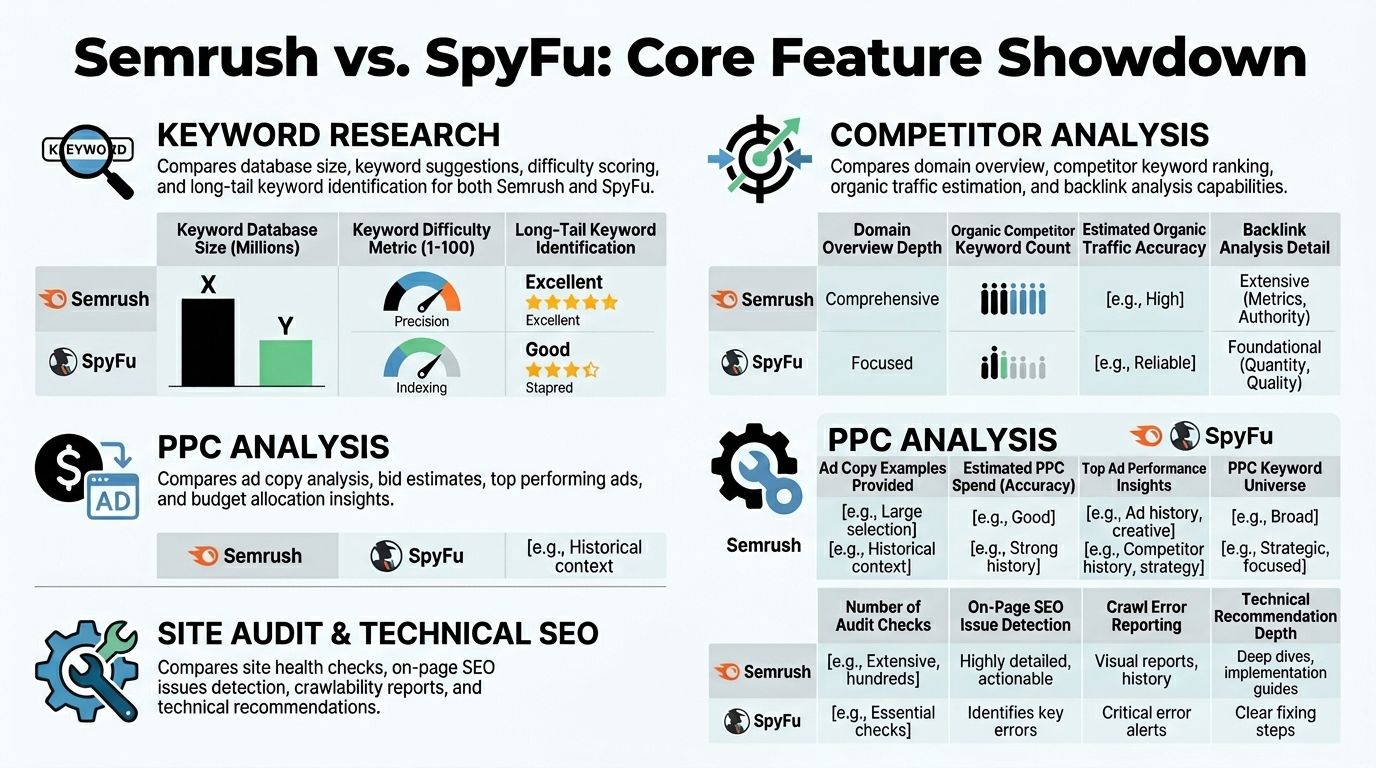
If the job is building an SEO plan, fixing site issues, and judging link quality, Semrush has the stronger toolset. If the job is tracing a competitor’s Google Ads behavior, spotting paid keyword patterns, and checking ad history fast, SpyFu is usually the quicker read.
Keyword research
Semrush is the better pick for broad keyword discovery and SEO planning.
Its database is larger, its filtering is better, and the workflow is built for turning a messy keyword set into a usable content or landing page plan. Robbie Richards’ comparison also points to a wider keyword index and more domain coverage, which lines up with what SEO teams usually see in day-to-day research (source).
SpyFu still has a place here. It just works best when keyword research is tied to ad competition rather than organic strategy. For PPC managers, that matters. You are often less concerned with building a full editorial map and more concerned with finding what competitors are buying, what themes repeat in their ads, and where your account has blind spots.
| Keyword research task | Better tool | Why |
|---|---|---|
| Broad organic expansion | Semrush | Larger index and better filtering |
| SEO planning by intent and SERP pattern | Semrush | Better structure for prioritizing content opportunities |
| Competitor paid keyword discovery | SpyFu | Faster path to ad-focused terms |
| Quick paid search checks by domain | SpyFu | PPC views are more direct |
One caution from practice. Keyword metrics do not match cleanly across tools. Semrush usually applies a stricter lens to SEO difficulty, while SpyFu tends to be more useful for finding commercial patterns around paid search. That means the same term can look easier in SpyFu than it does in Semrush. For SEO budgeting, I would trust the stricter estimate. For ad reconnaissance, I care more about the competitor footprint than the score itself.
Competitor analysis
SpyFu is still the cleaner tool for straight competitor ad research.
Its strength is not presentation. It is recall. You can usually get to paid keywords, ad history, and rival domains with fewer clicks and less setup. That is useful when you are reviewing an account before a client call or trying to explain why auction pressure changed over the last quarter.
Semrush handles competitor analysis from a wider marketing angle. You can connect domain research to organic visibility, content gaps, link signals, and ranking changes in one place. That broader context is useful for account strategy. It is less efficient when the only question is, “What are these advertisers doing in Google Ads right now, and what did they test before?”
That distinction matters because neither tool finishes the actual Google Ads workflow. Both help with research. Neither closes the loop inside the account. A PPC manager still has to turn competitor findings into campaign structure, search term decisions, negatives, and ad updates. If that handoff is a recurring pain point, this breakdown of PPC competitive intelligence workflows gets closer to the operational gap than another generic feature chart.
For PPC competitor work, ad history and keyword pattern visibility usually matter more than polished dashboards.
PPC analysis
In this area, buyers often overrate both platforms.
SpyFu is better for reverse-engineering competitor behavior. You can inspect paid keywords, review older ad copy, and spot categories where a rival keeps spending. For freelancers, small agencies, and in-house teams doing frequent account audits, that is useful immediately.
Semrush is better when PPC research has to sit next to SEO, reporting, and broader market analysis. It gives more surrounding context, and that helps if paid search is only one part of your remit. A growth lead or digital marketing manager will often prefer that wider view.
But there is a workflow gap both tools leave open. Neither one solves the in-platform work inside Google Ads particularly well. They help you research competitors. They do not do much to speed up search query review, account cleanup, negative keyword decisions, or the translation of research into live campaign changes. That is why many PPC practitioners end up using Semrush or SpyFu for intelligence, then relying on a separate plugin or account-side tool to make that research actionable.
Here is the practical split:
- Choose SpyFu if your main task is competitor ad surveillance
- Choose Semrush if PPC research needs to connect with SEO and wider reporting
- Use neither as your full Google Ads workflow tool because both stop short of execution
Backlink analysis and technical SEO
Semrush wins this category without much argument.
It has the backlink data, audit tooling, authority metrics, and site health features that SEO teams need to diagnose problems and prioritize fixes. SpyFu can support SEO research, but it does not replace a technical SEO stack. If your role includes link reviews, crawl issues, toxic backlink checks, or ongoing site monitoring, Semrush is the safer buy.
That also highlights a trade-off in this comparison. SpyFu can be the better PPC research tool for a narrow job and still be the wrong platform for a mixed SEO and PPC role.
Coverage and global flexibility
Semrush is the stronger option for teams working across multiple countries or client markets.
Its market coverage is wider, and that shows up fast when you are checking visibility outside a single core region. SpyFu is more comfortable in narrower search environments where competitor tracking matters more than international depth.
For agencies with a mix of local SEO, national campaigns, and multilingual work, that difference becomes operational, not theoretical.
Ease of use and reporting
SpyFu is easier to learn for one job. Semrush is easier to live in for many jobs.
That is the cleanest way to put it.
SpyFu gets you into competitor data quickly, but the interface can feel table-heavy once the work gets larger or more repetitive. Semrush asks for more ramp-up time, yet it usually holds up better when several teams need the same platform for research, reporting, and SEO operations.
If I were hiring for a PPC-only competitive research role, I could get someone productive in SpyFu quickly. If I were building a shared stack for SEO, paid search, and content, I would take Semrush and accept the extra complexity.
Pricing And Real Value For Your Money
A lot of teams buy the cheaper tool, then spend the savings in hours.
That is the core pricing question in semrush vs spyfu. The monthly fee matters, but the bigger issue is how much extra work the tool creates once campaigns are live, reports are due, and somebody needs answers fast.
SpyFu usually wins the first glance on price. It costs less, and for a freelancer, small PPC shop, or owner-operator who mainly wants competitor ad history and keyword research, that lower entry point is attractive. If the job is narrow, the value can be substantial.
Why SpyFu can be the smarter buy
SpyFu makes the most sense when you have a specific paid search workflow and you do not need much outside it.
That usually looks like this:
- Solo PPC consultants doing account research before audits or pitches
- Small agencies prospecting in competitive niches
- In-house marketers checking ad copy patterns, keyword overlap, and competitor movement
- Budget-conscious teams that do not need technical SEO, content workflows, or backlink operations in the same platform
The price also gets more interesting because historical data matters. If your main use case is reviewing competitor ad patterns over time, SpyFu often feels like better value than paying for a much broader platform you will only partly use.
But there is a catch. Cheap research is still expensive if the workflow stops at research.
SpyFu helps you spot what competitors are doing. It does less to help you turn that insight into cleaner account structure, faster search term review, or better negative keyword decisions inside Google Ads. That gap shows up later, in labor.
Why Semrush earns the higher price for some teams
Semrush costs more because it covers more jobs under one login.
If your team also needs technical SEO checks, backlink work, keyword research across markets, content support, and reporting, the subscription can replace several point tools. In that setup, the higher price is easier to justify because the spend is tied to fewer tool handoffs and fewer reporting workarounds.
That does not automatically make it better value.
A PPC manager who lives inside Google Ads all day can still find Semrush overpriced for the paid workflow. You are paying for a wider marketing stack, not a tighter optimization loop inside the ad account. If half the feature set sits untouched, the premium is wasted.
Budget test: Buy SpyFu if competitor PPC research is the main job. Buy Semrush if one platform needs to support SEO work and cross-functional marketing tasks.
The hidden cost is workflow friction
This is the part buyers miss.
Both tools are good at intelligence. Neither is especially good at closing the gap between research and in-platform execution for Google Ads. You still end up exporting, filtering, validating search terms, and making judgment calls manually. That is where subscription math gets distorted, because staff time is usually more expensive than the software.
For PPC practitioners, that creates a third pricing layer:
| Buyer type | Better value |
|---|---|
| Solo PPC consultant | SpyFu |
| SEO-led agency | Semrush |
| Hybrid SEO/PPC team | Semrush, if the SEO stack gets used |
| Budget-sensitive SMB | SpyFu |
| PPC team focused on Google Ads execution speed | Neither on its own |
That last row matters more than it sounds.
If the primary bottleneck is query cleanup, negative keyword expansion, and turning account data into action quickly, neither Semrush nor SpyFu fully solves the problem. They inform decisions. They do not finish the workflow. That is why a lot of experienced PPC teams end up pairing research software with Keywordme. It fills the Google Ads execution gap both platforms leave open, which makes the total stack more useful than either subscription alone.
The blunt version is simple. SpyFu is cheaper and focused. Semrush is more expensive and broader. Value depends on the work you need done after the research phase ends.
Which Tool Wins For Your Specific Role
The wrong way to choose is asking which platform is “best.” The right way is asking which one matches the work on your desk.
For agencies
Agencies usually need range more than purity.
If your team handles SEO retainers, technical audits, content planning, backlink reporting, and some paid media support, Semrush is often the better fit. It’s stronger as a shared platform across accounts because it supports more than one specialist discipline.
That matters in client work. The account manager wants reporting. The SEO lead wants site and link insight. The strategist wants keyword and market context. Semrush lines up with that environment better than SpyFu.
SpyFu can still be useful inside an agency, but mostly as a tactical PPC intelligence tool. It’s not the platform I’d want to build an SEO-heavy service model around.
For in-house SEO teams
Semrush is the clearer choice.
The reason is not just database size. It’s that in-house SEO work usually touches technical fixes, content planning, stakeholder reporting, and backlink review. You need one place to gather enough evidence to prioritize work internally.
The verified comparisons also point out that Semrush offers the larger global database and broader market support, which matters if your company serves several regions or plans to expand.
If your company only wants to monitor a few close competitors’ ad activity, SpyFu can complement that work. But on its own, it usually will not cover the full in-house SEO brief.
For freelance PPC specialists
For freelance PPC specialists, SpyFu becomes attractive in this scenario.
A freelance PPC manager often cares about a few things above all else:
- who competitors are bidding against
- what ad themes they keep repeating
- which paid keywords appear to matter most
- how to gather this intel without paying for a larger suite
SpyFu’s PPC focus and lower price make it easier to justify. If your business lives inside Google Ads and competitor research is your edge, SpyFu often gives more immediate value than Semrush.
That doesn’t mean Semrush is wrong for PPC freelancers. It means you may be paying for a lot you won’t touch often.
If paid search is your main product, specialized competitor insight usually beats broad feature depth.
For small businesses and lean teams
SpyFu is often the safer starting point.
A small business does not usually need a heavyweight platform on day one. It needs visibility into what nearby or direct competitors are doing in search, a manageable interface, and a bill that doesn’t create buyer’s remorse after the first month.
SpyFu fits that shape better.
The exception is when the business has a serious SEO roadmap from the start. If they’re investing in technical improvements, content production, and long-term organic growth, Semrush becomes easier to justify.
For hybrid SEO and PPC managers
This is the toughest call.
If one person owns both channels, Semrush often wins because the broader toolkit reduces context switching. You can move from keyword research to backlink checks to reporting without opening three more subscriptions.
But if the paid side of the role dominates and competitor ad research is the highest-value activity, SpyFu can still be the smarter choice.
The role-based cheat sheet looks like this:
| Role | Better fit |
|---|---|
| SEO agency | Semrush |
| In-house SEO lead | Semrush |
| Freelance PPC specialist | SpyFu |
| Small business owner | SpyFu to start |
| Hybrid growth marketer | Usually Semrush, sometimes SpyFu |
The practical answer is not glamorous. Semrush wins when the role is broad. SpyFu wins when the role is focused.
The Google Ads Workflow Gap Neither Tool Fills
This is the part most semrush vs spyfu reviews skip, and it’s the part PPC teams feel every day.
You do the research. You find the competitor keywords. You pull ad copy ideas. You spot gaps. Great.
Then you still have to deal with the ugly part of Google Ads execution.

Research is not execution
Neither Semrush nor SpyFu offers automation for cleaning junk search terms or one-click match type application across exact, phrase, and broad, which forces manual workflows that waste an estimated 20-30% of a PPC manager’s time according to the verified data from UseKaya (source).
The primary bottleneck.
Not research. Not dashboards. Not who has the prettier UI.
The primary bottleneck is what happens after the insights leave the tool.
The tedious work both tools leave on your desk
If you manage paid search at scale, this will sound familiar:
- Cleaning search term reports so junk queries don’t keep leaking budget
- Building negative keyword lists without mangling formatting
- Applying match types one by one instead of in a clean bulk flow
- Expanding ad groups from actual search term behavior instead of static exports
- Copying data between tools because export formats don’t match the action you need to take
That friction is why “all-in-one” claims around PPC often feel hollow in life.
The issue isn’t that Semrush and SpyFu lack research depth. The issue is that they stop short of the practical Google Ads work that eats time every week.
The workflow side of that problem is explored more directly here: https://www.keywordme.io/blog/google-ads-workflow-automation
Most PPC inefficiency doesn’t come from bad ideas. It comes from slow implementation.
Why this matters more than another feature checklist
A PPC tool can be excellent at spying on competitors and still fail to make your account cleaner, faster, or easier to manage day to day.
That’s a significant blind spot here.
Semrush gives wider context. SpyFu gives stronger ad spying. But neither one removes the repetitive labor between insight and action inside Google Ads.
If your team keeps saying “we know what to do, we just haven’t had time to implement it,” that’s not a strategy problem. It’s a workflow problem.
Final Verdict So Which One Should You Buy
Buy based on the work you need done this week, not the feature grid.
If your team needs one platform that supports broader search marketing decisions across multiple channels, Semrush is the safer buy. If your day-to-day need is competitor ad research on a tighter budget, SpyFu is easier to justify.
That part is straightforward. The part that usually gets missed is what happens after the research.
A lot of PPC teams do not struggle with finding keyword ideas or competitor ad history. They struggle with turning that research into clean Google Ads actions without wasting hours in exports, reformatting, and manual edits. That is the gap both tools leave open, and it matters more than another round of feature comparisons.
My recommendation is simple:
- Choose Semrush if search research supports a wider SEO and marketing workflow
- Choose SpyFu if competitor PPC intel is the main job
- Add Keywordme if the primary bottleneck is execution inside Google Ads
That last point is what makes this decision more practical. Semrush and SpyFu help you decide what to do. Keywordme helps you do it faster, especially when the work involves search term cleanup, negative keyword handling, match type changes, and bulk account actions.
If you are still comparing the wider market, this guide to SEMrush similar sites and alternatives is useful for seeing how Semrush fits into a broader tool stack.
So which one should you buy? Buy the research tool that matches your role. Then close the workflow gap separately, because neither Semrush nor SpyFu finishes the Google Ads job on its own.
If the manual work after research is what keeps slowing the account down, Keywordme is worth a look. It’s built for the tasks Semrush and SpyFu leave behind, like cleaning junk search terms, applying match types in one click, building negative keyword lists, and handling bulk keyword actions inside a simpler workflow.
.svg)