
PPC Competitive Intelligence: Your Guide to Outsmarting Rivals
PPC Competitive Intelligence: Your Guide to Outsmarting Rivals


PPC competitive intelligence is all about ethically peeking at your rivals' paid advertising campaigns to figure out their game plan. It’s about digging into the keywords they’re bidding on, the promises they’re making in their ads, and where they’re sending all that valuable traffic.
Doing this lets you make smart, data-backed decisions instead of just winging it.
What Is PPC Competitive Intelligence Anyway?
Let's cut right to it. Think of PPC competitive intelligence as your secret playbook for the Google Ads arena. You're not just quickly checking who else shows up when you search your top keywords. You’re putting on your detective hat and piecing together a complete picture of your competitor's entire advertising strategy.
This isn't just "spying." It's a structured way of understanding the battlefield. By seeing what’s working for others—and, just as importantly, what isn't—you can sidestep expensive mistakes and uncover opportunities no one else has noticed. It’s all about knowing their strengths so you can find their weaknesses.
It’s More Than Just Copying
The biggest mistake people make is thinking the goal here is to just copy a competitor. That’s a surefire way to always be one step behind them. The real gold is in understanding the why behind their strategy.
The point of all of this is to outmaneuver your competitors. It turns your PPC efforts from a reactive guessing game into a proactive, strategic operation. You're not just responding to lost rankings or traffic dips; you're finding opportunities early.
At its heart, this process involves a systematic approach to learning from your rivals. That often includes more advanced methods like benchmarking with competitors to get a clear read on their market position and tactics.
To get started, it helps to break down the core elements you'll be investigating. This table shows you exactly what to look for and why it matters.
Key Components of PPC Intelligence at a Glance
By analyzing these components together, you start to see the full picture of their strategy, not just isolated tactics. This is where the real insights are found.
The Strategic Edge It Gives You
Without this kind of intel, you’re basically running your ads with a blindfold on. You might be wasting money on keywords your competitors already know are duds, or you could be completely missing out on high-intent terms they're quietly dominating. A solid analysis puts you firmly back in control.
By diving into their campaigns, you can:
- Discover Untapped Keywords: Find valuable keywords your competitors are using that aren’t even on your radar.
- Refine Your Ad Copy: See what messaging and offers are pulling in clicks and use those insights to write better ads.
- Optimize Your Bidding Strategy: Learn your competitors' schedules and adjust your own to compete more effectively or find cheaper clicks when they're not around.
- Build a Stronger Negative Keyword List: Spot the irrelevant search terms your competitors are accidentally paying for so you can avoid making the same costly mistakes.
Ultimately, this proactive mindset changes how you manage your ad budget. Instead of spreading your money thin and hoping something sticks, you can focus your resources with surgical precision. This is how you stop just reacting to the market and start leading it.
Where to Find Your Competitors' PPC Secrets
So, you're ready to see what your competitors are up to. But where is all this juicy information hiding? It’s not like they're going to hand over their Google Ads login. The good news is, the data is scattered all over the place if you know where to look. Think of this as your treasure map.
The key to smart PPC competitive intelligence is to piece together clues from a few different sources. If you rely on just one tool or method, you're only getting a sliver of the picture. The pros build a more accurate view by pulling data from multiple places and seeing where the stories overlap.
Start With What Google Gives You
Before you even think about paying for a fancy tool, pop the hood on your own Google Ads account. You have a seriously powerful—and free—source of intel right there that most advertisers completely forget about: Auction Insights.
This report shows you, in plain English, who you’re actually up against in the ad auctions. This isn’t theory; it’s real-world data based on your specific keywords, ad groups, and campaigns. It’s your ground zero.
Auction Insights gives you the scoop on rivals with metrics like:
- Impression Share: Out of all the times an ad could have shown, what percentage of the time did yours show up versus theirs?
- Overlap Rate: How often did a competitor’s ad show up in the same search results as yours?
- Position Above Rate: When you both showed up, how often was their ad in a higher spot than yours?
- Top of Page Rate: How frequently did their ad land one of the top-of-page slots?
This is your front-line report from the trenches. If a new name suddenly pops up with a high impression share, that's a massive red flag that they're coming after your turf.
Uncover More With Third-Party Platforms
Auction Insights is an awesome starting point, but third-party tools are where you can really start connecting the dots. These platforms spend a fortune scraping and analyzing search results to estimate what everyone in your space is doing. They're pretty much non-negotiable for a deep dive.
At its heart, this is a special kind of competitor analysis, zeroed in on paid ads. Knowing the basics of how to conduct competitor analysis in general will give you a solid footing for your PPC-specific snooping.
Here are a few of the industry workhorses:
- SpyFu: A goldmine for historical data. SpyFu lets you travel back in time to see a competitor's ad copy and keywords from months or even years ago. This is clutch for spotting trends and seeing how their strategy has changed.
- Semrush: The jack-of-all-trades platform. Semrush delivers solid data on competitor keywords, ad copy, estimated traffic, and ad spend. Their Advertising Research toolkit is a daily driver for countless PPC pros.
- Ahrefs: While famous for its SEO chops, Ahrefs has some killer paid search features. You can see what keywords competitors are bidding on, check out their best-performing ads, and even dissect the landing pages they're driving traffic to.
The goal isn’t just to export a list of their keywords. It’s to analyze which keywords they spend the most on, what messaging they use for different audience segments, and how their ad copy has changed over time.
Good Old-Fashioned Manual Snooping
Never, ever underestimate the power of just acting like a customer. Manual checks are free, and they often reveal subtle details and nuances that automated tools miss. This is how you verify what the data is telling you and get a real feel for the user's journey.
Fire up an Incognito browser window (so your own search history doesn't skew the results) and start searching for your most valuable keywords.
What are you looking for?
- Ad Copy and Extensions: What hooks are they using in their headlines? Are they using sitelinks, price extensions, or callouts to make their ad bigger and more enticing?
- Landing Page Experience: Go ahead and click their ads. Does the landing page actually deliver on the promise from the ad? Does it load quickly? Is it a mess on mobile?
- Search Operators: Get a little crafty with advanced search operators like
site:competitor.com "specific offer"to trigger different ads and see how they've structured their campaigns around certain themes.
When you combine the free data from Google, the big-picture view from third-party tools, and the on-the-ground context from manual snooping, you get a crystal-clear view of your competitors' strategies. To really nail this down, check out our guide on finding your competitor PPC keywords.
Alright, you've got a mountain of data on your competitors. Now for the fun part: figuring out what it all means.
Simply having a list of your rival's keywords and ad examples isn't the goal. That's just the starting line. The real magic of PPC competitive intelligence happens when you start piecing together the story behind the data.
Think of yourself as a scout for a pro sports team, reviewing hours of game film. You're not just counting how many shots the star player takes. You're looking for their signature moves, their tells, and the specific plays their team runs to get them open. That's exactly what we're doing here. This is how raw data becomes a game-winning strategy.
For instance, did a competitor suddenly start spending a ton of money on a new group of keywords? That's not random. It’s a huge tell—they're likely launching a new product or kicking off a big promotion and believe they've found a new goldmine.
Analyzing Ad Creatives and Messaging
Your competitor's ad copy is a direct window into their marketing psyche. It shows you exactly what they think their customers want to hear and what they consider their strongest selling points. Don't just skim their ads; pull them apart piece by piece.
Start by looking for recurring themes. Are they always hammering on one or two key ideas?
- Price-Focused Language: If you see ads plastered with "50% Off," "Lowest Price," or "Clearance," you know their strategy is all about attracting bargain hunters. They're playing the price game, which can be a tough race to the bottom.
- Value-Driven Hooks: On the other hand, messaging like "Built to Last," "24/7 Support," or "Premium Quality" is aimed at a totally different person. They're targeting customers who care more about quality and service than getting the absolute cheapest deal.
- Urgency and Scarcity: Phrases like "Limited Time Offer," "Only 3 Left in Stock," or "Sale Ends Friday" are classic tactics to overcome hesitation. They want people to stop thinking and start clicking, right now.
Pay extra close attention to the ads they run the longest. An ad that’s been running for six months isn’t just sitting there by accident—it’s a proven winner that consistently makes them money. Tools like SpyFu are fantastic for digging into this ad history to see their most trusted creatives.
Deconstructing Their Keyword Choices
A competitor's keyword list reveals who they’re trying to talk to and how they plan on finding them. Are they throwing a wide net or using a very specific kind of bait? This is where you'll uncover the core of their targeting strategy.
Are they bidding on huge, expensive, broad terms like "running shoes"? That's a bold, high-budget play. It tells you they’re chasing brand awareness and trying to capture traffic at the very top of the funnel.
Or are they zeroing in on long-tail, specific phrases like "best waterproof trail running shoes for wide feet"? This is a much more surgical approach. They're targeting people who are way closer to buying, which often leads to a better ROI, even if the traffic volume is lower. If you want a step-by-step guide to this, check out our deep dive on Google Ads competitor analysis.
Evaluating the Landing Page Experience
The ad is just the promise. The landing page is where they have to deliver. If there's a disconnect between the two, you've found a major weakness. Don't just peek at their landing pages—go through the whole experience. Click one of their ads (use an incognito window!) and see what happens.
Landing Page Evaluation Checklist:
- Message Match: Does the landing page headline echo the promise from the ad? If the ad screams "free trial," the words "free trial" better be the first thing you see on the page.
- Call-to-Action (CTA): Is the main button obvious and compelling? Or do you have to hunt for it? A weak or hidden CTA is a missed opportunity.
- User Experience (UX): How does the page feel? Is it painfully slow to load? Does it look like a jumbled mess on your phone? A slow site is a conversion-killer and a golden opportunity for you to provide a faster, slicker experience.
- Conversion Path: How many hoops do they make you jump through to sign up or buy? A long, complicated form creates friction, which is something you can easily streamline on your own site.
By methodically breaking down these three elements—ad copy, keywords, and landing pages—you go from just watching your competitors to truly understanding them. You start to see the entire system they've built, which is how you find their weak spots and discover smart tactics you can borrow for your own campaigns.
Turning Competitive Insights into Winning Campaigns
Alright, so you've gathered a mountain of data on your competitors. Now what? Raw data is just noise until you use it to make your own campaigns better. This is where the real fun begins—translating those juicy tidbits into concrete actions that give you a serious edge in the Google Ads auction.
It’s time to stop just watching and start acting. We're going to take what you've learned about their strategy and use it to sharpen your own. Think of it as turning their ad spend into your education.
This simple framework is all you need to remember. It’s a loop: gather, analyze, and act.
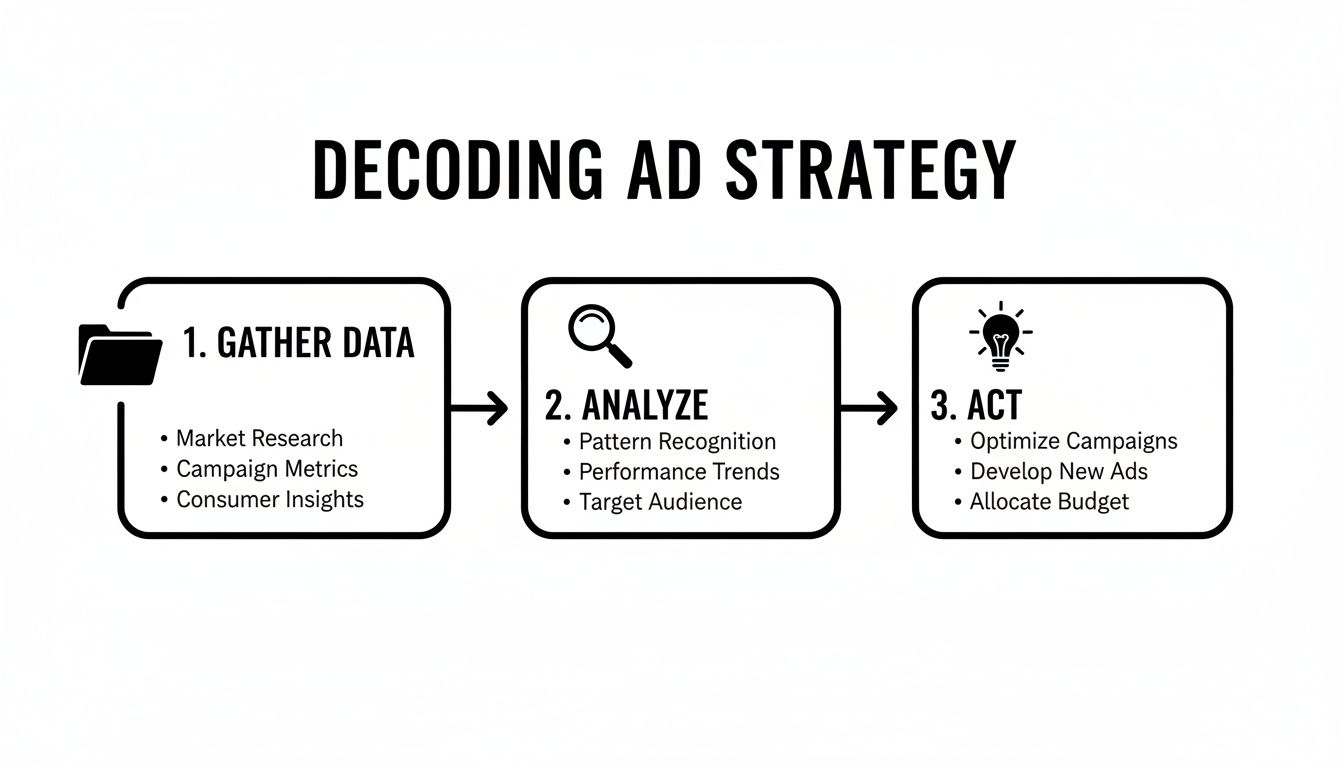
Let's break down exactly how to put this into practice, step-by-step.
Fortify Your Campaigns with Keyword Intel
Your competitors have already spent a small fortune figuring out which keywords actually convert. By peeking at their playbook, you get a massive head start. This intel is gold for two big reasons: finding new opportunities and plugging budget leaks.
First, hunt for keyword gaps. These are the valuable, relevant terms your competitors are bidding on that you've completely missed. Maybe they found a long-tail phrase with killer purchase intent that's not on your radar. Adding these to your ad groups is one of the fastest ways to expand your reach to people who are ready to buy.
Second, use their mistakes to build a rock-solid negative keyword list. Look for irrelevant searches that are probably triggering their ads by accident. If you sell premium leather shoes and see a competitor showing up for "cheap canvas sneakers," you can proactively add "cheap," "canvas," and "sneakers" to your negatives. You just saved yourself from wasting money on the same bad clicks.
Brainstorm Better Ads by Analyzing Theirs
Let me be clear: Never, ever plagiarize a competitor’s ad copy. But you should absolutely study their top-performing ads to figure out what makes your shared audience tick. They've already A/B tested their way to a winning message; you can learn from their homework.
Don't copy their words; decode their psychology. Are they leading with a specific benefit, a powerful emotional trigger, or a logical appeal like free shipping? These are the hooks you can adapt with your own unique brand voice and offers.
For example, if their best ads consistently hammer home "24/7 customer support," it’s a huge clue that your audience craves reliability. You can then brainstorm ways to highlight your own brand's service, maybe by talking up your "dedicated account managers" or "instant chat support."
A tool like Keywordme makes this whole process incredibly fast. Instead of manually digging through search results for hours, you can spot the keywords and ad copy angles that matter and get them organized in just a few minutes.
Optimize Bidding and Scheduling
One of the most overlooked goldmines in competitive analysis is timing. When are your competitors most active, and when do they dial it back? Knowing their ad schedule gives you a powerful lever to pull with your own bids.
Go Head-to-Head: If you see your main rival dominating the search results from 9 AM to 5 PM on weekdays, you know that's their prime time. You can choose to increase your bids during these hours to fight for the most valuable traffic.
Find the Gaps: Or, you can zig when they zag. If their ads seem to vanish after 8 PM or on weekends, that’s your opening! You can swoop in and own the auction, often at a much lower cost-per-click (CPC), capturing searchers when the big spenders are offline.
This isn't about setting your schedule and forgetting it. It's about using competitor data to form a smart hypothesis, testing it out, and then adjusting based on what your own campaign performance tells you.
From Insight to Action: Your PPC Workflow
This simple checklist helps you turn what you find into specific, actionable optimizations for your campaigns.
By consistently turning their patterns into your playbook, you can make every dollar in your ad budget work harder and smarter.
Choosing the Right PPC Intelligence Tools for Your Budget
Trying to pick a PPC competitive intelligence tool can feel a lot like walking onto a car lot. You've got the big, expensive SUVs that do everything, the sleek sports cars built for one purpose, and the reliable daily drivers. It's easy to get overwhelmed.
Here’s the thing: there's no single "best" tool. The best one is the one that fits what you actually need to do and, just as importantly, what you can afford. Let's look at the main players and figure out which one is right for you.
The All-in-One Powerhouses
Some tools are the Swiss Army knives of digital marketing. They pack in features for SEO, content, social media, and of course, PPC. These are the heavy hitters, and they come with a price tag to match.
Semrush: This is the tool most people think of first. Its Advertising Research toolkit is a fantastic starting point for peeking at a competitor's ad spend, top keywords, and ad copy. The real magic of Semrush is its massive database and how easily you can jump from PPC data to a competitor's SEO strategy.
Ahrefs: While Ahrefs built its name in the SEO world with its backlink checker, its paid search features have gotten seriously good. It excels at showing you which keywords your rivals are bidding on and, crucially, which of their landing pages are getting all that paid traffic. If you're already in the Ahrefs ecosystem for SEO, using it for PPC is a no-brainer.
These platforms are incredibly powerful, but they aren't cheap. They make the most sense for agencies and larger marketing teams who will actually use the whole suite of features.
A piece of hard-won advice: Never trust a tool's data blindly. Before you pay a dime, use the free trial to look up your own website and a few top competitors. If the data looks way off for the market you know best, it's probably not the right tool for you.
The Specialized PPC Detectives
Then you have the specialists. These tools don't try to do everything; they focus on doing one thing exceptionally well: PPC analysis. They often deliver a depth of information on ad copy and keyword history that the bigger platforms just can't match.
SpyFu: If you love digging into the history of your competitors' ads, SpyFu is your time machine. Its killer feature is the ability to see a competitor's ad copy and keyword choices from months, or even years, ago. Watching how their ads have changed over time gives you incredible clues about what’s actually converting for them.
It's also much more affordable than the all-in-ones, which is why it's a go-to for so many PPC freelancers and smaller businesses. If you're looking for the right PPC tool to get started with serious competitor analysis, this is often the perfect first step.
Making the Call for Your Budget
So, how do you decide? Let's break it down by who you are and what you need.
Large Agency or In-House Team: You'll probably get the most value out of an all-in-one platform like Semrush or Ahrefs. The ability to manage multiple clients and see the full marketing picture across different channels justifies the cost.
Freelance PPC Pro: Your world revolves around paid search. A specialist tool like SpyFu will give you the best bang for your buck. You get deep-dive data on ads and keywords without paying for a bunch of SEO or social media features you'll never touch.
Small Business Owner: Time and money are your most precious resources. Start with the free Auction Insights report right inside Google Ads. When you're ready for more, a budget-friendly option like SpyFu is a great way to find some quick wins without breaking the bank.
Where a Tool Like Keywordme Fits In
The tools we just covered are for reconnaissance—they're great for figuring out what your competitors are up to. But then you have the much harder job of actually acting on that intel. This is where a different type of tool, a workflow tool like Keywordme, enters the picture.
Keywordme wasn't built to be another research dashboard. Think of it as an execution tool. It's designed to help you take action on the data you've gathered with incredible speed.
So, after you've used SpyFu to find a list of new keywords to target or negatives to add, Keywordme lets you push them into your Google Ads account in a couple of clicks, right from your browser. It closes the gap between finding an insight and putting it to work, turning what used to be hours of tedious spreadsheet work into a one-minute task. When you pair a great research tool with a fast execution tool, you get a complete and brutally efficient PPC intelligence system.
Your Top PPC Intelligence Questions Answered
Alright, so you're digging into the nitty-gritty of competitor research. It's totally normal for a bunch of questions to pop up—it’s a space filled with tons of data, cool tools, and a few gray areas. Let's get them sorted out so you know exactly what you’re doing.
Think of this as the quick, no-fluff FAQ from someone who's been in the trenches.
How Often Should I Actually Be Spying on My Competitors?
Honestly? There's no single magic number. It really comes down to how cutthroat your industry is. But as a rule of thumb, you can break it down into a simple rhythm.
- Weekly Pulse Checks (5-10 minutes): At a minimum, glance at your Google Ads Auction Insights report every week. Is there a new face in the auction? Did a top rival suddenly crank up their impression share? A quick look here will stop you from being caught completely off guard.
- Monthly Deep Dives (1-2 hours): This is when you'll want to fire up a tool like SpyFu or Semrush. Use this time to really look at their ad copy, sniff out any new keywords they're testing, and see if their estimated budget has shifted in a big way.
- Quarterly Strategy Reviews (Half-day): Once a quarter, you need to zoom out. Block off a few hours to see the bigger picture. How has their messaging changed over the last 90 days? Are they pushing a different product line? This is where you connect the dots between their PPC tactics and their larger business goals.
In a super-fast market, like e-commerce during Black Friday, you might be checking things daily. But for a slower B2B niche, that monthly deep dive could be all you need. The trick is to find a consistent cadence that works for you, turning it into a habit instead of a chore.
Is It Ethical to Spy on Competitor Ad Campaigns?
This one comes up a lot. Let's draw a hard line in the sand: analyzing publicly available data is 100% ethical and a standard part of doing business. Everything we’re talking about here—from checking Auction Insights to using tools that analyze public search results—is completely fair game.
You're just looking at what any of your customers could see by typing a search into Google. It's no different than a coffee shop owner walking into the new cafe down the street to check out their menu and prices.
So, where do you cross the line into shady (and illegal) territory?
- Using shady methods like hacking or phishing to sneak into a competitor's ad account.
- Poaching an employee just to get them to spill their old company's campaign secrets.
- Intentionally clicking a competitor’s ads over and over to burn through their budget (this is known as click fraud).
As long as you’re sticking to public data and reputable third-party tools, you're not doing anything wrong. You're just being a smart marketer, not a corporate spy.
What’s the Biggest Mistake People Make with This Data?
Oh, this is an easy one. The single biggest mistake is mindless copy-pasting. You see a competitor bidding aggressively on a keyword and your first instinct is to just jump in and outbid them. This is a fast track to wasting a lot of money.
You have no idea what their numbers look like on the back end. You don't know their conversion rates, their profit margins, or what a customer is actually worth to them.
For all you know, they're losing money on that keyword as part of a bigger play, or maybe it only converts for them because of their brand recognition. If you just copy what they're doing, you're flying blind, adopting a strategy without understanding the why behind it.
Your goal isn't to imitate; it's to interpret. Use competitor data for inspiration. Let it spark ideas for your next A/B test, give you a list of new keywords to try, or offer a benchmark to measure your own performance against. Always, always filter what they're doing through your own business goals.
Can I See My Competitors' Exact Ad Spend?
Nope. Anyone who tells you they can show you the exact, to-the-penny amount a competitor is spending is selling you snake oil. That data is locked up tight inside their private Google Ads account.
What you can get are highly educated estimates from tools like Semrush, SpyFu, and Ahrefs.
Here's a simplified look at how they figure it out:
- They track a keyword's monthly search volume.
- They look at the estimated cost-per-click (CPC) for that keyword.
- They observe how often your competitor's ad shows up for it.
- Then, they multiply all those factors together to get a monthly spend estimate.
The final number isn't going to be perfect. But it's incredibly valuable for understanding the scale and priorities of your competitor's strategy. If a tool shows they're likely spending $20,000 a month on one group of keywords but only $500 on another, that's a massive clue about what they value most. Use these figures for direction, not as absolute facts.
Ready to turn these insights into action without the manual busywork? Keywordme is designed to help you execute your keyword strategy faster. Stop juggling spreadsheets and start optimizing your campaigns in a fraction of the time. Explore Keywordme today and see how quickly you can clean up wasted spend and expand your reach.
.svg)