
Your Guide to PPC Bidding Strategy
Your Guide to PPC Bidding Strategy


At its core, a PPC bidding strategy is your rulebook for spending money on ads. It's how you tell Google, Microsoft, or any other ad platform what you care about most. Are you chasing website traffic? Hunting for sales? Or just trying to get your name out there?
Your answer to that question sets the entire tone for your campaign and decides how the platform bids for you in the never-ending, real-time ad auction.
What Is a PPC Bidding Strategy
Think of it like going to a real-world auction. Some people show up ready to spend whatever it takes to win that one prized item. Others are there to patiently wait and scoop up a bargain. In the world of pay-per-click (PPC) ads, your bidding strategy is that exact same mindset put into action. It’s the set of instructions your campaign uses to decide what a click is really worth to your business.
Without a clear plan, you're basically handing over your credit card and hoping for the best. That’s a fast track to burning through your budget on clicks that go nowhere. A smart strategy, however, makes sure every dollar is pushing you toward a specific, measurable goal. To get the full picture, it helps to see how bidding fits into the wider digital marketing and advertising landscape.
The Core Purpose of a Bidding Strategy
A PPC bidding strategy is the bridge between your marketing budget and your actual business goals. It’s the critical piece that turns abstract objectives like "more leads" into concrete actions in the ad auction. The right strategy keeps you in the game and helps you get what you want without overpaying.
The whole point is to tell the machine how to bid for you. Whether you want maximum visibility, a ton of conversions, or a specific return on every dollar you spend, the bidding strategy is how you give those instructions.
Having a solid strategy is non-negotiable for a few key reasons:
- Budget Optimization: It stops you from wasting money on clicks that don't convert and focuses your spend on the keywords and audiences that actually matter.
- Goal Alignment: It makes sure you're judging success by the right metric. Who cares about a low cost-per-click (CPC) if your cost-per-acquisition (CPA) is through the roof?
- Competitive Edge: It helps you make smarter, data-backed bidding decisions on the fly, which is essential when you're up against tough competition.
Honestly, choosing your PPC bidding strategy is one of the first and most important decisions you'll make. It dictates how your budget gets used and what kind of results you can expect. It’s the difference between gambling on ads and making a calculated investment in growth.
Manual Bidding vs. Automated Bidding
When it comes to your PPC bidding strategy, you face a classic crossroads. Do you want to be in the driver's seat, making every turn yourself? Or are you ready to hand the keys to a powerful AI co-pilot? That’s the real difference between manual and automated bidding.
There’s no magic bullet here. The right choice really hinges on your campaign goals, how long it's been running, and frankly, how much control you want to have. Let's break down this showdown between taking charge and letting the machine learn.
The Case for Manual Bidding
Manual bidding, or Manual CPC, is exactly what it sounds like: you call the shots. You set the absolute maximum you're willing to pay for a click on any given keyword. It’s the ultimate hands-on approach, giving you total, granular control over every penny you spend.
Think of it like being a chef meticulously crafting a signature dish. You control every single ingredient, every temperature, every little detail. This level of precision is gold in certain situations.
You’ll want to stick with manual bidding when:
- You're Launching New Campaigns: With zero performance history, automated strategies are essentially flying blind. Manual bidding lets you get your feet wet, gather that crucial initial data, and set a baseline before an algorithm starts spending your budget based on guesswork.
- Your Budget is Super Tight: If every dollar is accounted for, manual control ensures you never bid more than you’re comfortable with. It’s a great way to prevent an overeager keyword from draining your daily budget unexpectedly.
- You're Protecting Brand Keywords: Your brand name is your fortress, and you need to defend it. Brand bidding is a non-negotiable PPC strategy that can seriously multiply your conversion rates. Manual CPC shines here, letting you maintain the 70-90% impression share needed to keep competitors at bay—something automated strategies can fumble when they're chasing CPA or ROAS targets. If you want to dive deeper, you can learn more about defending your brand with PPC on level.agency.
The biggest catch? It’s a massive time sink. Manually managing bids for hundreds, let alone thousands, of keywords is a monumental task that’s nearly impossible to do effectively at scale.
The Power of Automated Bidding
On the flip side, we have automated bidding, which includes Google’s entire suite of Smart Bidding strategies. This approach unleashes machine learning to tweak your bids in real-time for every single ad auction. The algorithm looks at dozens of signals—like the user's device, location, time of day, and even their browsing history—to figure out how likely they are to convert.
It's like having a team of thousands of analysts working 24/7, making split-second bidding decisions for you. This is the powerhouse option for taking mature campaigns to the next level once you have a good amount of conversion data to feed the machine.
Automated bidding isn’t about giving up control. It’s about shifting your focus from tedious, line-by-line bid changes to high-level strategy. You give the system a goal (like a target cost-per-acquisition), and it does the heavy lifting to get you there.
This type of PPC bidding strategy is your best friend when your main goal is to be efficient at a large scale. It can react to tiny shifts in the market and user behavior way faster than any human ever could.
Choosing Your Driver
So, who should be behind the wheel? It all boils down to your campaign’s specific needs and what you’re trying to achieve. Neither approach is "better"—they're just different tools for different jobs.
Here’s a quick cheat sheet to help you decide:
Most savvy advertisers I know use a hybrid model. They might kick off a new campaign with manual bidding to get a feel for things. Then, once they’re getting a steady stream of at least 15-30 conversions a month, they’ll flip the switch to an automated strategy to really open up the throttle.
A Look at the Different Smart Bidding Types
Once you decide to let Google's machine learning take the wheel, you're stepping into the world of Smart Bidding. This isn't just one strategy; it's a whole toolkit of automated options, each built to chase a different business goal. Think of it less like a single autopilot button and more like a dashboard with different modes for "economy," "sport," and "off-road."
The shift to automated bidding has truly changed the game for PPC managers. In fact, 62% of Google Ads pros now lean on it to do the heavy lifting. Strategies like Maximize Conversions have become the default choice for many, dominating over 70% of automated setups. But you can't just flip a switch on day one—you need to feed the machine good data first. Most experts suggest starting a new campaign with a manual approach until you're getting at least 30 conversions a month. For more on this, Defined Digital Academy has some great insights on common bidding mistakes.
Let's break down the most common Smart Bidding types so you know exactly which button to push and when.
Maximize Conversions
This one does exactly what it says on the tin. You tell Google, "Get me as many conversions as you can within my daily budget," and the algorithm gets to work. It will bid aggressively for clicks it thinks will convert and pull back on those that won't, all while trying to spend your full daily cap.
It's like telling a salesperson: "Just close as many deals as possible today. Don't worry about the cost of each one, just bring in the volume."
- Best For: Lead gen campaigns where every lead has roughly the same value (like a contact form fill or an e-book download). If your main goal is sheer volume, this is your strategy.
- Heads Up: Your cost-per-acquisition (CPA) can get a little wild here. The algorithm is gunning for quantity, not efficiency, so keep a close eye on your costs.
Target CPA (Cost Per Acquisition)
Target CPA takes the "get me leads" mission of Maximize Conversions and adds a much-needed financial guardrail. Here, you tell Google not just to get you conversions, but to get them at or below a specific price. You set your ideal cost for a new lead, and the algorithm does its best to average out at that number.
This is like telling your salesperson: "Close as many deals as you can, but you can't spend more than $50 to land each new customer."
Target CPA is a game-changer for anyone who knows exactly what a lead is worth to their business. It brings a level of predictability to your lead gen costs that makes budgeting so much easier.
Below is an example from Google showing where this setting lives in the platform.
This screenshot shows exactly where you punch in your target cost, making it the central control for this bidding strategy.
Target ROAS (Return On Ad Spend)
For any e-commerce business where one customer might spend $20 and the next might spend $2,000, Target ROAS is your best friend. Instead of focusing on the cost of a conversion, it hones in on the revenue it brings in. You set a target return for every dollar you put into ads.
For example, a Target ROAS of 500% tells Google you want to make $5 in revenue for every $1 you spend.
It's like telling your sales team: "I don't care how much you spend to close a deal, as long as you bring in at least five times that amount in revenue."
- Best For: E-commerce stores or any business with variable transaction values. When maximizing total revenue is the top priority, this is the way to go.
- Heads Up: This strategy is hungry for data. It needs a solid history of conversion values to work its magic. Without it, the algorithm is just guessing in the dark.
Maximize Conversion Value
This is the sibling to Maximize Conversions, but it's focused on money, not volume. The goal here isn't to get the most conversions; it's to get the most valuable ones your budget can buy. It will gladly ignore five users likely to make $50 purchases to chase the one user who might make a $500 purchase.
This is like telling your salesperson: "Forget the small fry. Spend all your energy chasing the whales who will bring in the most cash today."
This is a core pillar of a modern PPC bidding strategy, especially as more businesses shift from counting leads to measuring actual revenue. To really get this right, you should check out our guide on how to properly implement value-based bidding.
Enhanced CPC (eCPC)
Think of Enhanced CPC as the perfect bridge between manual and fully automated bidding. You still set your own keyword bids, but you give Google permission to nudge those bids up or down based on whether it thinks a click is more or less likely to convert.
It's like telling your salesperson: "Stick to the prices I gave you, but I trust your gut. If you get a really good feeling about a lead, you have my permission to offer a small discount to get the deal done."
- Best For: Advertisers who want to keep some control but still want to tap into Google's real-time signals. It's a fantastic stepping stone into the world of Smart Bidding.
How to Choose The Right Bidding Strategy
Picking the right PPC bidding strategy is a lot like being a chef choosing the right knife. You wouldn't use a meat cleaver for fine dicing, would you? The best strategy always comes down to what you’re trying to accomplish, how much you have to spend, and critically, how much performance data you've got in your back pocket.
Let’s be clear: there is no single "best" option that works for everyone. A brand-new company just trying to get its name out there has totally different needs than a veteran e-commerce store with years of sales data. The secret is aligning your bidding strategy with your actual business objectives right from the start.
This decision tree is a great visual shortcut for mapping your goals—like chasing more leads or getting a better return—to the right bidding approach.
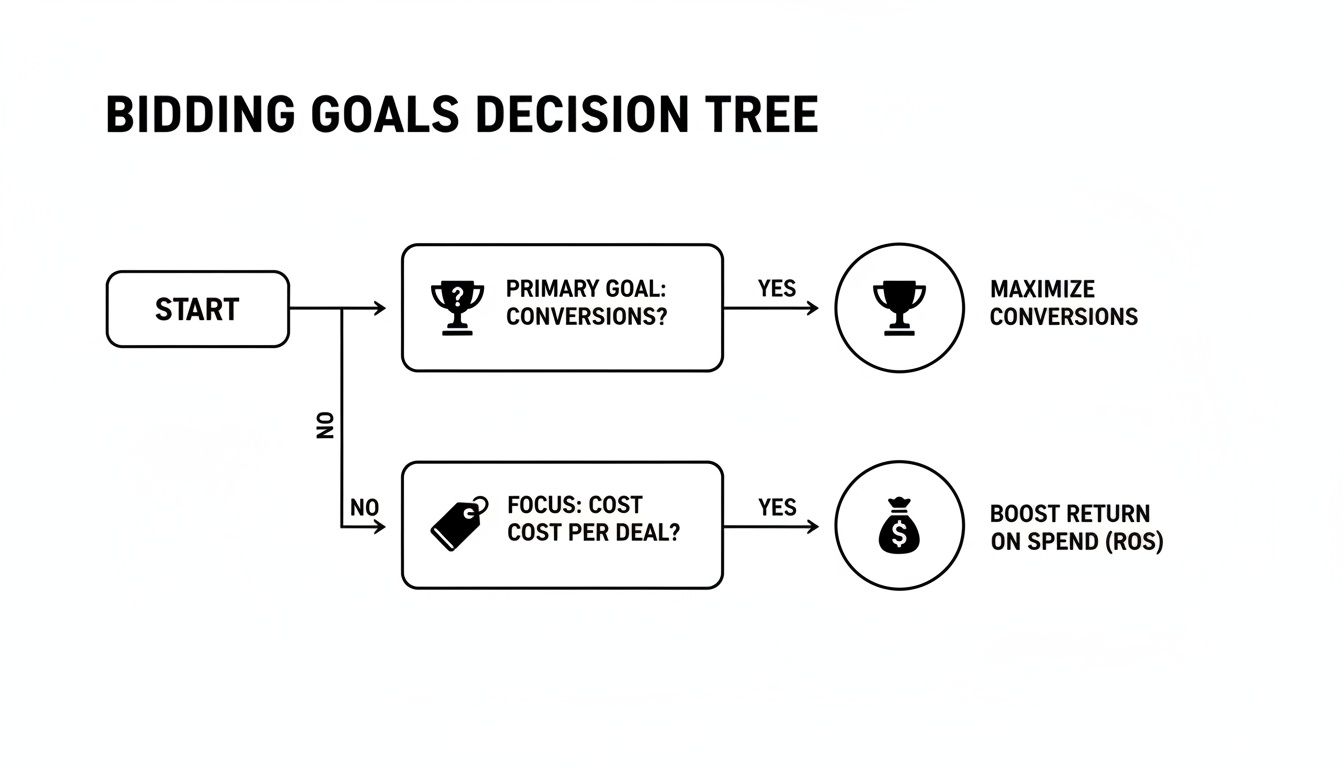
Ultimately, what "success" looks like for your business should be your north star, guiding you to the most logical way to bid.
Matching Goals to Strategies
Let's walk through a few common situations. This should help you connect the dots between your business goals and the perfect bidding strategy.
Scenario 1: You're a New Business Focused on Awareness
Your mission, should you choose to accept it, is to get as many relevant eyeballs on your site as possible. Conversions can wait; right now, it’s all about traffic and visibility.
- Your Go-To Bids: Maximize Clicks or Manual CPC.
- Why They Work: Maximize Clicks is purpose-built to get you the most visitors for your daily budget. Manual CPC, on the other hand, gives you that old-school, hands-on control, letting you set a hard cap on what you’ll pay per click while you gather that crucial early data.
Scenario 2: You're a Mature E-commerce Store
You’ve been around the block. You have tons of sales history, and you know a $1,000 order is a whole lot better than a $10 one. You're not just hunting for sales; you're hunting for profitable sales.
- Your Go-To Bid: Target ROAS (Return On Ad Spend).
- Why It Works: This strategy thinks in terms of revenue, not just the number of conversions. It digs into your past sales data to bid more aggressively for people who look like they're about to make a high-value purchase. Every ad dollar is put to work maximizing your return.
Scenarios for Lead Gen and Service Businesses
The right tool for the job also depends on your business model. What works for an online shop won't be the best fit for a SaaS company trying to book demos.
Scenario 3: You're a SaaS or Lead Generation Business
Your entire world revolves around getting a steady flow of qualified leads—demo requests, contact forms, you name it. You have a number in your head for what a lead is worth, and you need to hit it consistently.
- Your Go-To Bid: Target CPA (Cost Per Acquisition).
- Why It Works: Target CPA focuses squarely on getting as many leads as possible while keeping your cost-per-lead pinned to a specific target. It makes your acquisition costs predictable, which is pure gold when you're trying to scale.
Scenario 4: You're a Local Service Business
You just need the phone to ring and the appointment calendar to fill up. Your budget might be tight, so every single lead is precious.
- Your Go-To Bids: Maximize Conversions or Enhanced CPC.
- Why They Work: Maximize Conversions will go all out to get you the most calls or form fills possible within your budget. Enhanced CPC is the perfect middle ground; you still set your manual bids, but you give Google a bit of freedom to increase them for clicks that look like they're about to convert.
The rule of thumb is simple: The more data you have, the more sophisticated you can get. No conversion data? Start with traffic-focused bids. Got tons of rich, value-based conversion data? Go for ROAS.
Choosing the right PPC bidding strategy is a huge first step, but it’s only half the battle. It's just as important to make sure you're applying these powerful strategies to the right keywords. For a much deeper dive into that side of the equation, check out our guide on the art of bidding for keywords. Getting this alignment right is how you ensure your high-level strategy and your on-the-ground tactics are working together perfectly.
Measuring Success and When to Change Your Strategy
Alright, you’ve picked your PPC bidding strategy and your campaigns are live. Now for the moment of truth: figuring out if it’s actually working. Success in PPC isn't about racking up a mountain of clicks. It's about getting the right clicks that turn into actual business.
This is where you have to look past the vanity metrics. The real story of your bidding strategy is told through KPIs like Cost Per Acquisition (CPA), Return On Ad Spend (ROAS), and your Conversion Rate. These are the numbers that tell you if you're actually making money.
Setting Realistic Benchmarks
Before you can measure success, you have to define what it looks like. A classic mistake is plucking a target CPA or ROAS goal out of thin air. Your benchmarks need to be rooted in reality—specifically, your own historical data. If your account has been humming along at a $50 CPA, suddenly telling Google you want a $20 CPA is just setting yourself up for failure.
Patience is a superpower in PPC, especially when you're dealing with Smart Bidding. Whenever you switch up your strategy, Google’s algorithm kicks into a "learning period." This can last a week or two, and performance can get a little wild. Don't hit the panic button. Just let the machine do its thing.
The absolute worst thing you can do is flip-flop between bidding strategies every few days. You're just hitting the reset button on the learning phase over and over, starving the algorithm of the stable data it needs to actually optimize. Give it some breathing room.
Knowing When It’s Time to Pivot
So, when do you make a change? You're looking for consistent, negative trends after that initial learning period is over. Being able to spot these signals is what separates a good PPC bidding strategy from a great one.
Here are a few red flags that scream it’s time to rethink things:
- Skyrocketing CPA: If your Cost Per Acquisition is climbing week after week and shows no sign of coming back down to earth, your strategy might be too aggressive for your budget.
- Tanking ROAS: Is your Return On Ad Spend in a nosedive? This is a huge warning sign, especially for e-commerce, because it means you're making less money for every dollar you spend.
- Plummeting Conversion Rates: If you're getting more clicks but fewer conversions, the algorithm might be chasing the wrong crowd. This is why having your conversion tracking locked down is non-negotiable. If you need a refresher, you can learn more about setting up Google Ads conversion tracking in our detailed guide.
Recent data really drives this point home. The average cost per lead across all industries has creeped up to $70.11, which is a 5.13% jump from last year. It’s a clear signal that chasing cheap clicks is a dead end; you have to focus on strategies that deliver real value. To keep getting better, it helps to understand the details of mastering Amazon PPC strategy and interpreting experiment results. As a rule of thumb, when you do make an adjustment, base your new targets on at least four weeks of solid historical data. This gives the algorithm a stable foundation to build on. Discover more insights about these PPC benchmarks on WordStream.
How Keywordme Makes Your Bidding Strategy Smarter
Your chosen PPC bidding strategy is incredibly powerful, but it has a massive blind spot. It's only as good as the data you feed it. If you’re letting Google's AI bid on junk search terms, you're just automating wasted ad spend. This is where a tool like Keywordme becomes your ace in the hole.
Think of Smart Bidding as a high-performance race car engine. It's built for speed and efficiency. But if you pour dirty, low-grade fuel into the tank, that engine is going to sputter and fail.
Keywordme acts like a high-tech fuel filter, making sure only premium, high-octane data gets to your bidding algorithm. It works hand-in-hand with whatever strategy you choose—from Target CPA to Maximize Conversions—to make it smarter and way more effective.
Stop Automating Wasted Spend
Let's say you’re running a campaign with "Maximize Conversions." The algorithm is dutifully trying to find users likely to convert. But without proper keyword hygiene, it might be bidding on terms like "free accounting software template" when what you actually sell is premium accounting software. You get the clicks, but they're never going to become customers.
This is exactly the problem Keywordme solves. While Google's AI is busy figuring out the bids, our tool is in the background, automatically identifying and adding those irrelevant search terms as negatives.
Your bidding strategy decides how much to bid. Keywordme ensures it's only bidding on the right terms in the first place. This partnership is the key to maximizing your ROI.
Instead of just automating your bids, you start automating your optimization. It’s a simple shift in thinking that forces the algorithm to focus its firepower only on the high-intent queries that actually drive business.
A Faster Path to Better Results
Manually digging through search term reports is a soul-crushing process that can eat up hours every single week. With Keywordme, you can get the same—or better—results in a tiny fraction of the time.
Here's how that looks in the real world:
- Open the Plugin: Forget exporting messy spreadsheets. You just open the Keywordme Chrome plugin right inside your Google Ads account.
- One-Click Cleanup: You’ll instantly see all your search terms. With a single click, you can add words like "free" or "template" to your negative keyword list across the entire account. Done.
- Find Hidden Gems: At the same time, you might spot a golden nugget like "accounting software for small construction firms." With another click, you can add it as a new exact match keyword to the perfect ad group.
This entire workflow takes just a few minutes, not a few hours. By constantly feeding your campaigns clean data and relevant keywords, you speed up the algorithm's learning phase and make it much more efficient. The end result is a PPC bidding strategy that not only performs better but gets there up to 10x faster.
Got Questions About PPC Bidding? Let's Clear Things Up.
Still trying to figure out which PPC bidding strategy is the right fit? Don't worry, you're in good company. Let’s walk through some of the questions I hear all the time from other marketers.
How Long Until a New Bidding Strategy Actually Starts Working?
This is where you need to be patient. When you switch on a new Smart Bidding strategy, Google's algorithm kicks off a "learning period." Think of it like a new employee getting the lay of the land.
This phase usually takes about one to two weeks. Performance might look a little wild during this time, but that's normal. The system is just gathering the data it needs to start making smart moves. My advice? Hands off. Let the machine do its thing.
What If I Don't Have Much Conversion Data?
Starting out with little to no conversion history is a classic chicken-and-egg problem. If your account has fewer than 15-30 conversions over the last 30 days, jumping straight into something like Target CPA or Target ROAS is a recipe for disaster. They just won't have enough data to work with.
So, what do you do? You start with a strategy built for data collection.
- Maximize Clicks: The name says it all. Your goal is just to get as many people to your site as your budget allows. This is the fastest way to rack up clicks and, with any luck, your first few conversions.
- Manual CPC: This puts you in the driver's seat. You can set conservative bids, get a feel for what works, and gather that precious performance data without blowing your budget.
Once you have a solid foundation of conversions, then you can confidently switch over to a more sophisticated, automated strategy.
Why Are My Automated Bids So Incredibly High Sometimes?
It can be a bit of a shock to see Google bid way more for a single click than you ever would. But believe it or not, this is often Smart Bidding working exactly as designed. The algorithm isn’t just looking at the keyword; it’s crunching dozens of signals in real-time—things like the user’s device, their location, and what they’ve been searching for.
When Google places a high bid, it's because its calculations show an incredibly high chance that this specific click will turn into a conversion. It's making a data-backed investment on your behalf, seeing patterns that are invisible to the naked eye.
Basically, the system is happy to pay a premium for what it sees as a "sure thing" to make sure you hit your overall CPA or ROAS goal. As long as your main goals are being met, you have to trust the process. Those expensive clicks are usually balanced out by tons of much cheaper ones, all averaging out to hit your target.
A killer PPC bidding strategy is only as good as the keywords it's built on. Are you tired of junk search terms eating your budget and messing with your automated bidding? Keywordme is built to fix that. It cleans up your campaigns, builds negative keyword lists for you, and uncovers keywords you've been missing. It makes any bidding strategy work smarter. Try Keywordme free for 7 days and see for yourself.
.svg)