
Bidding for Keywords to Maximize Your Ad Spend
Bidding for Keywords to Maximize Your Ad Spend


When you bid on a keyword in Google Ads, you’re basically telling Google the most you’re willing to pay for someone to click your ad. This number, your maximum cost-per-click (CPC) bid, is the cornerstone of any pay-per-click (PPC) campaign. Get it right, and you get a great return. Get it wrong, and you’re just throwing money away.
Why Your Bidding Strategy Can Make Or Break Your Ads
Let's be honest—bidding on keywords can feel like you're just feeding a slot machine and hoping for a jackpot. But what if you could stop gambling and start strategizing? A smart bidding approach is what separates the campaigns that drain your budget from the ones that actually dominate your market.
This isn't just about setting a number and forgetting it. It’s about making sure your bids are directly tied to what you want to achieve. Are you just trying to get your name out there, or are you laser-focused on making sales? Each goal requires a totally different playbook.
The High Stakes of Keyword Bidding
The competition out there is no joke, and it's only getting tougher. The global digital ad market is exploding, with spending projected to hit a staggering $740.3 billion in 2024. In that crowded arena, 84% of brands are seeing positive results from PPC, which tells you one thing: it works, but only if you do it right.
And here’s a crucial piece of the puzzle: your bid is a huge factor in Google’s ad auction, but it’s not the only one. The relevance of your ad and your Quality Score are just as important in determining if you even show up and what you ultimately pay.
Your bid strategy is your financial game plan. It dictates how you compete, how much you spend, and ultimately, whether your campaigns generate a positive return or become a costly experiment. A weak strategy leads to wasted spend on irrelevant clicks, while a strong one connects you with high-intent customers at the perfect moment.
Connecting Bids to Business Goals
A killer campaign always starts with knowing your "why." Before you even think about bid amounts, you have to be crystal clear on what a win actually looks like for your business.
Here’s how different goals change your bidding approach:
- Brand Awareness: If you just want to get more eyeballs on your brand, you’ll probably focus on maximizing impressions. Your bidding strategy would aim to get your ad in front of as many people as possible, even if they don't click every single time.
- Website Traffic: Need to drive more visitors to your site? Then your focus shifts to maximizing clicks. You’re telling Google, "Get me as many clicks as you can for my budget."
- Lead Generation/Sales: This is where things get more sophisticated. When you’re chasing conversions—like someone filling out a form or buying a product—you'll use strategies geared toward getting the lowest possible cost per acquisition (CPA).
To understand the bigger picture of where bidding fits in, this guide on What is Search Engine Marketing (SEM) is a great place to start. Nailing down the "why" before we get into the "how" is the first step to building a truly profitable campaign.
Choosing Your Bidding Approach: Manual vs. Automated
When it comes to bidding, you're faced with a classic PPC dilemma. Do you take the wheel yourself with manual bidding, controlling every move? Or do you let Google's AI take over with an automated Smart Bidding strategy?
Honestly, there’s no single "correct" answer here. The best path forward really depends on your campaign goals, how much budget you're working with, and, frankly, how much time you can realistically spend digging around in your ad account. It’s less about which is "better" and more about which is better for you right now.
Taking Control with Manual Bidding
Manual CPC (Cost-Per-Click) is exactly what it sounds like. You tell Google the absolute maximum you're willing to pay for a click on your ad. This approach gives you total, granular control, which is a massive advantage for new campaigns with little to no performance history.
You can start small, get a feel for the landscape, and see what works without torching your budget. It’s a hands-on method, perfect for advertisers who want to understand the nuts and bolts of their account and make precise adjustments based on their own observations and expertise.
Manual bidding is your best friend when you're flying blind. For a brand-new product launch or a test campaign, it lets you set a low, conservative bid, see what kind of traffic comes in, and slowly increase your investment as you prove the concept. You prevent the algorithm from spending wildly before it knows what a good conversion looks like.
That kind of control is powerful, but it's also a time sink. You're the one responsible for checking performance and tweaking bids for individual keywords and ad groups. If you're going this route, our guide to effective PPC bid management is a great resource to have bookmarked.
Letting the Algorithm Drive with Smart Bidding
On the flip side, you have automated "Smart" Bidding. These strategies lean on Google's machine learning to optimize for your specific goals—like conversions or conversion value—in every single ad auction. This is what Google calls "auction-time bidding."
It's a game-changer because the algorithm can process thousands of signals in a split second to decide how likely a user is to convert, adjusting the bid on the fly.
This flowchart is a great way to visualize which bidding strategy aligns with your core business objective.
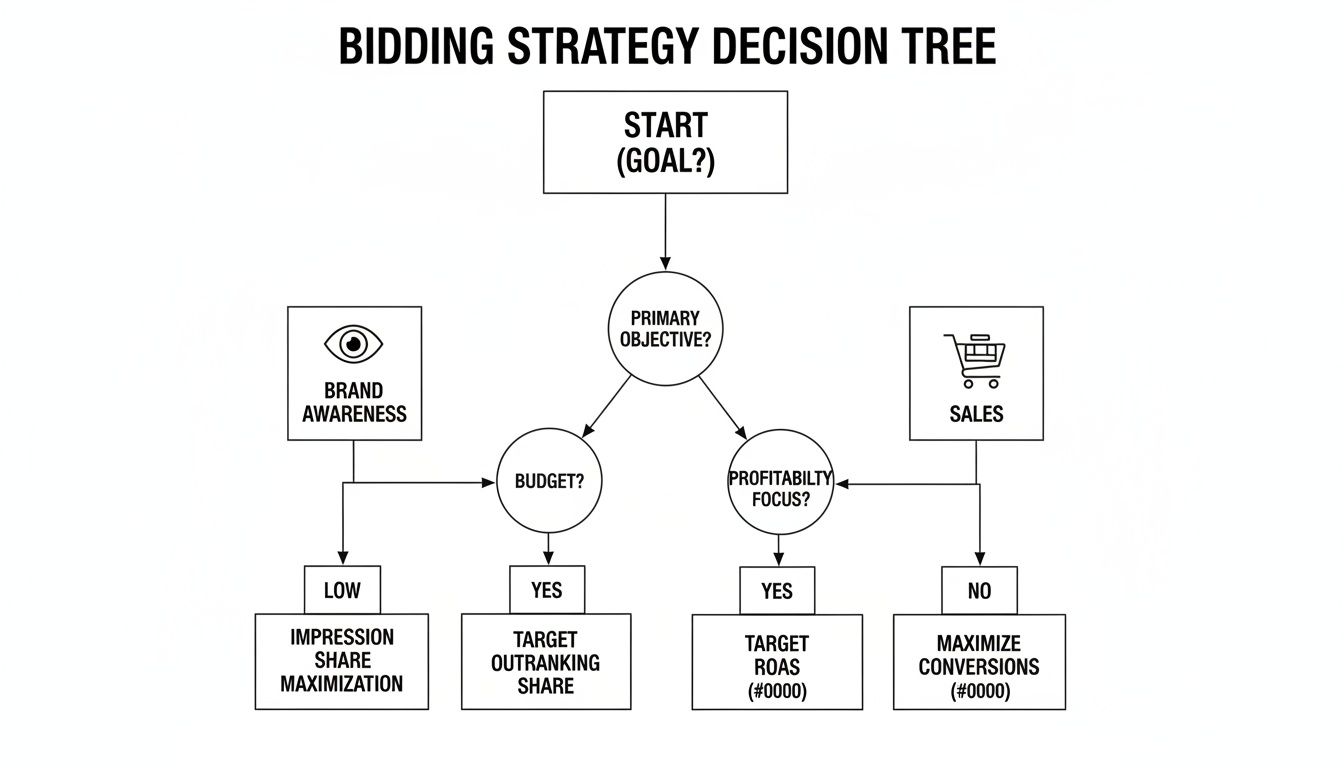
As you can see, if you just want to get your name out there, impression-focused strategies are the way to go. But if you’re chasing sales, conversion-based automation is where the real power lies.
Smart Bidding strategies like Target CPA (Cost-Per-Acquisition) or Maximize Conversions can save you a mountain of time. They’re designed to find pockets of high-value traffic you might completely miss on your own.
The catch? These algorithms are hungry for data. You need a solid history of conversions in your account before Google's AI can make genuinely "smart" decisions. Without enough data, it’s like a powerful engine with no fuel—it won't get you very far and can feel like a black box that just eats your budget.
Manual Bidding vs Smart Bidding Showdown
Still on the fence? This quick-glance comparison can help you decide which approach is the right fit for your campaign's needs, resources, and goals.
Ultimately, many seasoned advertisers use a hybrid approach. You might start a new campaign on Manual CPC to gather data and establish a baseline, then switch to a Smart Bidding strategy once you have enough conversion volume to feed the machine. There's no shame in changing your strategy as your account matures.
How to Set Your First Bids Without Flying Blind
Alright, you've picked a bidding strategy. Now for the million-dollar question: how much should you actually bid? This is where the rubber really meets the road in PPC.
If you bid too high, you’ll torch your budget on clicks that don't convert. But if you bid too low, your ads will be stuck on page 10, invisible to everyone. Let's walk through a practical way to set those first bids without just guessing.

The goal on day one isn't perfection. It's about making an educated guess—a bid that's competitive enough to get you some initial data but conservative enough to keep you from blowing your budget while the algorithm figures things out.
Use Google’s Tools to Get a Baseline
Before you pull a number out of thin air, lean on the data. Your best friend here is Google’s Keyword Planner.
Pop your target keywords into the planner, and it'll spit out a suggested bid range for both top-of-page and first-position placements. This isn't a magic number, but it’s an invaluable clue into what your competitors are currently paying to play.
Here's how to interpret the numbers it gives you:
- Low Range: This is pretty much the minimum you'll have to bid just to get your ad to show up on the first page, even if it's at the very bottom.
- High Range: This is a ballpark for what it takes to compete for those coveted top ad spots.
For a brand-new campaign, I almost always recommend starting somewhere between the low and middle of that suggested range. This strategy gets your foot in the door without immediately jumping into a costly bidding war. You can always dial up your bids later once you see which keywords are actually driving results.
Match Types Should Dictate Your Bids
Not all keywords are created equal, and your bidding should absolutely reflect that. A keyword's match type—Broad, Phrase, or Exact—is a powerful signal of user intent, and that should directly influence how much you're willing to pay for a click.
A tiered bidding approach based on match type is a smart, time-tested strategy.
- Exact Match
[running shoes for men]: This is your golden-ticket traffic. The searcher knows exactly what they want. You should feel confident bidding your highest on these terms because their conversion potential is through the roof. - Phrase Match
"blue running shoes": The user is getting specific, but there's still a little wiggle room in their search. I usually set a moderate bid here, a little lower than my exact match bids. - Broad Match
running shoes: This casts the widest net, catching all sorts of related (and sometimes unrelated) searches. Because the intent is so much lower and less predictable, you should assign your lowest bids to these keywords. It's a way to explore without paying a premium for irrelevant clicks.
This tiered structure acts as a built-in financial safeguard. It naturally channels your ad spend toward the keywords most likely to convert, while letting you dip your toes into broader terms with much less risk.
The "Start Small" Method I Swear By
When you're launching a fresh campaign, the last thing you want is an aggressive automated strategy to burn through your entire daily budget in an hour on junk traffic. Trust me, I've seen it happen.
Instead, I always suggest starting with a small, tightly controlled budget using a Manual CPC strategy. Kick things off with just $25-$50 per day. This forces you to be hyper-selective and gives the campaign enough runway to collect meaningful click and conversion data without breaking the bank.
After a week or two, you’ll have actual performance metrics to work with. That's when you can make an informed decision—whether it's raising bids on your winning keywords, culling the losers, or finally switching over to an automated strategy with real data to guide it.
Using Data to Outsmart Your Competition
Bidding on keywords isn't a solo sport. You're constantly up against other players, and what they're doing directly impacts your results. They're a goldmine of strategic data, but you have to know where to dig. Forget trying to simply outspend them—the real wins come from outsmarting them.

The trick is to treat competitive analysis as a living, breathing part of your bidding strategy, not a one-and-done task. If you keep a close eye on the auction landscape, you'll start to spot opportunities, anticipate their next move, and make adjustments that give you a serious edge.
Uncovering Insights in Google Ads
Your first stop for competitive intel is baked right into your Google Ads account: the Auction Insights report. This thing is invaluable. It shows you exactly who you're bumping shoulders with for your most important keywords. It's not just a list of domains; it's a scorecard.
This report reveals critical metrics that show how you really stack up against everyone else in the same auctions.
- Impression Share: This tells you what percentage of the time your ad showed up versus how often it could have. If a competitor has a way higher impression share, they’re probably bidding more aggressively or just have deeper pockets.
- Overlap Rate: This is how often another advertiser's ad was on the same search results page as yours. A high overlap rate means you're in a direct dogfight for that search term.
- Position Above Rate: When both you and a competitor showed up, this metric reveals how often their ad was ranked higher than yours. It’s a pretty blunt indicator of who’s winning the top spots.
This isn't just data for the sake of data. It helps you understand the competitive pressure on your money-making keywords. If you're consistently getting outranked on a high-value term (a low "position above rate"), it might be time to bump up your bid or get serious about improving your Quality Score.
Spotting Your Competitors' Weaknesses
Smart bidding means finding the gaps your competition leaves open. One of the most common weak spots? A limited daily budget. Ever notice a big competitor seems to vanish from the search results late in the afternoon?
That's a classic sign their daily budget has tapped out. This is your moment. Using ad scheduling, you can strategically crank up your bids when your competitors are forced to sit on the sidelines. You get to swoop in and grab high-value traffic with way less competition, often at a lower cost-per-click.
Another area to poke around is their keyword targeting. Are they only focused on the big, obvious head terms and ignoring valuable long-tail keywords? Those super-specific, multi-word phrases often have lower competition and much higher conversion rates because the user’s intent is crystal clear.
A savvy advertiser doesn't just throw money at the obvious high-volume keywords. They find the profitable little niches their competitors have overlooked, turning less expensive, high-intent searches into a steady stream of conversions.
This is where tactical analysis pays off big time. You can apply similar logic when exploring value based bidding strategies, which take this a step further by bidding more for users who are likely to become your most valuable customers.
Fine-Tuning Your Bids for Maximum ROI
Alright, so you’ve got your initial bids set. Don't pop the champagne just yet—that was the easy part. Where the real magic happens in paid search is in the constant, obsessive tweaking that follows. This isn't a "set it and forget it" game. It's more like tuning a high-performance engine.
Think of it this way: your first bids get the engine started. But to win the race, you have to be in the pit, making tiny adjustments based on performance data. That data is your feedback loop, telling you exactly where to find more power and efficiency.
Let The Right Metrics Be Your Guide
If you're only looking at clicks and impressions, you're flying blind. Sure, they tell you people are seeing your ads, but they don't say a thing about whether you're actually making money. To really understand what's working, you need to zero in on the metrics that are tied directly to your business goals.
There are two numbers I live and die by in my accounts:
- Cost Per Lead (CPL) or Cost Per Acquisition (CPA): This is your north star. It's the bottom-line cost for every new lead or sale you generate. If your CPA starts creeping up, it’s a big, flashing neon sign telling you something’s off—your bids might be too aggressive for the return you're getting.
- Conversion Rate (CVR): This little percentage tells you how many of your clicks are actually turning into something valuable. A dipping CVR can mean a lot of things. Maybe your bids are attracting window shoppers instead of serious buyers, or maybe your landing page isn't sealing the deal.
Context is everything here. According to industry benchmarks from WordStream, the average CPL across all industries is $70.11, and the average CVR is 7.52%. But those are just averages. The Animals & Pets industry boasts a 13.07% CVR, while Apparel sits at a much lower 3.99%. Knowing where you stand helps you set targets that are ambitious but achievable.
Your Secret Weapon: Bid Adjustments
Bid adjustments are one of the most powerful tools in your arsenal. They let you get incredibly granular, telling Google precisely how much more (or less) a specific type of click is worth to you, all without blowing up your whole campaign structure.
You can layer these adjustments based on all sorts of data:
- Device: Seeing way more sales from desktop users? You could apply a -20% bid adjustment for mobile searches to focus your budget where it performs best.
- Location: For a local plumber, a click from someone a mile away is probably worth more than a click from across the state. You can bid more aggressively for users in specific zip codes or within a certain radius of your shop.
- Time of Day: If you’re a B2B company and you know your best leads come in during work hours, why spend a ton of money at 2 a.m.? Schedule your bids to be higher from 9 to 5 on weekdays and pull back on weekends.
A quick note on Quality Score: think of it as a direct multiplier for your ROI. When Google sees that your ads, keywords, and landing pages are all tightly aligned and relevant, it rewards you. A higher Quality Score gets you better ad placements for less money. Seriously, improving it is one of the most profitable things you can do in your account.
Got Questions About Keyword Bidding?
Even after you've been in the PPC game for a while, a few questions always seem to pop up. The landscape is always shifting, so it's smart to stay curious. Let's clear the air on a couple of the most common head-scratchers when it comes to keyword bidding.
Should I Really Bid on My Own Brand Name?
This is probably the number one debate I see, and my answer is always a hard yes. Bidding on your own branded keywords isn't just a good idea; it's a critical part of a solid PPC strategy, playing both defense and offense.
On defense, you're building a wall around your most valuable digital real estate. If you don't bid on your brand name, I guarantee a competitor will. Picture a hot lead searching for you by name, only to see your rival's ad sitting at the very top of the page. That’s a customer you just handed over.
Offensively, it gives you total control over the user experience. Your organic listing is great, but you can't always control the snippet Google shows. With a paid ad, you dictate the message and send that user to a hyper-specific landing page—maybe one promoting a flash sale or a new product feature.
Think of branded campaigns as your strategic armor. They almost always have a ridiculously low Cost-Per-Acquisition (CPA) and sky-high Quality Scores because the user intent is a perfect match. It’s a cheap way to dominate your own search results and reinforce your authority.
So, How Much of My Budget Should I Actually Spend on Bids?
Ah, the classic "it depends" question. But let's get more specific than that. There's no universal magic number, but your budget allocation should be a direct reflection of your business goals.
What are you trying to achieve?
- Driving Sales or Leads? You’ll need to invest more heavily here. Your budget should favor high-intent keywords that scream "I'm ready to buy," like "emergency plumber near me" or "[your product] pricing."
- Building Brand Awareness? You can get away with a smaller slice of the pie, targeting broader, top-of-funnel terms just to get your name out there and introduce yourself to new audiences.
As a practical starting point, I often advise clients to put 70-80% of their budget toward their core, bottom-of-funnel campaigns—the ones you know already work. Use the other 20-30% to experiment with new keywords, test different audiences, or try out a new Smart Bidding strategy. This keeps the engine running while giving you room to innovate.
Ready to take the guesswork out of your keyword management? Keywordme offers a powerful, all-in-one tool to clean up search terms, find high-converting keywords, and optimize your campaigns up to 10x faster. Stop wasting ad spend and start driving better results.
.svg)