
A Practical Guide to PPC Bid Management
A Practical Guide to PPC Bid Management


PPC bid management is all about setting and tweaking how much you’re willing to pay for a click on your ads. It's the strategic heart of your campaign—get it right, and you can drive sales or leads without burning through your entire budget.
What Is PPC Bid Management Anyway?
Think of the pay-per-click (PPC) world like a massive, lightning-fast digital auction. Every single time someone searches for one of your keywords, an auction kicks off behind the scenes to decide which ads get shown. Your bid is your ticket to get into that auction and a huge part of whether you win a good spot.
But PPC bid management is so much more than just throwing money at keywords and hoping for the best. It's the art and science of figuring out exactly what a single click is worth to your business. The real trick is finding that sweet spot where you're bidding enough to stay competitive but not so much that you're eating into your profits.
The Core Goal of Bidding
At the end of the day, winning the top ad spot isn't the real goal. The main objective is to maximize your return on investment (ROI). Nailing this is what separates a campaign that profitably grows your business from one that just becomes a money pit.
To really get the full picture, it helps to understand what's involved in PPC management as a whole. Your bids are directly connected to everything else you're trying to achieve.
Think of your bidding strategy as the financial thermostat for your ad account. It’s always making small adjustments to keep things at the perfect temperature—balancing how often your ads are seen with how much you're spending to hit your goals.
This whole process is so critical that a massive market has popped up around it. The global market for PPC bid management tools was valued at around $2.17 billion in 2023 and is expected to explode to $5.8 billion by 2032. That kind of growth tells you just how seriously businesses are taking efficient bidding these days.
Ultimately, your approach to PPC bid management will make or break your campaigns. It directly impacts:
- Visibility: How often your ads show up and where they land on the results page.
- Traffic Volume: The number of people actually clicking through to your website.
- Cost-Effectiveness: What you pay for each click and, more importantly, for each conversion.
- Overall Profitability: The final return you see for every single dollar you spend.
Manual Bidding vs Automated Bidding
When it comes to managing your PPC bids, you're at a crossroads: do you take the wheel yourself, or do you let a sophisticated AI be your co-pilot? This is the classic showdown of manual versus automated bidding.
One isn't inherently "better" than the other. The real key is knowing when to use each. It’s about matching the right approach to your campaign's goals, your budget, and frankly, how much time you have to spare.
The Case For Manual Bidding
With manual bidding, you are in complete command. You personally set the maximum cost-per-click (CPC) you’re willing to pay for every single keyword or ad group. Want to bid $2.50 on one term and $1.75 on another? No problem. The power is all yours.
This hands-on control is a lifesaver in a few key situations:
- New or Small Campaigns: When you're just starting out or working with a tiny budget, manual bidding is perfect. It lets you learn the auction dynamics and see exactly where every penny is going without any algorithmic surprises.
- Highly Specific Goals: Got a brand keyword you absolutely must defend? Or a super-niche term you need to dominate? Manual control lets you set aggressive, precise bids that an algorithm might overlook.
- When Data is Scarce: Automated strategies are hungry for data. If you don't have enough conversion history, the algorithm is just guessing. Manual bidding is your best friend until you’ve collected enough performance data.
The big drawback? It’s a ton of work. As your account grows, trying to manage hundreds or thousands of individual bids becomes a full-time job. You'll inevitably miss out on the split-second auction opportunities that an algorithm can catch.
The Power of Automated Bidding
This is where automated bidding steps in. Think of it as a machine-learning engine that adjusts your bids in real-time for every single auction. It looks at a dizzying array of signals—the user’s device, their location, the time of day, their search history—to predict how likely they are to convert and bids accordingly.
Since the mid-2010s, automation has completely reshaped PPC. Smart Bidding strategies like Target CPA (Cost Per Acquisition) and Target ROAS (Return on Ad Spend) are now the norm, not the exception. In fact, over half of all businesses now use some form of AI-powered tools for their campaigns, a trend that continues to grow according to recent PPC industry reports.
Instead of just bidding for clicks, you tell the platform your desired outcome. For example, you can tell Google Ads, "I want new customers for no more than $30 each," and its Target CPA strategy will work tirelessly to hit that goal.
Automated bidding is like having a team of data analysts working for you 24/7. It crunches numbers and makes adjustments faster than any human ever could, freeing you up to think about the bigger picture.
This approach is a game-changer for larger accounts with a healthy amount of conversion data. But it's not a "set it and forget it" magic button. You still need to watch it closely to make sure the AI’s goals are aligned with your actual business goals. For some campaigns, you might even need to get more sophisticated by layering on business data, which you can learn about in our guide to understanding value-based bidding.
Manual vs Automated Bidding At A Glance
Choosing between the two really boils down to balancing hands-on control with operational efficiency. Sometimes you need the precision of a scalpel, and other times you need the power of a sledgehammer.
This table breaks down the core differences to help you decide which is right for your campaign right now.
Ultimately, the smartest advertisers often use a hybrid model.
They'll kick off a new campaign with manual CPC to get a feel for the landscape and gather initial performance data. Once they have a solid baseline—typically 15-30 conversions within a 30-day period—they’ll flip the switch to an automated strategy to scale up and drive efficiency.
Creating Your Bidding Workflow
It’s one thing to have a great bidding strategy on paper, but actually putting it into practice day in and day out is a totally different ballgame. Smart PPC bid management isn't about nervously tweaking bids every five minutes. It’s about building a repeatable workflow—a system that turns random guesswork into a reliable engine for growth.
Think of yourself as a pilot. You don't just hop into the cockpit, cross your fingers, and take off. You run through a pre-flight checklist, keep an eye on the instruments, and make calculated adjustments to stay on course. Your bidding workflow is your PPC checklist, keeping you on track to hit your targets.
Start with a Solid Foundation
Every good workflow is built on solid ground, and in PPC, that means research and structure. Skipping this part is like building a house on a sandy beach; it’s just not going to last.
- Deep Keyword Research: This is absolutely non-negotiable. The keywords you target are the bedrock of your entire bidding process. Tools like Keywordme are perfect for this, helping you find high-intent terms, see how many people are searching for them, and get a feel for what they’ll cost. This data is the raw material for every decision you make.
- Logical Campaign & Ad Group Structure: Please, don't just chuck all your keywords into one giant campaign. Group them into tight, thematically-related ad groups. For instance, if you sell shoes, you should have separate ad groups for "men's running shoes," "women's hiking boots," and "kids' school sneakers." This simple act of organization lets you be way more precise with your bids, which almost always gives your Quality Score and efficiency a nice little boost right from the start.
Setting Your Initial Bids
Okay, your account is neatly organized. Now it’s time to place your first bets. This isn’t a wild guess; it’s about making an educated move to get into the auction and start collecting data without torching your budget on day one.
A good starting bid is your entry ticket to the data game. You're not trying to win every auction immediately; you're trying to buy enough data to learn how to win profitably later on.
To set a smart baseline, go back to the data from your keyword research. Most tools will give you an estimated bid to get on the first page or to the top of the page. Aim for somewhere in that ballpark. It’s aggressive enough to start getting impressions but conservative enough that you won’t overpay before you have any real performance data to work with.
This flow chart gives you a great visual on how the process looks for both manual and automated approaches.
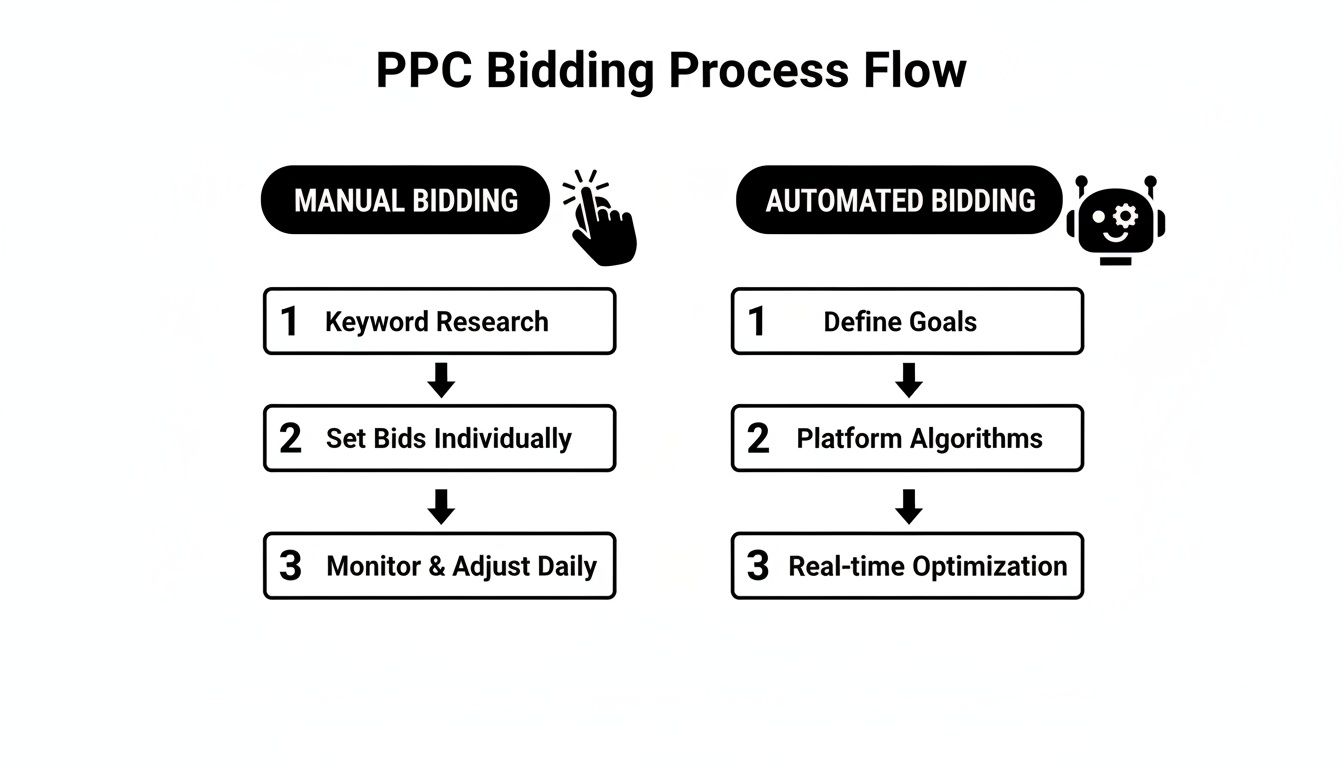
As you can see, both paths kick off with goals and research. They just split when it comes to execution—one relies on you to analyze the data and make the calls, while the other hands the keys over to an algorithm.
Establishing a Rhythm for Monitoring and Adjusting
Your workflow needs a steady, consistent rhythm. Checking your account ten times a day will make you reactive and emotional, while never checking it is a surefire way to waste money. The sweet spot is a sustainable cadence for monitoring and making changes.
Here’s a schedule that works for most people:
- Daily Check-ins (5-10 Minutes): Think of this as a quick health check. You're just looking for big, scary red flags—did spending suddenly skyrocket? Did a campaign stop running? Is there a massive drop in impressions? Don't make any big bid changes here. Just make sure the plane is still in the air.
- Weekly Analysis (30-60 Minutes): This is where you roll up your sleeves. Dig into the past week’s metrics. Figure out which keywords are actually making you money and which are just burning a hole in your pocket. This is when you’ll adjust your manual bids or check in on your automated strategies to see if they’re hitting their CPA or ROAS targets.
- Monthly Strategic Review (1-2 Hours): Time to zoom out. Look at the big picture. How is your overall strategy lining up with your actual business goals? Is it time to test out a new bidding strategy? Are there new campaigns or keywords you should be exploring?
This kind of structured approach keeps you from overreacting to the normal, everyday ups and downs. PPC performance is never a straight line, and one of the most common mistakes is making huge changes based on one bad day.
As you get comfortable with this workflow, you can start thinking about how new ad formats might play a role. For example, exploring how to create more authentic ads can really boost performance. There are some fantastic resources on leveraging AI for UGC ads that can give your campaigns an extra edge. By sticking to a solid workflow, your PPC bid management becomes a proactive, data-driven process that keeps you moving toward your goals.
Tracking the Right Performance Metrics

You can't manage what you don't measure. In PPC, it’s all too easy to drown in a sea of data, but successful PPC bid management isn't about watching every single number. It’s about knowing which numbers actually matter.
Think of these key metrics as the vital signs for your campaigns. They cut through the noise of vanity stats like impressions and tell you if your ad spend is actually moving the needle for your business. They show you where to pull back and where to put the pedal to the metal.
The Metrics That Really Count
Getting a handle on these core performance indicators is non-negotiable. They're the language of paid search, and each one tells a critical part of your bidding story.
Let's break down the metrics you need to know like the back of your hand:
- Click-Through Rate (CTR): The percentage of people who see your ad and click it. A high CTR is a fantastic sign that your ad copy is hitting the mark with your audience.
- Conversion Rate: This is where the magic happens. It's the percentage of clicks that turn into a valuable action, like a sale, a lead form submission, or a phone call. This tells you if you're attracting the right kind of traffic.
- Cost Per Acquisition (CPA): Also called Cost Per Conversion, this is the brass tacks. It tells you exactly how much you’re paying, on average, for each new customer or lead. This is where your bidding strategy meets your budget.
- Return On Ad Spend (ROAS): For many, this is the holy grail. ROAS measures the total revenue you earn for every dollar you spend on ads. A 4:1 ROAS means you're making $4 back for every $1 spent.
This tight focus on measurable outcomes is why PPC is such a powerhouse. Around 80% of businesses lean on PPC ads for growth, and for good reason. It's not uncommon for paid campaigns to see a 200% ROI and drive twice the traffic of SEO.
Turning Data Into Action
Knowing what the numbers mean is just step one. The real skill is using them to make smarter bidding decisions. Your metrics are basically diagnostic tools. A sinking CTR might signal weak ad copy, while a poor conversion rate could point to a clunky landing page.
Think of your metrics dashboard as an airplane's cockpit. CPA is your fuel gauge, ROAS is your altitude, and CTR is your engine's RPM. You have to keep an eye on all of them to fly straight and reach your destination.
Let’s say a keyword has a killer CTR but a terrible conversion rate. That’s a huge red flag. You're likely bidding on a term that attracts window shoppers, not actual buyers. The data is telling you to lower your bid or pause that keyword entirely.
Without solid conversion tracking, you’d just keep burning money on clicks that go nowhere. That’s why setting up reliable data collection is the absolute first step. If you need help with that, our guide on Google Ads conversion tracking is a great place to start.
Essential PPC Bid Management Metrics
So, what does "good" look like? While it can vary wildly between industries, understanding what each metric tells you is universal. Here’s a quick-glance table of the essentials.
By keeping a close watch on these core metrics, you can spot problems early, jump on new opportunities, and make data-backed adjustments. This is how you transform your PPC bid management from a guessing game into a reliable engine for business growth.
Common Bid Management Mistakes to Avoid
Even the sharpest PPC managers can stumble into common traps that tank campaign performance and bleed budgets dry. A big part of getting PPC bid management right is simply knowing what not to do.
Think of it like navigating a minefield. One wrong step can be expensive, but if you know where the mines are buried, you can walk through safely. Let’s break down the most common mistakes people make and, more importantly, how to sidestep them.
Falling for the "Set It and Forget It" Myth
This is easily the biggest mistake I see, especially when someone starts using automated bidding. They treat it like a Crock-Pot—just throw in the ingredients, turn it on, and walk away hoping for a masterpiece a few hours later. It just doesn't work that way.
Automated strategies are incredibly smart, but they aren’t magic. They need you to guide them. Without regular check-ins, an algorithm can easily go off the rails, overspending on junk clicks or completely missing a sudden shift in the market. Automation is your co-pilot, not the pilot. You're still flying the plane.
Smart bidding can't read your mind. It has no idea what your real business goals are unless you're actively monitoring performance and tweaking your CPA or ROAS targets to keep it aligned.
You’ve still got to pop the hood and do your weekly performance reviews. Make sure the AI is actually heading in the right direction. Ignoring it is just asking to waste your ad spend.
Ignoring Crucial Bid Adjustments
Not all of your customers are the same, so why would all of your bids be? It's a massive oversight to not use bid adjustments for different devices, locations, or even times of the day. It's like paying the same price for a front-row concert ticket as you would for a seat in the nosebleeds.
Let's get practical. Someone searching for "pizza near me" on their phone at 6 PM is way more valuable than someone casually browsing on a desktop at 10 AM. You need to be bidding more aggressively in that first scenario. You can layer on these adjustments for:
- Device Type: Got a ton of mobile conversions? Crank up those mobile bids. Is your site clunky on a phone? Maybe pull them back a bit.
- Location: Bid higher in the cities or regions that actually make you money and dial it down in the areas that don't.
- Time of Day: Dig into your reports. Find out when your customers are actually buying, and make sure your bids are at their most competitive during those peak hours.
Leaving this money on the table is just lazy. These adjustments are one of the easiest ways to add a layer of human intelligence on top of any bidding strategy you're running.
Neglecting Your Negative Keywords
Ah, the classic budget-killer. Not actively building out your negative keyword list is like leaving your front door wide open for traffic you never wanted. You end up paying for all sorts of useless clicks from people who had zero intention of ever buying from you.
Picture this: you sell premium running shoes. Without the right negative keywords, you could be burning cash on clicks from people searching for "free running shoes" or "cheap shoe repair." It’s just throwing money away.
You have to make it a habit to regularly dig through your search terms report and weed out all the irrelevant stuff. It's basic account hygiene. This simple cleanup ensures your bids are only showing up in auctions that can actually lead to a sale. If you need a refresher, our guide on how to find negative keywords is a great place to start. A little consistent effort here makes a huge impact on your ROI.
Your Top PPC Bidding Questions, Answered
Let's tackle some of the most common questions that pop up around PPC bid management. I'll give you the straight scoop to help you get a handle on the finer points of bidding, whether you're just getting your feet wet or you're a seasoned pro looking to sharpen your approach.
How Often Should I Be Changing My Bids?
Honestly, it all comes down to how much data you’re working with. If you're running a high-traffic account that’s pulling in tons of clicks and conversions every day, you might want to peek in and make tweaks daily or a couple of times a week.
For smaller campaigns where data comes in more slowly, checking in once a week is usually plenty. The key is to avoid making knee-jerk reactions. And if you're using automated bidding, your job changes—you're not fiddling with individual keyword bids anymore. Instead, you're the strategist, adjusting the big-picture targets like your Target CPA or Target ROAS to steer the algorithm in the right direction.
Can I Start a New Campaign with Automated Bidding?
I get why you'd want to, but it's a classic mistake. Kicking off a brand-new campaign with a smart bidding strategy is like asking a self-driving car to navigate a city it has no map for. Strategies like Target ROAS need historical conversion data to work their magic. Without it, the AI is just guessing.
My advice: Always start a new campaign on Manual CPC or Enhanced CPC. Give it a few weeks to collect at least 15-30 conversions. This gives the algorithm a baseline to learn from, so it's not starting from scratch.
Think of this as a "learning period." Once you’ve built up that initial performance history, you can flip the switch to automation with a much, much higher chance of success.
What's the Difference Between a Bid Adjustment and a Bid Strategy?
Good question. It's a "forest for the trees" situation.
A bid strategy is your overall game plan—the big picture. It’s the high-level decision you make for a campaign, like telling Google to "Maximize Conversions" or sticking with "Manual CPC." It defines your main goal.
A bid adjustment, on the other hand, is a specific, tactical move you make within that strategy. It’s a way to tell the platform, "Hey, for this specific situation, I want to bid a little more (or less)." You apply these as percentage changes to your base bids to add a layer of precision.
For example, you can set bid adjustments for:
- Device: Bid up for mobile users if you know they convert at a higher rate.
- Location: Get more aggressive with your bids in your most profitable cities.
- Time of Day: Spend more during the hours your customers are most likely to buy.
How Can I Tell If My Bids Are Just Too Low?
A few red flags will pop up pretty quickly. The most direct one is seeing a high "Impression Share Lost (Rank)" metric in your reports. That metric is literally Google telling you, "Your ads didn't show up this often because your bid was too low."
You'll also just feel it—important keywords that should be driving traffic will get almost no impressions or clicks. If that's happening, start by nudging your bids up slowly. The goal is to get on the first page consistently. Once you’re there, you can start making more strategic decisions based on what’s actually converting.
Ready to stop wasting time and money on your Google Ads? Keywordme makes it easy to find profitable keywords, build negative lists, and manage your campaigns up to 10x faster. Start your free 7-day trial and see the difference.
.svg)