
Maximize Your ROI with Expert PPC Audit Services
Maximize Your ROI with Expert PPC Audit Services


Paid search gets expensive long before many advertisers notice the underlying issue. A campaign can look active, click volume can look healthy, and reports can still hide deep waste underneath.
That’s why ppc audit services matter. They’re not just for broken accounts or takeover situations. They’re for any account where spend has grown faster than control, where changes piled up over time, or where automation started making decisions on shaky inputs.
A proper audit is less like a performance summary and more like a recovery plan. You’re looking for the leaks, yes, but you’re also figuring out which fixes deserve action first, which ones can wait, and which “problems” are just noise.
Why Your PPC Account Is Leaking Money
One stat should reset how you think about account health. Up to 68% of PPC budgets can be wasted due to inefficiencies such as poor keyword match types and irrelevant search terms, and global PPC spend is projected to hit $306 billion in 2026, growing at 11% year over year according to Digital Applied’s PPC statistics roundup. In the same source, regular audits are tied to potential ROI improvements of 20% to 50% after optimization.

Most wasted spend doesn’t come from one dramatic mistake. It comes from a pile of smaller ones. Broad match terms drift. Negative keyword lists get stale. Old campaigns keep spending because nobody wants to touch them. Conversion tracking breaks unnoticed, then smart bidding starts learning from bad inputs.
What a PPC audit really is
The easiest analogy is a mechanic’s diagnostic. If a car starts pulling to one side, you don’t just polish the hood and hope for better mileage. You inspect the systems underneath. PPC audit services do the same thing for an ad account.
A serious audit reviews:
- Account structure: How campaigns and ad groups are organized
- Keyword control: Match types, duplication, and search term quality
- Traffic filtering: Negative keyword coverage
- Ad relevance: Whether copy lines up with intent
- Conversion tracking: Whether the account can trust its own data
- Landing page alignment: Whether clicks are reaching the right experience
- Bidding logic: Whether strategy matches data quality and business goals
Practical rule: If you can’t explain why a campaign exists, how it’s segmented, and what action you want from its traffic, the account is already harder to optimize than it should be.
The same logic applies outside Google Ads too. If you're also trying to troubleshoot Meta ad campaigns, the pattern is familiar. Performance usually slips because targeting, tracking, creative-message fit, or account setup drifted out of alignment.
The point of an audit isn’t to produce a pretty slide deck. It’s to identify where the budget leaks, where the data can’t be trusted, and where the fastest fixes will move performance.
The Ultimate PPC Audit Checklist for 2026
Most audit checklists are too shallow. They tell you what to inspect, but not what “good” looks like or what to fix first. In practice, the best audits are ordered by risk. Start with the pieces that distort every other decision.
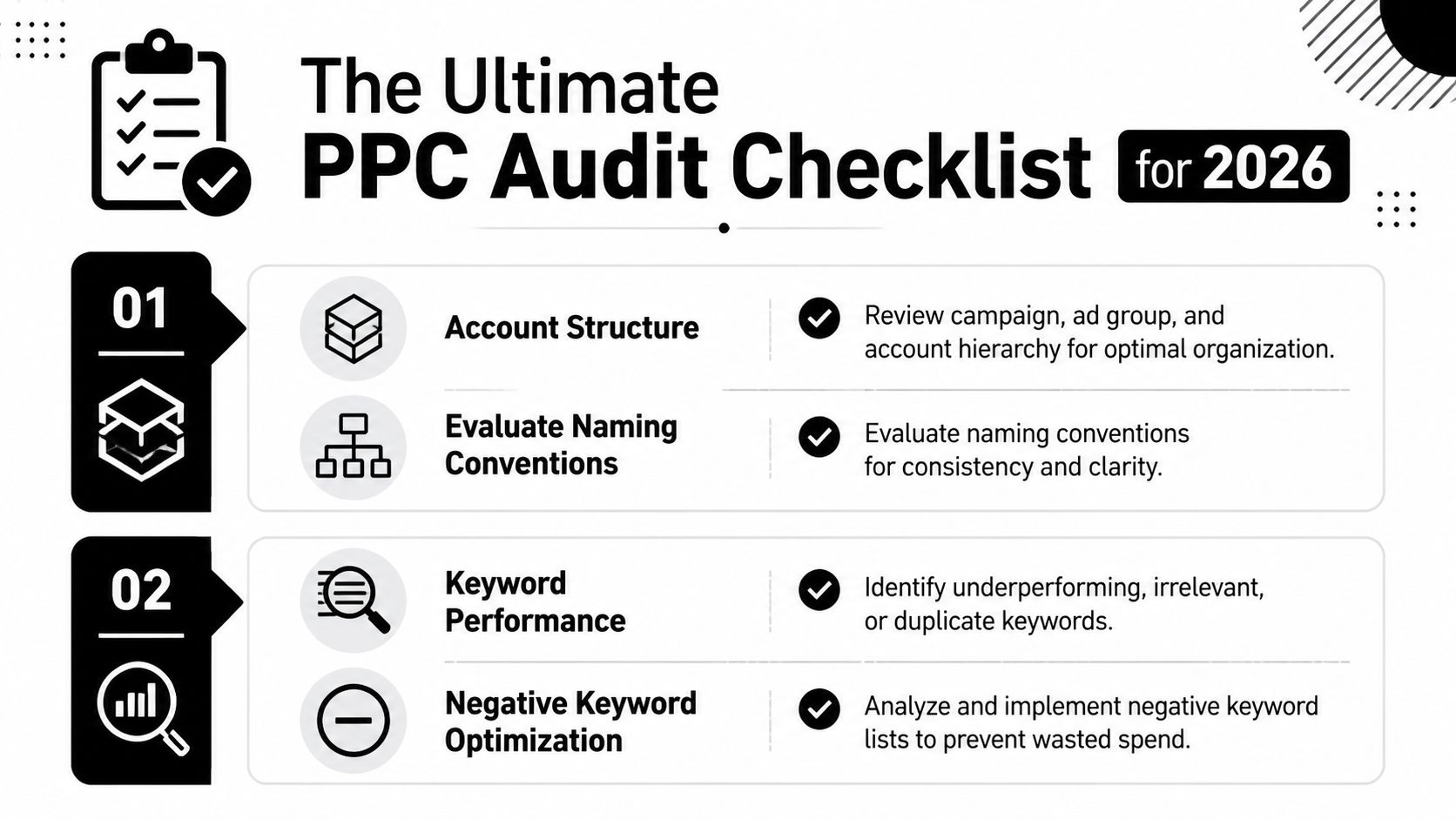
Start with account structure
Campaign inefficiencies are often the root of many expensive problems. Poorly organized campaign hierarchies can cause up to 30% to 50% wasted ad spend, and a flawed structure can drag Quality Scores below the 7/10 benchmark, inflating CPC by 20% to 40%. Audits that recommend restructuring can improve ROAS by 25% or more, based on the checklist guidance from PPC Geeks.
Here’s what to check first:
- Campaign purpose: Each campaign should have a clear job. Brand, non-brand, competitor, remarketing, and geographic plays shouldn’t be blended unless there’s a deliberate reason.
- Ad group logic: If ad groups contain unrelated terms, ad relevance slips and query control gets messy.
- Naming conventions: A clean naming system saves time during audits and reduces mistakes during bulk edits.
- Segmentation choices: Device, location, and audience layers should reflect how the business buys traffic.
If multiple campaigns target overlapping themes with loose keyword control, they can bid against each other. That’s one of the quietest ways an account wastes money.
Check keyword performance like an operator
Keyword reviews shouldn’t stop at “pause the losers.” That’s too blunt. You need to understand whether the issue is intent, match type, landing page mismatch, or duplicate coverage.
Look for:
- Search terms that never should’ve matched
- Duplicate keywords across campaigns or ad groups
- Broad match traffic without enough negative protection
- Terms that attract clicks but don’t support the actual conversion goal
- High-volume branded terms masking weak prospecting traffic
A lot of teams audit keywords from the keyword tab only. That misses the complete picture. Search term reports tell you what users typed. That’s usually where you’ll find wasted PPC spend fastest.
Good audits don’t ask only “Which keywords spent money?” They ask “Which queries created intent we actually want to buy again?”
For a more hands-on framework, this PPC audit checklist template is useful as a working document when you need to turn observations into a fix list instead of a passive report.
Review ads and landing pages together
Ad copy shouldn’t be judged in isolation. A strong ad can still feed a weak session if the landing page doesn’t match the promise of the click.
Audit this pairing:
- Headline to query match: Does the ad reflect the actual search intent?
- Offer clarity: Is the user being promised something specific?
- Landing page continuity: Does the page continue the same message, category, or offer?
- Conversion path friction: Are forms, demos, purchases, or lead actions obvious?
If CTR is healthy but conversion behavior is weak, the account may not have an ad problem at all. It may have a click-quality or landing-page-alignment problem.
Audit bidding with skepticism
Automation can help, but it doesn’t rescue bad foundations. If conversion tracking is off, delayed, duplicated, or incomplete, smart bidding will optimize toward noise.
Inspect:
- Bid strategy by campaign goal
- Conversion actions included in optimization
- Budget limits that choke learning
- Audience overlap that can distort CPC
- Seasonal or business-cycle shifts that make old settings stale
Many audits go soft. They note the current strategy, but they don’t test whether the account has the data quality needed to trust it.
Verify tracking and attribution before making big changes
If this layer is wrong, every downstream conclusion gets weaker.
Use a short validation pass:
| Audit area | What to verify | Why it matters |
|---|---|---|
| Conversion tracking | Primary actions fire correctly | Bidding decisions depend on this |
| Cross-domain flows | Sessions and conversions persist across domains | Broken journeys break attribution |
| UTM handling | Parameters survive redirects and forms | Reporting depends on source detail |
| Data consistency | Platform and site records tell a coherent story | Prevents false optimization signals |
Audit the measurement system before you audit the creative system. Otherwise you’re grading ads with a broken ruler.
A useful checklist isn’t the finish line. It’s the triage sheet. Actual work begins when you rank findings by business impact, ease of fix, and confidence that the data is clean enough to support the change.
Common Audit Findings You Can't Afford to Ignore
The accounts that need audits most rarely look disastrous at first glance. They look busy. Spend is going out, clicks are coming in, dashboards are moving. The trouble shows up when you inspect what’s producing new demand and what’s just flattering the report.
Branded performance hiding weak acquisition
Symptom: blended ROAS looks fine, leadership thinks paid search is healthy, and nobody wants to touch the account.
Diagnosis: branded and non-branded traffic are reported together, so brand demand is carrying the account. That hides whether paid search is winning net-new customers. As Andrei Visan’s SaaS PPC audit guide points out, isolating branded versus non-branded performance is a critical step that many audits miss, especially now that post-2025 privacy changes make conversion data less reliable.
Cure: split reporting first. Don’t pause brand just to prove a point. Measure it separately, compare intent layers accurately, and judge scaling decisions on non-brand performance without brand support.
Search term quality collapsing behind “good” keywords
Symptom: a campaign contains reasonable keywords, but lead quality is inconsistent and budget disappears faster than expected.
Diagnosis: the keyword list looks acceptable, yet actual search terms reveal loose matching, irrelevant variants, and weak negative coverage. This usually happens after months of incremental changes. Nobody made one terrible decision. The account just drifted.
Cure: audit search terms in chunks by theme, not just by campaign. Build negatives from repeated junk intent patterns. Then tighten match types only where control is clearly worth the trade-off. Overcorrecting can shrink useful discovery traffic, so this needs judgment.
The keyword list is your plan. The search term report is what the platform actually did with that plan.
Automation running on damaged inputs
Symptom: bidding looks smart on paper, but results swing hard and explanations don’t hold up.
Diagnosis: the account relies on automation while tracking, attribution, or conversion-action selection has problems underneath. In those situations, the machine doesn’t fix the account. It scales the wrong signal.
Cure: fix measurement before changing too many levers at once. Phase changes so you can tell what improved and what didn’t. When teams change keywords, bids, ad copy, audiences, and landing pages all at once, they lose the thread and call it “testing.”
That’s why the best audits aren’t just diagnostic. They’re selective. They show which findings matter now, which ones are cosmetic, and which ones should wait until the account can measure them properly.
Accelerate Audit Fixes with Keywordme
Audit fixes slow down in the same place over and over. The diagnosis is clear, but the implementation gets stuck in exports, filters, and manual keyword edits. By the time the team is ready to push changes, the account has already spent another week on avoidable traffic.
That gap matters because many of the fastest post-audit gains come from search term action, not from another round of commentary. Waste usually shows up in patterns. Repeated irrelevant modifiers, loose query variants, and missing negatives across multiple campaigns. Fixing that by hand works on a small account. It breaks down fast once the account has volume.
Keyword cleanup needs a production process. Pull live query data, sort it by intent, decide what should be blocked, decide what deserves promotion, then apply changes consistently. The teams that get value from an audit are the ones that can turn findings into account changes within days, not weeks.
What fast implementation actually looks like
A workable sequence looks like this:
- Pull search term data by theme, not just by campaign
- Sort queries into waste, keep, test, and promote
- Build negative lists from repeated intent patterns
- Turn proven queries into planned keyword coverage
- Apply match types based on control needs, not habit
- Push updates in bulk without rebuilding everything in spreadsheets
Keywordme keyword workflow software helps with that execution layer. It is built for cleaning search terms, expanding ad groups from real query data, assigning match types, and creating negative keyword lists in bulk. That shortens the lag between “we found the issue” and “the issue is fixed,” which is where a lot of audits lose momentum.
I see the same mistake on first large-account audits. Teams treat every finding as equally urgent.
They are not. Start where cleanup changes spend quality fastest, then work outward. Search term waste and negative coverage usually come first because they reduce bad traffic without forcing a full account rebuild. Match type restructuring comes next if query control is still weak. Ad copy tests, landing page changes, and bid strategy adjustments can wait until the account structure is cleaner.
That order protects signal quality. It also makes results easier to interpret.
Tools can speed up the mechanical work, but they do not replace judgment. A query with poor short-term efficiency may still belong in the account if it supports discovery in a growth campaign. A broad match keyword may still earn its place if negatives are tight and conversion tracking is sound. The point is not to make the account stricter everywhere. The point is to remove obvious waste quickly and keep the traffic that is doing useful work.
Teams building repeatable optimization systems often pair account cleanup with workflow tools outside the ad platform too. For example, LunaBloom AI is one of the products marketers use when they want faster execution across adjacent growth tasks, not just reporting.
A good audit report identifies problems. A useful recovery plan fixes the ones that are costing money right now, in the right order, with as little manual drag as possible.
Choosing a PPC Audit Service and Understanding Pricing
Buying ppc audit services gets confusing because the deliverables often sound similar while the actual depth varies a lot. One provider gives you a surface-level checklist. Another digs into search terms, tracking integrity, branded separation, and automation risk. Both may call it a “full audit.”
That’s why pricing only makes sense when you understand the model behind it.
PPC Audit Pricing Models at a Glance
| Model | Best For | Pros | Cons |
|---|---|---|---|
| Flat-fee | One-time account reviews with a clear scope | Predictable cost, easier to compare offers, clean for project work | Scope can get shallow if the account is complex |
| Hourly | Accounts with unclear issues or unusual setup | Flexible, useful for forensic work, can go deep where needed | Final cost may be hard to predict |
| Retainer | Teams that want recurring review and follow-through | Ongoing accountability, easier implementation support, useful when the account changes often | You need to make sure you’re paying for active analysis, not just a recurring document |
None of these models is automatically better. The key question is whether the provider is pricing diagnosis only, or diagnosis plus prioritization and support.
What separates a real audit from a basic one
A lot of audit services still focus on surface metrics and old account hygiene. That’s not enough now. As Ryze’s PPC audit guidance notes, many audit guides are outdated and miss modern automation and infrastructure issues. The same source says accounts that receive quarterly audits see 38% better ROAS and points out significant 2026-era gaps like conversion tracking breaks and attribution distortions.
Ask these questions before hiring anyone:
- How do you validate conversion tracking before making recommendations?
- Do you separate branded and non-branded performance?
- How do you review search terms, not just keywords?
- What do you check in automated bidding and conversion-action setup?
- Will you prioritize findings by business impact, or just list them?
- Do you provide implementation guidance, or only observations?
- How do you handle cross-domain tracking, UTM preservation, or attribution issues?
If the answers stay vague, the audit probably will too.
Pricing should follow scope, not buzzwords
Some buyers want a cheap diagnostic. Others need a strategic teardown because the account has years of history, multiple stakeholders, and messy tracking. Those are different jobs.
A useful way to think about it is this:
- Simple account, clean tracking, low change volume: a fixed-scope audit may be enough
- Mixed campaign types, unclear conversion data, takeover situation: hourly work can make sense
- Fast-moving account with recurring launches or seasonal shifts: a retainer model may fit better
If you’re comparing service packages, this breakdown of pay per click packages helps frame what should be included beyond basic management language.
And if your team is also building internal marketing workflows with AI support, products like LunaBloom AI can be useful on the operations side. Just don’t confuse workflow tooling with an actual audit methodology. They solve different problems.
The right provider should be able to explain not just what they’ll review, but how they’ll help you act on it without creating chaos in the account.
The True ROI of a Professional PPC Audit
A professional audit pays off in ways most reports never spell out clearly. Yes, it can cut waste. But the larger value is strategic. It gives the team a cleaner decision environment.

When an account is audited properly, three things usually happen. First, wasted spend becomes visible in plain language. Second, the team stops chasing vanity metrics that don’t connect to business outcomes. Third, optimization gets faster because the account structure and measurement rules make more sense.
Where the return actually comes from
The strongest return usually comes from a mix of outcomes:
- Cleaner acquisition data: better decisions on where to scale and where to pull back
- Stronger budget allocation: spend moves toward traffic that matches the business goal
- Lower operational drag: fewer hours lost to manual cleanup and reactive fixes
- More resilient performance: the account is less exposed to tracking issues, overlap, and reporting distortion
There’s also a competitive edge here. Teams with clean accounts can test faster because they trust the baseline. Teams with messy accounts hesitate, overreact, or keep feeding spend into campaigns they don’t really understand.
This short video is a useful companion if you want another view on audit thinking and performance troubleshooting.
A good audit doesn’t just help you spend less. It helps you spend with intent.
That’s the true ROI. Better decisions, cleaner systems, faster execution, and a paid search account you can effectively steer.
Frequently Asked Questions about PPC Audits
Can I do a PPC audit myself
Yes, in some cases.
A self-audit is realistic when the account is small, conversion tracking is stable, and the campaign structure has not been patched together over several years. You need to be able to review search terms, match types, bidding logic, conversion paths, and reporting consistency without guessing. That is where self-audits usually break down. In-house teams often know the account too well, so they stop seeing the small leaks that keep spend inefficient.
How long does a PPC audit usually take
The timeline depends less on spend and more on complexity. A tidy account with clear goals can be reviewed quickly. An account with multiple campaign types, imported conversions, cross-domain tracking, and years of structural changes takes longer because the measurement setup has to be checked before any performance conclusions are trustworthy.
If tracking is wrong, the rest of the audit is just commentary.
How often should I get an audit
Quarterly is a good working rhythm for many accounts. It is frequent enough to catch drift in search terms, bidding behavior, budget allocation, and tracking quality before those issues become expensive. A larger review once a year also helps, especially after major account changes, site migrations, offer changes, or a handoff between agencies and internal teams.
High-spend or high-volatility accounts often need a tighter cadence.
What should I expect to receive after an audit
Expect a recovery plan, not just findings. A useful audit should show what is wrong, why it matters, what to fix first, who should handle it, and how to measure whether the fix worked. If you receive a long spreadsheet with no prioritization, the hard part has just been pushed back onto your team.
The best audit deliverables shorten time to action.
If your audit findings keep turning into manual cleanup work, Keywordme can help operationalize the next steps. It gives Google Ads teams one place to handle search term cleanup, negative keyword building, match type assignment, and keyword expansion so fixes get implemented faster.
.svg)