
Mastering Pay Per Click Packages for 2026
Mastering Pay Per Click Packages for 2026


SEO Title: Pay Per Click Packages That Work
Meta Description: Compare pay per click packages, pricing models, and agency checklists so you can choose or build a package that drives better ROI.
One agency sends a proposal for “PPC management” that looks lean and cheap. Another sends a proposal that costs far more, includes more line items, and somehow still leaves you unsure what you’re buying.
That confusion is normal.
Pay per click packages are one of the least standardized offers in digital marketing. Two providers can use the same label and be selling completely different things. One may be offering little more than campaign setup and a monthly report. Another may be doing keyword mining, search term cleanup, landing page feedback, bid strategy reviews, attribution work, and ongoing account restructuring.
That gap matters more now than it used to. Paid search is less forgiving, ad platforms are more automated, and weak account management gets expensive fast. Buyers need to know how to evaluate what’s inside a package. Agencies need to know how to structure a package that clients understand and teams can deliver profitably.
Why Navigating PPC Packages Feels So Complicated
A buyer opens three PPC proposals before lunch and still cannot answer a basic question. What, exactly, is the agency going to do each month to improve results?
That confusion starts with the way PPC packages are sold. Agencies reuse the same labels. Setup. Optimization. Reporting. Strategy. Management. The language sounds clear until someone asks for scope, cadence, and ownership.
In practice, those labels hide very different service models. One agency may call it optimization if a specialist checks pacing, adjusts bids, and sends a report at month end. Another may include weekly search term reviews, negative keyword maintenance, ad testing, audience exclusions, feed checks, landing page feedback, and conversion tracking audits under the same word. Both can present a tidy proposal. Only one gives you enough control to protect budget and improve performance over time.
The market feels inconsistent because agencies package PPC around delivery economics. Headcount, margins, software stack, account load, and process maturity shape the offer long before the proposal reaches the client. A low-fee package often depends on templates, automation, and limited hands-on review. A higher-fee package may fund senior oversight, faster response times, and tighter quality control. The trade-off is real. Cheap is not always careless, and expensive is not always better. The problem is that many proposals hide where the work is automated, where it is manual, and who is accountable when results stall.
Ask a harder question. What happens in this account every week?
That question helps both audiences this guide serves. Buyers can judge whether the fee matches the work. Agencies can pressure-test whether their package is deliverable at the promised margin. If the answer is vague, the package is probably doing too much on paper or too little in reality.
Complexity also comes from the split between deliverables and outcomes. A package can include reports, dashboards, call summaries, and polished slides while leaving core performance issues untouched. Good packaging ties activity to business impact. That means clear tracking, a defined optimization routine, and enough account attention to catch waste before it compounds. Agencies that use the right features in effective PPC management software can standardize that work, reduce labor waste, and give clients more visibility into what they are paying for.
Clean data, disciplined account structure, and steady decision-making are increasingly essential now, as ad platforms reward these attributes. Automation can help, but it also hides weak thinking. If conversion tracking is off, the bidding strategy learns the wrong lesson. If search terms are ignored, spend drifts. If package scope is thin, the account may stay active while performance slips for months.
That is why PPC packages feel harder to compare than they should. Buyers are not just choosing a price. They are choosing a management system. Agencies are not just selling tasks. They are selling a repeatable way to turn ad spend into revenue without burying the team in custom work.
The Core Components of a High-Value PPC Package
The easiest way to judge a package is to stop looking at the label and inspect the parts.
A high-value package works like a solid house build. If the foundation is off, the paint won’t save it. In PPC, that means flashy dashboards don’t matter much if campaign structure, targeting, and tracking are weak.
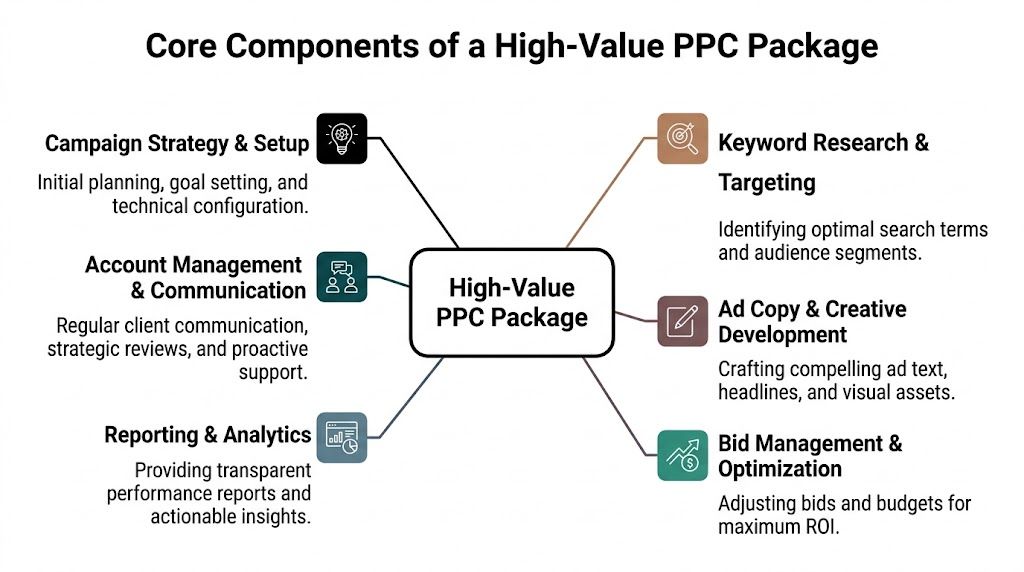
Campaign strategy and setup
This is the foundation.
The provider should define goals, choose the right campaign types, set conversion actions, organize account structure, and establish naming conventions that make the account manageable later. If this is rushed, the agency spends the next few months patching avoidable problems.
Setup also includes practical decisions buyers often miss:
- Goal selection: Are you optimizing for lead volume, qualified leads, online sales, or another business outcome?
- Platform scope: Is the package focused on Google Ads only, or does it include Microsoft Ads, YouTube, or remarketing?
- Tracking readiness: Are the right events in place before spend ramps up?
A package that skips this work often creates a clean launch and a messy quarter.
Keyword research and targeting
In this area, many low-cost packages cut corners.
Keyword research should include commercial intent mapping, match type choices, negative keyword planning, search term analysis, and ad group logic. It should also reflect actual buyer search behavior, not just how the product team describes the service.
A keyword list by itself isn’t strategy. The strategy is in how terms are grouped, filtered, and assigned.
Broad targeting can create early volume. It can also create expensive noise if nobody is actively shaping it.
For buyers, ask whether keyword work continues after launch. For junior strategists, remember this: the search term report often tells you more about account health than the pitch deck ever will.
Ad copy and creative development
Ad copy carries too much weight to treat it as filler.
The package should include headline testing, offer positioning, intent alignment, and message variation by audience or product line. If the account uses multiple campaigns, the copy shouldn’t feel copied and pasted with a few nouns swapped out.
Good copy does three jobs at once:
- It signals relevance to the user.
- It supports ad rank and click quality.
- It pre-qualifies the click so the landing page gets a better visitor.
That’s one reason package quality affects spend efficiency. As covered in the earlier section, clicks are getting more expensive. Better messaging helps make each one count.
Bid management and optimization
Many clients assume the “real work” happens here, and they’re partly right.
Bids, budgets, device adjustments, search query exclusions, and performance reviews all belong here. But bid work only performs well when it’s fed by strong structure and clean data.
If you want a useful breakdown of the tooling side, this guide on features of effective PPC management software is worth reviewing because it shows what serious optimization support should look like behind the scenes.
Reporting and analytics
A high-value package reports on performance in a way that supports decisions, not just client reassurance.
That means reports should explain what changed, why it changed, what was tested, what was paused, and what needs attention next. A PDF with clicks, CPC, and conversions is not enough on its own.
The stronger agencies use reporting to create accountability in both directions. They show the data, and they point out where landing pages, sales handling, or tracking gaps are affecting outcomes.
Account management and communication
This is the part buyers undervalue until they’ve had a bad experience.
A package needs a communication rhythm. That may mean monthly calls, written recaps, escalation paths, and access to someone who can answer strategy questions without hiding behind jargon.
Good account management shortens decision cycles. It also stops small issues from becoming expensive ones.
Here’s the simple test. If a provider disappears between invoice dates, it isn’t a high-value package. It’s outsourced button-pushing.
Decoding PPC Pricing Models and Industry Benchmarks
A buyer approves a PPC package at what looks like a reasonable monthly fee. Three months later, the account is overspending, reporting is muddy, and both sides feel misled. In most cases, the problem starts with the pricing model, not the ads.
Good pricing does two jobs at once. It gives buyers a fair way to compare providers, and it gives agencies enough margin to manage the account properly. If either side gets that balance wrong, ROI suffers.
Percentage of ad spend
This is still one of the most common structures because it grows with account size.
For agencies, that makes sense when higher spend creates more work. Larger budgets usually mean broader keyword sets, more campaign segmentation, more testing, and more internal scrutiny from the client side. For buyers, the model can feel reasonable if service depth increases as spend rises.
The risk is incentive drift. If compensation rises every time budget rises, clients will question whether the agency is scaling spend for performance or for fees.
This model works best with defined scope bands, clear reporting, and regular budget reviews tied to business outcomes.
Flat monthly retainer
A flat retainer is easier to budget. That matters for small businesses, finance teams, and any client comparing PPC against other monthly operating costs.
It also forces cleaner scoping. Agencies have to decide what is included, what triggers a change order, and what level of support the package can sustain profitably. That discipline is healthy.
The weakness shows up when the account changes faster than the contract. A once-simple lead gen account can become a multi-location account with call tracking issues, landing page testing requests, and a second ad platform. If the fee stays static, one of two things happens. The agency absorbs the extra labor, or service quality drops.
Hybrid pricing
Hybrid pricing is often the most workable option because it matches how PPC is managed.
A base fee covers strategic oversight, reporting, account communication, and core optimization work. A variable fee covers the extra load that comes with larger budgets, additional platforms, or specialized campaign types. That structure gives agencies a healthier operating model and gives buyers a clearer explanation of what they are paying for.
If you want a broader reference point on PPC pricing models, that overview is useful because it shows how providers frame pricing structures across service types.
For agencies building packages, hybrid pricing also creates room to price specialist work properly instead of hiding it inside one generic management fee.
Performance-based pricing
Performance pricing gets attention because it sounds aligned with ROI. It often creates conflict.
PPC results depend on more than campaign management. Tracking quality, landing page speed, sales follow-up, offer strength, and close rates all affect conversion volume and revenue quality. If those variables sit outside the agency’s control, a performance-only contract can turn into a blame loop.
Performance bonuses can work. Performance-only models usually require tight attribution, shared definitions, and a client with stable operations.
Why benchmarks vary so much
There is no clean market rate that fits every account. Pricing changes with business model, sales cycle, platform mix, geography, conversion tracking quality, and how much strategic work the provider is doing.
That is why benchmark ranges should be used as orientation, not as a pricing rule.
A local emergency plumber running one service area and one core offer does not need the same package as a SaaS company managing branded search, competitor campaigns, remarketing, and offline conversion imports. Both are buying PPC management. They are not buying the same workload.
Buyers should read package pricing through the lens of account complexity. Agencies should price against labor reality, not against what looks attractive in a proposal comparison sheet.
The cost driver many proposals understate
Quality Score affects more than media efficiency. It changes how much work the account needs and how expensive bad management becomes.
According to Improvado’s PPC analysis, low Quality Scores below 5 can inflate CPC by 2 to 4 times compared with scores of 7+ because effective bid strength is shaped by bid and Quality Score. The same analysis says tightly themed ad groups and relevant ad copy can reduce CPC significantly and improve ROI.
That has direct pricing implications. An agency that structures campaigns well may charge more for management and still lower total acquisition cost. An agency that prices cheaply but ignores relevance, search term control, and ad group quality can cost the client far more in wasted spend.
For buyers, that is the true comparison. Fee level matters, but total account economics matter more.
For agencies, this is also where better tools create an edge. Platforms like Keywordme help teams tighten keyword structure, reduce waste faster, and support stronger package margins without cutting strategic effort. If you want a more buyer-focused budget reference, this guide on how much Google Ads costs for different business types is a useful companion.
Sample PPC Package Templates for Any Business Size
Abstract pricing talk only gets you so far. Packages make more sense when you see how service levels stack up side by side.
The table below shows a clean way to think about three common tiers. These aren’t fixed market prices. They’re working templates that help both buyers and agencies frame the scope properly.
Sample PPC Package Tiers 2026 Benchmarks
| Feature | Starter Package | Growth Package | Scale Package |
|---|---|---|---|
| Best fit | Small business testing paid search or running a focused local offer | Established business expanding lead flow or ecommerce reach | Multi-location, multi-market, or complex account with advanced management needs |
| Platform scope | One primary platform | One to two platforms | Multiple platforms and campaign types |
| Campaign structure | Core campaigns with straightforward ad group setup | Broader structure with segmented campaigns by offer or audience | Advanced segmentation by geography, product line, funnel stage, or audience |
| Keyword management | Initial keyword research, match type setup, basic negative keywords | Ongoing search term review, routine negative keyword expansion, tighter intent mapping | Deep search term mining, bulk restructuring, shared exclusions, cross-campaign cleanup |
| Ad copy work | Core ad copy set and limited refreshes | Ongoing ad testing and message refinement | Continuous testing by segment, offer, and funnel intent |
| Bid management | Baseline bidding oversight and budget pacing | Active bid reviews with routine optimization | Frequent bid strategy refinement, automation oversight, and segmented budget control |
| Tracking and reporting | Basic conversion tracking and monthly reporting | Stronger reporting with business-focused commentary | Advanced reporting, attribution review, and deeper performance diagnostics |
| Communication | Monthly email summary or call | Scheduled reviews and strategic recommendations | High-touch account management with regular planning and escalation support |
| Geographic targeting | Basic location targeting | Refined targeting by region or service area | State-based or micro-segmented structures where the market justifies it |
| Strategic focus | Control waste, validate offer, build clean foundation | Improve efficiency, expand reach, and tighten conversion quality | Scale responsibly, segment aggressively, and protect efficiency across larger spend |
What changes between tiers
The progression isn’t just “more stuff.”
The primary shift is operational depth. A starter package should create control and clarity. A growth package should improve efficiency while opening room to scale. A scale package should handle complexity without letting waste spread through the account.
That difference matters in large markets. As noted in this discussion of state-based or micro-segmented campaigns, geographic targeting becomes a strategic lever when campaign structure is adapted by region rather than treated as a simple checkbox.
How buyers should use this table
Don’t shop for the biggest package by default.
Shop for the package that matches your current complexity, your conversion readiness, and your internal ability to support the traffic. If your landing pages are weak and your tracking is basic, a huge package won’t fix the fundamentals by itself.
Use these questions instead:
- Are we still proving core offer-market fit? A starter structure may be enough.
- Are we seeing traction but leaking efficiency? Growth scope usually makes sense.
- Are multiple regions, products, or audiences competing for budget? That’s scale territory.
The wrong package is often one step ahead of operational reality. It adds complexity before the business can use it well.
How agencies should use this table
For agencies, these tiers help prevent scope creep.
They also give junior strategists a delivery framework. If the package is starter, don’t promise scale-level segmentation. If the package is scale, don’t run it like a starter account with more meetings attached.
A good package ladder makes the upgrade path obvious. Clients should understand what additional complexity they’re paying for and why it matters.
Your Checklist for Evaluating and Choosing a PPC Provider
Choosing a provider should feel less like shopping and more like interviewing a key operator.
You’re not just buying ad management. You’re buying judgment, process, and accountability.

Ask how they think, not just what they include
A weak provider can list all the usual deliverables and still manage the account poorly.
The better question is why they structure campaigns the way they do. Ask how they handle keyword grouping, match type control, search term review, landing page alignment, and budget allocation when performance starts to split by audience or geography.
If the answer stays vague, assume the work will too.
Make conversion tracking a non-negotiable topic
Many deals go sideways here.
According to Forum Communications' piece on wasted PPC budget, many campaigns waste spend because success isn’t properly measured, and a major gap in many packages is the failure to include multi-touch attribution setup. That’s the question buyers should bring into every sales call: how will you track and attribute conversions beyond the last click?
If a provider can’t explain that clearly, they can’t defend your spend clearly either.
Ask to see the reporting logic before you ask to see the dashboard design.
Red flags worth taking seriously
Some warning signs are obvious. Others are subtle.
- Guaranteed outcomes: No serious PPC operator guarantees rankings or easy wins from day one.
- Reporting without interpretation: Numbers alone don't equal strategy.
- No clear ownership: If you can't tell who touches the account, expect inconsistency.
- Generic proposals: If the document reads like it could fit any business, it probably does.
- Silence on search terms and negatives: That usually means weak spend control.
A structured review process helps. This PPC audit checklist template is a useful framework for pressure-testing a provider’s thinking before you sign.
Check reputation, then go beyond reputation
Lists can help you build a shortlist. If you’re gathering options, this roundup of top-rated PPC agencies can save time.
But reputation is only the starting point.
A known agency can still be a bad fit for your business model, timeline, or budget. A smaller agency can outperform if its process is tighter and its attention is stronger. The right choice is the team that can explain your account before they ever touch it.
A useful video can also sharpen your review process:
The simplest final test
Ask what they’ll do in the first month, what they’ll change in month two, and how they’ll know whether those changes worked.
A strong provider answers directly. A weak one circles back to “optimization” and hopes that sounds like enough.
For Agencies How to Structure Profitable PPC Packages
Profitability in PPC services doesn’t come from charging the highest fee. It comes from packaging work in a way your team can deliver repeatedly, clearly, and without burning hours on preventable chaos.
That starts with scope.

Scope the package around decisions, not tasks
Many agencies build packages as task lists. Setup. Ads. Optimization. Reporting.
That’s easy to sell and hard to protect.
A better approach is to package around the decisions your team is responsible for. Budget allocation. Search term filtering. Campaign restructuring. bidding oversight. Attribution inputs. Landing page feedback. When you define the package around decision ownership, clients understand the value more clearly and strategists know where their authority begins and ends.
Separate foundation work from recurring management
This one mistake crushes agency margin all the time.
Initial setup, conversion tracking review, account rebuilds, and migration work are not the same as monthly management. If you blend them into one vague monthly package, you end up absorbing high-effort onboarding inside a fee that was meant to cover routine maintenance.
Break the offer into stages:
- Foundation engagement: Setup, restructure, tracking, and launch prep
- Core monthly management: Ongoing optimization, reporting, and communication
- Advanced add-ons: Attribution consulting, landing page testing support, or segmentation projects
That structure protects your team and makes pricing easier to justify.
Agencies lose money when custom work hides inside standard packages.
Build tier logic around complexity, not client ego
A lot of package naming is cosmetic. Starter. Pro. Elite. Platinum.
What matters is the complexity threshold behind each tier.
One tier may cover a single-platform account with limited campaign breadth and a clean sales path. Another may include multiple campaigns, broader keyword surfaces, and recurring ad testing. The top tier may require geographic segmentation, higher-touch communication, and deeper reporting support for multiple stakeholders.
That’s where agencies often undersell themselves. They let account complexity climb without reclassifying the package.
Use clear upgrade triggers. If the client adds more markets, more products, more stakeholders, or more required reporting layers, the package should change.
Package around workflow efficiency
Operational efficiency is the difference between a profitable account and a resentful one.
Manual search term cleanup, negative keyword formatting, and match type application eat time fast. They also create inconsistency across accounts when every strategist has a slightly different method.
Profitable agencies standardize those workflows. They use checklists, templates, naming systems, and tools that reduce repetitive account labor. That gives senior people more time for real judgment work instead of spreadsheet housekeeping.
Don’t oversell Smart Bidding. Manage it
Automation helps. It does not remove the need for human oversight.
According to Straight North’s foundational PPC strategy, mismanaging Smart Bidding strategies such as Target ROAS can inflate average CPC by 15 to 25% without proportional ROI gains. The same source notes that clean data, weekly reviews by device and geography, and bulk optimization workflows can produce a 10 to 15% ROAS uplift, while tools like Keywordme can handle bulk optimization up to 10x faster than manual work.
That changes how an agency should package labor.
You shouldn’t sell “AI-powered optimization” like it’s a replacement for strategy. You should sell disciplined oversight of automation. Clients pay for the person who knows when to trust the machine, when to constrain it, and when to change the account inputs feeding it.
Use internal service rules to prevent scope creep
Clients rarely ask for “scope creep.” They ask for one more landing page review, one more market, one more campaign type, one more dashboard cut.
If you don’t define service boundaries, the account expands until the economics break.
Set internal rules such as:
- Communication rules: How many scheduled reviews are included?
- Revision rules: How much copy testing is standard before it becomes custom work?
- Segmentation rules: At what point does geo expansion trigger a tier shift?
- Support rules: Which requests are strategic consulting, not account maintenance?
These rules don’t make your agency rigid. They make it stable.
Train junior strategists on package economics
Junior PPC staff often understand platform mechanics before they understand service economics.
That’s a problem because account decisions affect margin. Overbuilding campaign structures, taking on unlimited revisions, or running custom analyses for every minor fluctuation can sink profitability even if results are decent.
Train the team to think in three layers:
| Agency layer | What it means |
|---|---|
| Client outcome | What business result the package is meant to support |
| Operational workload | What recurring labor is actually required to support that outcome |
| Margin protection | What must be standardized, limited, or priced separately |
That framework helps newer strategists understand why package design matters just as much as campaign design.
Sell clarity, not complexity
The strongest agencies often sound simpler in sales calls, not more complicated.
They can explain exactly what is included, what gets reviewed, what gets improved, and what requires a separate engagement. That clarity builds trust. It also reduces post-sale friction because the client knows what they bought.
Complexity should exist inside your operating system, not inside your pitch.
When agencies package services well, clients feel guided instead of managed. The team feels in control instead of overloaded. That’s where profitability shows up. Not just in fees, but in retention, smoother delivery, and accounts that don’t collapse under their own mess.
Beyond the Package A Partnership for Growth
The best pay per click packages do more than bundle tasks.
They create a working relationship where spend is measured carefully, optimization has a purpose, and both sides understand what success looks like. Buyers need that clarity because paid traffic gets expensive when management is loose. Agencies need it because vague packages create bad expectations and weak margins.
A strong package earns trust in practical ways. Clean structure. Useful reporting. Clear communication. Honest limits. Real strategy.
That’s true whether you’re buying services or building them.
For clients, the right package should help you judge value beyond the headline fee. For agencies, the right package should make delivery repeatable without turning the work into a commodity. That’s the sweet spot. Not the cheapest offer. Not the flashiest proposal. The package that can be run well, explained clearly, and improved over time.
If you want to speed up keyword cleanup, negative keyword management, match type handling, and campaign expansion without the usual manual grind, try Keywordme. It’s built for PPC teams that want cleaner workflows, faster optimization, and tighter control over wasted spend.
.svg)