
Phrase Match vs Broad Match Google Ads 2024: Which Wins In
Phrase Match vs Broad Match Google Ads 2024: Which Wins In


SEO Title: Phrase Match vs Broad Match Google Ads 2024
Meta Description: Phrase match vs broad match Google Ads 2024 explained with practical rules for control, scale, and when smaller accounts should avoid broad match.
You're in the Google Ads search terms report, and the account looks messy.
A handful of queries make perfect sense. A few are borderline. Then you hit the junk. Searches that are adjacent to your offer, technically related, but nowhere close to what would turn into revenue. At that point, most PPC managers ask the same question: was broad match too loose, or did phrase match stop being as safe as it used to be?
That confusion is normal now. The old mental model was simple. Exact meant control, phrase meant a sensible middle ground, and broad meant chaos unless you had time to babysit it. In practice, that model doesn't hold up well anymore. Google changed how matching works, and a lot of junior buyers are still making decisions based on rules that belonged to a very different version of Google Ads.
The core issue in phrase match vs broad match Google Ads 2024 isn't definition. It's operational risk. Which one gives you enough scale without letting garbage traffic eat the budget? Which one can your account effectively support? And when does broad match help, versus when does it just create expensive learning for no reason?
The PPC Manager's Dilemma in 2026
A common account review now looks like this: the campaign is live, Smart Bidding is on, keyword themes are reasonable, and performance still feels unstable. Some days broad match finds useful queries you'd never have added manually. Other days it opens the floodgates to research traffic, low-intent clicks, or searches that make sense only if you squint.
Phrase match doesn't fully solve that anymore.
A lot of teams still reach for phrase because it feels safer. That instinct made sense before Google loosened the rules. Today, phrase often acts less like a strict filter and more like a narrower version of broad. So the old shortcut, “use phrase for control,” can lead you into a false sense of security.
Here's the practical dilemma most managers are dealing with:
| Match type | What it usually gives you | What it usually costs you |
|---|---|---|
| Phrase match | Tighter intent coverage, cleaner starting point, easier query review | Less scale, rising CPC pressure, not as controlled as it used to be |
| Broad match | Query discovery, reach, automation compatibility | More junk traffic risk, more negative work, weaker predictability in smaller accounts |
That trade-off is why match type decisions now affect ROI, management time, and lead quality more than keyword syntax itself.
What usually goes wrong
The biggest mistakes are rarely technical. They're strategic.
- Using broad too early: New or low-volume accounts often don't have enough signal to help Google separate useful intent from vague relevance.
- Trusting phrase too much: Teams assume phrase still protects them from drift, then get surprised when close intent matching expands farther than expected.
- Skipping search-term hygiene: Match type choice matters, but the search terms report still tells you whether the campaign is healthy.
Practical rule: If you can't review search terms consistently, broad match is usually a bad bargain.
Most accounts don't need ideology here. They need a decision rule. Use broad when the account can absorb ambiguity. Use phrase when the account still needs control, cleaner intent, or a more stable baseline.
How Google Redefined Keyword Matching
Google Ads matching used to feel more literal. You picked words, added match symbols, and expected searches to stay fairly close to that structure. That's not how it works now.
Google says phrase match now shows ads when searches include the meaning of the keyword, while broad match can trigger for searches that are related to that meaning or intent in its Google Ads phrase match documentation. That one distinction matters a lot.
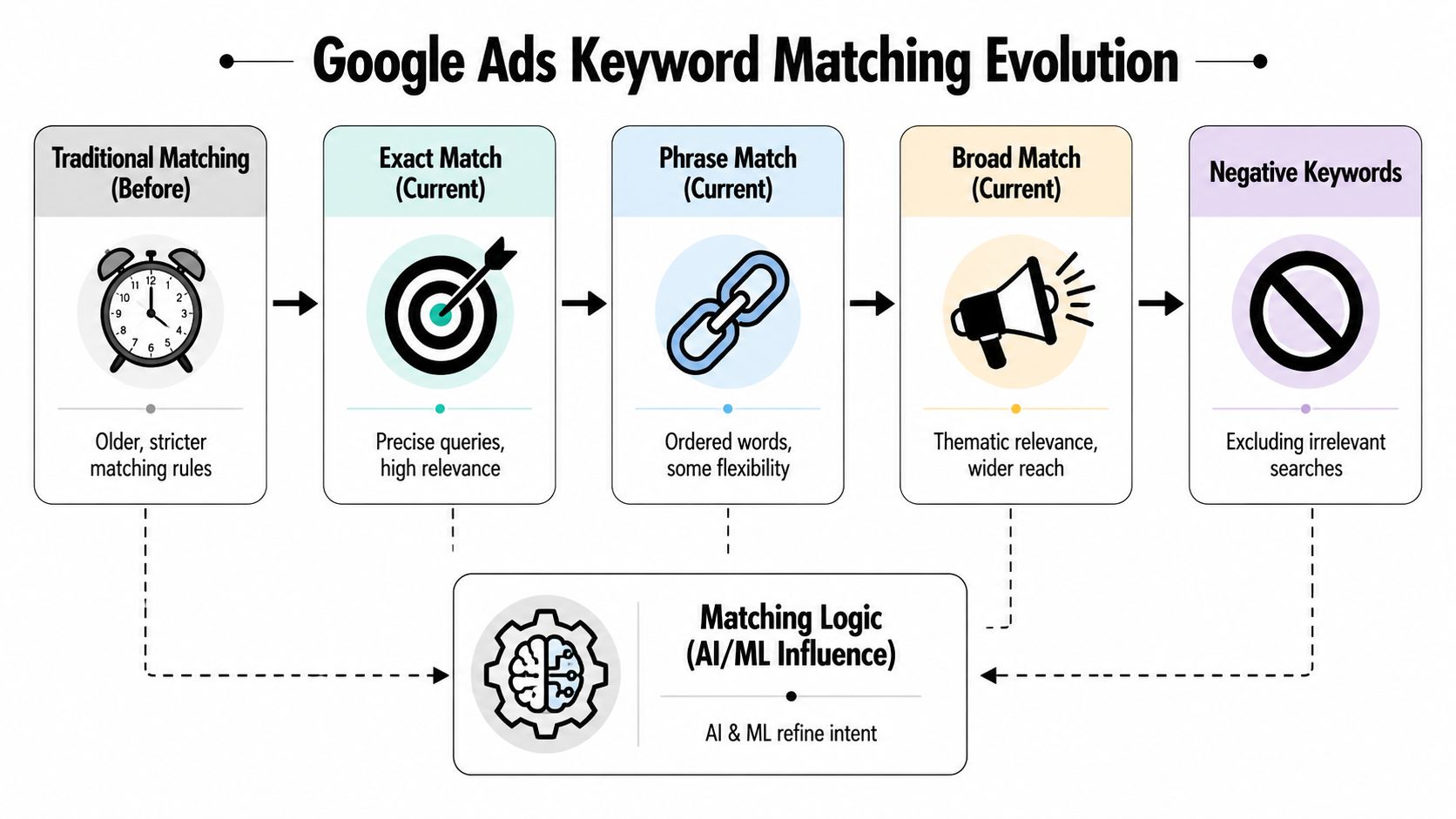
Meaning versus related intent
Think of phrase match as “same idea, somewhat tighter boundaries.” Think of broad match as “same topic family, wider interpretation.”
If your keyword is a high-intent product or service term, phrase match is more likely to stay anchored to that core commercial meaning. Broad match is more willing to explore nearby intent, adjacent needs, and thematic relevance. That can be useful. It can also waste money if your account doesn't have enough data to steer the algorithm.
Why the old definitions mislead people
A junior PPC manager might still think phrase means ordered wording with modest flexibility. In real accounts, that expectation breaks quickly. Matching now relies much more on semantic interpretation than on exact wording patterns.
That's why phrase and broad often overlap more than teams expect.
- Phrase is looser than legacy PPC teams remember
- Broad is no longer just a chaos setting
- Negative keywords matter more because semantic matching expands reach faster
- Smart Bidding changes the outcome because Google uses more signals than the keyword alone
Phrase no longer behaves like a strongly controlled middle option in many accounts. It behaves more like a narrower broad match.
What this means inside live campaigns
This shift changes how you should build and judge campaigns.
A phrase keyword is no longer enough by itself to guarantee tight traffic. A broad keyword is no longer automatically reckless if the campaign has strong conversion signals and disciplined search-term cleanup. So the question isn't which definition sounds better. The question is which type fits the amount of data, budget tolerance, and cleanup effort your team can support.
That's the part many surface-level guides miss.
Broad Match Unpacked The Good The Bad and The Risky
Broad match is best understood as a discovery tool. Google positions it as the default match type and says it uses related-query intent signals beyond exact and phrase in its broad match help page. In practice, that makes broad useful for finding terms your keyword list didn't predict.
That's the good part.
The bad part is that discovery costs money, and not every account can afford to pay for that exploration.
Where broad match actually helps
Broad can work well when you want to uncover real query language from the market. That's especially useful when product naming is messy, buyer vocabulary varies, or searchers describe the same need in several ways.
A healthy broad match workflow usually looks like this:
- Use broad for discovery: Let it surface terms you wouldn't have built manually.
- Mine search terms fast: Pull out strong commercial queries and promote them into tighter match types if needed.
- Build negatives aggressively: Cut off irrelevant themes before they become recurring waste.
- Pair it with automation carefully: Smart Bidding helps, but it doesn't remove the need for account hygiene.
If you're also dealing with suspicious or low-quality clicks, it's worth reviewing LinkJolt's guide on click fraud, because wasted spend isn't always just a match type problem.
Where broad match burns budget
Broad gets risky when advertisers expect precision from a tool designed for exploration.
You'll see this in small lead gen accounts all the time. The account has modest conversion volume, limited history, and no rigorous negative process. Broad starts matching to loosely related searches, traffic quality gets mixed, and the team spends the next week trying to figure out whether the issue is bidding, landing page relevance, or keyword intent. Often it's just broad doing what broad does.
An independent analysis cited by Eight Oh Two's broad match guide reported phrase-match search terms typically generate CPCs within about 12% of average, while broad-match search terms are around 40% worse than the average CPC spread. That doesn't mean broad is always wrong. It means scale often comes with less predictable unit economics.
Broad match is not a precision layer. If you use it like one, the account usually tells on you fast.
For a deeper look at how to structure broad safely, Keywordme has a useful article on broad match keywords in Google Ads.
Phrase Match Re-evaluated Is It Still Relevant
Phrase match still matters. It just doesn't mean what many advertisers think it means.
The old pitch was clean: phrase gives you control without strangling reach. That story is weaker now because phrase has become more meaning-based and less literal. Independent coverage, including Search Engine Journal's phrase match guide, notes that Google's update made phrase match looser and reduced the control advertisers once had.
That sounds like a reason to abandon it. I wouldn't.
Where phrase match still earns its keep
Phrase is still useful when you need a better starting point than broad can give you.
That includes accounts with tight budgets, high-value lead forms, niche B2B offers, local service campaigns with narrow intent, and new launches where you need to understand what “good traffic” looks like before you let the system roam wider. In those situations, phrase gives you a more stable baseline for query quality.
It's also a strong bridge between exact and broad. You can use it to collect cleaner search-term data, identify recurring winners, and learn where intent starts to drift.
Where phrase match disappoints
Phrase becomes a weak choice when people use it for emotional comfort instead of strategic purpose.
If you're running phrase because broad feels scary, but phrase is still pulling in meaning-based variations you weren't planning for, then you're paying for a sense of control rather than actual control. That's where teams get stuck. They don't get the reach advantage of broad, and they don't get the old precision they expected from phrase.
A better way to think about phrase is this:
- Use phrase to establish intent quality
- Use phrase when budget waste would hurt quickly
- Use phrase when the account lacks enough data for broad to behave
- Don't assume phrase alone solves relevance problems
Phrase match still has value, but mostly as a tighter operating mode, not as a guaranteed safety net.
If you want the practical implications of that shift, this write-up on how phrase match changed in recent Google Ads updates is worth reviewing.
Head to Head Performance and Cost Comparison
The easiest way to judge phrase match vs broad match in Google Ads 2024 is to compare them on the things that affect account performance: reach, cost pressure, conversion quality, and labor.
Here's the fast view.
| Factor | Phrase match | Broad match |
|---|---|---|
| Control | Better control, though less strict than before | Lowest control of the two |
| Scale | Moderate | Highest |
| Query quality predictability | Usually cleaner | Usually more volatile |
| Negative keyword workload | Moderate | Heavy |
| Best fit | Smaller budgets, newer campaigns, quality-sensitive lead gen | Mature campaigns, discovery, larger data sets |
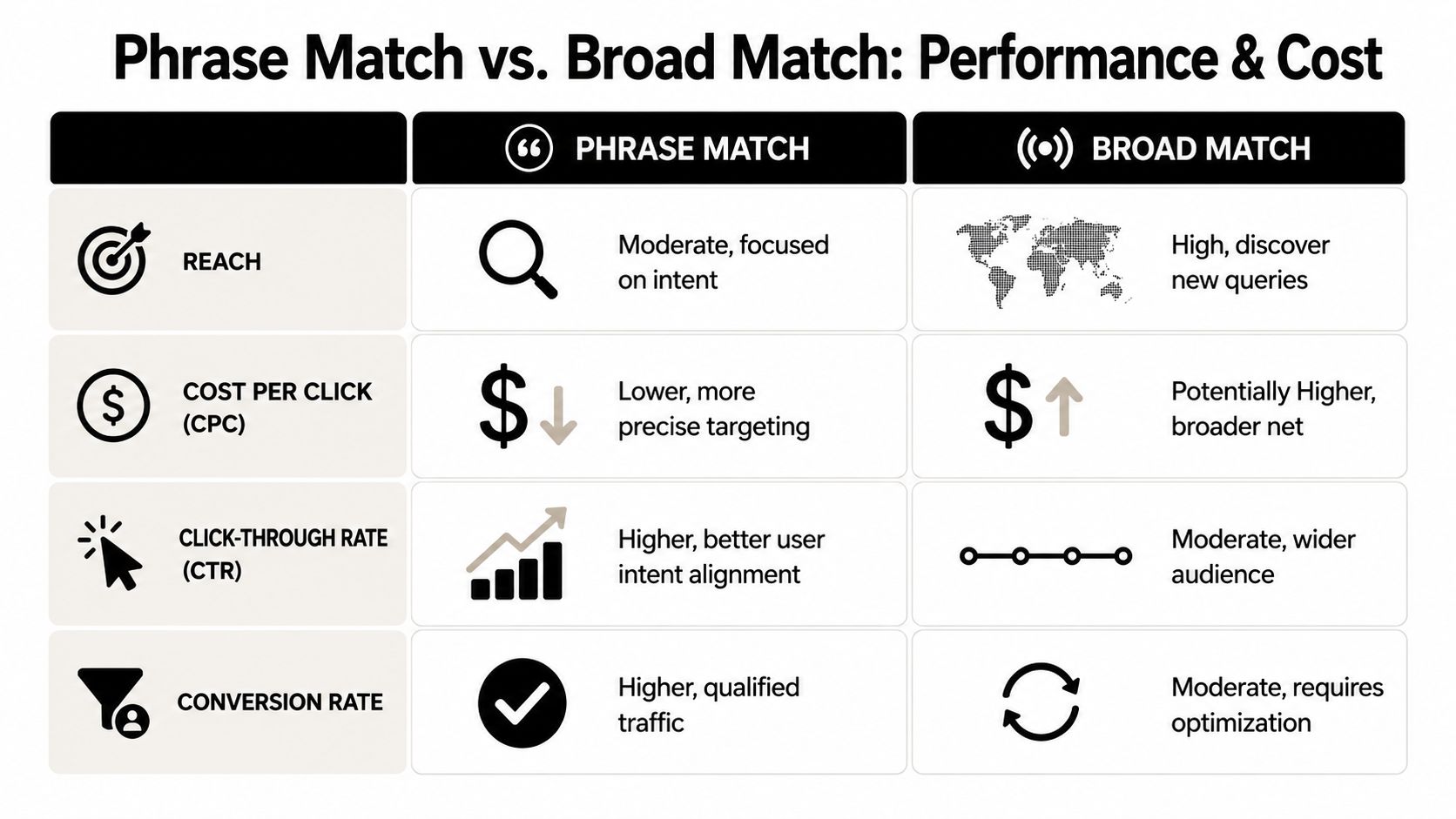
Cost pressure is no longer where many teams expect it
A major shift from the last couple of years is that phrase match hasn't maintained its old cost advantage. Search Engine Land reported that between June 2023 and June 2025, broad match CPCs rose 29% while phrase match CPCs rose 43% in its analysis of why phrase match is losing ground to broad match in Google Ads.
That matters because plenty of advertisers still assume phrase is the cheaper, safer middle option by default. In many accounts, that assumption is getting weaker.
What wins where
Broad usually wins on coverage and discovery. If the campaign already has strong signal quality, broad can uncover commercially useful query themes and help automation work across a wider pool of searches.
Phrase usually wins on traffic discipline. If lead quality matters more than raw volume, phrase still gives you a cleaner operating environment.
This video is a useful companion if you want to see the broader match type discussion in action.
The management burden is the hidden cost
Broad often looks efficient from a distance. Inside the account, someone still has to sort winners from junk, add negatives, watch overlap, and keep query themes aligned with ads and landing pages.
Phrase takes work too, but the cleanup burden is usually lighter. That difference becomes important in lean teams. If nobody has time for search-term maintenance, broad's theoretical upside can disappear in very ordinary account chaos.
For a practical framework, Keywordme's guide on how to compare keyword match types lays out the trade-offs clearly.
Your Strategic Playbook When to Use Each Match Type
The best decision rule right now isn't “broad is modern” or “phrase is safer.” It's minimum viable data.
If the account doesn't generate enough trustworthy conversion signal, broad match often asks Google to make too many judgment calls with too little feedback. That's when broad starts spending like a discovery engine without learning like one.
Start with account readiness
One independent guide recommends testing broad match only in established accounts with 20+ conversions per month, and only where it isn't stepping on phrase or exact coverage, according to Define Digital Academy's match type deep dive.
That's a useful rule because it forces discipline. It asks whether the account has enough signal to support ambiguity.
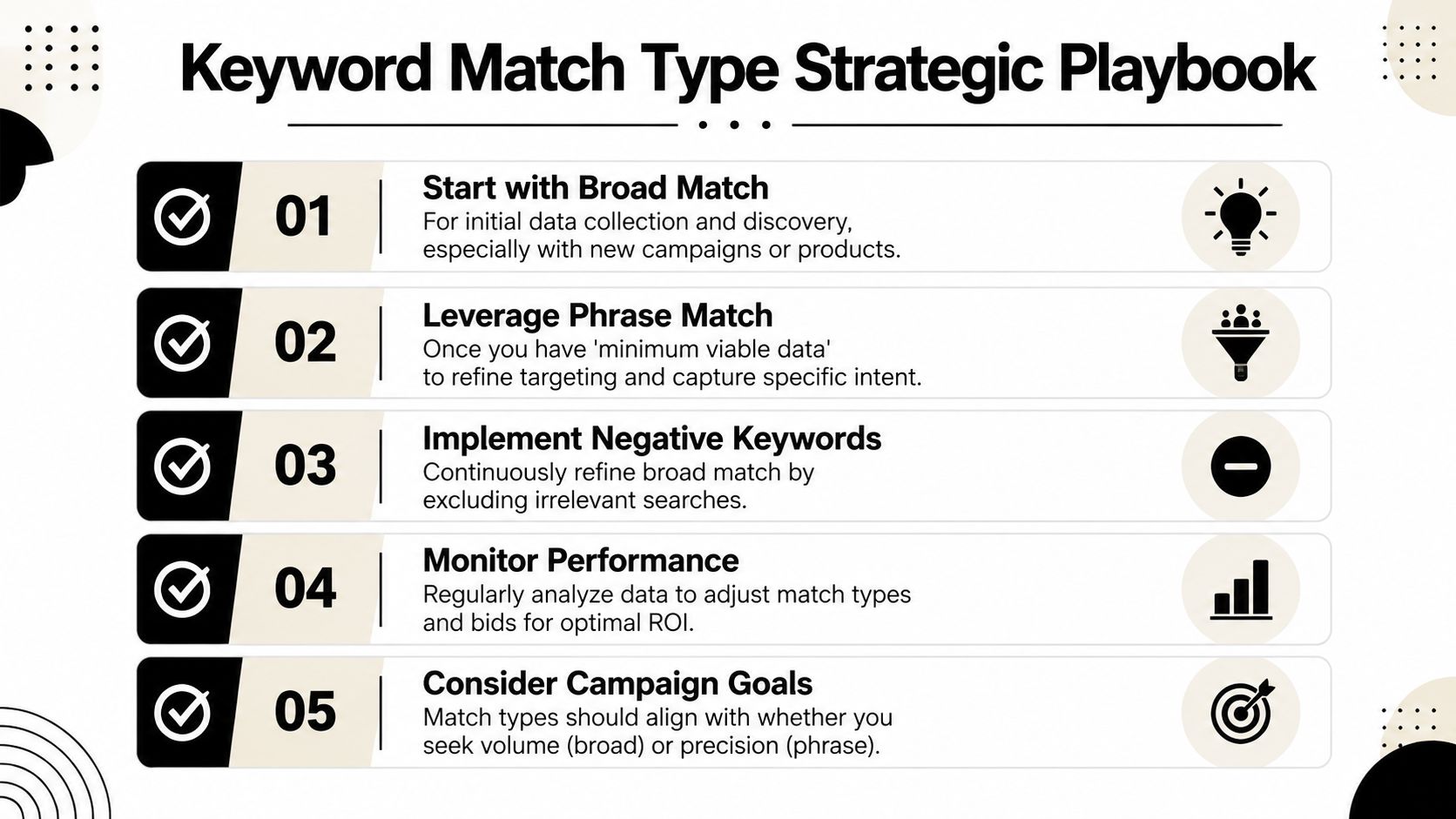
Use phrase match first when these are true
- You're launching a new campaign: You need a cleaner baseline before opening the door wider.
- Lead quality matters more than lead volume: This is common in B2B, high-ticket services, and local categories with expensive sales follow-up.
- The budget is tight: Broad can teach you useful things, but small accounts often can't afford expensive exploration.
- The conversion signal is thin: If the account rarely converts, broad has less to learn from.
Test broad match when these are true
Broad becomes more attractive when the account already has solid conversion tracking, enough volume to teach Smart Bidding, and a team that reviews search terms consistently. It also helps when you're trying to expand beyond the query set your manual keyword research captured.
If you sell online and need help finding stronger commercial terms before you widen matching, this guide to keyword research for Shopify is a useful example of how to tighten intent before you scale.
Don't ask broad match to discover your market, define your intent, and protect your budget at the same time. That's too many jobs for one setting.
The practical play is simple. Start with phrase when the account needs guardrails. Add broad when the account has enough signal and enough management discipline to turn discovery into profit.
Automating Your Workflow with Keywordme
Most of the pain here isn't deciding between phrase and broad once. It's managing the fallout every week after that decision.
Search terms need review. Winners need promotion. Junk needs to become negatives. Match types need updating across multiple keywords and ad groups without turning the work into a spreadsheet marathon.
A practical workflow inside the account
The cleanest process is usually this:
Review the search terms report
Look for three buckets: obvious negatives, promising new queries, and search terms that belong in tighter match types.Apply negatives quickly
Broad only works if cleanup is fast. The longer junk stays live, the more budget it eats.Promote proven queries
If a search term repeatedly shows strong commercial intent, move it into a more deliberate keyword structure instead of hoping the system keeps finding it efficiently.Adjust match types in bulk
This matters more than is commonly appreciated. Manual formatting slows everything down, especially across larger accounts.Repeat on a schedule
Match type strategy falls apart when optimization happens only after spend problems become obvious.
Where tooling helps
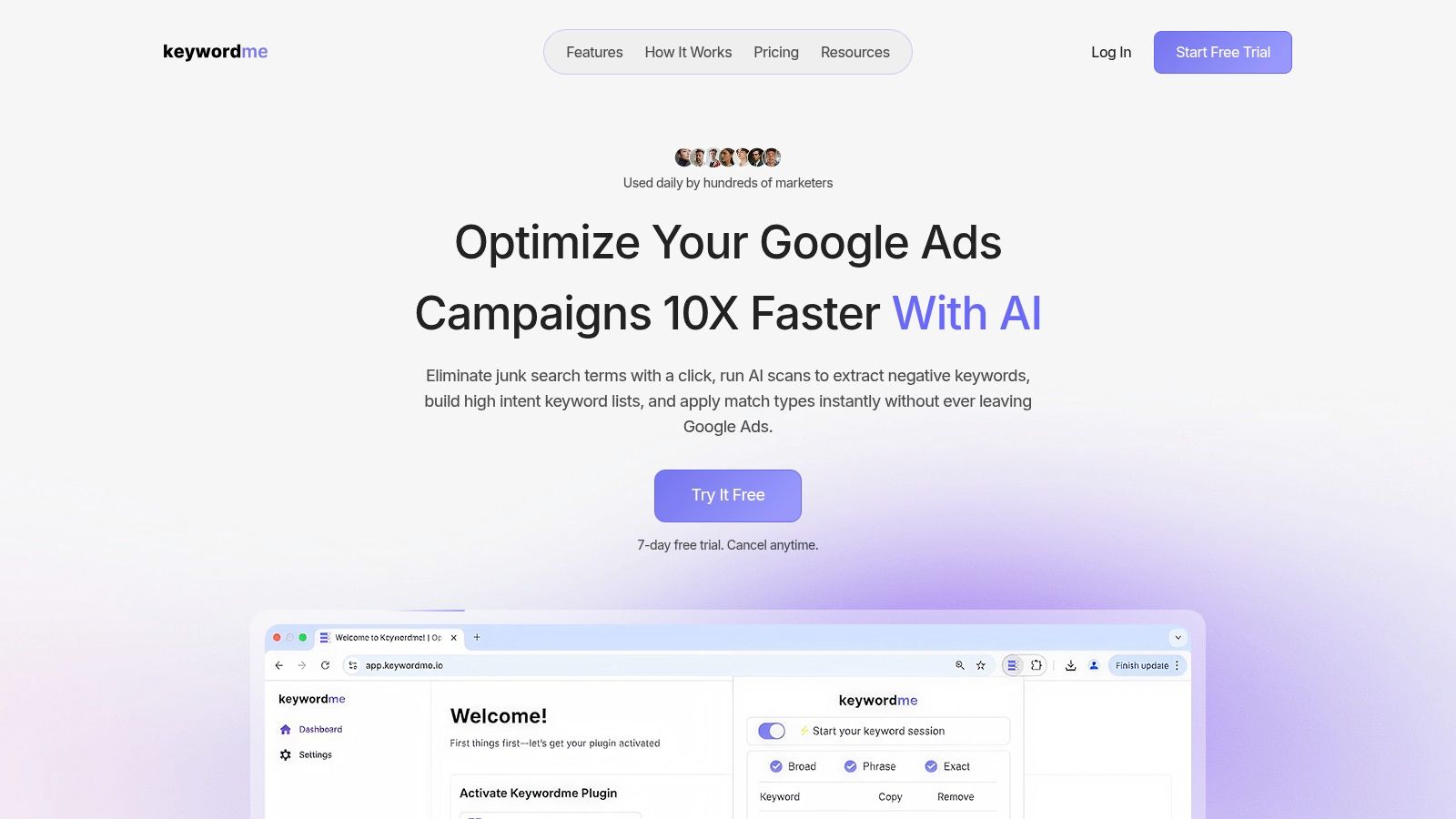
For these needs, a workflow tool such as Keywordme is suitable. It's built for Google Ads keyword handling, including bulk match type application, search term cleanup, negative keyword building, and campaign expansion from real query data inside the Chrome plugin workflow. That's useful when you need to move quickly from “this term is junk” to “exclude it,” or from “this query looks good” to “add it in the right match type” without the usual copy-paste routine.
The bigger the account gets, the less this is about keyword theory and the more it's about execution speed.
That matters whether you favor phrase or broad. Phrase needs disciplined pruning because it isn't as tight as it used to be. Broad needs even more cleanup because discovery without control becomes waste fast. Good systems don't remove judgment. They make judgment easier to apply consistently.
If you're tired of bouncing between reports, spreadsheets, and bulk edit work, take a look at Keywordme. It gives PPC teams a faster way to apply match types, build negatives, and turn search term data into action without slowing down campaign management.
.svg)