
Managed PPC Campaigns: A Guide to Boosting Your ROI
Managed PPC Campaigns: A Guide to Boosting Your ROI


Your ads are live. Money leaves the account every day. You get clicks, maybe a few leads, and a report full of charts that somehow says things are “improving” while your gut says the opposite.
That frustration is usually the result of one simple problem. Nobody is managing the account with enough discipline. A lot of businesses think managed PPC campaigns mean paying someone to launch ads and check in once a month. That's not management. That's babysitting a budget.
Real management is strategy, control, cleanup, testing, and ruthless prioritization. It's deciding what deserves budget, what should be cut, and what should never have been targeted in the first place. If your account has loose match types, weak search term hygiene, sloppy reporting, or blind trust in automation, you're not running a system. You're funding an experiment.
Tired of Wasting Money on Google Ads?
If your Google Ads account feels like a slot machine with invoices, you're not alone. You tried the obvious stuff. You picked keywords, wrote ads, set a budget, and hoped intent would do the heavy lifting. Then the clicks came in, the costs kept climbing, and the sales team started asking why the leads were junk.

This is exactly why managed PPC campaigns matter. PPC is mainstream now, not some optional growth channel. About 65% of small to mid-sized businesses run PPC campaigns, and businesses earn an average of $2 in revenue for every $1 spent on Google Ads, according to Mailmodo's PPC statistics guide. The opportunity is real. The waste is real too.
What wasted spend usually looks like
Most weak accounts suffer from the same problems:
- Bad keyword control: Broad targeting pulls in irrelevant searches.
- No negative keyword discipline: You keep paying for traffic that was never going to convert.
- Lazy bidding choices: Either fully manual with no time to manage it, or fully automated with no guardrails.
- Weak landing page alignment: The ad promise and the page offer don't match.
- Reporting theater: Plenty of clicks, no clear line to profit.
Managed PPC campaigns should reduce uncertainty, not just generate activity.
If you're in a competitive vertical, the cost of getting this wrong gets ugly fast. Legal advertisers know this better than most. If you want to see how specialized strategy matters in a tough market, this breakdown of personal injury PPC is worth your time.
The fix is management, not more tinkering
You do not need more random tests. You need someone treating your ad account like a profit system. That means tighter targeting, better query review, cleaner campaign structure, and a clear decision process for scaling or cutting spend.
If your campaigns feel messy, start by reviewing the common failure points in this guide on solving Google Ads problems. Then decide whether you want to keep spending your own time learning through mistakes, or hire a team that already knows where money leaks out.
What Are Managed PPC Campaigns Really
Managed PPC campaigns are not “we run your ads for you.” That definition is way too soft. A better comparison is this: self-managing PPC is like trading your own retirement account while reading forum posts at midnight. Managed PPC is hiring someone to protect the downside, allocate capital properly, and make decisions based on evidence instead of mood.
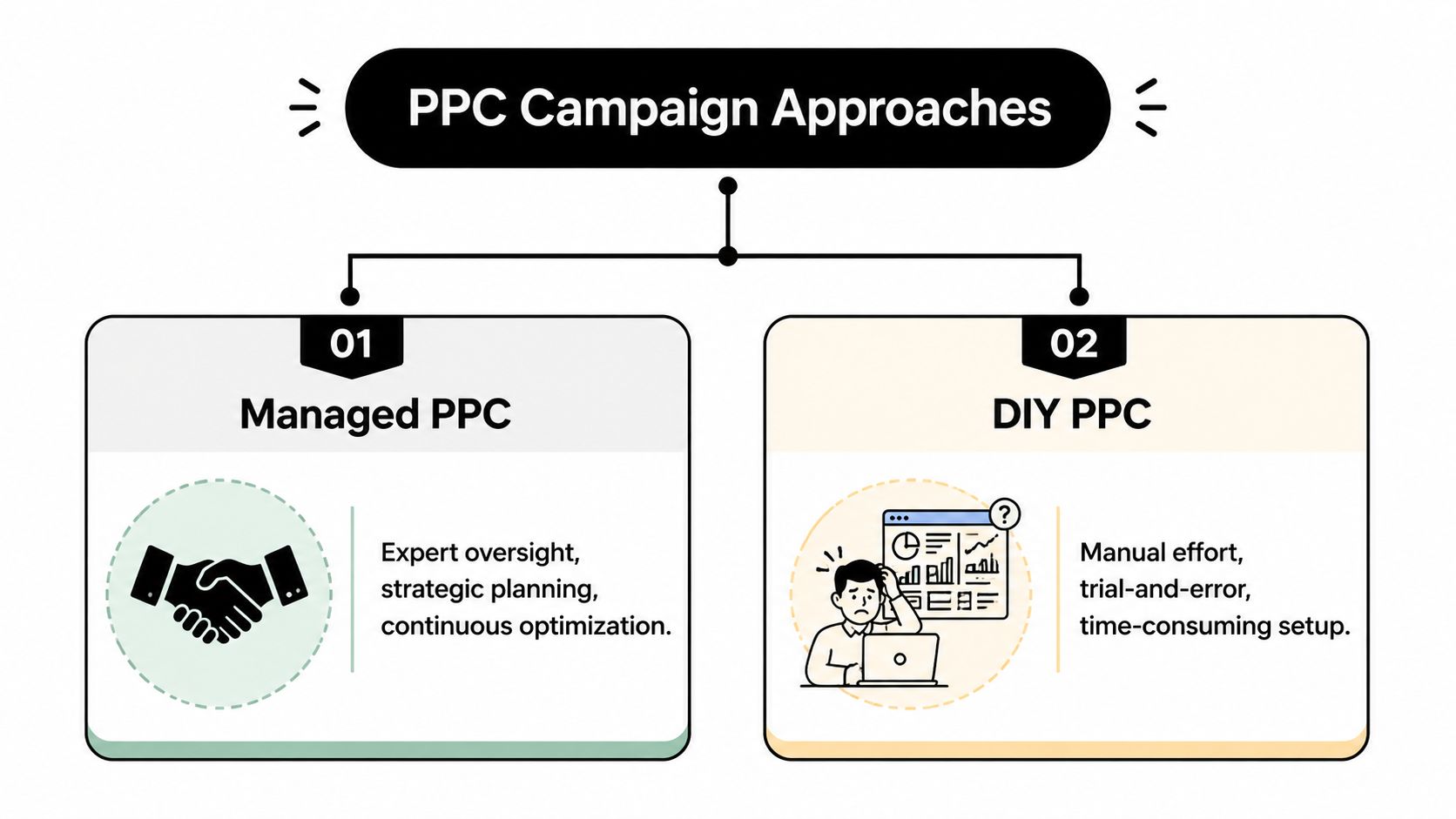
A real provider handles the full operating system behind paid search. That includes account structure, keyword research, audience targeting, ad copy, bid strategy, search term review, negative keyword expansion, landing page recommendations, tracking setup, and reporting that ties performance back to business outcomes.
What you're actually paying for
Good management usually covers these jobs:
| Function | What it means for your business |
|---|---|
| Strategy | Campaigns match your goals, margins, and sales process |
| Execution | Ads, keywords, audiences, and extensions are built correctly |
| Optimization | Waste gets cut, winners get more budget |
| Tracking | You can see what leads to revenue, not just clicks |
| Reporting | Decisions are based on performance, not vanity metrics |
That last point matters more than most clients realize. A lot of PPC accounts are active but unmanaged. The campaigns are running, but nobody is aggressively pruning bad traffic, refining search intent, or forcing the platform to work inside real business constraints.
Automation helps, but it doesn't replace judgment
Modern PPC is heavily automated. Automated bid strategies are projected to manage 78% of all Google Ads spend as of 2026, and advertisers using smart bidding report 14% higher conversion rates on average than manual bidding, based on Digital Applied's PPC statistics data. That doesn't mean you hand the keys to Google and walk away.
Smart bidding works when the account has clean inputs, reliable conversion tracking, and someone watching for bad traffic, weak queries, and misplaced budget. Without that, automation just gets better at spending money quickly.
Practical rule: Let automation handle bid calculations. Keep humans in charge of strategy, targeting, and cleanup.
If you're evaluating agencies, don't just ask whether they “use AI” or “use automation.” Ask how they override it, when they limit it, and what they do when platform recommendations conflict with your economics. This guide on choosing a PPC management partner gives a useful outside perspective on what that vetting process should look like.
Managed vs Self-Managed PPC An Honest Breakdown
Some businesses should manage PPC in-house. Most should not. That's the honest answer.
If you have a sharp operator on staff, enough time to monitor search terms, strong landing pages, reliable tracking, and the appetite to learn the platform thoroughly, self-management can work. But most business owners are not short on platform access. They're short on time, focus, and tolerance for expensive mistakes.
The side-by-side reality
Here's the tradeoff in plain English:
| Decision area | Self-managed PPC | Managed PPC campaigns |
|---|---|---|
| Time | You own all setup, review, testing, and reporting | A specialist handles day-to-day work |
| Learning curve | Steep, especially once campaigns scale | Much lower on your side |
| Control | Maximum direct control | Shared control with expert guidance |
| Speed of fixes | Often slow because PPC competes with other priorities | Faster if the manager is proactive |
| Tool access | Usually basic unless you buy more software | Often includes a stronger tech stack |
| Risk of waste | Higher if query review and structure are weak | Lower if the provider is competent |
The big mistake is thinking “control” means “better outcomes.” It doesn't. Plenty of owners keep full control over accounts they barely have time to check. That's not control. That's neglect with admin access.
When self-management makes sense
Self-managed PPC can be reasonable if:
- You run a simple offer: One service, one geography, one clear conversion action.
- You enjoy the work: Some founders like being inside the account.
- You can review often: PPC punishes neglect. If you can't check search terms, bids, and lead quality consistently, don't do this.
- You already understand sales quality: Not every lead is equal, and the platform won't figure that out for you.
If that sounds like your setup, you may benefit from learning more about self-serve advertising platforms and where they fit.
When managed PPC is the better call
Managed PPC campaigns are usually the right move when any of the following are true:
- Your clicks are expensive enough that mistakes hurt
- Your team is stretched thin
- You need clean reporting for leadership
- Your market is competitive
- You need someone to challenge bad assumptions, not just push buttons
DIY PPC saves the management fee. It often costs more in wasted spend, bad traffic, and delayed learning.
A strong provider also brings process. They know how to segment campaigns, isolate intent, structure ad groups sensibly, and stop budget from bleeding into low-value traffic. That process is what most DIY accounts are missing.
My recommendation
If your monthly ad budget is meaningful to the business, don't treat PPC like a side task. Either assign it to a serious in-house operator with time and authority, or hire someone who lives in these accounts every day.
Half-managed PPC is usually the worst option. That's when the owner checks in occasionally, an assistant uploads a few changes, and the platform fills the gaps with recommendations that mostly help the platform spend more. Pick a lane. Build the skill in-house, or buy it from someone who already has it.
Decoding Service Models and Pricing
PPC pricing gets murky because many agencies sell the same service in different packaging. The model matters because incentives matter. If your provider gets paid in a way that rewards more spend instead of better outcomes, you need to know that before the contract starts.

The common pricing models
Percentage of ad spend
This is common because it's simple. Spend goes up, fee goes up.
That simplicity is also the problem. A percentage-of-spend model can implicitly reward bigger budgets, even when bigger budgets aren't the right move. It doesn't automatically mean the agency is bad. It means you need stronger accountability around efficiency and business outcomes.
Flat monthly fee
This gives you predictability. You know the management cost, and budgeting is easier.
The downside is mismatch. A flat fee can work well if the scope is clear, but it can also hide under-servicing on larger accounts or overcharging on small, simple ones.
Performance-based pricing
This sounds great because incentives seem aligned. Sometimes they are.
In practice, the details matter a lot. You need very clear definitions for what counts as a lead, what counts as a sale, how attribution works, and what happens when sales cycles are long or involve multiple touchpoints.
Attribution is where cheap pricing falls apart
A cheap manager who reports only last-click wins can make weak decisions look smart. That's dangerous. Effective managed PPC campaigns require stronger attribution modeling because organizations using last-click attribution systematically underinvest in awareness-stage keywords, which leads to reduced market share growth, as explained in Straight North's PPC strategy guide.
If your provider doesn't talk about attribution, they're probably overvaluing the easiest conversions and starving the campaigns that create future demand.
The fee matters. The decision quality behind the fee matters more.
A better provider often costs more because they're doing harder work. They're cleaning data, validating tracking, questioning attribution, and making budget calls based on the full customer journey instead of whatever got the last click.
What to ask before you sign
Use this short checklist:
- What's included: Ask exactly which tasks happen weekly, not just monthly.
- Who touches the account: Sales rep, strategist, junior specialist, or all three?
- How reporting works: You want business clarity, not dashboard screenshots.
- How they handle attribution: This separates operators from presenters.
- What happens if performance stalls: You need a plan, not excuses.
Before you compare proposals, it helps to hear how agencies frame these arrangements in practice:
Key Performance Indicators You Must Track
Most PPC reports are padded with numbers that feel busy and say very little. Clicks, impressions, average position, view metrics. Nice to know. Not enough to run a business.
You need a small set of KPIs that tell you whether the account is producing profitable customer acquisition. If your provider can't connect performance to those numbers, the reporting is decoration.
Focus on these four metrics
Conversion rate
This tells you how efficiently traffic turns into leads or sales. But context matters. Google Ads conversion rates vary by industry. HVAC contractors can reach 6.5% on Google Search ads, e-commerce businesses average 3.49%, and IT and managed services average 1.6%, according to Shopify's PPC statistics roundup.
That means a conversion rate that looks weak in one market may be normal in another. Stop comparing your account to random screenshots online.
Cost per acquisition
CPA tells you what you paid to get a customer or lead. This is one of the fastest reality checks in PPC. If the CPA works with your margins, the campaign may be healthy even when surface-level metrics look average.
Return on ad spend
ROAS answers the essential question for owners. Did the spend produce enough revenue to justify itself?
If your business tracks revenue clearly, this should be front and center. If it doesn't, fix the tracking before debating creative or bids.
Customer lifetime value
Some leads look expensive until you measure what they're worth over time. Businesses with repeat purchases, contracts, or strong retention should not judge every campaign through a short-term lens.
The KPI trap to avoid
A low conversion rate does not always mean the campaign is failing. A high click-through rate does not always mean the campaign is healthy. Metrics only matter in relation to cost, lead quality, sales close rate, and value per customer.
Reality check: A campaign with fewer conversions can be better if those conversions are the right buyers.
If you want a stronger framework for reading your own reports, this guide on PPC performance metrics you need to track is a solid next step.
What a useful report should answer
Your reporting should make these questions easy to answer:
- Where is the budget going
- Which campaigns produce qualified leads
- Which search terms waste spend
- What changed since the last review
- What action is being taken next
If the report doesn't drive decisions, it's not a management tool. It's a document.
How to Choose the Right PPC Partner
Most PPC providers know how to sell confidence. Fewer know how to run a disciplined account. You do not need the smoothest pitch. You need a partner who can explain their process clearly, defend their decisions, and show how they think when the account gets messy.
Ask better questions
Most clients ask the wrong things. They ask how long the agency has been in business, whether they're certified, and if they've worked in the industry before. Those questions are fine, but they don't tell you how the account will be managed.
Ask these instead:
- How often do you review search terms
- How do you build and maintain negative keyword lists
- What do you optimize manually even when automation is active
- How do you judge lead quality beyond form fills
- What does your reporting look like when performance drops
- What tools are in your workflow
A real operator won't be annoyed by those questions. They'll welcome them.
Watch for red flags
Bad partners usually reveal themselves fast:
| Red flag | What it usually means |
|---|---|
| They talk mostly about clicks | They may not understand business outcomes |
| They promise fast wins without qualification | They're selling certainty they can't control |
| They won't explain account structure | There may be no clear system |
| They rely only on platform automation | They're outsourcing judgment to Google |
| They avoid tool discussions | Their workflow may be manual and sloppy |
Communication matters too. You want someone who can say, “This campaign is attracting the wrong intent, and we're cutting it,” not someone who buries weak performance under soft language.
The partner should feel operational, not theatrical
A good PPC partner acts like part of your team. They ask about sales feedback. They care whether leads are qualified. They push for cleaner tracking. They challenge broad targeting when it's causing damage.
Good agencies don't just explain results. They explain decisions.
If you're still deciding whether to keep PPC in-house or hand it off, this article on in-house vs agency marketing will help you pressure-test the fit.
My advice is simple. Hire the team that can show you how they think. Fancy decks are cheap. A repeatable optimization process is not.
How Keywordme Supercharges Managed Campaigns
Most PPC waste starts in the weeds. Search terms pile up, irrelevant clicks slip through, and match types get messy. Then the account manager spends hours doing cleanup that should have taken minutes. You pay for that inefficiency one way or another.
This is where the tech stack behind managed PPC campaigns matters. Up to 30% to 50% of ad spend is wasted on irrelevant clicks due to poor negative keyword management, and AI-driven tools like Keywordme automate negative keyword list building and bulk match type assignments, cutting workflows by up to 10x, based on the verified data tied to NetLynx's PPC skills discussion.
Why this matters to clients
You should not be paying management fees for endless copy-paste work. You should be paying for judgment, prioritization, and performance decisions.
When a team uses better tooling, a few good things happen fast:
- Negative keyword cleanup gets tighter: Less junk traffic, less wasted spend.
- Match type control improves: Search intent gets cleaner.
- Query mining becomes scalable: Managers can process more data without drowning in it.
- Strategy gets more time: Less grunt work means more attention on account direction.
That's the core value of tool-assisted management. It doesn't replace the human. It makes the human more useful.
If you're hiring for managed PPC campaigns, ask what the team uses for search term analysis, negative keyword workflows, and match type handling. If the answer sounds painfully manual, expect slower optimization and more room for error.
If you're tired of paying for clicks that never should've happened, take a serious look at Keywordme. It helps PPC teams clean search terms, build negative keyword lists, and apply match types without the usual manual slog, so your budget goes toward strategy and performance instead of account janitorial work.
.svg)