
Local Services Ads Ranking Factors That Matter
Local Services Ads Ranking Factors That Matter


Raise your bid and you'll rank first. That's the most common advice on Local Services Ads ranking factors, and it's the fastest way to misread the system. Bid matters, but Google built LSAs to match a nearby searcher with a screened, relevant provider who responds. If you treat it like a standard keyword auction, you'll fix the wrong lever first.
Why LSA Visibility Is More Than Bid
Two providers want the same local request. One bids more but misses calls, has thin profile details, and lists a service area the team rarely covers well. The other bids less, matches the job cleanly, and answers fast. There's no documented reason to assume the higher bid wins every time.
Google describes placement as an auction that combines your bid with expected lead potential and profile quality, and its inputs include responsiveness to inquiries, search relevance, rating, review count, response time, images, verification, and other business information, without publishing universal percentage weights, as set out in Google's documentation on how Local Services Ads ranking works. That's the key discipline for any analyst. You can work with documented inputs, but you can't assign them fixed shares.
A Better Mental Model Than Highest Bidder Wins
Think in four layers. Eligibility decides whether you can enter at all. Demand fit decides whether you match the service and location requested. Auction strength covers bid and budget. Operational performance covers whether your team answers, replies, and earns feedback that supports continued visibility.
That order changes troubleshooting. If verification is incomplete, bid tweaks are premature. If the job type is wrong, a bigger budget buys more of the wrong demand.
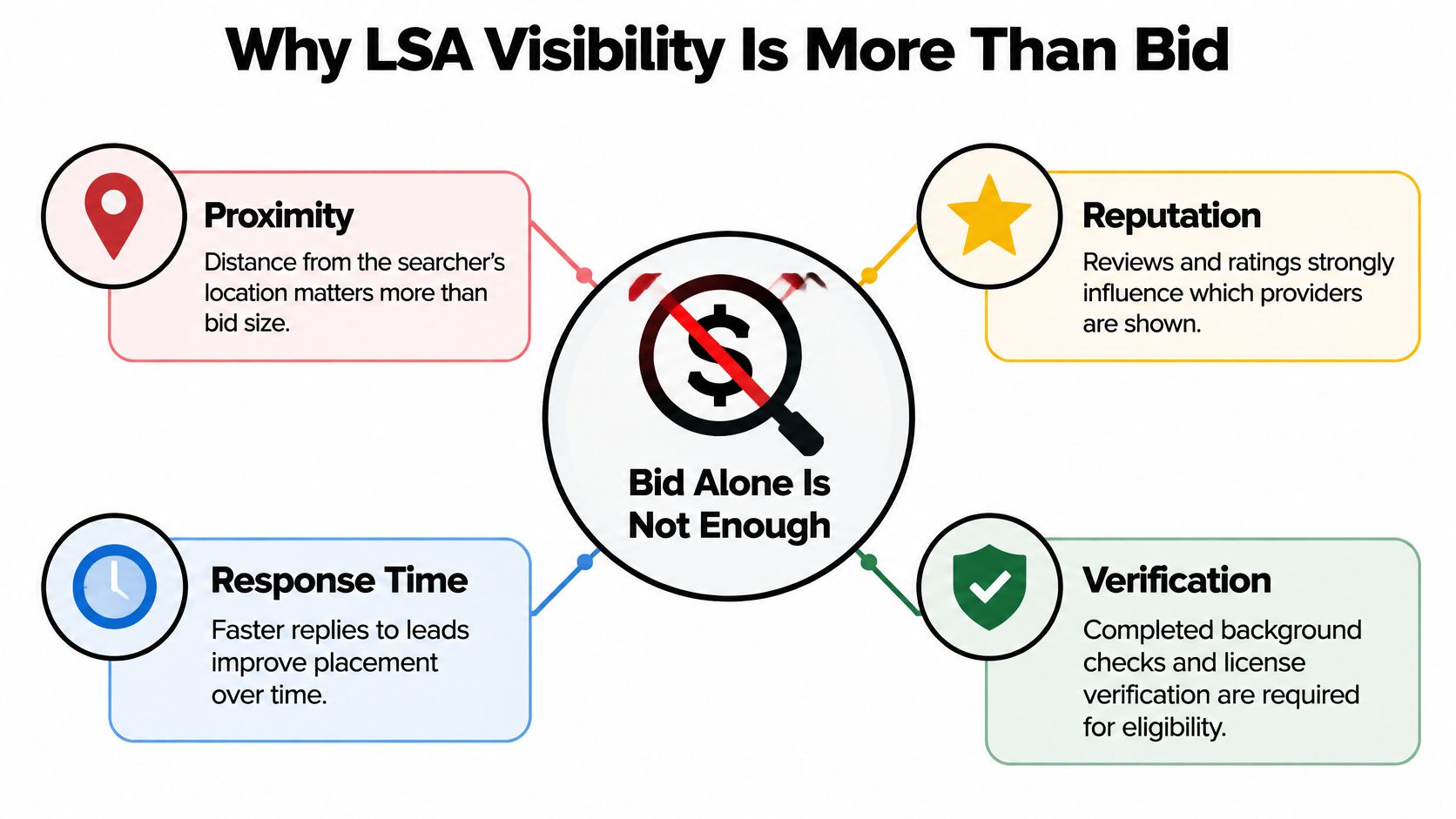
A homeowner comparing painters cares about trust and fit before price signals, which is why resources like I PAINT STUFF hiring tips are useful context for how buyers evaluate a local provider. Google's system points in a similar direction, toward credibility and relevance, not bid alone. For the setup basics behind that model, our guide to how Local Service Ads work for providers covers the format before you start testing.
Bid can help a qualified, relevant, responsive provider compete harder. It doesn't repair a provider who isn't qualified, relevant, or responsive.
How the LSA Auction Shapes Placement
A search starts the process, not your bid sheet. Someone requests a specific service in a specific place, and Google first narrows the field to providers who appear eligible and relevant for that request. Only then does auction competition mean much.
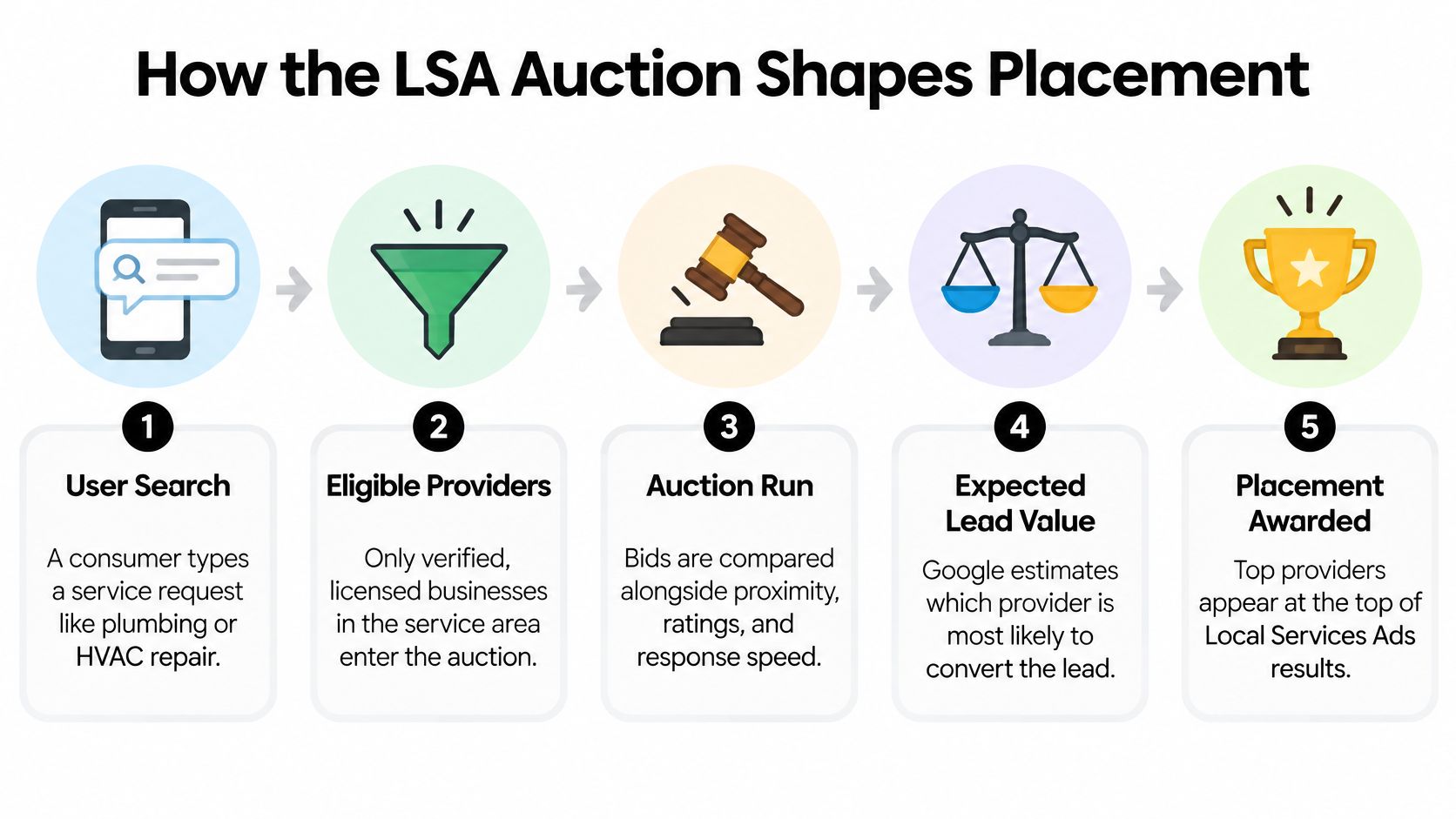
Expected lead potential is the phrase many teams gloss over. In plain terms, Google isn't just asking what you'll pay. It's estimating whether this search is likely to become a useful lead for this provider, based on the match between request, category, geography, and profile strength. That estimate is auction dependent, so the same business won't carry identical strength into every search.
What Bid Actually Buys You
Raising a bid can move an ad higher. Google is clear on that direction, and experienced buyers shouldn't pretend budget is decorative. But the same guidance stresses that quality service still matters, especially responsiveness and reviews. A stronger profile may also support better placement and, in Google's own framing, may pay a lower cost per lead than a weaker profile competing for similar demand.
That's an important analyst distinction. Ranking and cost per lead are related, but they aren't the same outcome. A bid increase that lifts visibility while your missed calls climb can produce expensive, fragile volume. A profile improvement that lifts trust and response quality can improve both competitiveness and efficiency, though Google doesn't promise either result in a specific case.
- Relevance first: The service requested has to line up with the services and areas you've declared.
- Quality alongside bid: Rating, review count, images, verification, and business information shape profile quality.
- Behavior after the click: Missed calls and slow replies weaken the responsiveness story Google can observe.
Why the Auction Is Not Fully Visible
You can't see Google's internal weighting, and you shouldn't invent one to fill the gap. What you can see are inputs you control and outcomes you record, such as lead volume by service and area, response behavior, and booked jobs. Treat the auction like a scored competition with partly hidden scoring. Your job is to remove documented weaknesses first, then test auction levers with clean notes.
This also explains a frustrating pattern. A provider raises budget, sees a short lift, then stalls. The bid change helped compete, but it didn't fix relevance, availability, or answer rates. Once those constraints bind, more money pushes against a ceiling the money didn't create.
Local Services Ads Ranking Factors Compared
Eligibility isn't the same as relevance, and relevance isn't the same as auction strength. Teams blur those categories, then wonder why a verified business still gets weak placement or why broad coverage produces poor-fit leads. Separating what Google can evaluate from what you can control makes the diagnosis cleaner.
Requirements also vary by category and location, and businesses must pass screening and verification that may include background checks, business-registration checks, insurance checks, license checks, and minimum review requirements, as described in Google's screening and verification requirements for Local Services providers. Until that gate is cleared, ranking talk is mostly theoretical. You can't optimize responsiveness for leads you aren't eligible to receive.
LSA Ranking Factor Decision Guide
| Factor | What Google evaluates | Marketer control | Best optimization action |
|---|---|---|---|
| Verification and eligibility | Completed checks, licensing, insurance, registration, category requirements | High, but approval isn't instant | Finish every requested check and keep documents current |
| Proximity and service area | Fit between searcher location and your declared coverage | Medium | Claim only areas your team can serve promptly and profitably |
| Job match | Whether selected job types match the request | High | Enable services you genuinely perform, remove poor-fit work |
| Bid and budget | Willingness to pay and remaining capacity to compete | High | Fund proven services first, judge cost against booked jobs |
| Responsiveness | Answering calls and messages, average response time, missed calls | High | Protect call coverage during every advertised hour |
| Reviews and rating | Rating, review count, and customer feedback patterns | Medium | Build a repeatable post-job review request process |
| Profile completeness | Images, business information, hours, service details | High | Complete every field with accurate, current information |
| Business hours | Whether you're available when demand arrives | High | Match advertised hours to real staffing, not ambition |
Read the dependencies in that table, not just the rows. Broader coverage can create more chances to be relevant, but it doesn't guarantee placement, and it can dilute fit if travel time slows response or lowers close rates. Tighter coverage can sharpen fit while reducing total opportunity.
Budget works the same way. A small budget can limit how much you can test, even when your profile quality is strong. That doesn't erase the quality benefit. It means you have less auction participation in which to prove it.
Decision rule: Fix blocking eligibility first, then fit, then response behavior, then bid. Reversing that order spends money to learn what a checklist would have told you.
Notice what the table doesn't do. It doesn't rank factors by invented weight, because Google hasn't published one. Some factors are documented inputs. Others, like exact proximity influence in a given market, you can only infer through careful local testing. Keeping those categories separate is what makes your conclusions trustworthy.
Actionable LSA Ranking Improvements
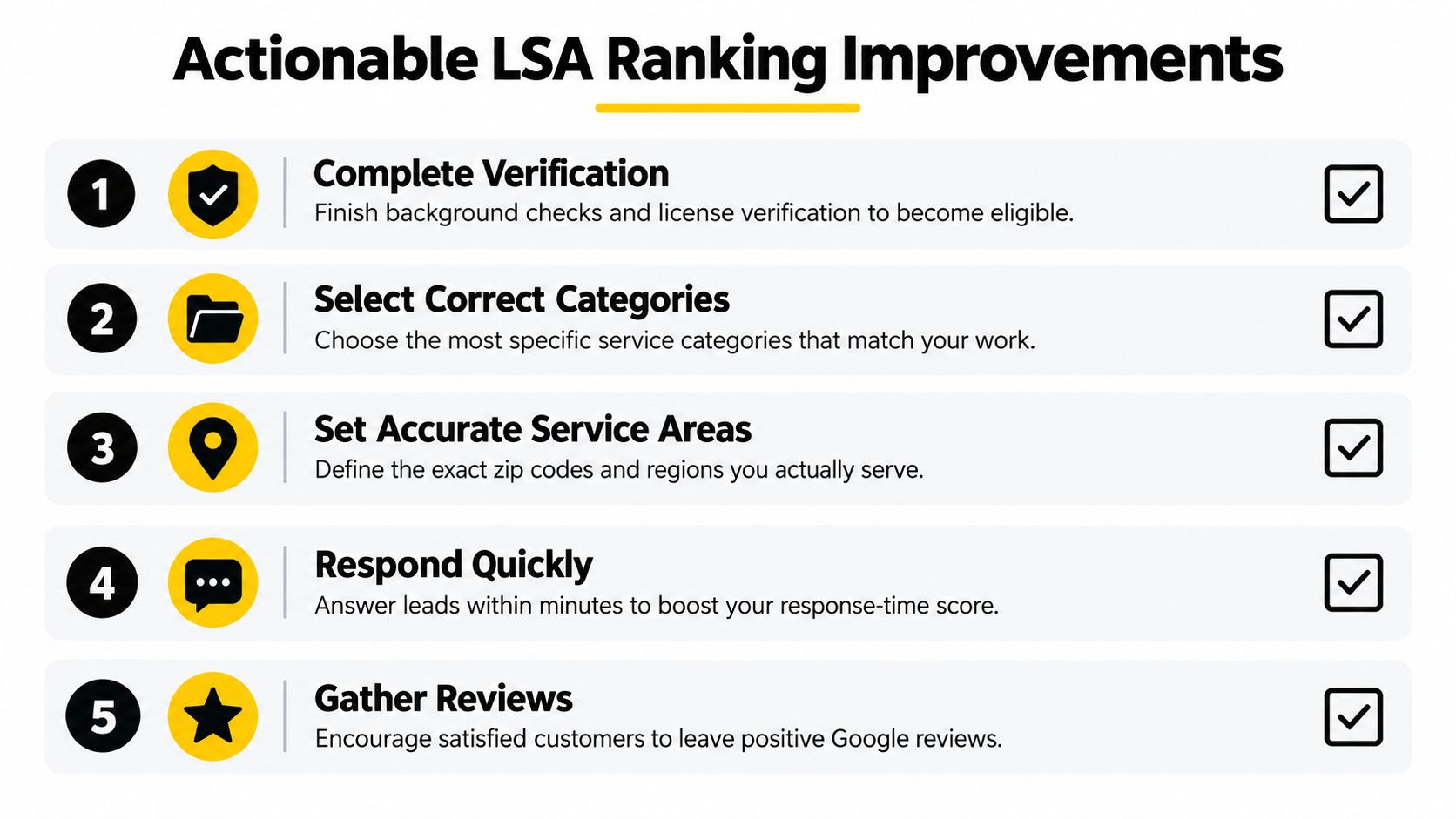
Start where failure is binary. Confirm your category is eligible in your market, complete every screening step Google requests, and keep license, insurance, and registration details current. If Google asks for a review of your information, treat it as urgent operational work, not admin clutter, because incomplete verification can block the badge and the ads behind it.
Next, audit job types against work your crew wants and can deliver well. Remove services you routinely decline, subcontract reluctantly, or price so defensively that callers rarely book. Declined and poor-fit leads teach your team the wrong lesson and waste response capacity you need for good demand.
Protect Responsiveness Like Revenue
Set up call routing so an LSA lead reaches a person who can qualify and book, not a voicemail box nobody checks until lunch. Cover breaks, job-site hours, and message replies with named owners. Log missed calls and slow responses by time of day, then fix the staffing gap that produced them instead of blaming lead quality in general.
Align business hours with that coverage. Advertising availability you can't staff creates a predictable loop, more inquiries arriving when nobody answers, weaker responsiveness, and harder questions about visibility later. It's better to be reliably reachable in defined hours than nominally open and practically absent.
Strengthen Trust and Profile Quality
Build review requests into job closeout, while the work is fresh and the customer knows whom they're rating. Respond professionally to feedback, especially critical feedback, and fix recurring complaints at the source. Treat images the same way, using clear, current photos that show real people, vehicles, and finished work rather than generic stock imagery.
Profile completeness is unglamorous, which is why competitors neglect it. Check service descriptions, hours, areas, and business information for contradictions across your LSA profile and your wider web presence. A homeowner researching urgent help, for example someone comparing providers for emergency fire water mold restoration, will cross-check details quickly, and inconsistency erodes the trust your verification was meant to establish.
Spend With a Booked-Job Standard
Set bids and budgets from the value of a booked, profitable job, not from lead volume alone. Fund your proven core services and tightest service areas first, then expand into adjacent demand with separate tracking so you can see whether fit holds. If budget runs out early in the day, decide deliberately whether that reflects healthy demand worth funding or broad targeting worth narrowing.
For teams also running search campaigns, our breakdown of Google Ads tactics for local businesses helps separate keyword-level control from the profile and operations control LSAs demand. The channels complement each other, but they don't reward identical habits. LSA gains usually come from boring consistency, answered calls, accurate areas, current documents, and reviews earned job after job.
Run improvements in a fixed review order each month. Check eligibility and verification, then job types and areas, then responsiveness logs, then reviews and profile quality, then bid and budget. That sequence keeps you from fine-tuning spend on top of a structural problem.
How Ranking Factors Work Together
These scenarios are explanatory models, not case studies, and they don't reveal Google's weights. They're useful because ranking rarely turns on one factor acting alone. A daytime request from inside your core area lets several strengths stack at once, clear job match, credible profile, staffed phones, and a competitive bid.

That design traces back to the product's origin. LSAs were built around matching consumers with locally screened providers, using trust mechanisms such as background checks and the Google Guaranteed badge rather than conventional keyword-only placement, as Google explained in its announcement of Local Services for small businesses. So the daytime provider isn't winning on one trick. The business looks eligible, relevant, and reachable at the same moment.
When Hours and Coverage Change the Picture
Now move the same request to the edge of that provider's area, outside normal hours. The bid hasn't changed, but the opportunity has. Travel is longer, staffing is thinner, and the chance of a missed call rises. A closer competitor with staffed coverage may present the safer match for the searcher, even before bid differences enter the reasoning.
Directory style demand shows the same fit problem in another category. Someone browsing a Pennsylvania iPhone repair directory still narrows by location, availability, and trust before contacting anyone. Local intent is always specific, and generic breadth rarely beats a precise match.
The short walkthrough below is useful for visualizing how a searcher moves from request to shortlist before any provider gets paid.
A highly rated provider with weak lead handling shouldn't be assumed to dominate, either. Reviews support trust, but repeated missed calls tell a different operational story. The reverse also holds. A responsive team with a modest bid can still struggle if a license lapsed, a job type is missing, or the declared area doesn't fit the search. Interaction is the point. One strength rarely cancels a blocking weakness elsewhere.
Measure and Test Ranking Factors
You can't inspect Google's auction directly, so your evidence has to come from disciplined records. Start with a baseline period where you change nothing, and log eligibility status, verification state, profile completeness, hours, service areas, job types, bid settings, and budget. Without that snapshot, every later conclusion is guesswork dressed as analysis.
Segment results by service, location, time of day, and lead source before you judge performance. Blended lead counts hide the exact patterns ranking work depends on, such as one area producing booked jobs while another produces price shoppers, or one job type generating calls your team keeps declining. Device splits can help too, mainly as a prompt to check how quickly mobile inquiries get answered.
Track Outcomes Past the Lead
- Operational metrics: Average response time, missed calls, and message reply gaps by hour.
- Quality metrics: Qualified leads, booked jobs, completed revenue, and poor-fit reasons.
- Auction metrics: Impressions, lead volume, and cost per qualified lead after each change.
- Profile metrics: Review count, rating movement, image updates, and verification status.
Connect those records in one sheet or CRM view. A rise in impressions means little if booked jobs fall because coverage widened into low-fit neighborhoods. A rise in cost per lead may be acceptable if cost per booked job improves.
Change one meaningful group of variables at a time where practical. If you tighten service areas, don't also rewrite the profile, switch bid approach, and extend hours in the same week, then credit whichever change you liked most. Annotate every edit with a date and a reason, including operational changes like a new answering rota, because those affect documented inputs just as a bid edit does.
A short spike after a change is a signal to keep watching, not proof of causality.
Repeat comparisons across comparable periods and watch for seasonality, capacity limits, and competitor entry distorting results. Prioritize in a stable order, blocking eligibility issues first, documented quality improvements second, and uncertain experiments last. Coverage precision, profile wording, and bid strategy belong in that experimental tier. Test them, by all means, but label conclusions as local evidence from your account rather than universal Local Services Ads ranking factors.
Common Ranking Myths and Recovery Steps
The highest bidder always wins. Reviews carry a fixed weight Google has secretly published somewhere. Adding more service areas always creates more ranking opportunity. A badge by itself guarantees placement. None of those claims survives Google's own documentation, and guaranteed ranking promises should end a sales conversation, not start one.
Reputation problems deserve particular care. Serious or repeatedly negative customer feedback can create visibility and compliance consequences beyond a slightly weaker conversion rate. When placement drops, resist the urge to raise bids first and inspect later.
A Practical Recovery Sequence
- Confirm eligibility: Check category status and complete any requested verification reviews.
- Correct fit: Fix service areas, job types, and business hours to match real capacity.
- Inspect operations: Review missed calls, response times, and message coverage.
- Refresh quality: Update images, business information, and your review request process.
- Reassess spend: Adjust bid and budget only after the steps above are clean.
Billing disputes sit downstream of that same discipline, and our notes on how to dispute a Local Services Ad lead explain that process separately. The ranking conclusion stands on its own. LSA placement is a multidimensional auction shaped by eligibility, customer fit, trust, responsiveness, and bid, not a single score you can buy or hack.
Keywordme helps PPC teams clean up search terms, build negative keyword lists, and expand campaigns from real query data, so the search budget supporting your local lead strategy isn't wasted on junk clicks while your LSA profile does the trust work. If you're ready to tighten that side of your account, visit Keywordme and see how the workflow fits your campaigns.
