
Impression vs Click: What Drives Real PPC Growth?
Impression vs Click: What Drives Real PPC Growth?


The whole impression vs click debate really boils down to one simple thing: an impression means your ad showed up on someone's screen, while a click means they actually did something about it.
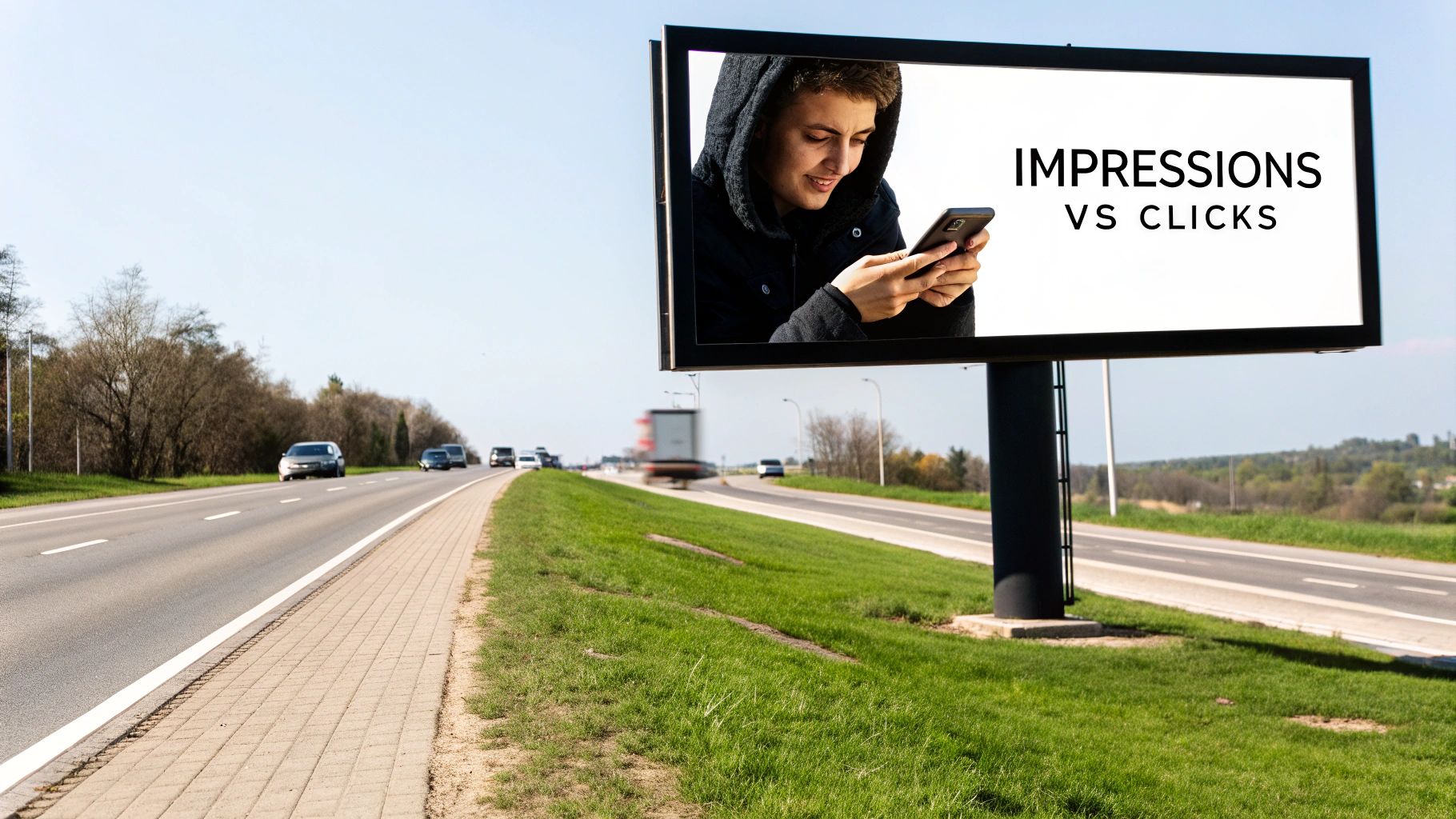
Think of it like this: impressions are all the cars that drive past your billboard on the highway. Clicks are the people who pull off the exit to come visit your store.
The Foundations of PPC: Clicks vs Impressions
In the world of pay-per-click (PPC), impressions and clicks are the absolute building blocks. They’re the first metrics you look at, but they tell completely different stories about what users are doing and what they actually want. Getting a solid handle on their unique roles is the first real step to building an ad strategy that actually makes you money.
An impression is counted every single time your ad is pulled from the server and displayed on a search results page or website. That’s it. It doesn't mean the person saw it, read it, or even consciously registered it was there. Its job is pure visibility and reach.
A click, on the other hand, is a deliberate action. It's a signal that your ad did its job—it was interesting and relevant enough to make someone stop what they were doing and take the next step. Clicks are what fuel direct-response campaigns, getting people to your landing pages where the real magic happens.
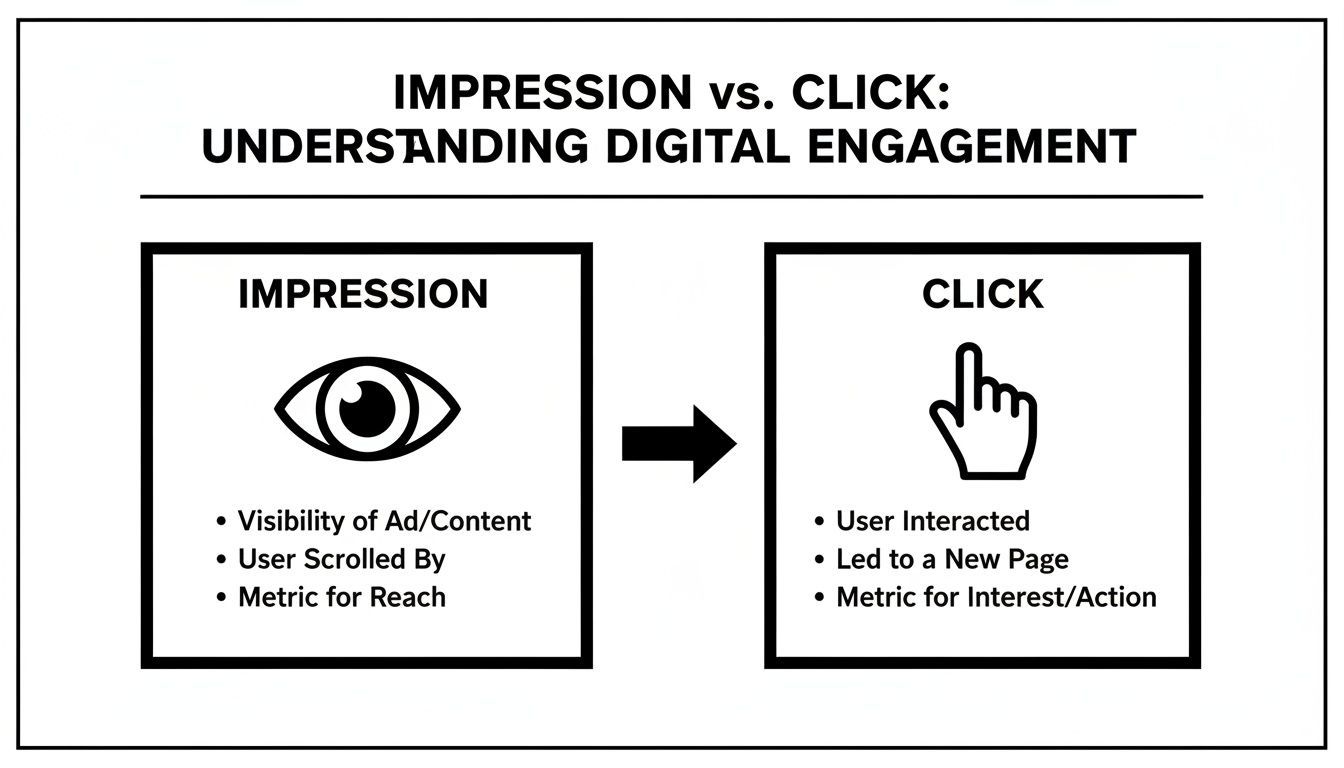
The image above does a great job of showing how impressions are about passive exposure, while clicks signal active interest. This makes clicks a much, much stronger indicator of a potential customer's intent.
How They Work Together
Of course, neither of these metrics lives in a bubble. It's the relationship between them that really tells you if your campaign is healthy or on life support. This is where Click-Through Rate (CTR) comes into play, which is just the percentage of impressions that turn into clicks. If you want to dig deeper, this is a great resource on What Is CTR And How To Calculate It.
Impression vs Click at a Glance
Sometimes, you just need a quick cheat sheet. This table breaks down the core differences in a simple, straightforward way.
At the end of the day, impressions are about getting seen, while clicks are about getting action. Both are important, but you need to know which one to focus on to hit your specific campaign goals.
The Critical Difference Between Seeing and Acting
Think about the last time you drove down a highway. You probably saw dozens of billboards, but how many did you actually read? That quick glance is an impression—it's passive, fleeting, and usually forgotten in seconds.
Now, picture yourself searching for a nearby coffee shop on your phone and tapping the first result. That's a click—a deliberate, conscious action.
This is the core of the impression vs. click debate. It’s not just about visibility versus interaction; it’s about the massive chasm in user intent. An impression just happens to someone. A click is a choice made by someone who is actively looking for something. They aren't just a viewer; they're an engaged participant on a mission, and you might just have the solution they need.
Why Search Clicks Outperform Display Impressions
This difference becomes razor-sharp when you compare search ads to display ads. A person typing "best running shoes for flat feet" into Google is on a mission. They have a specific problem and are actively hunting for a solution—a product to buy. An impression for an ad that matches that search is incredibly valuable because it’s shown to someone who's already decided to shop.
Compare that to someone scrolling through a news site who happens to see a banner ad for running shoes. They're in a completely different headspace. The ad is an interruption, not a solution. It might plant a seed for later (brand awareness), but their intent to buy right then and there is practically zero.
The real value isn't just in being seen. It's in being seen by the right person at the exact moment they’re looking for what you offer. A single, high-intent click from a search ad is often more powerful than a thousand passive impressions on a display network.
The numbers back this up, and it's not even close. When you put Google Search Ads head-to-head with Display Ads, the performance gap is staggering. Across all industries, Search Ads have an average click-through rate (CTR) of 3.17%, while Display Ads lag way behind at just 0.46%.
Let that sink in. For every 10,000 impressions, that’s about 317 motivated clicks from search versus a mere 46 passive clicks from display.
This is a game-changer for your budget. Pumping money into millions of cheap display impressions might fluff up your reports, but it rarely delivers the same ROI as a few thousand well-targeted search impressions that actually earn clicks. If you want a deeper dive on this, our guide on what click-through rate is and how it affects your campaigns is a great next step. It's all about putting your ad spend where it counts—in front of people who are ready to take action.
How Impressions and Clicks Actually Define Your Campaign's Health
Impressions and clicks aren't just numbers to glance at on your dashboard. They're the very foundation of your campaign's performance, the raw ingredients that cook up every other metric you care about. They tell you if your strategy is hitting the mark or just draining your budget.
The most direct and revealing metric born from the relationship between impressions and clicks is your Click-Through Rate (CTR). It’s a simple calculation—clicks divided by impressions—but it’s arguably the most vital sign of your ad's relevance and appeal.
A high CTR is a strong signal to Google that users are connecting with your ad. It means your message is compelling and useful to them. A low CTR, however, is a red flag. It points to a disconnect between your ad copy, your targeting, and what searchers are actually looking for.
The Domino Effect on Your Bottom Line
This isn’t just about feeling good about your ad copy; a strong CTR has a very real, very tangible impact on your ad spend and overall success.
- A Better Quality Score: Ad platforms see a high CTR as a sign of quality. They reward you with a higher Quality Score, which is their rating of your keywords and ads.
- Lower Ad Costs: Here's the best part. A better Quality Score often means you pay less for each click. Platforms will give you a better ad position at a lower Cost-Per-Click (CPC) because your ad is seen as more relevant. That's right—a higher CTR can literally make your ads cheaper.
- More Visibility: Ads with high CTRs and Quality Scores get shown more frequently and in better positions, which naturally leads to more of the right kind of traffic.
It’s a powerful cycle. When you create relevant ads, you earn more clicks. Those clicks boost your Quality Score, which in turn lowers your costs and gets you even more impressions in front of the right people.
Clicks are the bridge between being seen (impressions) and being profitable (conversions). You have to look at the entire funnel—from the first impression to the final sale—to find the leaks in your strategy and make sure your budget is actually growing the business.
Following the Trail to Conversions
At the end of the day, it's all about conversions. By understanding the journey from impression to click, you can begin to troubleshoot and optimize the entire path a customer takes.
If you're getting tons of impressions but your CTR is in the gutter, your ad copy or targeting is likely the problem. If you have a fantastic CTR but your Conversion Rate is low, the issue is probably on your landing page.
This whole journey has changed wildly over the years. The first-ever banner ad from AT&T back in 1994 had a mind-blowing 44% CTR. Today, thanks to ad fatigue and a much more crowded internet, a good Google Search ad might get a 3-5% CTR, and display ads often land below 0.5%.
That massive drop shows why every single click is more precious than ever. You can dig deeper into how these metrics have shifted by checking out these insights on CTR vs conversion rate. Analyzing each step of the funnel is the only way to turn passive views into profitable actions.
When to Focus on Impressions Over Clicks
It's so easy to get tunnel vision and just chase clicks. We've all been there. But honestly, that's not always the right play. While clicks are the lifeblood of direct response and sales, there are strategic moments when putting your energy into impressions is actually the smarter move for long-term growth.
Deciding between impressions and clicks really boils down to one simple question: what’s your campaign's main goal? Are you trying to make a sale right now, or are you playing the long game, building a brand that people will remember and trust down the road?

Prioritize Impressions for Brand Building
When your number one goal is to build brand awareness, impressions are your absolute best friend. Think of it like you're introducing yourself to a whole new market. You're not asking for a sale on the first date—you're just trying to make a good first impression (pun definitely intended).
Here are the key situations where letting impressions take the lead makes perfect sense:
- Launching a New Product or Service: Nobody can buy something they don’t know exists. Your first job is to get your name and your shiny new offering in front of as many relevant eyeballs as you possibly can.
- Major Brand Awareness Campaigns: If you're pushing into a new market or trying to change how people see your company, maximizing your reach is everything. The goal is to become so familiar that when a customer finally needs what you sell, your brand is the first one they think of.
- Dominating a Niche: You want to be seen as the authority. By showing up consistently for relevant searches, you build credibility and establish your presence, even if people don't click every single time.
In these scenarios, you're not chasing an immediate action. You're building mental real estate with your target audience. A massive volume of impressions ensures your brand becomes part of the conversation.
Prioritize Clicks for Performance and Sales
Alright, let's flip the coin. For most campaigns—especially in e-commerce and lead generation—clicks are king. There's no getting around it. Clicks are the direct pipeline between your ad and a potential conversion.
Here’s when you need to be laser-focused on getting that click:
- Driving Sales: For any online store, a click is the very first step in the checkout process. Simple as that. No click, no sale.
- Lead Generation: Whether you need a form fill, a phone call, or a newsletter signup, you have to get users to your landing page first. That takes a click.
- Performance-Based Marketing: If your budget is tied directly to ROI, then every single click has to pull its weight. Here, you're not just buying traffic; you're buying potential revenue.
Choosing your focus is all about aligning your bidding strategy with what your business actually needs to accomplish. Clicks drive immediate results, while impressions build the foundation for future success.
Turning Wasted Impressions Into Profitable Clicks
Alright, we’ve covered the theory behind impressions and clicks. But let's be honest, theory doesn't pay the bills. The real challenge is turning all that data into actual profit. It's time to get our hands dirty.
The mission is simple: cut out all the junk impressions from irrelevant searches and zero in on the clicks that have a real shot at becoming customers. This isn't about getting more clicks for the sake of it; it's about getting the right clicks and making every single ad dollar pull its weight.
Your First Line of Defense: Negative Keywords and Match Types
The fastest way to stop hemorrhaging cash on useless impressions is to build a rock-solid negative keyword list. Think of it as your campaign's bouncer. You're telling Google Ads precisely which search terms are not welcome.
For instance, if you’re selling high-end "running shoes," you'd immediately add words like "free," "cheap," and "used" as negatives. Just like that, you've stopped showing up for people who were never going to buy from you in the first place.
Your next move is to dial in your match types. Using exact match [running shoes] gives you ultimate control, showing your ad almost exclusively for that exact phrase. Phrase match "running shoes" loosens the reins a bit, while broad match can be a wild card, quickly racking up tons of irrelevant impressions if you’re not watching it like a hawk. You have to align your match type strategy with your goals and how much risk you're willing to take with your budget.
If you want to go deeper, check out our guide on how to add negative keywords to your Google Ads campaigns.
Your search terms report is a goldmine. It's the raw, unfiltered voice of your potential customers, showing you exactly what they typed into Google. Digging through it is the only way to find the budget-draining junk terms and uncover the hidden gems that actually lead to sales.
A Smarter Way to Get Better Clicks
Let's face it: manually combing through thousands of search terms is a mind-numbing task, especially if you're managing more than one account. This is where a little automation can make a huge difference. Keywordme was built to handle this exact problem, turning a tedious chore into a one-click fix.
Here’s a quick peek at how Keywordme lets you clean up those junk search terms directly inside your Google Ads account.
As you can see, you can easily spot the irrelevant terms, select them, and add them as negatives in bulk without ever having to leave the report. It's a simple, continuous loop of refinement.
By automating this critical step, you can finally stop wasting money on impressions that go nowhere and start investing in clicks that actually turn into customers.
Unlocking Growth with Search Impression Share
While impressions give you a raw count of how many times your ad was seen, they don't tell the full story. They don't tell you how many times your ad could have been seen. That’s where a much more powerful metric, Search Impression Share (SIS), completely changes how you should look at the relationship between impressions and clicks.
In a nutshell, Search Impression Share shows you the percentage of impressions your ads actually got compared to the total number they were eligible for. Think of it as your slice of the total potential search pie for the keywords you're targeting.
Why Impression Share Matters More Than Raw Impressions
A low SIS is a huge red flag that you’re leaving money on the table. It means that for whatever reason—usually a capped budget or a low Ad Rank—your ads aren't showing up every time they could be.
Keeping a close eye on your SIS is absolutely vital for scaling your campaigns. It points directly to missed opportunities, showing you where you can grab more market share without just blindly throwing more money at your budget. If you want to dive deeper into the nuts and bolts, you can check out our guide on impression share for a complete breakdown.
Search Impression Share reveals a critical truth: even eligible impressions don't guarantee visibility. If you're not tracking it, you're flying blind, completely unaware of how much potential traffic you're missing out on every single day.
Let's say you have a 60% SIS. That means you're missing out on a whopping 40% of potential impressions—and by extension, all the clicks and sales that could have come from them. As a general rule of thumb, Google Ads benchmarks suggest aiming for an 80%+ SIS, which means your ads are appearing in at least 80 out of every 100 possible searches.
This metric is also tied directly to your CTR. A poor click-through rate can ding your Quality Score, which then lowers your Ad Rank and, you guessed it, keeps your impression share from growing. To really understand how these metrics feed into each other, you can discover more insights about CTR monitoring for Google Ads.
Ultimately, boosting your ad relevance and Quality Score is the best way to earn a higher impression share, win more auctions, and drive truly profitable growth.
Answering Your Top Questions
Let's tackle some of the most common questions that come up when we talk about the whole impressions vs. clicks debate. Here are some quick, straight-to-the-point answers to help you sharpen up your campaign strategy.
Are High Impressions Always a Good Thing?
Not at all. In fact, a massive number of impressions paired with a tiny click-through rate (CTR) is usually a red flag. It’s a classic sign that your ad is popping up for irrelevant searches, your ad copy isn't hitting the mark, or your targeting is just plain wrong.
Context is king here. If you're running a brand awareness campaign, then sure, high impressions are exactly what you want. But for a lead generation campaign? High impressions without clicks are just you lighting your ad budget on fire.
What Is a Good Click-Through Rate?
Ah, the classic "it depends" answer. But we can do better than that. A "good" CTR changes dramatically depending on your industry, the type of campaign, and where you're running your ads.
For a general rule of thumb, a CTR of 3-5% on the Google Search Network is pretty respectable. If you're on the Display Network, where people aren't actively searching, anything over 0.5% can be considered a win. The real secret is to stop worrying about industry averages and start benchmarking against your own past performance.
The only benchmark that truly matters is your own. If your CTR is consistently going up, you're on the right track. If it's flat or falling, it's time to start testing new ad copy, keywords, or audiences.
What Is the First Step to Stop Wasting Money on Bad Impressions?
Your very first move, without a doubt, should be to get familiar with your Search Terms Report. This report is pure gold—it shows you the exact phrases people typed into Google right before your ad appeared. There is no better place to find out where your budget is being wasted.
Go through that report, find any search terms that have zero to do with what you sell, and immediately add them as negative keywords. This one simple habit can dramatically improve your campaign's profitability. To get a better sense of your overall visibility and how many potential eyeballs you're reaching, you should also look into What is Impression Share.
Ready to stop burning cash on useless impressions and start getting clicks that actually convert? Keywordme helps you clean up your search terms and optimize campaigns up to ten times faster. See for yourself by starting a free 7-day trial at https://www.keywordme.io.
.svg)