
Master How To Choose Keywords For Google Ads Success
Master How To Choose Keywords For Google Ads Success


Let's be real—if you're not obsessively checking your search term reports, you're probably just lighting money on fire. A 'set it and forget it' approach to keywords is one of the most common and costly mistakes you can make in Google Ads. It’s a guaranteed way to get a terrible return on your ad spend.
Stop Wasting Money on the Wrong Keywords
So many advertisers fall into the same trap: they go way too broad. They think a keyword like "shoes" will cast a wide net and bring in tons of traffic. And it will! But it's also a magnet for wasted money because you have no idea what the person is actually looking for. Men's shoes? Kids' shoes? Shoe repair? Or maybe just pictures of shoes for a school project?
This is where you need to shift your mindset. You're not just buying clicks. You're investing in conversions.
Your entire Google Ads strategy is built on your keywords. The second you stop thinking about buying traffic and start focusing on investing in conversions, you unlock real profitability.
Your goal is to get in front of people who are already looking for what you sell. That means homing in on keywords that scream, "I'm ready to buy!"
The True Cost of a Lazy Keyword Strategy
Imagine you sell high-end leather briefcases online. It might be tempting to bid on a broad term like "bags." The problem? You're going to pay for clicks from people searching for "school bags," "plastic bags," and "gym duffle bags"—none of whom are your customers.
Every single one of those irrelevant clicks is cash straight out of your pocket with zero chance of a return. It's like paying for a billboard in a town where no one can afford your product.
This visual really drives the point home. You want to move from vague, expensive keywords to precise, profitable ones.
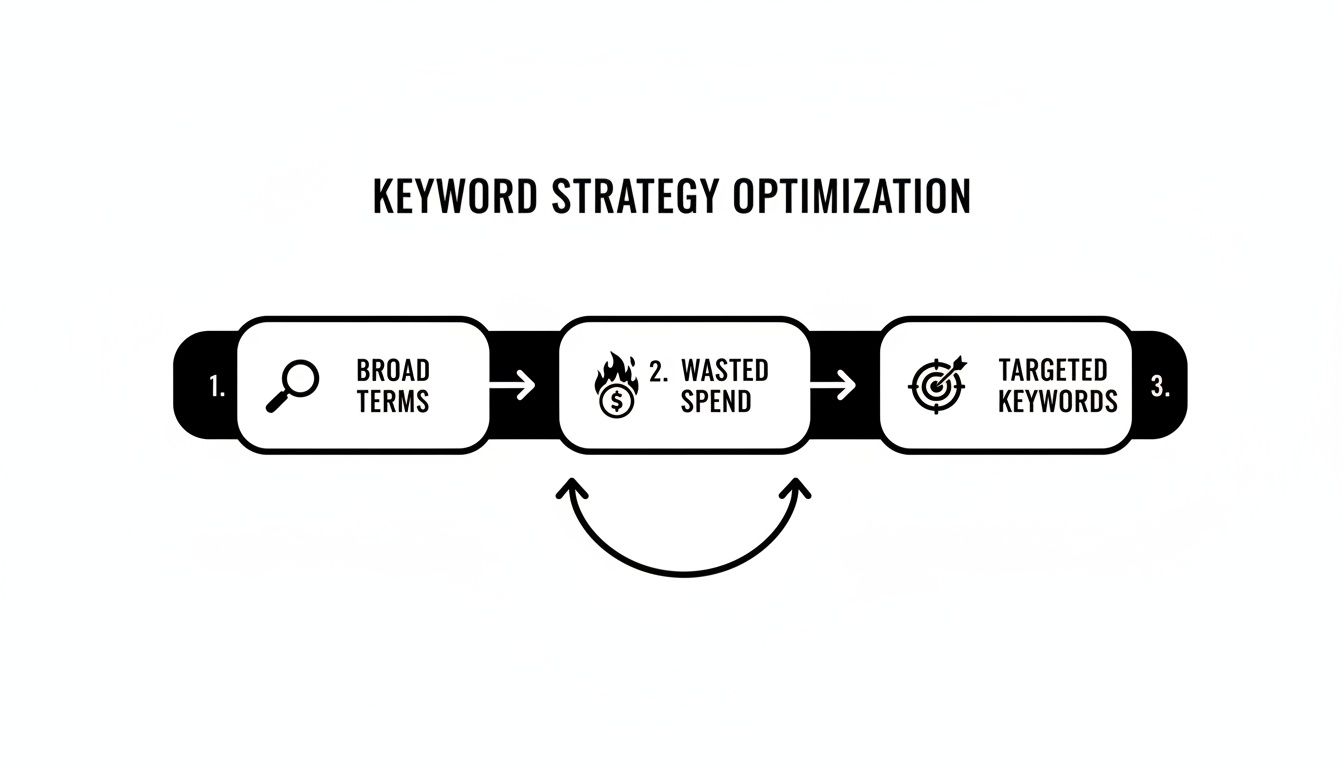
As the infographic shows, broad keywords are a direct path to wasted spend. The real gold is buried in your search term reports—the actual phrases people type into Google. This is where you’ll find amazing, profitable, long-tail keyword ideas straight from your audience.
To help you spot the difference, here's a quick comparison of keywords that just browse versus those that buy.
High-Intent vs. Low-Intent Keyword Examples
| Keyword Type | Example | User Intent | Conversion Likelihood |
|---|---|---|---|
| Broad/Informational | "running shoes" | Researching options, learning | Low |
| Navigational | "Nike website" | Trying to find a specific site | Low to Medium |
| Commercial | "best running shoes for flat feet" | Comparing specific products, close to deciding | High |
| Transactional | "buy Nike Air Zoom Pegasus 40 online" | Ready to purchase now | Very High |
See the difference? The more specific the search, the more likely the person is to pull out their wallet. Your job is to focus your budget on those high-intent, transactional keywords.
The Power of Being Specific
The right keywords can make or break your campaigns, especially when search trends go wild. Think back to 2020 when 'COVID 19' exploded. Search volume for that term jumped by a mind-boggling 3,650% month-over-month in March. Marketers who reacted fast rode a massive wave of traffic. Today, top branded keywords like 'YouTube' and 'Facebook' show just how powerful targeted, evergreen terms are, as highlighted in recent keyword research reports.
Even a single negative keyword can be a game-changer. I’ve seen clients save hundreds of dollars overnight with just a few simple tweaks. For example, if you sell new cars, adding "used" as a negative keyword instantly stops you from paying for clicks from buyers you can't even help.
At the end of the day, understanding user intent is what separates the profitable campaigns from the money pits. It's all about getting inside your customer's head and bidding on the exact phrases they use when they're ready to buy. That’s how you turn ad spend into a real engine for growth.
Get Inside Your Customer's Head by Decoding Search Intent

Here's something I learned the hard way: not all keywords are created equal. If you take away just one thing about how to choose keywords for your ads, let it be this. A search for 'what is a CRM' comes from a totally different mindset than a search for 'best CRM for small business.' One is just curious; the other is a potential customer.
Understanding the why behind a search—what we call search intent—is the real secret to finding people who are actually ready to buy. It's the difference between collecting window shoppers and closing deals.
Think of your keywords as signals. When you target the right ones, your ads line up perfectly with what someone needs in that exact moment. This is how you stop burning cash on clicks that lead nowhere.
The Different Mindsets Behind a Search
Every single search query fits into one of four main buckets. Once you get a feel for these, you'll immediately start picking better keywords and building smarter campaigns.
- Informational: People in this mode are just looking for answers. They're asking "how to," "what is," or "why." They want a blog post, not a sales page.
- Navigational: These folks already know where they're going. They're just using Google as a GPS to get to a specific site, like typing "Keywordme login" instead of the full URL.
- Commercial: Now we're talking. These searchers are in research mode. They're comparing options, reading reviews, and trying to figure out the best solution. The wallet is on the table.
- Transactional: This is the gold mine. These people are ready to buy, right now. They know what they want and are actively looking to make a purchase.
For Google Ads, you want to pour the vast majority of your budget into commercial and transactional keywords. Informational searches are great for SEO and content marketing, but they're usually a money pit for direct-response ad campaigns.
How to Spot Keywords That Are Ready to Convert
So, how do you zero in on these money-making keywords? The trick is to listen for "modifier words"—those extra terms people tack onto their search that scream intent. These are the dead giveaways of a motivated buyer.
Here's a quick cheat sheet of modifiers I always look for:
Transactional Intent (Ready to Buy NOW):
- Buy
- Discount
- Deal
- Coupon
- For sale
- Order
Commercial Intent (Hot Leads):
- Best
- Top
- Review
- Alternative
- Vs (like in "Keywordme vs SEMrush")
- Comparison
When you build ad groups around keywords containing these modifiers, you're automatically getting in front of people who are deep into the buying cycle. You’re showing up at the exact moment they’re about to make a decision.
For example, don't just bid on a broad keyword like "project management software." Instead, go after "best project management software for agencies" or "buy Asana business plan." It’s obvious which of those has a better chance of turning into a sale. The intent is crystal clear. For a much deeper look, you should read our guide on what high-intent keywords are and how to find them.
This is precisely the process Keywordme was designed to streamline. When you're looking at your real search term data inside your Google Ads account, our tool automatically flags these high-intent phrases for you.
You might see a profitable search like "acme widget discount code" pop up. With a single click in Keywordme, you can instantly add "acme widget discount" as a new exact match keyword to its own dedicated ad group. It takes the manual grunt work out of the equation and lets you capitalize on winning trends immediately, making sure every dollar you spend is aimed at bringing in new customers.
Your Modern Toolkit for Keyword Research
Long gone are the days of just tossing a bunch of keywords at Google and hoping for the best. To win at Google Ads now, you need to be precise. You need a set of tools that gives you accurate data without burying you in spreadsheets. The goal is to work smarter, not just grind harder.
The right tools are your secret weapon. They help you figure out what your customers are actually searching for, validate your gut feelings, and—most importantly—stop you from blowing your budget on keywords that will never convert.
The Heavy Hitters vs. Action-Oriented Tools
When you think about keyword research, a few big names probably come to mind. Tools like SEMrush and Ahrefs are industry staples for good reason. They have massive keyword databases and some seriously sophisticated analysis features. SEMrush's Keyword Magic Tool, for example, boasts a library of over 25 billion keywords, and Ahrefs Keywords Explorer is known for its 94% accuracy in spotting trends.
These platforms are perfect for the initial discovery phase. You can get a high-level view of the entire search landscape, check out what your competitors are bidding on, and brainstorm new campaign ideas. They're fantastic for painting the big picture.
But here’s the problem: data is useless if you can't act on it.
Big data tools give you the map, but you still need a vehicle to get where you're going. The real challenge isn't finding keywords; it's quickly and efficiently getting the right ones into your live campaigns.
This is where the process usually breaks down. You export a giant spreadsheet of potential keywords from one of these big tools, and then what? You're stuck manually sorting, organizing by match type, and painstakingly uploading everything into Google Ads. It’s a massive time sink.
From Research to Results in a Few Clicks
What if you could just skip the spreadsheet mess altogether? That's exactly why we built Keywordme. Instead of just giving you another list of theoretical keywords, our Chrome plugin works directly inside your Google Ads account. It analyzes the most valuable data you have: your actual search terms report. This is the goldmine. It shows you the exact queries real people are using to trigger your ads.
Think about how this changes your workflow:
- See a garbage search term? One click and it’s on your negative keyword list. No more copy-paste drudgery.
- Find a phrase that's converting like crazy? One click turns it into a new exact match keyword in the perfect ad group.
- Notice a new cluster of related terms? Instantly create a new ad group for that theme and start adding relevant keywords on the spot.
This approach transforms hours of manual labor into a few minutes of strategic decision-making. You're not just researching; you're actively optimizing your account in real-time. You’re closing the loop between insight and action instantly. It’s a workflow we’ve seen cut optimization time by up to 10x for our users.
The modern way to choose keywords isn't about picking just one tool. It's about building a smart, streamlined process. Use a powerhouse like SEMrush for your big-picture strategy, and then lean on Keywordme for the critical, day-to-day work of turning real customer data into better ROI. This combo helps you build a responsive, agile, and way more profitable Google Ads machine.
For a more detailed comparison, you can check out our guide on the best keyword tool for Google Ads.
Getting Your Match Types and Negative Keywords Dialed In
Alright, you’ve done the research and have a list of promising keywords. That’s a great start, but here's a hard-earned lesson from the trenches: the keywords you choose are only half the story. The real make-or-break moment comes down to how you use them. This is where keyword match types enter the picture, and getting them right is non-negotiable for controlling your ad spend.
Think of match types as the instructions you give Google for who gets to see your ads. Nail this, and you’ll get a steady stream of relevant, profitable traffic. Get it wrong, and you’re basically lighting your budget on fire.
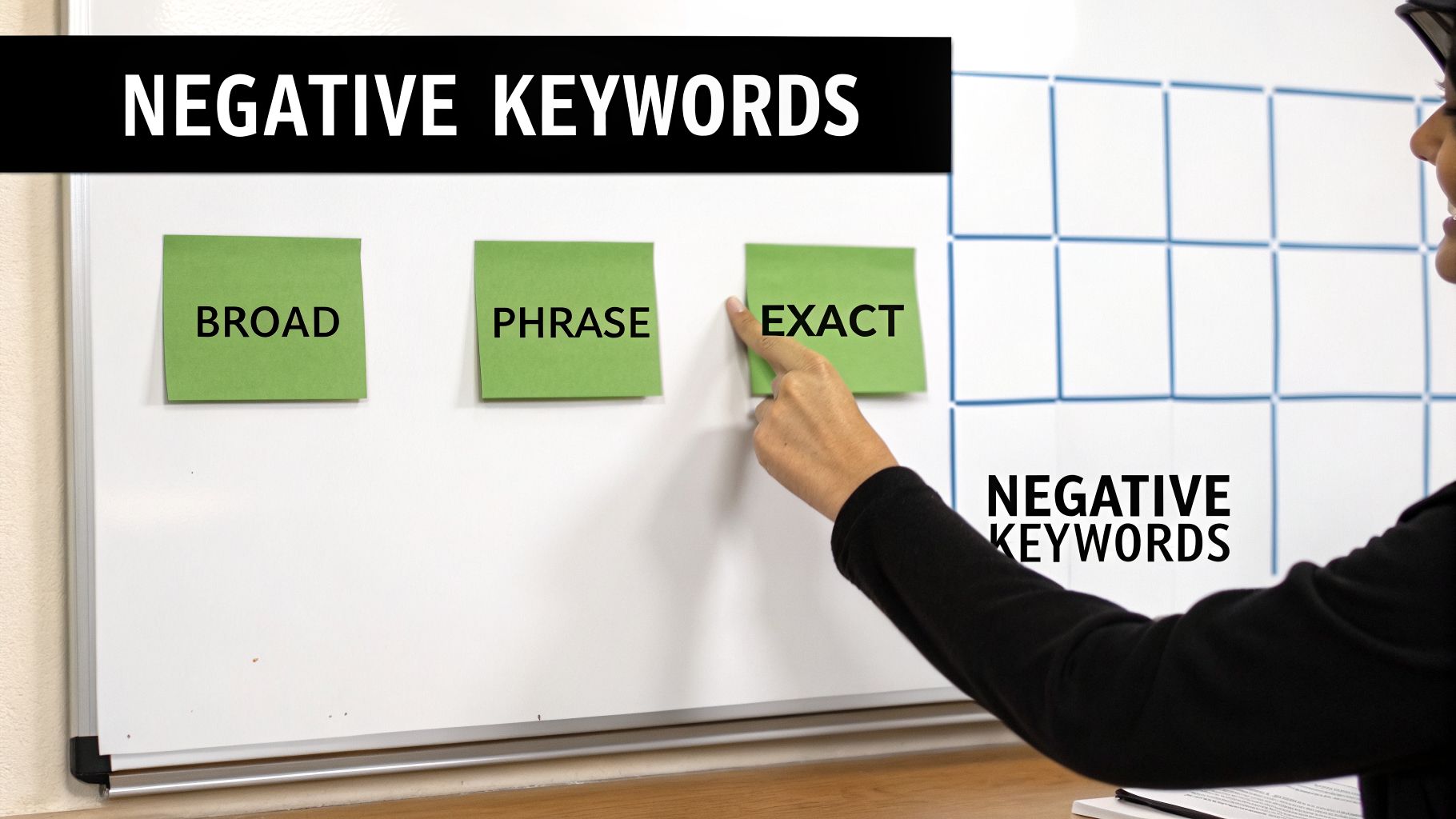
You’ve got three main tools in your toolbox: Broad, Phrase, and Exact match. Let’s cut through the jargon and talk about how they work in the real world.
Choosing the Right Tool for the Job
Figuring out when to use each match type is a core skill in learning how to choose keywords that actually perform. Every match type has a specific job, and the healthiest ad accounts I’ve seen use a smart mix of all three.
Broad Match: This is your exploration tool. It gives Google the most freedom to show your ad for searches it thinks are relevant. Broad match has a bad rap for burning cash, but when you pair it with smart bidding in its own budget-controlled campaign, it can be an absolute goldmine for finding new, high-converting search terms you’d never have discovered otherwise.
Phrase Match: Here’s your middle ground, offering a nice balance of reach and control. Your ad can show for searches that include the meaning of your keyword, making it perfect for when you have a solid idea of what people are looking for but still want to catch those slight variations in how they search.
Exact Match: This is your sniper rifle. It gives you maximum control, showing your ad only for searches with the exact same meaning or intent as your keyword. This is where you put your proven, money-making keywords to work, maximizing your ROI.
One of the biggest mistakes I see beginners make is lumping all their keywords into one ad group with the same match type. A much better strategy is to create a tiered structure: use Broad Match to discover what works, then "graduate" your winning terms to Phrase and Exact Match ad groups for tighter targeting and better profits.
To make this crystal clear, here’s a quick-and-dirty guide on how to deploy each match type based on your campaign goals.
Match Type Strategy Guide
Choosing the right match type is all about aligning your tool with your goal. This table breaks down when to use each one, from wide-net discovery to precision targeting.
| Match Type | Best For | Example Use Case | Risk vs. Reward |
|---|---|---|---|
| Broad Match | Keyword discovery and market research. | A campaign with a small, dedicated budget to find new search terms for "CRM software." | High Risk / High Reward |
| Phrase Match | Targeting a defined audience with some flexibility. | Targeting searches like "best CRM for real estate agents" to capture relevant variations. | Medium Risk / Medium Reward |
| Exact Match | Maximizing conversions on proven, high-intent keywords. | Bidding on "[buy crm for small business]" after data shows it converts well. | Low Risk / High Reward |
Think of it as a funnel: Broad Match feeds Phrase Match, and Phrase Match feeds Exact Match.
The Unsung Hero: Your Negative Keywords
Now, let's talk about the true MVP of a profitable Google Ads account: the negative keyword. If your match types are your offense, negative keywords are your defense. Honestly, they're your budget's best friend.
A negative keyword simply tells Google what searches you don't want your ad to show up for. It’s the single most effective way to stop wasting money on clicks that will never convert. Every time you dig into your search terms report and find a query that makes you wince, you should be adding it as a negative.
For instance, if you sell premium software, adding negatives like "free," "template," and "jobs" can instantly save you hundreds or even thousands of dollars. We go into much more detail on this in our guide on how to add negative keywords to your campaigns.
The only problem? Doing this manually is a massive chore. You have to export your search term report, sift through endless spreadsheet rows, and then upload your lists. It's so tedious that most advertisers simply don't do it as often as they should.
This is exactly where a tool like Keywordme is a game-changer. It works right inside your Google Ads account, so when you spot a wasteful search term, you can add it as a negative keyword with a single click. No more spreadsheets. No more copy-pasting. It transforms a task that used to take hours into a simple, two-minute daily check-up, keeping your budget safe and your campaigns lean.
Thinking Beyond the Keyboard: How to Win in the Age of Voice and AI Search
Let's talk about how people actually search for things now. It's not just a series of choppy keywords typed into a box anymore. We're in an era of conversation. Think about it—you don't bark "pizza delivery" at your smart speaker. You ask, "Hey, where can I get a good deep-dish pizza delivered near me?"
This isn't just a minor shift; it's a fundamental change in search behavior. If you're still stuck on two-word phrases, you're going to miss out. The explosion of voice assistants and AI-driven results means that targeting these natural, long-tail questions is no longer optional. It's how you grab some of the most valuable, high-intent traffic out there.
Start Talking Like Your Customers
To get this right, you have to get out of the robotic keyword mindset and start thinking like a person having a conversation. People are asking their devices full, detailed questions, and your job is to have the keywords that serve up the answer.
This adds a new dimension to your keyword research. It's time to brainstorm the actual questions your customers are asking.
- What’s the real problem they’re trying to solve with your product?
- How would they phrase that problem out loud?
- What specific details would they mention?
When you target these longer, more natural phrases, you’re not just guessing. You're aligning your ads with the exact language people use when they’re ready to make a decision. This does wonders for your ad relevance and tends to attract folks who are much closer to pulling out their credit cards.
Forget just bidding on "running shoes." Start going after queries like "what are the best running shoes for marathon training" or "where can I buy waterproof trail running shoes?" These aren't just searches; they're cries for a specific solution.
The numbers back this up. Voice and visual search are completely changing how to choose keywords. Globally, 20% of all internet users now rely on voice search, and a massive 58% of them are on the hunt for local businesses. We've also seen a 20% jump in voice queries that include descriptive words like 'best' or 'top'. This isn't some passing fad—it's the new standard.
Getting Your Ads Ready for the AI Takeover
The evolution doesn't stop at voice. Generative AI is being woven directly into search results, and it's set to shake things up even more. Many experts are bracing for a serious drop in clicks to traditional website links because AI will just spit out the answer directly.
So, how do you avoid becoming invisible? You need to make your ads part of the answer that the AI provides. This requires a few smart moves:
- Build Around Questions: Dedicate entire ad groups to question-based keywords. Think who, what, where, when, why, and how.
- Write Hyper-Specific Ad Copy: Your ads have to be the answer. If the keyword is "how much does a small business CRM cost," your headline better give a price range or a clear path to finding one.
- Embrace 'Best' and 'Top' Keywords: The data shows people want recommendations. Weave these words into your keywords and ad copy to show up for users who are comparing their options.
As AI continues to blur the lines between search and purchase, you'll need to get familiar with concepts like Agentic Commerce. This is the idea that AI agents will eventually make purchases on our behalf, making ad relevance and direct answers more critical than ever.
This is exactly where a tool like Keywordme can be a game-changer. Instead of just guessing what these long, conversational queries might be, you can find the ones that are already bringing you traffic in your search term reports. Keywordme makes it easy to spot these golden nuggets. With a single click, you can create a new, perfectly targeted ad group for that exact conversational phrase, making sure your campaigns are built for the future of search.
Common Questions About Choosing Keywords
Alright, so you’ve got the basics down. But let's be honest, keyword selection isn't a one-and-done deal. It’s a living, breathing part of managing any successful Google Ads account. As you get deeper into the work, new questions always surface.
I've heard them all over the years. Here are some of the most frequent ones I get from marketers, along with some straight-to-the-point answers based on what I've seen work.
How Often Should I Review My Keywords?
You absolutely need to be in your search term report at least once a week. More often is even better, especially for new or high-spend campaigns. This weekly check-in is your golden opportunity to plug budget leaks by finding new negative keywords and to spot those hidden gem search terms that deserve their own ad groups. It's the single most impactful maintenance task you can do.
For a more strategic, birds-eye-view, a quarterly review is usually the right cadence. That's your time to analyze broader performance trends, kick around ideas for new campaigns, and decide if your current match type strategy is still pulling its weight.
The biggest roadblock to frequent optimization is simply time. It’s a grind. Tools like Keywordme can make that weekly review ridiculously fast, turning what used to be a multi-hour task into a few minutes of clicking. This makes consistent, high-impact optimization feel less like a chore and more like a superpower.
What Is a Good Keyword Volume to Target?
Honestly, there’s no magic number here. It's a constant balancing act between relevance and search volume.
A keyword with 10,000 monthly searches might seem like a goldmine, but if it's super broad (like "office furniture"), you're just going to set your budget on fire with clicks from people who are just browsing.
On the other hand, a long-tail keyword with only 50 monthly searches could be incredibly profitable. Think about a search like "buy ergonomic chair for tall person." The volume is low, but the intent is crystal clear. That person is ready to buy.
A solid strategy uses a mix of both. You need some higher-volume terms for reach and discovery, but you build your most profitable, conversion-focused ad groups around those highly specific, lower-volume keywords.
Can I Just Use Broad Match Keywords to Save Time?
Please don’t. Relying solely on broad match is one of the fastest ways to completely drain your ad budget. While Google's algorithm has definitely gotten smarter over the years, broad match will still happily show your ad for all sorts of irrelevant queries that have zero chance of converting. It's just too risky to use as a primary strategy.
A much savvier approach is what I call "controlled" broad match. Here’s how you set it up:
- First, create a separate "Discovery" campaign and give it a very strict, limited budget.
- Put your broad match keywords in this campaign and only this campaign.
- Then, be hyper-vigilant about adding negative keywords, ideally checking in daily.
This setup lets you fish for new, profitable search terms without putting your main budget at risk. When you find a winner, you can "promote" it to a Phrase or Exact match keyword in your core campaigns where you have more control and can maximize ROI.
How Is Keywordme Different from Google's Keyword Planner?
Google's Keyword Planner is an essential tool for starting out. It's fantastic for brainstorming, getting rough search volume forecasts, and exploring new angles for your campaigns. But at the end of the day, it's all based on suggestions and estimates.
Keywordme works with something far more powerful: your actual search term data from live campaigns. This is the ground-truth data of what real people are typing into Google right before they click your ad.
This is where you can move incredibly fast. You can act on this real-world data instantly, right from within your Google Ads account.
- See a junk term that’s wasting money? One click and it's a negative keyword.
- Find a high-converting phrase you hadn't thought of? Instantly create a new exact match keyword for it.
Keywordme closes the loop between seeing the data and actually doing something about it, turning raw information into optimized campaigns in seconds. And when you're thinking about your customer's full journey, you might even consider things like optimizing your WordPress tagline to ensure your messaging stays consistent from the ad all the way to your landing page.
Ready to stop guessing and start optimizing with real data? Keywordme turns hours of manual keyword cleanup into a few simple clicks, directly inside your Google Ads account. Try it free for seven days and see how much faster you can improve your ROI. Find out more at https://www.keywordme.io.
.svg)