
Your Guide to High CPC Keywords
Your Guide to High CPC Keywords


Ever looked at your Google Ads bill and wondered why one click cost you a few cents, while another cost more than a nice dinner out? It’s a super common question, and the answer tells you everything you need to know about the basic economics of paid search. These budget-busters are what we call high CPC keywords.
In simple terms, these are the search terms that cost a small fortune for a single click. They're almost always tied to high-value products or services where one new customer can bring in a ton of revenue. That high potential profit makes them incredibly competitive, which sends the bid prices through the roof.
Why Some Clicks Cost a Fortune
Think of the Google Ads auction like a high-stakes real estate auction. A keyword is your plot of land, and its value depends entirely on what you can build on it—or in this case, how much money a single click can realistically make you.
A click for a keyword like ‘funny coffee mugs’ is like a small, affordable lot out in the suburbs. It’s got value, sure, but the profit from that one sale is pretty modest.
The Economics of Expensive Clicks
Now, picture a click for a term like ‘mesothelioma lawyer’ or ‘small business insurance quote’. That's not a suburban lot; that's prime real estate in the middle of Manhattan. The reason it's so expensive is just simple math.
Fierce Industry Competition: Some industries are just packed with heavy hitters. Think law, finance, and insurance. These companies have huge ad budgets and are all fighting for the same few spots on the search results page. That competition alone creates an intense bidding war.
Huge Potential Customer Value: The lifetime value (LTV) of a new customer in these fields is massive. One legal client could be worth tens of thousands of dollars. An insurance customer might pay premiums for the next 20 years. When you look at it that way, paying $50, $100, or even more for a single qualified click isn't crazy—it's a calculated business investment.
High Purchase Intent: High-cost keywords almost always scream commercial intent. Someone searching for "best auto loan rates" isn't just window shopping. They're deep in the buying cycle and ready to make a major financial decision. Advertisers will gladly pay a premium to show up right at that critical moment.
The cost of a keyword is a direct reflection of its perceived value. The more potential profit a click can generate, the more advertisers are willing to pay for it. That’s what drives the Cost Per Click (CPC) sky-high.
To really get a handle on why some clicks cost so much, you need to understand the basics of What Is Cost Per Click. It's the foundation of all PPC advertising.
By figuring out what is causing high CPC in Google ads, you can start making much smarter choices with your budget. Nailing these fundamentals is the absolute first step to getting your ad spend under control and improving your ROI.
The Most Expensive Keyword Industries
Ever wonder why a single ad click can cost more than a fancy dinner? It's because when it comes to advertising costs, not all industries are created equal. While an e-commerce shop might happily pay a dollar or two per click, some sectors operate on a completely different level.
These are the battlegrounds where high CPC keywords are the norm. We're talking about fields where one new customer can make a company's entire quarter—think legal services, finance, insurance, and high-value B2B software. In these arenas, the lifetime value of a client is so massive that paying hundreds for a single click isn't just common; it's smart business.
The Big Spenders in Digital Ads
So, which industries are consistently shelling out the most for ad clicks? It all boils down to the potential return on investment. When one conversion can bring in tens or even hundreds of thousands in revenue, advertisers are more than willing to get into a bidding war for the right person's attention.
The legal field is the perfect example. For a law firm specializing in personal injury or class-action suits, landing just one new case can be incredibly profitable. This high-stakes game naturally drives up the cost for the most valuable search terms.
In fact, the legal industry often sees some of the highest CPCs out there, with the most expensive keywords hitting a wild $1,090.00 for a single click. While the average is a more grounded $6.75, that huge gap shows you just how much firms will pay for a shot at a massive case. You can dig into more of the data by checking out the full research on PPC benchmarks from HubSpot.
It's a simple calculation: when a single client could be worth six figures, paying a thousand dollars for that click stops being an expense. It becomes a strategic investment.
This chart gives you a quick visual. It's a simple comparison, but it clearly shows how a low-value keyword (like for a cheap phone case) stacks up against a high-value one in a pricey industry.
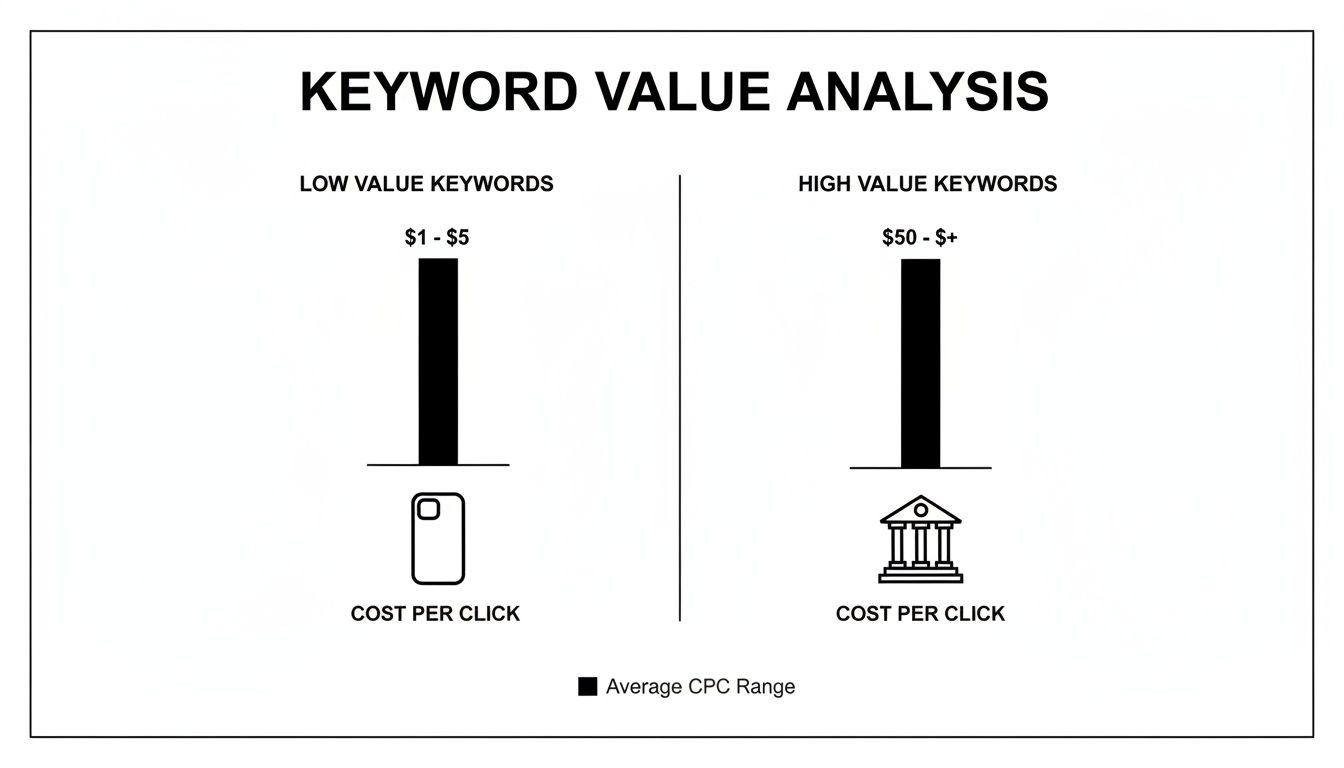
You can see how the potential customer value directly inflates what an advertiser is willing to bid for that click.
Top 5 Industries by Maximum CPC
To give you an even clearer picture, let's look at the top industries that consistently pay the most for traffic. The following table highlights just how intense the competition for high CPC keywords can get, showing both the average cost and the absolute peak prices advertisers are willing to pay for that one golden click.
While those average CPCs might not look too scary, the "Highest CPC" column tells the real story. It reveals just how ferocious the bidding can get for searchers who show serious buying intent. For anyone advertising in these spaces, controlling your budget and optimizing every last detail isn't just a good idea—it's essential for survival.
How to Find High CPC Keywords in Your Niche
Alright, let's go treasure hunting. Finding high-CPC keywords is a lot like that—you're digging through the noise to find the most valuable spots in your market. First, you have to know where they are before you can decide what to do with them.
Think of it like getting a map of the most expensive real estate in town. Knowing which keywords carry a hefty price tag gives you a huge advantage. You can either decide to pay the premium to compete for that high-intent traffic or smartly step aside and focus your ad budget on more affordable, but still effective, terms.
Using SEO Tools to Uncover CPC Data
The quickest way to get a lay of the land is with a good SEO tool. Platforms like Ahrefs and Semrush are goldmines of data, giving you a clear window into what people are actually paying for ads.
You'll want to jump into their keyword research features, often called something like "Keyword Explorer" or "Keyword Magic Tool." Just pop in a broad "seed" keyword for your industry—think "business loans" or "cybersecurity software." The real work begins once you start applying filters.
Here’s a simple workflow to get you started:
- Filter by CPC: Set a minimum cost-per-click. I’d suggest starting with $10 or $20 just to see what pops up. This instantly clears out all the low-cost, low-intent junk.
- Sort by CPC (High to Low): This is the most direct move you can make. It shoves the priciest keywords right to the top, showing you exactly what your competitors are willing to shell out the big bucks for.
- Spot Commercial Intent Words: Keep an eye out for phrases like "quote," "pricing," "services," "vendor," or "near me." These are buying signals, and they tell you the searcher is getting ready to open their wallet, which naturally sends bids soaring.
Running through this process will give you a solid list of potentially valuable—and expensive—keywords. It's your first step toward understanding the economics of your niche.
Tapping into Google's Own Data
Third-party tools are great for spying on the competition, but sometimes you need the data straight from the source. That's where Google Keyword Planner comes in. It's a free tool built right into every Google Ads account, and its bid estimates are based on real auction history.
Inside Keyword Planner, you can explore new keywords and check out the "Top of page bid (high range)" for each one. This number tells you what advertisers have historically paid to snag a top ad spot.
Sorting your keyword list by this high-range bid is one of the most reliable ways to spot the high-CPC keywords that Google itself sees as valuable. It might be an estimate, but it's an estimate from the horse's mouth.
Ethically Spying on Your Competitors
Here's another great tactic: just see what your competitors are already paying for. Don't worry, you're not hacking into their accounts—you're just using publicly available data from tools like Semrush or Ahrefs.
Most of these platforms have a competitor analysis feature. Just plug in a competitor's website, and you can pull up a list of keywords they're actively bidding on. Sort that list by CPC, and you'll see where they're investing the most cash. This reveals what they think is driving revenue and where the battlefield is most crowded.
To figure out which high-CPC keywords make sense for your own business, you'll need to use some proven keyword research strategies. This helps you build a complete picture of what's happening. When you combine tool-based research with a little competitor snooping, you get a repeatable process for finding the most important keywords for your ad strategy.
Strategies to Tame Those Eye-Watering Keyword Costs
Watching your budget evaporate on high CPC keywords can be terrifying. It feels like you’re just lighting money on fire. But it doesn't have to be that way. With a few smart moves, you can go after that valuable, high-intent traffic without having to sell a kidney to fund your ad account.
The secret isn’t just outspending the other guy. It’s about being more precise and focusing on quality. When you get this right, those expensive clicks start turning into profitable customers, and your campaign becomes a predictable growth driver instead of a source of anxiety.
The Power of Quality Score
If there's one "hack" to lowering your CPC, it's improving your Quality Score. Think of it as Google’s way of giving you a discount for being a good advertiser. When you give users a great experience, Google rewards you with better ad positions and, you guessed it, lower costs.
Google is constantly grading your ads on a few key things to determine this score:
- Expected Click-Through Rate (CTR): Is your ad so relevant and compelling that people can't help but click it?
- Ad Relevance: Does your ad's promise line up perfectly with what the user actually searched for?
- Landing Page Experience: Once they click, is your page fast, easy to use, and does it deliver what the ad offered?
Nailing these three elements sends a powerful signal to Google that you’re providing value. Even a one-point bump in your Quality Score can lead to a surprisingly big drop in what you pay for each click on those pricey keywords.
Choosing the Right Bidding Strategy
Your bidding strategy is the command center for your campaign's spending, and picking the right one is absolutely crucial for managing costs. Google Ads gives you a whole menu of automated and manual options, and each one has its place.
Automated strategies like Target CPA (Cost Per Acquisition) let Google's machine learning do the heavy lifting. You tell it how much you’re willing to pay for a conversion, and the algorithm tries to hit that number. This works great if you have a decent amount of conversion history for the system to learn from.
On the flip side, manual bidding puts you in the driver's seat. You set the maximum CPC for every single keyword. It’s definitely more work, but that level of granular control can be a lifesaver when you're dealing with a handful of ultra-expensive keywords.
There's no single 'best' bidding strategy. The right choice depends on your campaign goals, your budget, and how much time you can dedicate to management. For many, a hybrid approach works best—using automated bidding for broad campaigns and manual control for your most critical, high CPC keywords.
We get into the nitty-gritty of this in our full guide on how to lower CPC in Google Ads. It’s packed with actionable tips.
Focusing Your Firepower with Targeting
Not every click is worth the same, especially when you’re paying top dollar. One of the costliest mistakes I see is advertisers running their campaigns wide open—24/7, to everyone, everywhere. You can slash your wasted spend by focusing your budget only on the people and times that actually drive business.
Two of the most powerful levers you can pull here are:
- Ad Scheduling: Dig into your data. When do your leads and sales actually happen? If you're a B2B company that gets conversions from 9 to 5 on weekdays, there's no reason to be running ads at 3 AM on a Saturday. Turn them off and save that cash.
- Geographic Targeting: Stop paying for clicks in areas you don't serve or where people just don't convert. You can get as specific as you need to—targeting only the most profitable cities, states, or even ZIP codes for your business.
By combining a stellar Quality Score, a smart bidding strategy, and laser-focused targeting, you can absolutely get those expensive high CPC keywords to work for you. It's all about proving your relevance to Google, which earns you lower costs and a much healthier return on your investment.
Using Negative Keywords to Stop Wasting Money
Paying for clicks that will never, ever convert is one of the quickest ways to torpedo your ad budget. And when you're playing in the high-CPC keyword arena—where a single click can set you back $50 or more—this isn't just a small leak. It's a gaping hole in your boat.
Think of it this way: running an ad campaign without a strong negative keyword list is like leaving your wallet on a park bench. It's only a matter of time before your money ends up in someone else's pocket. Negative keywords are your single best defense for plugging those leaks and making sure every expensive click counts.
Mining for Gold in Your Search Terms Report
So, how do you find these budget-draining terms? Your treasure map is already in your Google Ads account. It’s called the Search Terms Report.
This report gives you an unfiltered look at the actual queries people typed into Google just before clicking your ad. Making a habit of reviewing this report isn't just a good idea; it's essential. You’ll be shocked at the irrelevant things you’re paying for.
For example, a law firm bidding on "personal injury attorney" might discover they're paying for clicks from people searching "personal injury attorney jobs." That's a click with a zero percent chance of becoming a client, but it costs you just the same.
The routine is simple, but consistency is key:
- Pop open your report and start scanning. Look for any search term that makes you say, "Wait, we don't do that."
- Spot the irrelevant junk. These are often searches from job seekers ("careers," "salary"), DIYers ("how to," "template"), or people looking for a completely different product or service.
- Add them as negative keywords. With a click, you can block that term and prevent your ad from showing up for it ever again.
This simple cleanup is one of the highest-impact things you can do to protect your budget. If you want a more detailed walkthrough, check out our guide on how to add negative keywords to your campaigns.
Gain Surgical Control with Match Types
Blocking bad searches is only half the battle. You also need to control how your main keywords get triggered in the first place. That’s where match types come in, giving you surgical control over who sees your ads.
- Broad Match: This is Google's default setting and, honestly, the riskiest. It basically tells Google to show your ad for anything remotely related to your keyword. It's a fantastic way to burn through your budget on irrelevant clicks. Use with extreme caution.
- Phrase Match: This is the sweet spot for most keywords. It ensures your core phrase is in the search but allows words to appear before or after it. So for "[personal injury attorney]," your ad would show for "best personal injury attorney near me" but not for "attorney for personal injury jobs." Much better.
- Exact Match: This gives you the tightest grip. Your ad only shows for searches that are an identical match or a very close variant. This is the match type you want for your most expensive, highest-intent keywords.
By combining a robust negative keyword list with precise match types, you build a powerful filter. This ensures that when you pay the high price for a click on a high CPC keyword, it’s from someone who is actually looking for what you sell.
Automating the Cleanup for Maximum Protection
The only real downside here is how mind-numbingly tedious this all can be. Manually digging through thousands of search terms to find the bad ones is a huge time sink—time most of us just don't have.
This is exactly the kind of headache a tool like Keywordme was built to solve. It takes that manual, soul-crushing chore and turns it into a quick, almost satisfying task.
Instead of wading through messy spreadsheet exports, Keywordme lays out all your search terms clearly, letting you instantly add them as new keywords or, more importantly, as negatives. It streamlines the whole cleanup process, helping you stop wasting money and protect your ROI, especially on those pricey campaigns.
A Few Common Questions About High CPC Keywords
Let's tackle some of the common questions that pop up when you're dealing with pricey keywords. It's easy to get tripped up by the high costs, but getting the right answers can make all the difference.
Are High CPC Keywords Always Better To Target?
Nope, not at all. And this is a trap a lot of people fall into. Just because a keyword has a high CPC doesn't mean it's the right one for you. It usually just means it has a ton of competition.
The only "best" keyword is one that makes you money. For some businesses, the winning move is to go after less competitive, lower-CPC keywords that still bring in sales. But for others, like law firms or SaaS companies with a high customer lifetime value, paying top dollar for a click can be incredibly profitable.
The real takeaway is this: Don't chase high CPCs for the ego boost. Chase them because the math works out and you know they'll bring a positive return. It’s about profit, not price.
How Can I Lower My CPC Without Losing Traffic?
This is the million-dollar question. The answer almost always circles back to one thing: improving your Quality Score. Think of it as Google’s way of rewarding you for creating a great experience for their users. Better experience = better ad positions and lower costs.
To get that "discount" from Google, you need to dial in three things:
- Ad Relevance: Your ad copy has to feel like a direct answer to the search. If someone types in "emergency plumbing services," your ad needs to shout "Emergency Plumbing," not just generic "Plumbing Services."
- Landing Page Experience: Is your page fast? Does it work well on a phone? Most importantly, does it deliver exactly what your ad promised? A clunky or irrelevant landing page is a Quality Score killer.
- Expected Click-Through Rate (CTR): Your goal is to write ads that are so relevant and compelling, people can't help but click. A high CTR is a massive signal to Google that your ad is a fantastic match for the search.
Nailing these three things tells Google you're a top-tier advertiser. And of course, the other huge piece of the puzzle is using negative keywords to stop paying for clicks that were never going to convert anyway.
What Is a Good CPC?
There’s no magic number. A "good" CPC is completely relative.
A $5 CPC might feel like a bargain for a real estate agent who could make thousands from a single new client. But for someone selling $10 phone cases, a $5 click would sink the business. A good CPC is simply a price that lets you bring in a customer and still turn a profit.
You have to know your own numbers. Let’s run a quick example. Imagine you make $200 in profit from every sale, and your website converts visitors at a 5% rate (meaning 1 out of every 20 visitors buys something).
Based on that, you could pay up to $10 per click and still break even ($10 CPC x 20 clicks = $200 cost to get one $200 sale). In that scenario, any CPC under $10 is "good" because you're in the green.
How Does a Tool Like Keywordme Help?
When you're playing with high CPC keywords, every irrelevant click is a painful waste of money. The stakes are just too high for guesswork. This is exactly what Keywordme was built to fix.
Instead of manually digging through messy search term reports, Keywordme instantly shows you which terms are burning through your budget so you can add them as negative keywords on the spot. It also makes it dead simple to lock down your expensive keywords with the right match types (like phrase and exact), so you only show up for the searches that really matter.
Basically, it handles the tedious, time-sucking cleanup tasks for you. That means you can protect your ad spend, improve your Quality Score, and get a much better return from your most valuable—and expensive—keywords.
Ready to stop wasting money on irrelevant clicks and get the most out of your high CPC keywords? Keywordme puts all the essential optimization tools right at your fingertips, helping you clean up campaigns and boost your ROI in a fraction of the time. Start your free trial today and see the difference.
.svg)