
Google Ads Management Near Me: Your Local Hiring Playbook
Google Ads Management Near Me: Your Local Hiring Playbook


You're probably here because the ads are running, the phone is ringing a little, and the leads still feel thin. Or worse, you've already paid for a few “experts,” and all you've gotten back is a polished deck, a few vanity metrics, and a lot of excuses. That's the normal mess behind google ads management near me searches, and it's exactly why the hiring process needs to be blunt, not charming.
The hard truth is that local Google Ads lives or dies on geo intent, search-term cleanup, and lead quality. Google still dominates search advertising at scale, with a 69.04% PPC market share, reach to over 90% of internet users globally, $237.8 billion in ad revenue in 2023, and more than 100 billion ad impressions per day across Search, Display, and YouTube, which is why local advertisers end up fighting in crowded auctions whether they want to or not (DemandSage's Google Ads statistics). If your manager doesn't know how to keep that spend tight, you'll fund junk clicks and call volume that never turns into work.
Why Local Google Ads Management Is Harder Than It Looks
A local google ads management near me search looks simple until you run the account. A roofer, dentist, HVAC shop, or law firm does not need more clicks. It needs the right people, in the right radius, at the right time, on the right device, searching with the right intent.
Bad managers get exposed fast because local PPC punishes sloppy setup. They bid on broad terms, leave “research” traffic untouched, and treat clicks like appointments. Google's location reporting separates targeted locations from matched locations, and that gap matters because the person you meant to reach and the person who saw the ad are not always the same. Semrush on Google Ads statistics covers the broader scale of Google Ads, but the local problem is more specific. If the account is not being audited, wasted spend starts piling up.

What good local management actually protects
A competent local manager treats geography like a budget lever, not a default setting. They segment by service and area, then shape bids around where the work is profitable. Local-service campaigns pull in nearby suburbs, commuter traffic, and even tourists who are interested in the area but not inside your service zone. Google's location targeting guidance makes the point clearly, presence and interest are different signals, and that difference is where local budgets leak (Google Ads location targeting support).
Practical rule: If the manager cannot explain how they separate true service-area traffic from out-of-area curiosity, they are not managing local ads. They are buying clicks.
The right audit starts with the account, not the pitch. A sharp operator checks geo segmentation, search-term cleanup, and lead quality before spending more money. That is why a resource like Google Ads management for local businesses only matters if it talks about location control, call quality, and negative-keyword hygiene, because those are the pressure points that decide whether the campaign feeds the calendar or burns budget. For a more tactical breakdown, Google Ads for local businesses is worth comparing against the proposal you are about to sign.
Where to Actually Find Local Google Ads Managers
Start with places that give you real signal, not polished branding. A local pack result or a Google Maps listing can show who is nearby, but proximity does not prove they can clean up search terms, structure an account, or report on lead quality. Plenty of agencies rank locally and still waste money once the campaign is live.
Industry directories help more, as long as you treat them like a shortlist, not a verdict. Clutch and UpCity can show reviews, niches, and service focus, which is enough to narrow the field quickly. Google Partner Search is also worth checking because it filters for agencies that meet Google's program requirements, though that alone says nothing about whether they can handle local campaigns properly.
Freelance marketplaces are useful in a different way. Airtasker's local-services listing shows “50 Google Adwords Experts near you” and a price range of $60 to $433 for a Google Adwords expert, which tells you the market has supply and a lot of variation (Airtasker Google Adwords management). That is helpful for price discovery. It is a bad place to hire blindly.
Best places to start first
- Warm referrals: Ask other local owners who get booked jobs from ads. Their answers are usually more honest than a review page.
- Google Maps and local pack: Good for finding nearby operators fast, weak on depth.
- Directories: Better for comparison shopping, but still requires real vetting.
- Freelance marketplaces: Useful for price discovery, not for blind trust.
If you are weighing in-house management against hiring an outside team, this comparison of in-house vs agency marketing gives you the tradeoff clearly. My blunt take is simple. Start with referrals and direct searches, then use directories to confirm whether the shortlist can manage local Google Ads without burning budget.
The Vetting Checklist That Filters Out 80 Percent of Agencies
Most agency homepages are built to look competent before they prove anything. Ignore the adjectives. Look for evidence. If a manager can't show you what they touch, how they track, and what outcome they optimize for, they're selling confidence, not performance.
What to verify before you take a sales call
First, check whether they talk about Google Ads certifications and partner status without overplaying it. Certification isn't a magic wand, but it does show they've at least trained on the platform. More important is whether they can explain your vertical, because local service ads, home services, and lead-gen accounts live or die on different signals.
Then look for case studies that show more than spend and clicks. If the story stops at traffic or impressions, it's incomplete. You want to see lead quality, booked work, or some real business outcome tied to the account. That's where a lot of agencies fall apart, because they can present activity, but not accountability.
Red flag: If reporting is just pretty PDFs and screenshots, they're probably hiding the actual decision-making.
The next filter is tracking. A serious manager should be talking about GA4, call tracking, and offline conversion imports, not just forms in a spreadsheet. Google's own reporting can separate targeted from matched locations, and the better local managers use that to understand where the budget went (Semrush on Google Ads statistics). If they can't explain how they'll measure quality calls and real leads, the rest doesn't matter much.
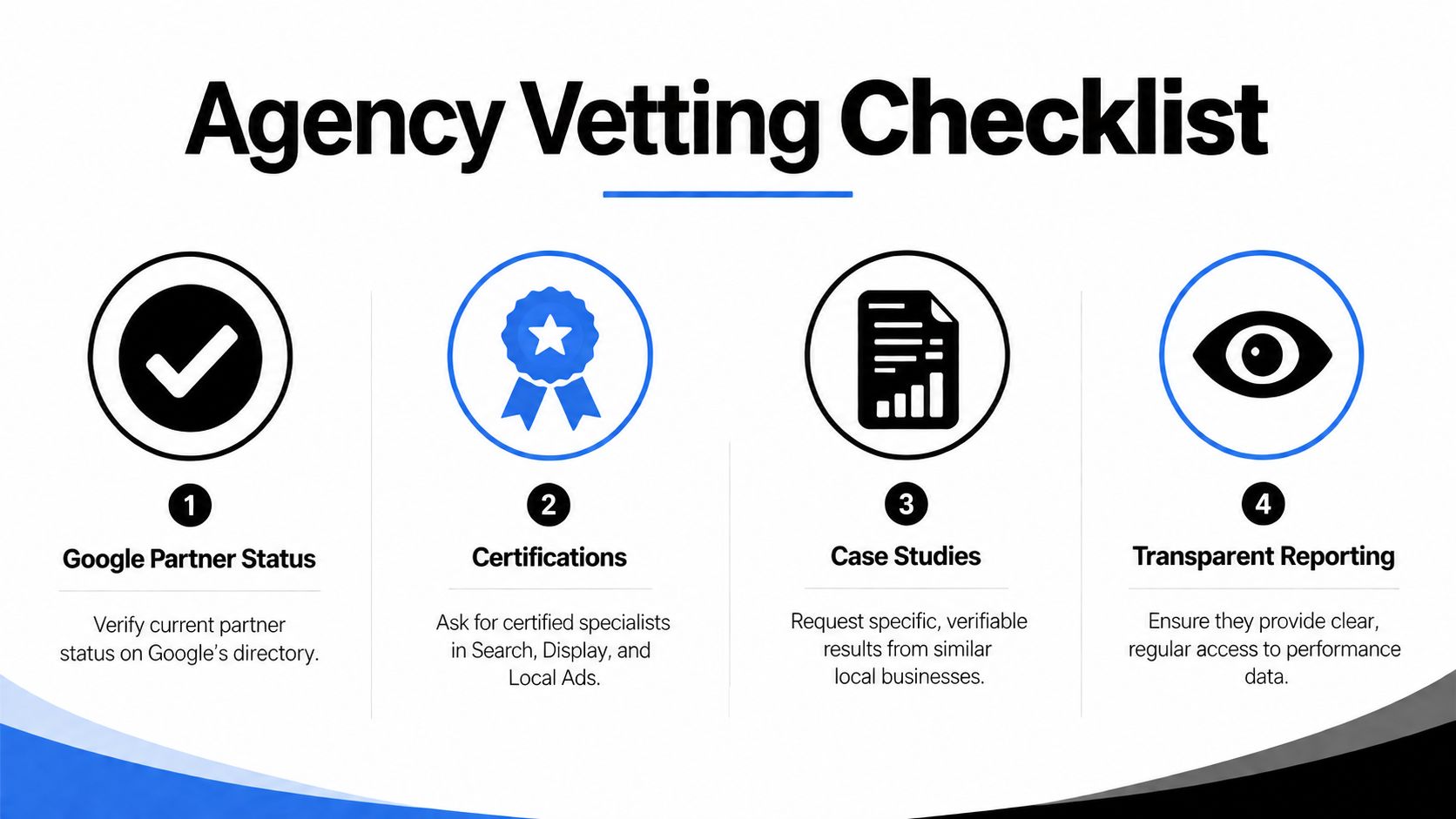
How to read a homepage in five minutes
- Certifications shown clearly: Good sign, but not enough on its own.
- Specific case studies: Better if they mention the business type and outcome.
- Tracking language: Look for call tracking, lead quality, and offline conversion import.
- Reporting promise: You want live dashboards or direct account access, not glossy exports.
One more thing. If they brag about managing every channel for every business, be cautious. Small business marketing stacks are usually messy, and the one-stop-shop pitch sounds nice until nobody owns anything well. That warning lines up with the realities described in in-house vs agency marketing, where control matters more than shiny breadth.
Questions That Expose a Weak Manager in the First Call
The first call should feel like an audit, not a sales pitch. If you're talking more than they are, that's usually a bad sign. A strong manager wants to understand margins, service area, lead quality, and what counts as a real customer in your business.
Discovery questions worth asking
Ask how they'd audit your current account. A good answer mentions search terms, conversion tracking, location data, and the difference between calls and qualified leads. A weak answer jumps straight to “we'll optimize the campaign” without telling you what they'd inspect first.
Ask what they need from you to judge success. If they never mention margin, job value, or lifetime value, they're probably going to optimize for cheap leads, which is how local accounts get filled with junk. Also ask how they'd deal with out-of-area interest, because local campaigns get messy fast when your service zone and your search zone don't line up.
Operations questions that matter
Find out how often they review search terms. If they say monthly and call it a day, keep moving. Strong operators review the query mix, clean out junk, and promote winners into tighter keyword structures. That's the discipline that keeps local campaigns from drowning in irrelevant intent.
“How do you manage negative keywords week to week?” is a better question than “Do you use negatives?”
That one question tells you whether they work the account or just glance at it. You also want to hear how they handle geo bid adjustments, presence-based targeting, and ad scheduling, especially if your phones aren't staffed all day. A manager who runs call-heavy tactics after hours without a staffing plan is wasting your money.
Contract questions that protect you
Ask who owns the account. Ask what happens if performance drops. Ask how reporting is delivered and whether you can keep direct access. If the answer sounds slippery, it probably is.
The best agencies are direct about process, not theatrical about partnerships. They know the account belongs to the business, not the vendor. If they can't say that plainly, I wouldn't trust them with spend.
Pricing Models and What Local Management Costs
Local Google Ads management gets expensive when the proposal hides the pricing model. Don't let that happen. You need to know whether you're paying a flat fee, a percentage of spend, hourly, project-based, or performance-based, because each model pushes the manager toward different behavior.
Flat retainers are the easiest to compare, and they're usually the cleanest fit for local lead generation. Percentage-of-spend sounds fair until you see how it can reward a bigger bill instead of better efficiency. Hourly and project work make sense for audits, setup, or cleanup, but they can get messy if the scope keeps expanding.
Published pricing from real Google Ads management providers
| Provider | Monthly Fee | Setup Fee | Notable Inclusions |
|---|---|---|---|
| Third Marble Marketing | Starts at $499 per month | Not specified | Search, Remarketing, Display, Shopping, Performance Max, and YouTube ads (Third Marble Marketing) |
| Pronto Marketing | $500 per month | $500 setup fee | Google Ads Certified specialist, plus a 10% monthly fee when ad budgets exceed $5,000 per month (Pronto Marketing) |
Those two published price points give you a hard reality check. If someone quotes far below that and promises full management, they are probably cutting corners somewhere. If they quote far above it without a clear explanation of the extra work, ask exactly what you are buying.
Pronto also says it keeps ad groups to no more than 15 to 20 keywords, which is a concrete operating rule worth paying attention to (Pronto Marketing). That level of detail matters more than vague claims about “full-service optimization.”
Local service campaigns also hide costs in setup, tracking, creative, and revision cycles. That is where cheap proposals get expensive. A low monthly fee with a large setup bill can still work if the process is tight, but a vague monthly fee with weak tracking discipline is usually a money sink.
Before you sign, audit the account structure and search-term quality with a tool like Keywordme's Google Ads account audit guide. If the current build is already messy, you want to know that before a manager starts billing you to clean it up.
Red Flags That Mean Walk Away Before You Sign
A weak local Google Ads manager usually gives itself away before the contract is signed. The first warning sign is account ownership games. If the agency wants to keep the account locked down and refuses admin access, that is control, not management.
The second warning sign is reporting that dodges revenue, qualified calls, or booked work. Impressions, clicks, and raw lead counts are easy to dress up. They do not tell you whether the campaign is producing jobs, and local service businesses live or die on job quality.
The deal-breakers I'd never excuse
- No negative-keyword process: This is a serious miss. Accounts that actively use negatives tend to stay cleaner and convert better than accounts that never filter junk queries, and WordStream's guidance on search-term hygiene makes the point plainly, zero-conversion queries with repeated clicks should be added as negatives, and strong search terms should be moved into tighter ad groups (WordStream Google Ads performance).
- Guaranteed rankings or lead counts: No one controls every auction outcome, and anyone promising certainty is selling fiction.
- Broad geo targeting with no explanation: That usually means wasted clicks from the wrong suburbs, commuters, tourists, or people too far away to matter.
- Locked contracts with no performance clause: If they want a long leash before they prove themselves, you are funding their learning curve.
The search-term workflow matters because sloppy hygiene is where budgets leak. Good operators pull recent queries, cut dead weight fast, and tighten keyword themes around intent. If a manager never talks about negatives, search terms, or ad-group cleanup, they are probably not doing the work.
Bottom line: If the pitch sounds polished but the mechanics are vague, walk.
One more warning. Call-only or mobile-heavy tactics outside staffed hours are a poor fit for many local businesses. If they do not ask when your team answers the phone, they are optimizing in a vacuum.
A bad manager also shrugs off account structure. If they treat every city, suburb, or service area the same, they are setting you up for messy geo segmentation and wasted spend. Local campaigns need clean boundaries, clear service intent, and lead-quality filtering from day one.
A manager who cannot explain how they handle search-term cleanup, geo segmentation, and lead quality is not ready for your account.
Audit the Account and Speed Up Onboarding With Keywordme
The easiest way to avoid a weak manager is to show up with your own audit. A tool like Keywordme can help you pull the last 30 days of search terms, flag junk queries, surface high-converting terms worth promoting, and build a clean negative list before the first serious call. That changes the conversation from “What do you think?” to “Here's what the account is already telling us.”

What to hand the new manager
Start with search terms, not opinions. Pull the queries, sort out the obvious junk, and separate the few terms that drove quality leads. Then export the negatives and the winners in a format the new manager can use immediately. That saves time and stops a lot of back-and-forth during onboarding.
Next, tighten the ad-group structure. If a campaign has too many loosely related terms jammed together, rebuild it around intent. That's the same logic behind cleaner geo segmentation, because local intent gets messy when service terms, city names, and “near me” modifiers are all mixed together.
If the account is noisy, the audit should calm it down before anyone touches bids.
I'd also use the audit to test whether the agency understands presence-based versus radius targeting, not just generic city setup. Google's location rules allow more precision than most managers bother using, and local campaigns lose a lot of money when they chase people who are merely interested in the area instead of being in it (Google Ads location targeting support). That's the difference between a clean onboarding and a messy one.
If you want a faster handoff, send the audit before the first meeting. It shortens discovery, forces accountability, and gives the next manager less room to improvise. It also creates a paper trail that makes bad recommendations easier to spot.
If you want cleaner local search terms, tighter negative lists, and an account audit that tells you where the waste is before you hand over budget, start with Keywordme. It's built for the exact cleanup work that separates a decent local Google Ads manager from a budget burner. Visit it, run the audit, and walk into your next hire with data instead of hope.
.svg)