
Win with Competitor Keywords in AdWords: Boost Your ROI
Win with Competitor Keywords in AdWords: Boost Your ROI


Spying on your competitor's AdWords keywords is one of the best shortcuts for building a profitable PPC campaign. You're basically getting a behind-the-scenes look at the search terms your rivals are putting their money on. This hands you a proven list of keywords that are already working in your niche, saving you a ton of time and cash on trial and error.
Why Competitor Keywords Are Your Secret Weapon
Let's be honest—launching a Google Ads campaign from scratch can feel like you're just throwing money at a wall and hoping something sticks. You're spending real budget, crossing your fingers that you land on keywords that actually convert. But what if you could sidestep most of that expensive guesswork? That’s where analyzing competitor keywords adwords becomes the smartest move you can make in PPC.

This isn't about blindly copying what your competitors are doing. It's about intelligently using the time, effort, and budget they've already sunk into figuring out what works. Think of their keyword list as a battle-tested roadmap, and you just got a copy.
Uncover Proven Conversion Opportunities
When you see a competitor consistently bidding on a specific keyword, that’s a massive clue. It's a strong signal that the term is making them money. This kind of insight helps you dodge common pitfalls, like bidding on low-intent phrases that just drain your budget with no return. You get to jump into the game with a huge head start.
Here's what this strategy really does for you:
- Find hidden gems: You'll uncover high-intent phrases you probably would've missed on your own.
- Validate your keyword ideas: It confirms that the keywords you've brainstormed are on the right track because others value them too.
- Benchmark your performance: You get a real feel for the competitive landscape and what it’ll take to actually win impressions.
The real win here is simple: you're making data-driven decisions from day one instead of flying blind on assumptions. That's your fastest path to a positive ROI.
The Google Ads game is all about data now. The days of just guessing are long gone. Smart businesses are using powerful tools to see exactly what their rivals are targeting. To give you some perspective, major analytics platforms serve over 1.2 million businesses that use this data to track ad strategies, uncovering everything from estimated CPCs to historical ad copy.
In the end, just grabbing keywords isn't enough. You need to fold this information into a bigger picture of what your rivals are up to. This means adopting comprehensive competitor monitoring strategies to stay ahead. Our complete guide on Google Ads competitor analysis dives way deeper into this process.
https://www.keywordme.io/blog/google-ads-competitor-analysis
Gearing Up: Picking Your Keyword Espionage Toolkit
Before you can start digging into your competitors' strategies, you need the right set of tools. You wouldn't go on a stakeout without a good pair of binoculars, and the same logic applies here. This is your guide to the best gear for uncovering those high-impact competitor keywords adwords without all the guesswork.
We'll look at everything from the free goldmine hiding right inside your Google Ads account to the powerhouse third-party platforms that do most of the heavy lifting. The idea is to build a toolkit that actually works for your budget and your goals, whether you're a one-person shop or a seasoned marketing pro.
Google's Tools vs. Third-Party Powerhouses
The first decision you'll face is whether to stick with what Google gives you or bring in some outside help. Honestly, you should probably do both.
Google's own Auction Insights report is your first stop. It's free, it's fast, and it tells you exactly who you're bumping shoulders with in the ad auctions. You can see who’s bidding on the same terms you are and just how often your ads show up together. It’s an invaluable reality check.
But for the real deep-dive, you’ll need a third-party tool. These platforms go way beyond just auction data. They let you peek behind the curtain and see the entire paid keyword list of pretty much any competitor. This is how you find the golden nuggets—the keywords your rivals are banking on that you haven’t even considered.
To get a full picture of the competitive landscape, it's worth exploring the best SEO monitoring tools out there. Many of them have powerful features for paid search analysis, too.
Competitor Keyword Analysis Tool Comparison
Let's quickly size up the main options. Each tool has its own sweet spot, so picking the right one depends on what you're trying to accomplish with your competitor AdWords campaigns.
As you can see, they each solve a different piece of the puzzle. The free tools give you a snapshot, while the paid ones deliver the full story.
The real power move is combining these tools. Use Auction Insights to spot your main rivals, then grab their entire keyword playbook with a third-party platform. It's a one-two punch that works every time.
This approach gives you the best of both worlds: the high-level strategic overview and the nitty-gritty tactical details.
For example, a specialized browser extension like the Keywordme Chrome plugin is built specifically to connect your research with your day-to-day work. It lets you take those competitor keyword lists you’ve found and pull them directly into your Google Ads workflow, turning what used to be a clunky, multi-step process into a smooth operation. It's a massive time-saver that helps you put your findings into action immediately.
How To Find and Filter High-Value Keywords
Alright, let's get our hands dirty. This is where we stop talking theory and start digging for the actual competitor keywords that move the needle. You can't just export a massive spreadsheet of terms and call it a day—that’s not a strategy, it’s a data dump. Our real job here is to find the high-value needles in that digital haystack.
Your first move? Figure out who you’re really up against online. These often aren't the same companies you compete with offline. You need to identify the websites that consistently pop up in the search results for the keywords you wish you owned. Tools like Google's Auction Insights or other third-party platforms are perfect for this, as they show you exactly who's fighting for the same digital real estate.
Identifying Your True Online Rivals
Once you have a shortlist of domains, it's time to plug them into a competitor analysis tool. The goal is simple: pull the entire list of paid keywords they're bidding on. Doing this gives you a raw, unfiltered look at every term your competitors think is valuable enough to spend money on. That’s a huge head start for your own research.
Don't panic if the initial list is enormous and a bit of a mess. That’s totally normal. Our next job is to bring some order to this chaos.
This flowchart gives you a good idea of the typical workflow for gathering raw keyword data, from broad sources like Google Ads to more specialized third-party tools and plugins.
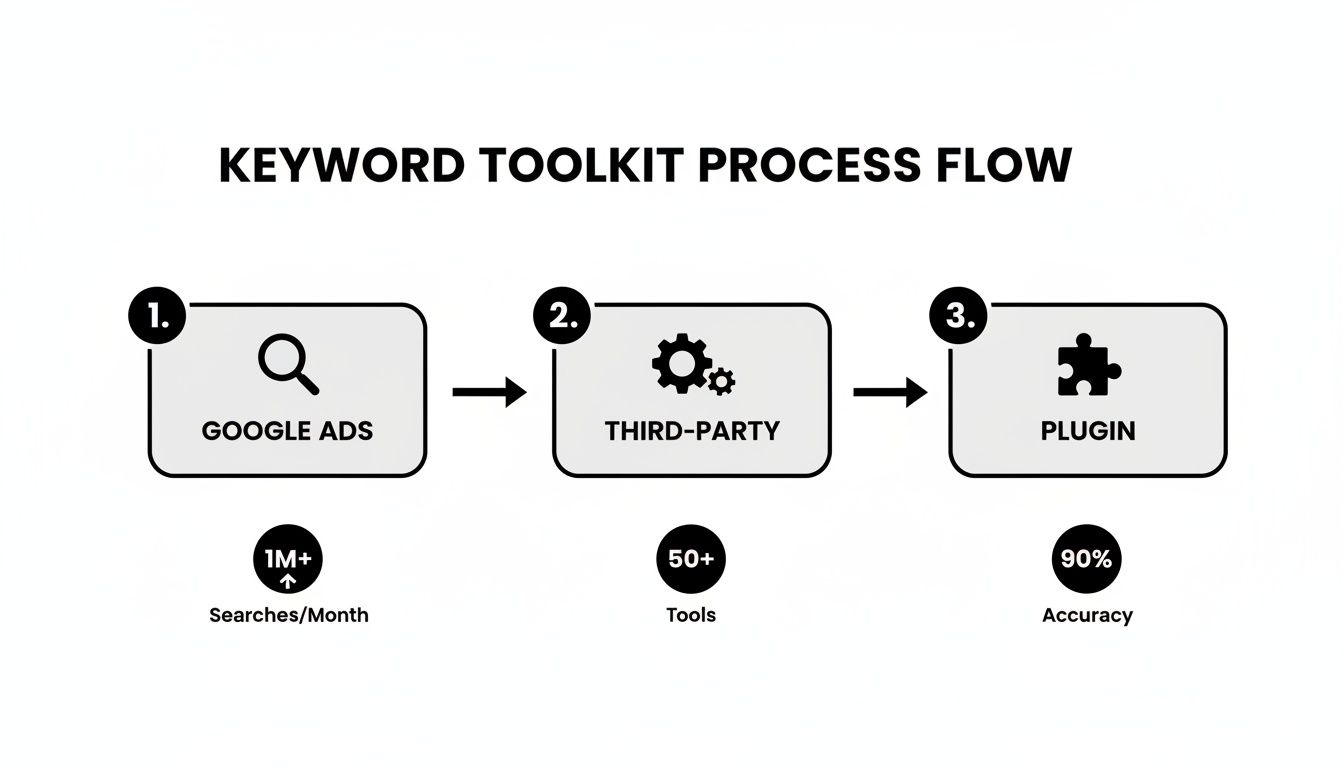
Each data source gives you a different piece of the puzzle. When you combine them, you get a much clearer picture of the entire competitive landscape.
Filtering for Commercial Intent
Now for the most important part: filtering. The single biggest factor we need to focus on is commercial intent. We’re hunting for the keywords that signal someone is ready to pull out their wallet, not just window-shopping for information.
Keep an eye out for keywords that contain modifiers like these:
- Product-specific terms: Think "nike air max" instead of just "running shoes."
- Transactional words: Look for "buy," "pricing," "quote," or "sale."
- Comparison terms: Phrases including "vs," "review," or "alternative" are gold.
- Local queries: Anything with "near me" or a specific city name screams intent.
These are the terms where your competitors are almost certainly seeing the best return on their ad spend. Pull these high-intent phrases out and put them on a priority list.
It's easy to get sidetracked by big search volume numbers. But a keyword with 100 monthly searches and sky-high commercial intent is infinitely more valuable than a generic term with 10,000 searches that brings in zero conversions.
After you’ve filtered for intent, start looking at metrics like the estimated Cost Per Click (CPC) and overall competition level. A high CPC often points to a high conversion value. Remember, we’re not just looking for cheap keywords; we’re looking for profitable ones. This is the absolute core of analyzing competitor keywords adwords like a pro.
Finally, get everything organized. I like to sort my final, cleaned-up list into a few buckets to make it actionable:
- Quick Wins: High-intent, super-relevant keywords with moderate competition.
- Strategic Targets: High-value, high-competition keywords that will be the backbone of your core campaigns.
- Long-Tail Opportunities: Niche, hyper-specific phrases that you can target with dedicated ad groups.
If you want to go even deeper on sifting through the data, our guide on analyzing competitor PPC keywords can help you fine-tune your process. An organized list like this isn't just data anymore—it’s the blueprint for your entire campaign structure.
Turning a Keyword List Into a Winning Strategy
Okay, so you've got this massive list of competitor keywords. Right now, it's just raw data. But with a bit of analysis and strategic thinking, that list becomes your battle plan. Let's start transforming those raw findings into a PPC strategy that actually gets you clicks and customers. It's time to sift, sort, and prioritize.
This part of the process is all about making smart judgment calls. We need to look past just the big search volume numbers and dig into the metrics that really signal profitability. The goal here is to turn that messy spreadsheet into a clean, actionable campaign ready to launch.
Mapping Keywords to Your Business Goals
First things first: relevance is everything. Go through your list, and for every single keyword, ask yourself: "Does this perfectly match something I sell?" If the answer isn't a definite "yes," that keyword gets bumped to a low-priority list or tossed out completely. Be ruthless.
With a leaner, more relevant list, you can start digging into the money-making potential. I always focus on a few key metrics here:
- Search Volume: Sure, higher is often better, but don't get hypnotized by huge numbers. I've seen lower-volume keywords with killer intent outperform the big ones time and time again.
- Estimated Cost Per Click (CPC): A high CPC isn't always a red flag. In fact, it often means other advertisers are making good money from that term, which tells you it's a high-value target.
- Conversion Potential: This is where you really need to put on your customer hat. Think about the intent. A keyword like "buy leather messenger bag" is worlds away from "what are bags made of" in terms of its likelihood to convert.
Don't be afraid to go head-to-head with a competitor on a high-cost keyword if it’s hyper-relevant to your core business. But also keep an eye out for those overlooked, lower-cost gems where you can clean up without draining your budget.
Honestly, this stage is a constant balancing act between your ambition and your budget. You have to decide which hills are worth dying on and where you can find an easier path to victory.
Structuring for a High Quality Score
Once you’ve got your priority list locked in, the next move is structuring it for success within Google Ads. This means organizing your shiny new competitor keywords adwords into tight, logically themed ad groups. Trust me, a well-organized structure is your secret weapon for a better Quality Score, which Google rewards with lower CPCs and better ad positions.
Think of each ad group as a small, specialized container. It should only hold a handful of extremely similar keywords that all point to the same user intent. For example, all your keywords related to "emergency plumbing services" go in one ad group, while terms about "bathroom faucet installation" get their own.
This tight-knit approach lets you write incredibly specific ad copy and send people to the exact right landing page. When your keyword, your ad, and your landing page are all in perfect harmony, your Quality Score skyrockets. If you want to dive deeper into this, you can learn more about how to use auction insights to your advantage in our other guide.
This is exactly where a tool like Keywordme can save you a ton of headaches. Instead of burning hours manually sorting keywords and building campaigns in spreadsheets, you can get it all done in a fraction of the time. It helps you take that prioritized list and instantly turn it into a perfectly structured campaign, freeing you up to focus on the high-level strategy instead of the tedious grunt work.
Time to Put Your Competitor Keywords to Work
Alright, let's get down to business. You've done the digging, sifted through the data, and now you have a killer list of competitor keywords. This is the fun part—actually getting that intelligence into your Google Ads account and making it work for you.

But hold on. This isn't just a simple copy-and-paste job. To do this right, you need to be strategic about how you integrate these keywords. It's a delicate balance between driving new traffic and protecting your budget. Let's walk through the nuts and bolts.
Nail Your Keyword Match Types
One of the first, and most critical, decisions you'll make is choosing the right match type. This one setting determines how much leash you give Google when it decides which searches trigger your ads. It's a constant battle between casting a wide net (reach) and getting the right fish (relevance).
Here’s my field-tested approach:
- Broad Match: Honestly? I avoid this almost entirely for new competitor campaigns. It can be a budget-killer, showing your ads for all sorts of tangentially related searches. Use it with extreme caution, if at all.
- Phrase Match: This is my workhorse. Phrase match gives you a great mix of volume and control. Your ads will show for searches that include the meaning of your keyword, which is usually the sweet spot for capturing relevant traffic without getting too wild.
- Exact Match: This is your sniper rifle. You get maximum control, showing your ads only for searches with the exact same intent as your keyword. I use this for the high-priority, bottom-of-the-funnel terms that I know are pure gold.
My advice? Start with Phrase Match and Exact Match for your top-tier competitor keywords. This lets you test the waters safely. You can always loosen the restrictions later once you have some real performance data to back up your decisions.
Write Ad Copy That Steals the Click
Bidding on competitor terms is just step one. The real magic happens when you convince someone to click your ad instead of the one they were originally looking for. Your ad copy is your frontline salesperson, and it needs to be sharp.
Get inside the searcher's head. If they’re Googling "competitor X alternative," your headline better be something like "The #1 Alternative to Competitor X." If they’re searching for a specific feature that your competitor offers, your ad needs to shout about how you do it better, faster, or cheaper. Be direct, highlight what makes you different, and give them an irresistible reason to choose you.
Seriously, Set Up Your Conversion Tracking
Let me be blunt: if you aren't tracking conversions, you are flying blind and wasting money. Period. Without accurate tracking, you have absolutely no idea which keywords are actually driving results and which are just draining your bank account.
Before you activate a single one of these new keywords, double- and triple-check that your conversion tracking is bulletproof. This means tracking every action that matters—quote requests, demo sign-ups, sales, phone calls, whatever your goals are.
This data is your feedback loop. It's the only way to know what's working so you can invest more, and what's failing so you can cut it loose. Don't even think about skipping this step. It's non-negotiable if you want to prove your ROI and scale what you're doing.
Got Questions? I've Got Answers.
Let's tackle some of the most common questions that pop up when talking about competitor keywords in Google Ads. I've heard these from clients and fellow marketers time and time again, so here are the straight-up, no-fluff answers you need.
Is This Even Legal? Can I Bid On My Competitor's Keywords?
Yes, absolutely. Bidding on the same keywords as your competition is not only legal, but it’s a fundamental part of how the whole Google Ads auction works. It’s fair game.
But there's a huge string attached. You absolutely cannot use your competitor's trademarked brand name in your actual ad copy. While you can bid on "Nike running shoes" all day long, your ad headline can't say "Official Nike Retailer" if you're not. That's a fast track to getting your ads disapproved and is a big violation of Google's policies.
How Often Should I Be Doing This Research?
Competitor keyword research isn't something you can set and forget. The advertising world moves fast—new competitors pop up, and old ones change their game plan.
Here’s the rhythm I recommend to stay ahead:
- A Quarterly Deep Dive: Every three months, set aside time for a full-blown analysis. This is when you'll spot the big strategic shifts, uncover new keyword trends, and rethink who your main targets are.
- A Quick Monthly Check-In: Once a month, just do a quick health check. Jump into your Google Ads account and look at the Auction Insights report. It's the perfect way to spot a new, aggressive competitor or see if a rival has suddenly ramped up their budget before it hurts your performance.
Staying on top of this research is what separates the pros from the amateurs. It’s how you keep your campaigns agile and avoid getting blindsided by a competitor's next move.
This steady cadence keeps you operating with fresh intel, not old assumptions.
What If My Competitors Are Bidding On Junk Keywords?
Finding this is actually great news! Just because a competitor is throwing money at a keyword doesn't mean you should. They might have different goals, a slightly different product, or frankly, they might just be making a mistake.
Always, always filter their keywords through the lens of your business. If a keyword is a poor fit for what you sell, don't just brush it aside. Grab it and add it to your negative keyword list immediately.
This is such a crucial step. It actively shields your budget from worthless clicks and instantly makes your campaigns more targeted. Think of it as a golden opportunity to be smarter with your money than they are with theirs.
Ready to stop guessing and start winning? Keywordme turns complex competitor keyword data into an actionable strategy in minutes. Ditch the spreadsheets and streamline your entire Google Ads workflow. Start your free 7-day trial today and see the difference.
.svg)