
Master AdWords Keyword Competition: Analyze & Win Profits
Master AdWords Keyword Competition: Analyze & Win Profits


When you're diving into Google Ads, one of the first things you'll bump into is "keyword competition." What is it, really?
Simply put, it’s a measure of how many other advertisers are trying to show up for the exact same keyword you are. Think of it as a popularity contest. High competition means that keyword is the "cool kid" everyone wants to be seen with, making it a crowded and expensive party. Low competition means you've found a hidden gem—fewer people are vying for that spot, which often translates to a better deal for you.
Getting a handle on this is your first real step toward building a Google Ads strategy that doesn't just spend money, but actually makes it.
What AdWords Keyword Competition Really Means

Picture Google Ads as a lightning-fast auction. Every single time someone hits "search," an auction happens behind the scenes to decide which ads get shown. The keyword competition metric is your sneak peek into how many bidders are showing up to that auction.
This isn't just some abstract label; it's pure supply and demand.
A popular, high-intent keyword is like a storefront on Fifth Avenue. Everybody wants that prime real estate, so advertisers flock to it, driving the bidding price—your Cost-Per-Click (CPC)—through the roof.
On the flip side, a low-competition keyword is like a fantastic little shop on a quiet side street that only a few people have discovered. With way fewer bidders in the mix, you can often snag that ad spot for a bargain. This is exactly why jumping into high-competition keywords without a plan is one of the fastest ways to burn through your ad budget.
Understanding the Competition Scale
To make life easier, Google breaks competition down into three simple levels: Low, Medium, and High. This scale is your quick-glance guide to how much of a fight you're in for.
- Low: Not many advertisers are bidding here. This usually means lower costs and a much better shot at getting your ad seen.
- Medium: A decent number of advertisers are in the ring. Costs are average, and these keywords can often be steady, reliable performers.
- High: The auction is packed. Tons of advertisers are bidding aggressively, which almost always guarantees higher CPCs and a tough battle for visibility.
Behind these simple labels is a more granular score. Google actually uses a 0-100 index to calculate competition. This number comes from dividing the number of filled ad slots by the total number of ad slots available for a given keyword. So, if you see a competition score of 75, it means that about 75% of the available ad space is already snatched up by your competitors.
It’s also super important not to mix this up with SEO competition. They're related, but totally different beasts. Paid ad competition is about bidders, while SEO competition is about organic ranking difficulty. If you want to get clear on the organic side, check out our guide on what keyword difficulty is in SEO.
Keyword Competition Levels at a Glance
Here's a quick summary of what each Google Ads competition level means for your strategy and budget.
This table should help you make smarter, faster decisions as you sort through potential keywords for your campaigns.
Competition Isn't the Same as Search Volume or CPC
It’s a classic rookie mistake to confuse keyword competition with search volume and CPC. You see a keyword with "High" competition and automatically assume it must get tons of traffic and cost a fortune per click. Not so fast.
While these three metrics are definitely related, they tell three very different stories. Think of them as three separate gauges on your campaign's dashboard. Just because one needle moves doesn't mean the others will follow in lockstep. Getting a feel for how they play off each other is where the real opportunities hide.
For instance, you might find a super-specific, long-tail keyword with pretty low search volume—maybe just 200 searches a month. But what if those 200 people are desperate for a solution and ready to buy right now? You could find a handful of competitors fighting over that tiny, valuable audience, driving up the competition and the CPC, despite the small search numbers.
How These Metrics Actually Work Together
On the flip side, a keyword could have a massive search volume—say, 50,000 searches a month—but Google labels the competition as "Medium." How does that happen? Maybe the search term is broad, so advertisers are bidding carefully because the user's intent isn't crystal clear. This can create a sweet spot where you get in front of a lot of people without having to mortgage your house.
Here’s a simple way to think about how they interact:
- Search Volume: This is pure audience demand. How many people are typing this into Google?
- AdWords Keyword Competition: This is advertiser supply. How many other businesses are trying to show ads for that same term?
- Cost-Per-Click (CPC): This is the market price. It’s the result of the tug-of-war between that supply and demand.
The unique dance between these three metrics is what really shapes your entire keyword strategy.
Quality Score: The Great Equalizer
So, if you can't just outspend everyone, how do you win a bidding war? The answer is your Quality Score. This is Google's way of rewarding advertisers who actually give searchers a good experience.
Think of Quality Score as your secret weapon. A high score can seriously slash your CPC, meaning you can pay less than a competitor for the exact same ad position. It levels the playing field, making it possible for a smart advertiser with a smaller budget to outrank a lazy giant.
Google figures out your score by looking at three main things: your ad's expected click-through rate (CTR), how relevant your ad is to the keyword, and the quality of your landing page. Nail these three, and you're essentially telling Google, "My ad is the best answer here." As a reward, Google gives you a discount on your clicks and a better ad rank. This is exactly how you can go after a high-competition keyword without an unlimited budget.
How to Analyze Competition Data Like a Pro
Seeing a keyword slapped with a "High" or "Low" competition label is just the first step. The real magic happens when you turn that simple tag into a smart, winning Google Ads strategy. It’s all about looking beyond the surface and figuring out the story the data is telling you.
The foundation for really getting a handle on AdWords keyword competition is solid Google Ads keyword research. This is how you go from just hoarding a list of keywords to actually understanding what they're worth to your business.
A huge part of this is digging into historical data to find patterns. You can see seasonal spikes coming a mile away—like the mad dash for "gift baskets" every December—and adjust your budget for that peak demand instead of getting blindsided by skyrocketing CPCs.
Sizing Up Your Actual Competitors
It's one thing to know a keyword is competitive; it’s a whole different ballgame to know who you're up against. Are you in a bidding war with a few local shops or are you fighting global corporations with what feel like infinite budgets?
You have to dig deeper. The other players in the auction will completely shape your strategy. If you’re facing off against a massive brand, you might want to zig where they zag by focusing on long-tail keywords they overlook. But if you’re up against smaller businesses, it might turn into a straight-up battle for the best Quality Score.
To get the full picture of who’s showing up for your target keywords, you can learn more about using the Auction Insights report in our dedicated article.
This simple visual breaks down how competition, search volume, and CPC are all connected.
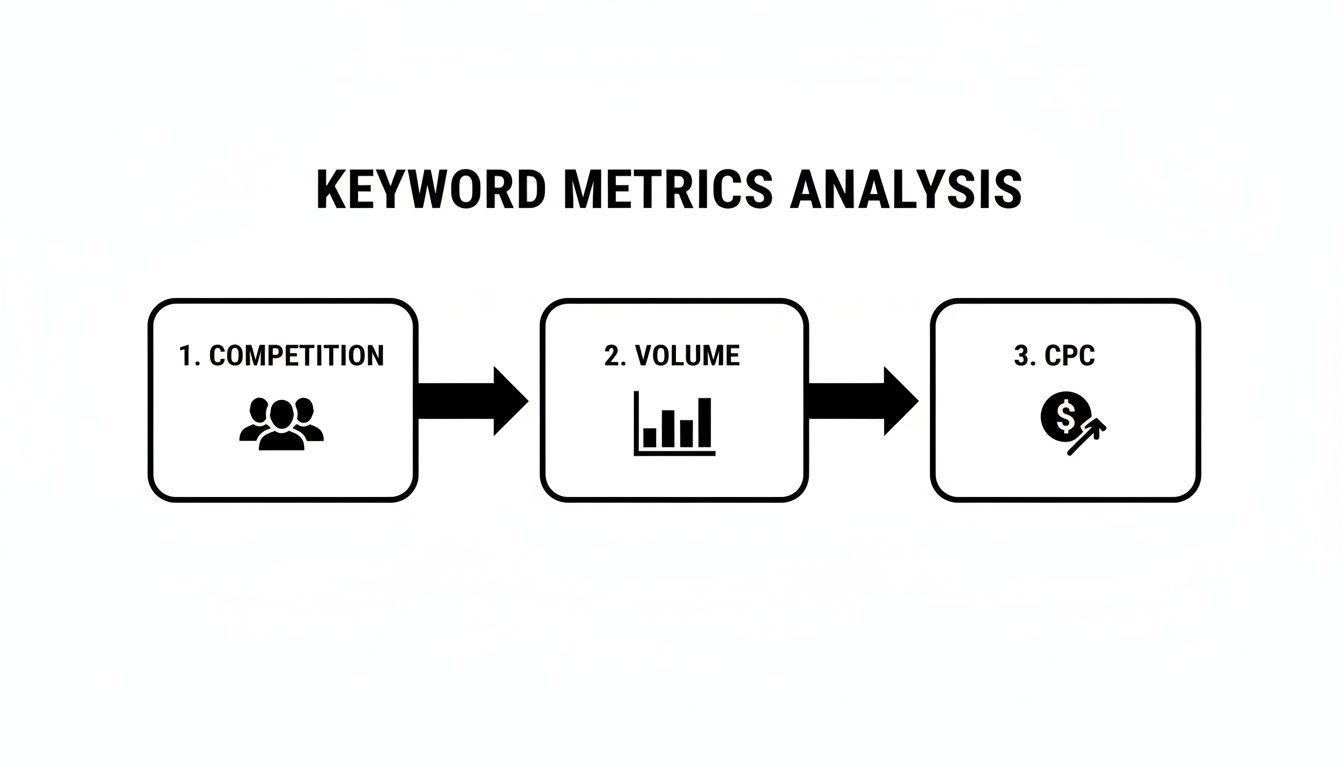
As you can see, when more advertisers jump into the ring for a popular keyword, the price you pay for each click tends to go up right along with it.
Connecting Competition to Commercial Intent
Ever wonder why a keyword like "buy waterproof running shoes" is always way more competitive than "best running form"? It all comes down to commercial intent. The first person is practically holding their credit card, which makes them a goldmine for advertisers. The second person is just kicking tires and looking for information.
High competition is often a dead giveaway for high commercial intent. Figuring out this connection is absolutely crucial.
Your job isn’t just to find keywords. It’s to match your bids to what the searcher actually wants to do. A high-competition, high-intent keyword might be worth that premium price if it leads straight to a sale. On the flip side, a low-competition, low-intent keyword is perfect for top-of-funnel blog posts or guides.
This kind of strategic thinking is backed by years of data. In fact, Google Keyword Planner lets you look at historical search volume data all the way back to 2016. This gives you a massive treasure trove of information for spotting trends, seasonal cycles, and demand shifts that you'd never see by just looking at a snapshot in time. Once you get the hang of this, you’ll have a reliable process for making sense of the data and building campaigns that win.
Winning Strategies for High-Competition Keywords

So, you've found a keyword you love, but the AdWords keyword competition is through the roof. What now? Your first instinct might be to just throw more money at the problem, but that's a surefire way to burn through your budget with little to show for it. The real pros don't just outspend their rivals; they out-think them.
The trick isn't to run away from these valuable, competitive terms. It's about approaching them with a much smarter, more precise game plan. By focusing on a few specific tactics, you can carve out a profitable space for yourself, even when the auction is packed.
Go Long with Hyper-Specific Keywords
Instead of getting into a bidding war over a broad, expensive keyword like "running shoes," it's time to get specific. Think about the long-tail keywords that signal a searcher is ready to buy. A phrase like "best waterproof trail running shoes for wide feet" might have less traffic, but the person typing it in knows exactly what they're looking for.
This is where you find the gold. Targeting these hyper-specific phrases connects you with people who are much further along in their buying journey. The result? Your ad spend is way more efficient, and your return on investment gets a serious boost.
Maximize Your Quality Score
In a competitive auction, your Quality Score is your secret weapon. Seriously. It’s Google's way of rewarding advertisers who create a great experience for users, and a high score can dramatically slash your cost-per-click (CPC), giving you a huge leg up.
So, how do you get that stellar score? It boils down to nailing three things:
- Tightly-Themed Ad Groups: Stop lumping hundreds of loosely related keywords into one ad group. Build small, laser-focused groups where every single keyword is directly tied to the ad copy.
- Irresistible Ad Copy: Write ads that feel like a direct answer to the user's search. Use the keyword, highlight what makes you different, and give them a crystal-clear call-to-action.
- Seamless Landing Page Experience: The page they land on after clicking your ad must be fast, mobile-friendly, and deliver on the promise you made in the ad. Relevance is king.
Obsessing over your Quality Score is the single most effective way to compete when costs are high. A score of 8/10 or higher can mean you pay significantly less than competitors for the very same ad position.
Carve Out Your Niche with Advanced Targeting
Finally, remember that you don't have to show your ads to everyone, everywhere, all the time. Advanced targeting lets you zero in on the audience segments that actually make you money, so you can stop wasting your budget on low-value clicks.
Get surgical with these tactics:
- Geo-Targeting: Are your best customers in specific cities, states, or even zip codes? Target only those areas to make every dollar work harder.
- Dayparting (Ad Scheduling): Dive into your campaign data. Find out which days and hours bring in the most conversions, then schedule your ads to run only during those peak times.
- Device Targeting: Does your audience convert better on desktop than on mobile, or vice versa? Adjust your bids to prioritize the platform that drives real results for your business.
By layering these strategies, you can precisely target your most valuable traffic. This makes it entirely possible to win auctions and drive profit, even when the AdWords keyword competition is fierce.
Finding Hidden Gems in Low Competition Keywords

While everyone else is duking it out in a bloody bidding war over the obvious, high-competition keywords, the savviest advertisers are quietly panning for gold elsewhere. This is where you find the low-competition keywords that build seriously profitable Google Ads accounts.
Think of them as the secret side streets with no traffic that lead straight to your ideal customer's house. They almost always have lower CPCs because fewer people are fighting for them, which means a much better return on your ad spend. Better yet, they often pull in hyper-qualified traffic because the search itself shows someone has a very specific need.
Learning how to unearth these opportunities is a practical skill that gives you a massive edge. It's all about looking where your competitors aren't.
Practical Ways to Uncover Low-Competition Gold
So, how do you actually find these hidden gems? It starts by shifting your focus from the big, expensive head terms to more specific, nuanced phrases. You stop thinking about just what people want to buy and start thinking about the problems they're trying to solve.
Here are a few tactics that I’ve seen work time and time again:
- Explore Question-Based Queries: Keywords starting with "how to," "what is," or "why does" are often gold mines. A person searching for "how to fix a leaky faucet under the sink" is way more specific—and likely more motivated—than someone just typing in "plumber."
- Dig into Brand-Adjacent Terms: What products or services complement your own? If you sell high-end hiking boots, targeting low-competition keywords like "best socks for long hikes" lets you catch a super-relevant audience right before they even think about footwear.
- Leverage Long-Tail Variations: As we've touched on, long-tail keywords are an advertiser's best friend. These super-specific, longer phrases are where you’ll find pockets of untapped opportunity. For a deeper dive, check out our complete guide on how to do long-tail keyword research.
The goal isn't just to find cheap keywords; it's to find undervalued ones. A keyword with low AdWords keyword competition and high commercial intent is the ultimate win. It delivers motivated buyers at a fraction of the cost.
Streamlining the Hunt with Keywordme
Let's be honest, manually sifting through spreadsheets to find these nuggets is a huge time-suck. This is exactly where a good tool changes the game, turning a mind-numbing task into a quick, strategic move.
Keywordme is built specifically for this. Instead of guessing, you can plug it directly into your Google Ads account and let your own search term data be your guide. It’s the ultimate source of truth.
You can instantly filter your real campaign data to find promising search terms that are already getting you clicks and conversions but have low competition.
With a few clicks, you can surface these opportunities and then—without even leaving the platform—build new, tightly-themed ad groups around them. This is how you find and act on low-competition keywords at speed, building a more resilient and profitable account while everyone else is still stuck in their spreadsheets.
Your Top Keyword Competition Questions, Answered
Alright, we've walked through the basics. Now, let's dig into the questions that I hear all the time from advertisers trying to make sense of AdWords keyword competition. Getting these concepts straight is the key to avoiding costly mistakes and building a PPC strategy that actually works.
Think of this as the "what they don't tell you in the manual" section. These are the nuances that can make or break your campaigns.
Is a Low Competition Keyword Always a Good Thing?
Nope, and falling for this one is a classic rookie mistake. A keyword with "Low" competition might look like a hidden gem, but more often than not, there's a good reason it's so cheap.
Sometimes, it’s because the search volume is practically zero. You can win all the auctions you want, but if nobody is searching for the term, it's like setting up a shop in a ghost town. Other times, the keyword has no commercial intent. Think about "free photo editor"—advertisers aren't fighting over it because the searcher has already made it clear they don't want to spend money.
A "High" competition keyword, on the other hand, is often a neon sign flashing "BUYER INTENT HERE." It’s competitive because it’s profitable. The smartest approach is to build a balanced portfolio: use a killer Quality Score to affordably target high-value competitive keywords, while also scooping up less expensive, top-of-funnel traffic with relevant low-competition terms.
How Does Quality Score Help Me Beat the Competition?
Your Quality Score is your secret weapon in a bidding war. Seriously. It’s Google’s way of rewarding you for giving searchers exactly what they want, and the reward is a lower CPC and a better ad position.
A high Quality Score (an 8/10 or better) means you can literally outrank a competitor who is bidding more money than you. It completely levels the playing field, allowing a small business with super-relevant ads to compete with a huge company's massive budget. It proves that Google Ads isn't just about who has the deepest pockets; it's about who delivers the most value.
How Often Should I Check Keyword Competition Levels?
Keyword competition isn't a "set it and forget it" metric. It's constantly changing. Market trends, holidays, a competitor's new product launch, or even a new business deciding to advertise can shift the landscape overnight. What was a "Medium" competition keyword last quarter could easily be "High" today.
Here’s a good rhythm to follow:
- For your core, everyday keywords: Check in on the competitive landscape at least once a quarter.
- For your most important, high-spend campaigns: A monthly health check is a much better idea.
This kind of regular review helps you understand if you’re just seeing a temporary spike or a permanent market shift that requires you to adjust your entire strategy.
Can I Target a High Competition Keyword on a Small Budget?
You absolutely can, but you have to be a sniper, not a machine gunner. You can't just throw your budget at a broad, competitive term and hope for the best. The name of the game is precision.
Instead of the main keyword, start by targeting long-tail variations—the more specific, the better. Then, get ruthless with your targeting. Use tight geographic filters to only show ads in your most profitable areas. Layer on ad scheduling to run campaigns only during the hours you know your customers are buying.
And above all, obsess over your Quality Score. When your budget is tight, every single click has to count. Your goal isn't to win every auction; it's to win the right auctions and carve out your own small, highly profitable slice of that traffic.
Ready to stop guessing and start winning? Keywordme plugs right into your Google Ads account, helping you find those undervalued, low-competition keywords and optimize your campaigns faster than ever. Start your free 7-day trial today and see the difference real data makes. Visit https://www.keywordme.io to learn more.
.svg)