
7 Best Sources for YouTube Ads Examples (2026)
7 Best Sources for YouTube Ads Examples (2026)


Why do marketers save dozens of YouTube ads examples and still ship creative that feels generic?
The problem usually starts after the swipe. Teams collect hooks, thumbnails, and CTAs, but they do not study the context behind them. A strong ad on YouTube is tied to an objective, format, audience, and offer. Strip that context out, and the swipe file turns into a pile of disconnected ideas.
That matters on a platform this large. YouTube continues to command massive global reach and ad spend, as noted in Sprout Social's YouTube stats roundup. Creative research needs more discipline than “save anything that looks polished.”
The useful approach is straightforward. Build a swipe file from a few reliable sources. Tag each example by funnel stage, ad format, hook style, offer type, and CTA. Then compare patterns across brands instead of copying a single ad in isolation. I use the same process when reviewing pay-per-click advertising examples across channels, because the best ideas usually come from structure, not surface-level style.
That is the angle of this list. These are not just places to browse ads. Each source helps answer a different question: what YouTube is promoting, what award-winning creative looks like, what competitors are running now, and where to find useful references outside Google's own ecosystem.
Here are the seven sources I'd use.
1. YouTube's Best in Ads (Google/YouTube gallery)
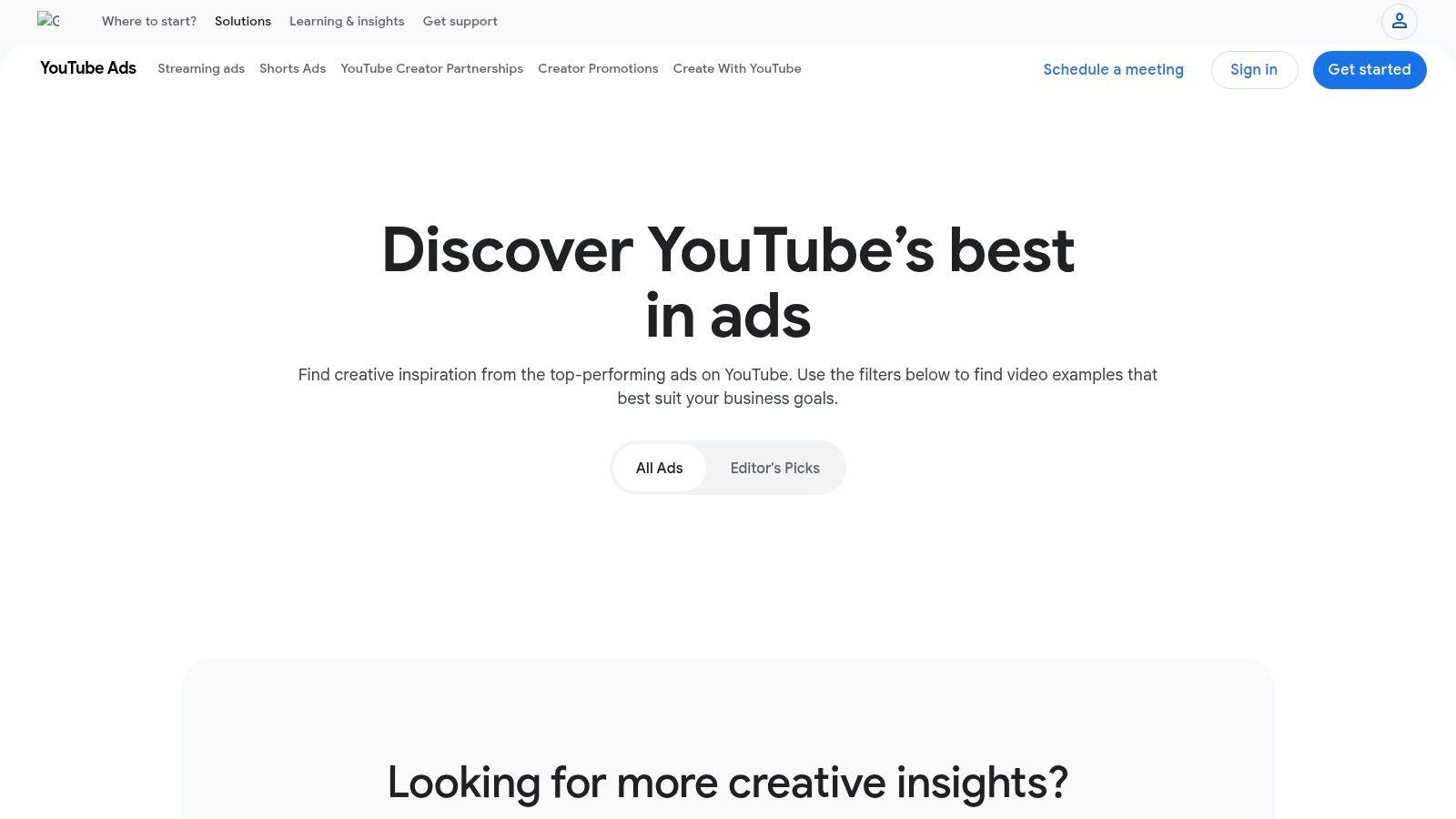
If you want the cleanest starting point, use YouTube's Best in Ads. It's the least messy way to find current YouTube ads examples without digging through random blog posts stuffed with old winners from completely different buying environments.
I like this gallery because it keeps you close to what YouTube itself is surfacing. That matters when you're benchmarking hooks, pacing, branding, and CTA style for the platform you're buying on.
How to use it well
Don't browse it like entertainment. Browse it like account research.
- Filter by objective: If you're building awareness creative, don't swipe bottom-funnel direct response ads.
- Filter by region: US creative often behaves differently from broader global examples, especially in offer framing and humor.
- Map to creative rules: Use the gallery alongside Google's ABCDs framework so your notes stay tactical instead of turning into vague “this feels strong” comments.
Practical rule: Save examples by funnel stage, not by brand name. That keeps your swipe file usable when you're under deadline.
The main weakness is obvious. You won't get spend data, targeting details, or the ugly tests that failed before a polished ad surfaced here. It's inspiration with some performance signal, not full competitive intelligence.
That said, it's still one of the best top-of-stack sources for marketers who need quality fast. If you also collect patterns from search and display, these pay-per-click advertising examples pair nicely with the gallery and help you keep messaging consistent across channels.
2. YouTube Works Awards (Google Ads Impact Awards transition)
The YouTube Works Awards are where I go when I need examples that help sell strategy internally. A creative gallery can show what looks good. Awards case studies can help explain why a campaign structure made business sense.
That's useful when a client or stakeholder keeps asking for “something viral” without defining the goal. The stronger YouTube Works entries usually connect audience insight, format choice, creative execution, and measurement in a way that's easier to reverse-engineer.
What it's best for
These examples are better for full-funnel thinking than for raw volume.
- Stakeholder buy-in: The case-study framing helps when you need to justify a format mix or creative direction.
- Cross-format learning: Shorts, in-stream, and broader campaign integration show up more clearly than in many swipe galleries.
- Business context: You often get enough narrative to understand the problem the ad was built to solve.
One practical angle matters a lot here. A cross-platform testing dataset highlighted in this YouTube strategy breakdown found that “once-in-a-lifetime deal” angles performed 34% better at bottom-funnel conversion when paired with non-skippable in-stream ads, while top-funnel pre-framing worked best with in-feed video ads that feel more like organic content. That's the kind of thinking these award examples can sharpen, even when the case page itself doesn't hand you every media detail.
Good award entries don't just show creative quality. They show fit between message, format, and objective.
The downside is volume. You won't get the endless depth of a dedicated spy tool, and not every winner gives enough tactical detail for media buyers who want to know exactly how the account was structured.
3. VidTao
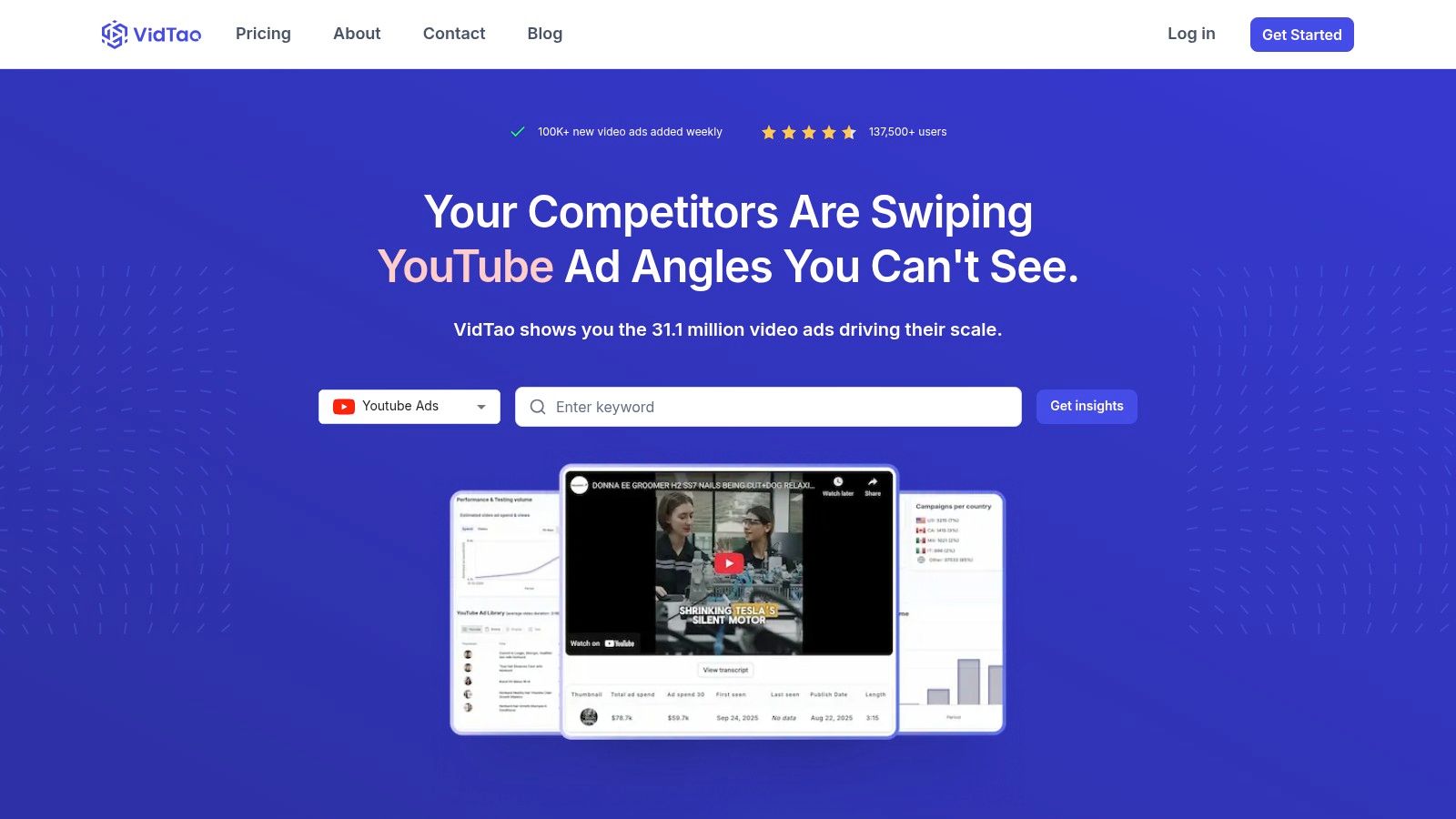
If Google's own galleries are the showroom, VidTao is the workshop. It's built for performance marketers who don't just want polished YouTube ads examples. They want active ads, niche patterns, and unlisted creative that brands run only as paid media.
That's the main draw. A lot of winning YouTube creative never gets uploaded as a proud brand asset. It exists in paid campaigns, gets iterated hard, and disappears. VidTao helps you find more of that layer.
Where it earns its keep
I'd use VidTao when the assignment is competitive research, not general inspiration.
- Competitor surveillance: Search by brand or niche and look for recurring hooks, offers, and edit styles.
- Swipe file building: The browser workflow is useful when you want to save ads while browsing YouTube naturally.
- Creative clustering: Group what you find by angle, opener, CTA, and landing-page match rather than dumping everything into one folder.
For agencies and in-house teams doing structured PPC competitive analysis, that workflow matters. The tool is most valuable when someone on the team is actively tagging findings and turning them into test hypotheses.
The trade-off is that paid intelligence tools can feel overwhelming if your process is sloppy. Teams often collect too many ads and too few insights.
Field note: If an ad catches your eye, don't save just the video. Save the hook, offer, page type, and likely funnel stage in the filename or note field.
VidTao also becomes more useful when paired with a backend targeting mindset. One big gap in most “inspiration” articles is search-term quality. According to Lunio's analysis of YouTube ad example content, 42% of YouTube ad spend is wasted on mismatched search terms that could be filtered through negative keyword automation. Creative research is only half the job. Placement and term hygiene still decide whether that creative gets a fair shot.
4. iSpot.tv
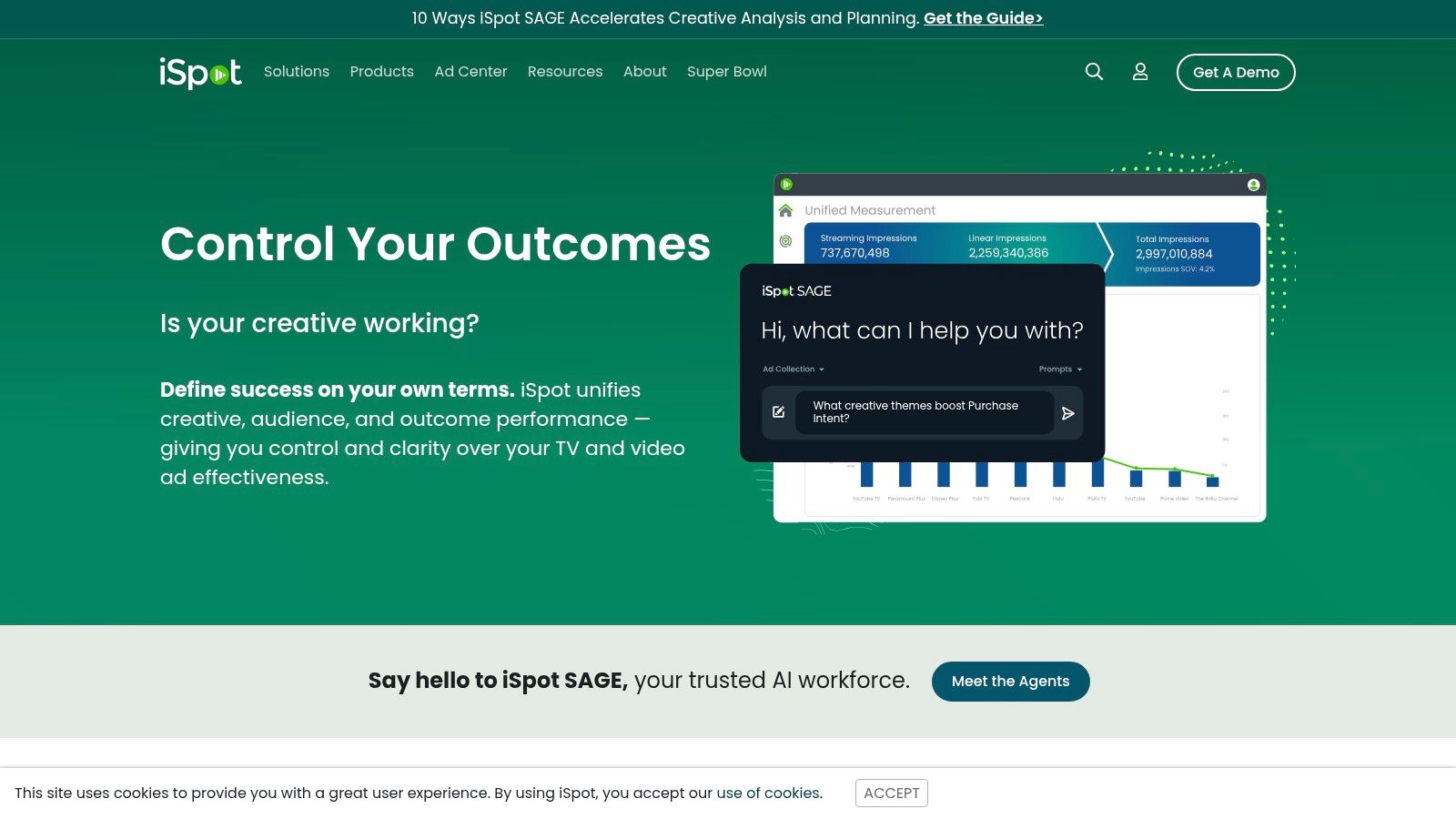
iSpot.tv is one of the better places to study how a brand carries one video idea across TV, streaming, CTV, and digital placements. That cross-channel view is what makes it useful for YouTube research. You are not just collecting ads. You are comparing how the same offer, story, and opening get edited for different levels of viewer intent.
I use it to answer a practical question. Did the brand build one hero asset and trim it down everywhere, or did it produce distinct versions for each placement? That difference usually shows up fast in the first five seconds, the CTA, and how soon the product appears.
What to study inside iSpot.tv
iSpot.tv is strongest for polished brand campaigns with multiple edits in market. It helps you examine adaptation, not just inspiration.
- Version control: Compare long-form, cutdown, and alternate edits to see what gets removed first.
- Opening speed: Check whether the ad reaches brand, problem, or product fast enough for YouTube attention spans.
- Offer translation: Watch how the same campaign shifts from awareness language to harder-working response copy.
- Creative consistency: Review whether visual identity, voice, and CTA stay aligned across channels.
That last point matters if you are building a swipe file for analysis instead of entertainment. Save each ad with notes on format, hook type, runtime, and CTA. Then add one line on what changed between placements. That is where the pattern usually appears.
This is also a strong resource to pair with a library of ad copy examples for offer and CTA analysis. The script, supers, and closing ask often explain why one version feels built for performance while another feels built for reach.
The trade-off is simple. iSpot.tv can bias you toward high-production campaigns that look great in a deck and miss on YouTube if the pacing is slow or the value proposition arrives late. Use it to study structure and adaptation. Validate YouTube fit with native-platform signals before you borrow the idea.
5. Ads of the World (Clio Network)
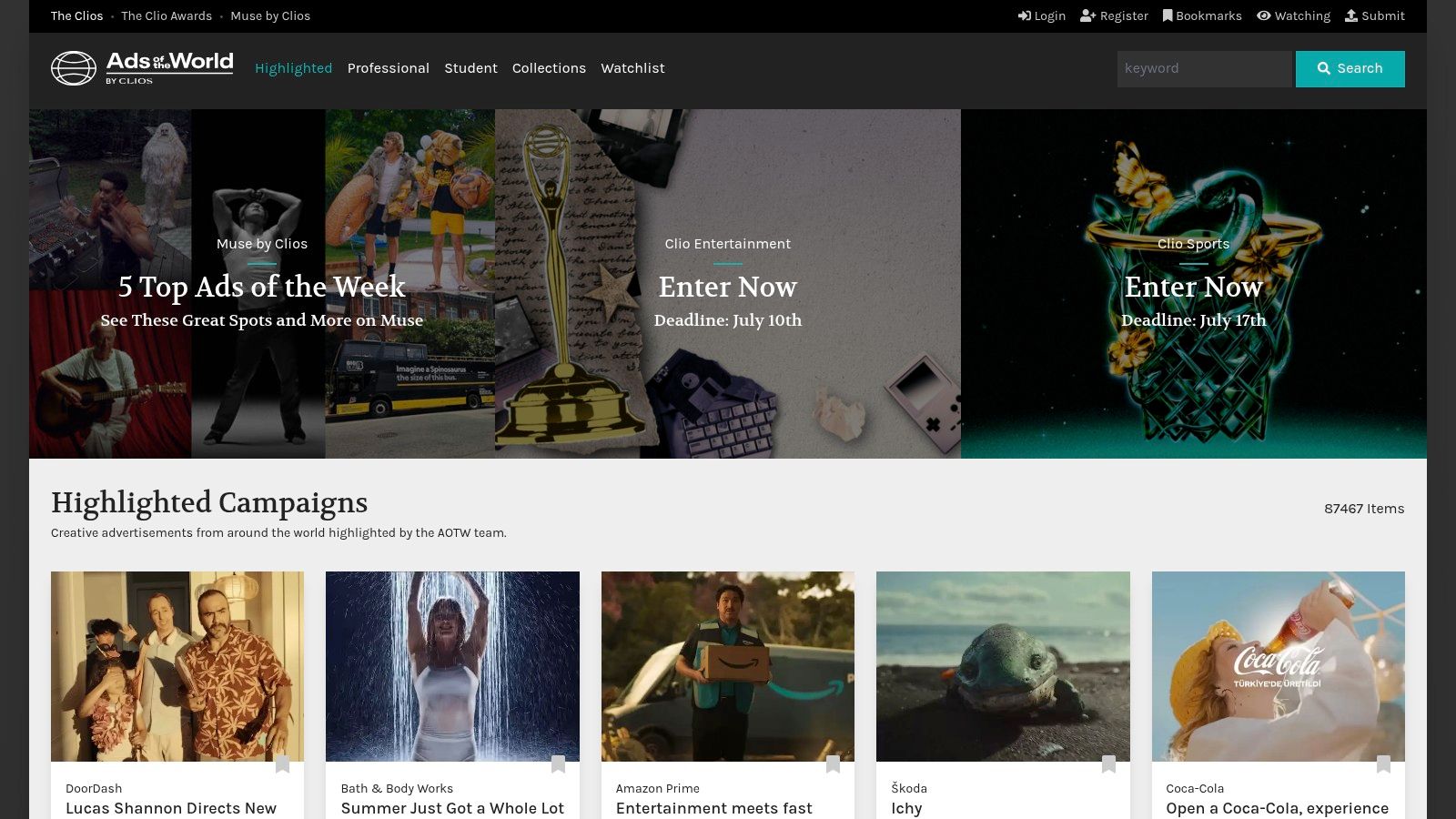
Ads of the World is where I'd go when a campaign needs a creative jolt. It's broad, fast to browse, and packed with campaigns across industries, countries, and styles. That breadth is the point.
If your current swipe file is overloaded with the same DTC talking-head structure, this site can shake that loose. You'll see different storytelling patterns, visual devices, and tone choices that don't always show up in narrower performance-marketing libraries.
What it's actually good for
Use it for concept hunting, not final media decisions.
- Storyline mining: Look for recurring opening devices, not just pretty production.
- Category contrast: Study what adjacent industries do differently with humor, demo, or testimonial structure.
- Credit trails: Agency and production credits can help you trace who's making the work you keep saving.
That last point matters more than people think. If you keep noticing the same sharp copy rhythm or edit pacing, the creative team behind it often explains a lot.
For copywriters and media buyers, this is also a smart companion to strong ad copy examples. The visual idea and the value proposition should reinforce each other. Too many YouTube campaigns have one or the other.
A gorgeous video with a weak offer is still a weak ad.
The catch is placement clarity. Ads of the World isn't built to tell you exactly how a campaign ran on YouTube, what targeting sat behind it, or how heavily it leaned on paid distribution versus PR and organic attention. Great for creative direction. Less reliable for media teardown.
6. AdForum Creative Library
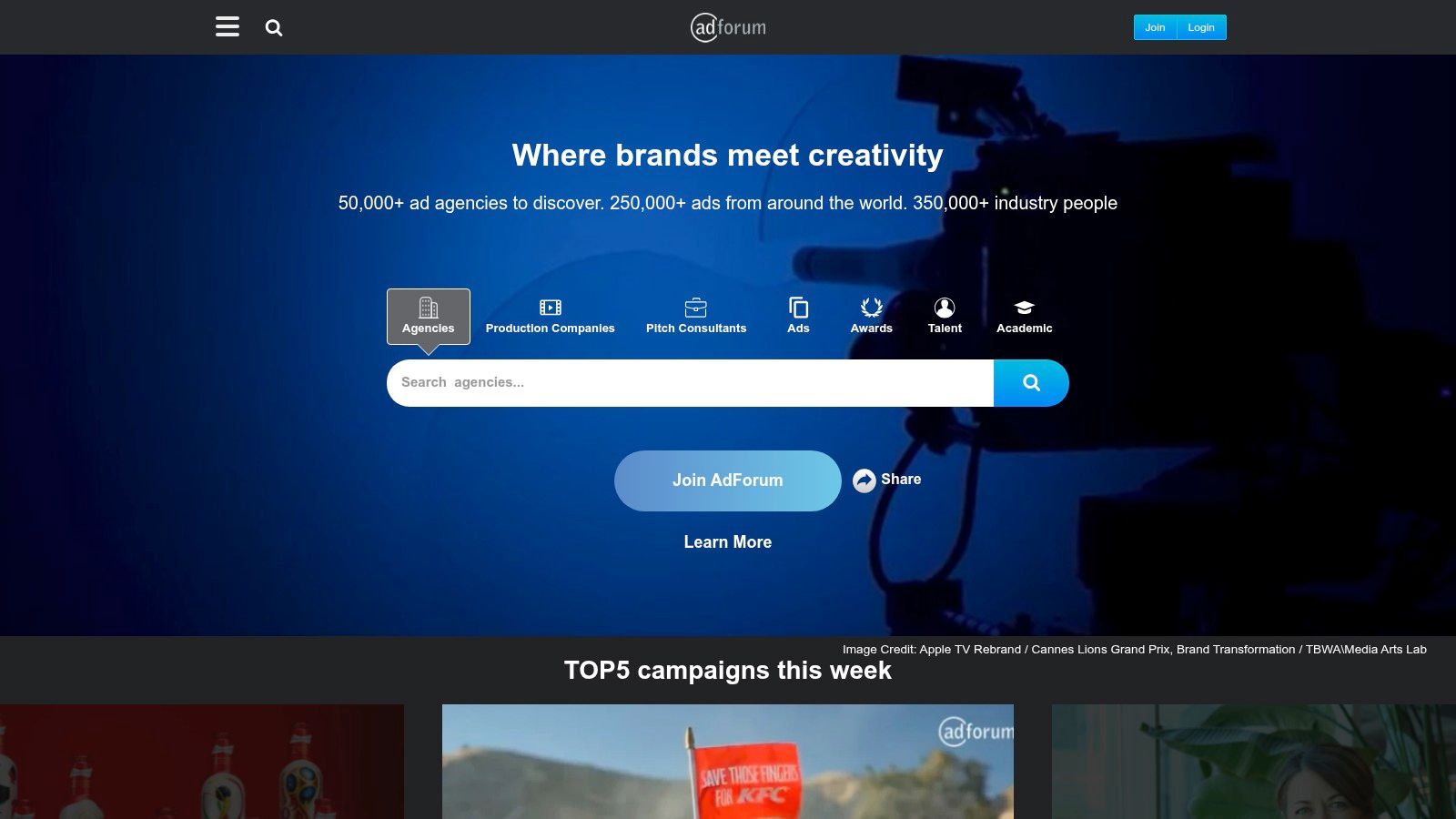
AdForum is stronger than a casual swipe site when you need depth. Agency teams have used it for years because it's good at surfacing campaign history, credits, award connections, and related creative from the same brand or shop.
That makes it useful for tracing how a single idea evolves. Sometimes the winning YouTube execution isn't obvious until you compare multiple edits and campaign spin-offs.
Best use cases for AdForum
I wouldn't treat AdForum as a daily inspiration feed. I'd use it when the brief is strategic and the brand category is crowded.
- Historical review: Check how a brand has changed tone over time.
- Award filtering: Separate recognized work from random uploads.
- Production pattern spotting: Repeated collaborators can reveal a brand's creative comfort zone.
This is also where you can get smarter about format fit. For example, if you're studying in-stream concepts, remember the mechanics matter. AdEspresso's YouTube ads guide notes that in-stream ads must be at least 12 seconds long, which forces a minimum narrative arc with room for a hook, value proposition, and CTA before the viewer can skip. That simple rule changes how you judge examples. Some concepts are sharp in six-second theory and weak in a real in-stream structure.
The main drawback is focus. AdForum is not just about YouTube, so you have to bring your own filter. If you don't already know what kind of creative architecture you're looking for, it's easy to get distracted by award bait that doesn't belong in a working media account.
7. Ad Age Creativity
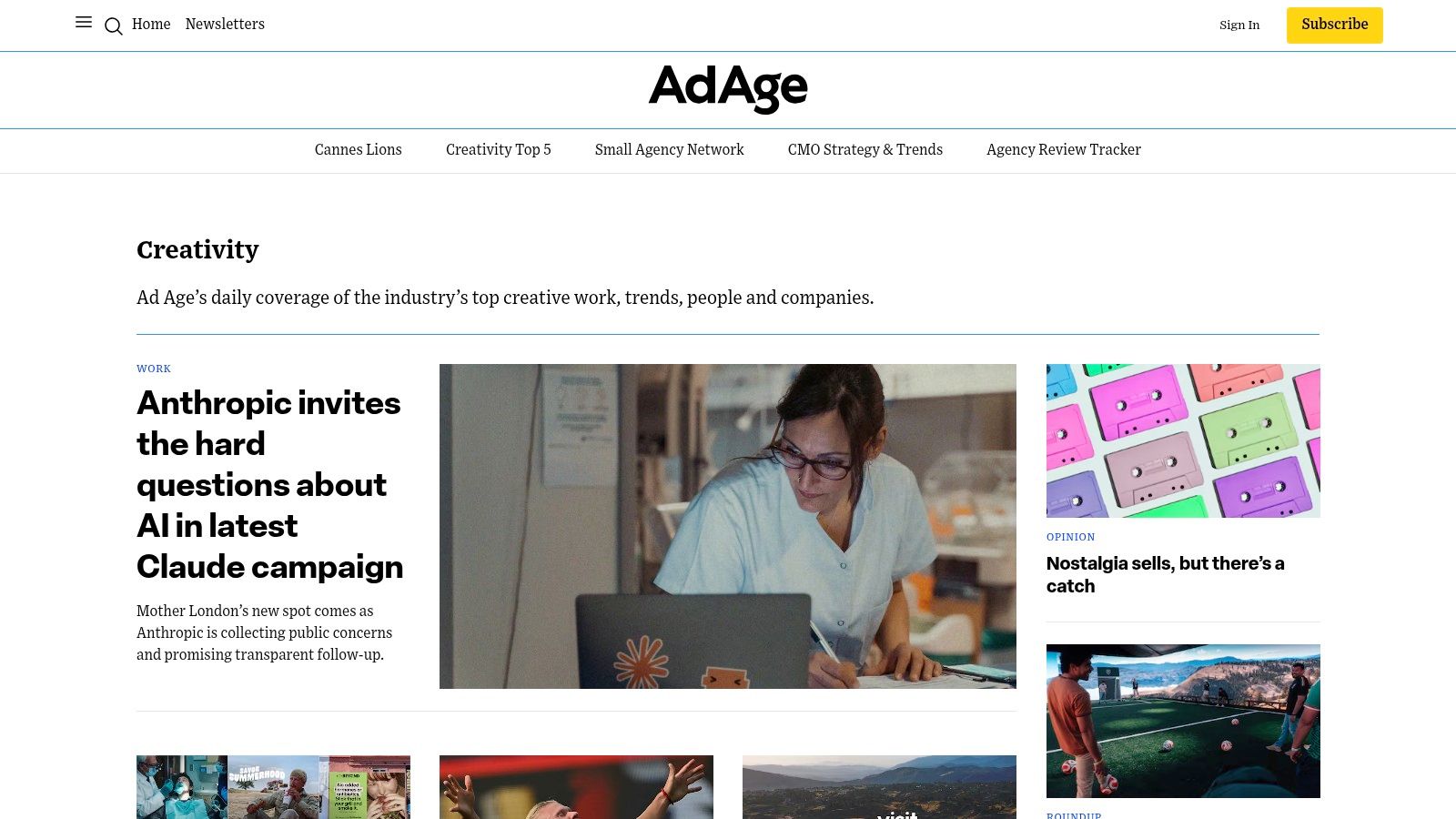
Ad Age Creativity is the source I'd use when I want interpretation, not just inventory. It's editorial, which means you're getting campaign context, cultural timing, agency framing, and sometimes business outcomes when they're available.
That's valuable because YouTube ads examples are easy to misread in isolation. A creative that looks average on its own can make far more sense once you understand the launch moment, audience, or larger campaign system around it.
Why this source is different
Ad Age helps answer the “why now?” question.
- Cultural relevance: Timely coverage around major moments gives context that libraries often miss.
- Strategic commentary: The editorial angle can reveal why a campaign resonated beyond the platform.
- Integrated view: You can see how YouTube fits into a wider media plan instead of treating it like a silo.
The best use is pattern confirmation. If you're seeing a style emerge in YouTube libraries and then seeing editors spotlight campaigns with similar choices, that's a stronger signal than either source alone.
A practical example from outside the editorial ecosystem makes the point. Dollar Shave Club's ad “Our Blades Are F***ing Great” generated 12,000 orders in the first 48 hours, according to Landingi's roundup of YouTube ad examples. The ad worked because the value proposition was brutally clear, the hook arrived early, and the CTA reduced friction. That kind of strategic reading is exactly what editorial analysis helps sharpen.
Don't just ask whether an ad is memorable. Ask what action it made easier.
The downside is obvious. It's not a searchable ad vault built for PPC operators. It's a curated lens. That's why I use it as the layer that explains trends, not the layer that replaces a working swipe file.
7-Source Comparison of YouTube Ad Examples
| Example | Implementation Complexity (🔄) | Resource Requirements (⚡) | Expected Outcomes (📊 ⭐) | Ideal Use Cases (💡) | Key Advantages |
|---|---|---|---|---|---|
| YouTube's Best in Ads (Google/YouTube gallery) | 🔄 Low, browseable gallery, no setup | ⚡ Minimal, free web access | 📊 Up‑to‑date format & engagement benchmarks, ⭐⭐⭐ | 💡 Quick creative benchmarking; map to Google's ABCDs | Official source; region/goal filters; high recency |
| YouTube Works Awards (Google Ads Impact Awards transition) | 🔄 Low–Medium, read curated case studies | ⚡ Minimal, free access; limited examples | 📊 Strong evidence of business impact & narrative, ⭐⭐⭐⭐ | 💡 Stakeholder buy‑in; full‑funnel modeling; pitches | Focus on effectiveness and measurement context |
| VidTao | 🔄 Medium, search tool + Chrome extension learning curve | ⚡ Moderate, free tier; paid features for advanced use | 📊 Competitive intelligence; reveal unlisted ads, ⭐⭐⭐⭐ | 💡 Competitor research; build swipe files; ad discovery | Access to unlisted creatives; performance‑marketer focus |
| iSpot.tv | 🔄 Medium, browse freely; enterprise setup for analytics | ⚡ Moderate–High, paid for attention/outcome metrics | 📊 Cross‑platform impression/attention insights, ⭐⭐⭐⭐ | 💡 TV/CTV + digital comparisons; seasonality and flighting analysis | Large US catalog; attention and outcome measurement (enterprise) |
| Ads of the World (Clio Network) | 🔄 Low, simple browsing and filtering | ⚡ Low, mostly free; optional account | 📊 Broad creative inspiration and craft benchmarking, ⭐⭐⭐ | 💡 Creative idea exploration; production/style reference | Huge breadth; daily updates and creative credits |
| AdForum Creative Library | 🔄 Medium, searchable archive; some gating | ⚡ Moderate, membership may be required for full access | 📊 Awards‑driven and historical insights; find edits/credits, ⭐⭐⭐ | 💡 Agency/new‑business research; trace talent and partners | Deep historical/awards coverage and robust credits |
| Ad Age Creativity | 🔄 Low, read editorial analysis and roundups | ⚡ Low–Medium, free content; some paywalled articles | 📊 Strategic context and cultural relevance, ⭐⭐⭐⭐ | 💡 Strategic commentary; timely cultural & campaign analysis | Editorial authority; explanations of why creative approaches worked |
Turn Inspiration Into High-Converting Campaigns
How do you turn a saved ad into a campaign that can hold CPA?
Start by treating inspiration as research, not a script. A strong swipe file should capture more than the headline or visual style. Log the format, hook, offer, CTA, landing page type, audience intent, and where the ad likely sits in the funnel. That is the difference between copying surface-level creative and building tests with a real chance to work.
Format choice shapes the result. As noted earlier, in-feed ads often earn stronger click-through than non-skippable in-stream, but higher CTR does not automatically mean better business performance. In-feed can be a better fit when the next step needs intent, such as a product page visit or lead form. In-stream often does more work higher in the funnel, where the goal is reach, recall, or audience building.
Placement fit matters too. Ad Library's video ad examples post makes a useful point for Shorts creative: build for vertical viewing, assume muted playback, and use on-screen text that carries the message without audio. I use that as a filtering rule in a swipe file. If an ad was clearly made for Shorts, I do not treat it as a model for standard in-stream or in-feed placements.
Retargeting deserves the same level of discipline. A PPC discussion on YouTube retargeting practice points to a practical pattern many account managers already see in-platform. People who watched a meaningful portion of the video usually outperform loose video-view audiences. That makes them a better pool for follow-up offers, product proof, or stronger CTAs.
Good creative still loses when account structure is loose. Keywordme earns its place here because search-term control and negative keyword management affect where YouTube campaigns pick up intent signals and where budgets get wasted. If you are pulling ideas from ad galleries and spy tools, pair that inspiration with tighter exclusions, cleaner targeting, and landing-page alignment. That is how a swipe file turns into account performance instead of a folder of ads you liked.
If you are testing concepts quickly, PhotoMaxi's AI video techniques can help speed up production and give you more angles to validate before you commit full budget.
Keywordme helps turn raw inspiration into cleaner execution. If you're building campaigns from YouTube ads examples and want tighter keyword control, faster negative list management, and less wasted spend, try Keywordme.
.svg)