
Target ROAS Bidding Explained for Smarter Google Ads
Target ROAS Bidding Explained for Smarter Google Ads


You've raised the budget, tightened the keywords, and still the return looks stuck. One campaign produces plenty of conversions, another attracts expensive orders, and the blended ROAS barely moves. That's the point where many advertisers start changing bids, budgets, audiences, and landing pages all at once, making it impossible to tell what helped.
Target ROAS bidding gives Google a different job. Instead of pursuing conversions without regard to their value, it asks the system to maximize conversion value while averaging toward a return on ad spend target. The strategy can work well, but only when conversion values are reliable, campaign economics are coherent, and the team treats bidding as an operational process rather than a setting to switch on and forget.
The practical complication is that this process no longer looks identical across networks. Google still presents Target ROAS as a named bidding strategy, while Microsoft Advertising has moved the target into Maximize Conversion Value for new campaigns. That makes reporting language, migration planning, search-term hygiene, and value tracking part of the same decision.
Why Target ROAS Bidding Changes How You Scale Ads
A marketer sees the problem first in a spreadsheet. Manual CPC has delivered a familiar level of traffic, Maximize Conversions has found a dependable pool of buyers, and then performance flattens as the budget grows. More spend brings more activity, but not necessarily more useful revenue. The campaign is optimizing for the wrong definition of “more.”
Target ROAS changes the objective from conversion volume to conversion value efficiency. Google categorizes it under the “Increase profit” goal and describes it as a strategy designed to obtain as many conversions or as much conversion value as possible at a fixed return on ad spend, rather than maximizing clicks or traffic. Google's Smart Bidding overview explains that distinction.
That difference matters for an ecommerce account with products at different prices, or a lead-generation account that assigns different values to qualified actions. A low-value conversion and a high-value conversion shouldn't automatically receive the same bidding priority. Target ROAS gives Google permission to bid more selectively when the expected value of an auction justifies the cost.
Where the strategy earns its place
Manual CPC remains useful when you need direct control, especially while validating tracking or testing a new structure. Maximize Conversions is a sensible choice when the primary goal is acquiring as many conversions as possible and the conversion values aren't yet dependable. Target ROAS becomes more relevant when the account can distinguish valuable outcomes from ordinary ones.
The trade-off is reach. A demanding target can make Google more selective, which may protect efficiency while restricting delivery. A realistic target can support growth, but it won't rescue weak offer economics, duplicate conversions, or poor search-term quality.
Practical rule: Scale a campaign only after deciding whether the business wants more actions, more value, or a specific return on spend. The bidding strategy has to match that choice.
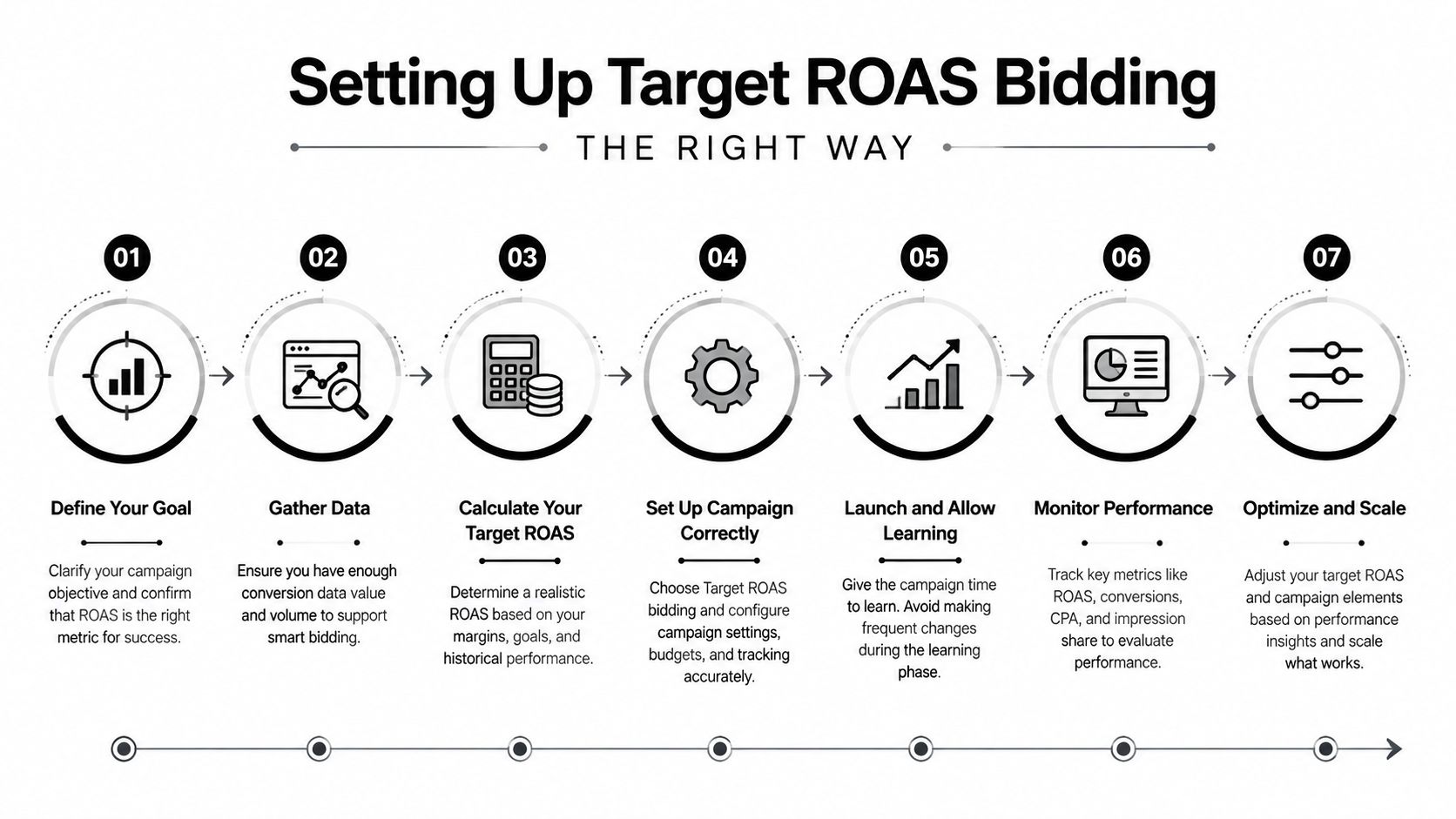
For agencies and in-house teams, this also changes the internal conversation. “Set tROAS” is too shallow a workflow. The core process is to define conversion value, establish a defensible baseline, set the target, monitor lagged results, and keep the inputs clean enough for automation to make useful decisions.
How Google's Algorithm Uses Target ROAS
Google does not apply one fixed bid to every auction. With Target ROAS, Smart Bidding estimates the likelihood and value of a potential conversion, then adjusts the bid around the expected return. Its goal is to maximize conversion value while averaging toward the target across eligible campaign traffic. Hitting the target on every individual click is not the operating model.
The calculation is:
ROAS = conversion value ÷ cost × 100
A conversion value per cost of 4 produces a 400% ROAS. Google's Search Ads 360 guidance describes this conversion-value-per-cost calculation and instructs advertisers to multiply it by 100 when entering the target as a percentage. The official Search Ads 360 guidance also recommends using recent historical performance as the starting point.
The auction-time decision
The system functions like a trader evaluating each opportunity before deciding how much capital to risk. A potential buyer with signals associated with a valuable order may justify a stronger bid. An auction with weak value expectations may receive a smaller bid or no competitive bid.
Google can use contextual and behavioral signals such as device, location, time, browser, operating system, and inferred intent. These signals do not guarantee a result. They help the model estimate how the auction matches conversion and value patterns available in the account.
Bids will vary across auctions, days, and platforms. One day may contain several high-value orders, while another produces lower-value conversions or delayed reporting. Target ROAS is evaluated as an average outcome over time, so reacting to every daily movement can interrupt the learning path.
What the model needs from you
The algorithm can optimize only the value it receives. If purchases report conversions with missing, duplicated, or misleading values, Google may make reasonable bid decisions from inaccurate business data. Conversion tracking, primary conversion actions, transaction values, and conversion lag therefore require the same attention as the target itself.
For a broader explanation of automated bidding signals and conversion goals, see Keywordme's guide to Smart Bidding optimization. Cleaner search-term data and tighter negative lists can improve the inputs around the bidding system, while consistent conversion values give it a better basis for forecasting.
Target ROAS is a forecasting system, not a multiplier applied after the click. Its results depend on the quality and consistency of the feedback sent from the account.
Prerequisites and Data Thresholds You Must Meet
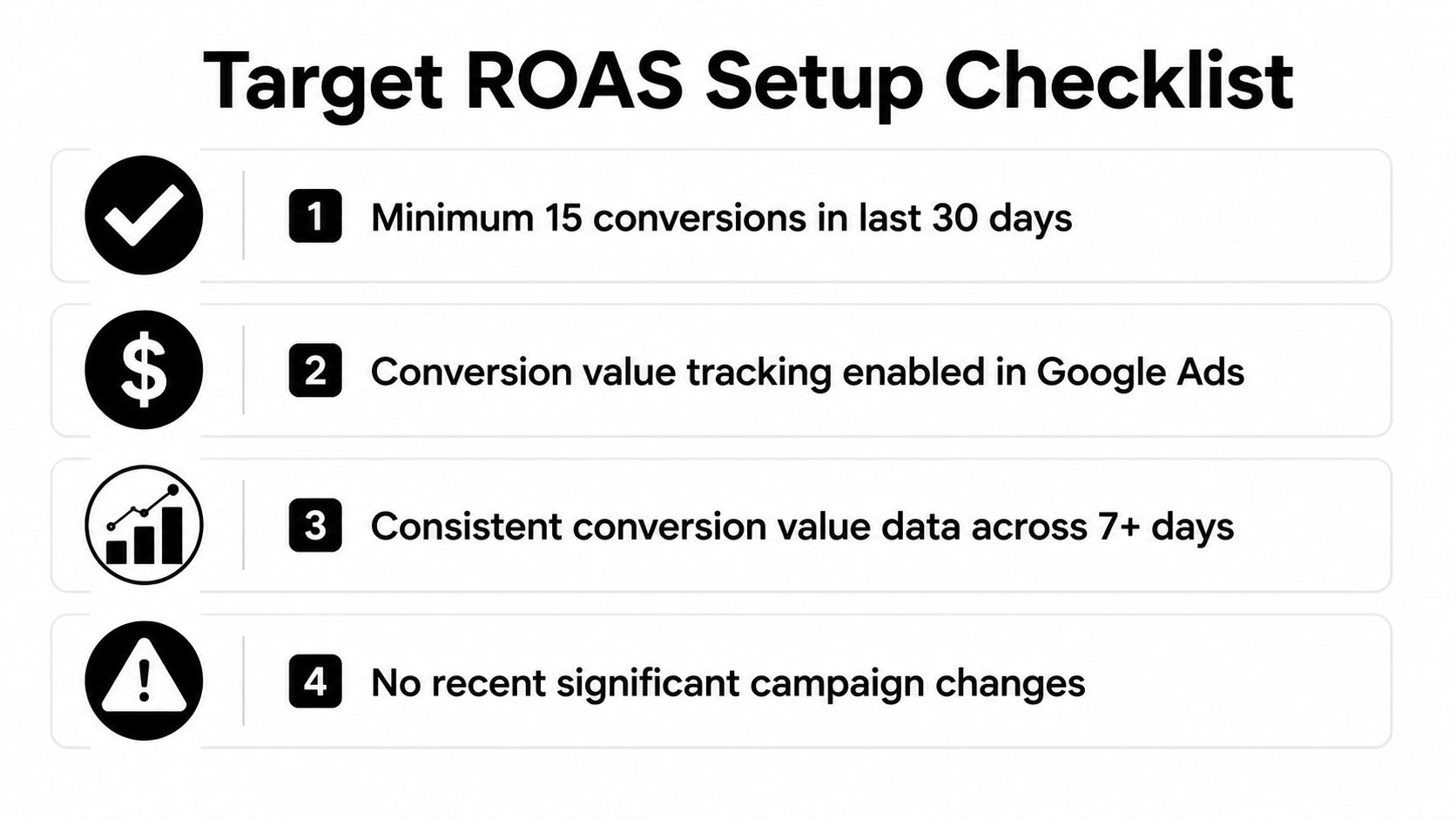
Google sets different readiness requirements by campaign type. Search and Shopping campaigns typically need at least 15 conversions in the past 30 days at the conversion-tracking level for Target ROAS, according to Google's Target ROAS requirements. Display campaigns typically need at least 15 conversions with valid conversion values across all campaigns combined.
Display has an important exception. Google says that new Display campaigns no longer need prior conversion history to use Target ROAS bidding. That does not remove the need for accurate value tracking. It only changes the prior-history requirement for that campaign type.
Audit the conversion foundation
Start in the conversion actions rather than the bidding menu. Confirm that the action used for optimization is the one that represents a meaningful business outcome, then inspect whether Google Ads receives the correct value for each outcome. A conversion count without a trustworthy value stream gives Target ROAS very little to optimize toward.
A practical audit should answer these questions:
- Volume: Does the relevant campaign type meet Google's stated conversion threshold?
- Value: Does each conversion pass a useful value, rather than a generic placeholder?
- Consistency: Do comparable campaigns use the same value logic and primary conversion definitions?
- Lag: Are recent days excluded from baseline analysis because conversions may still be arriving?
- Duplication: Could imported analytics actions and website actions count the same business event twice?
A lead-generation account needs particular care. Assigning values to leads can make value-based bidding workable, but only if the assigned values reflect meaningful differences in lead quality and the account can pass those outcomes consistently. If every lead receives the same arbitrary value, Target ROAS may behave more like volume optimization with extra reporting complexity.
The operational lesson is that eligibility isn't the same as readiness. Meeting the threshold may allow the strategy, but accurate values and stable measurement determine whether it can make sensible decisions. Keywordme's explanation of Google Ads conversion volume is useful when deciding whether the account has enough signal to justify automation.
Setting Up Target ROAS Bidding the Right Way
Start with the account's recent economics, not the return you want to see. Review conversion value, cost, margin differences, and conversion lag before choosing a target. Recent performance can provide the baseline, while comparable campaigns may help when the campaign has no relevant Target ROAS history. The setup should reflect the business objective and the conversion actions selected for optimization.
Calculate conversion value divided by cost to establish the recent ROAS, then express it as a percentage for the target setting. If that baseline moves sharply from period to period, investigate the cause before automating bids. Mixed margins, product groups, or lead values can give the system conflicting signals, so campaign structure may need attention first.
Use the official Shopping workflow
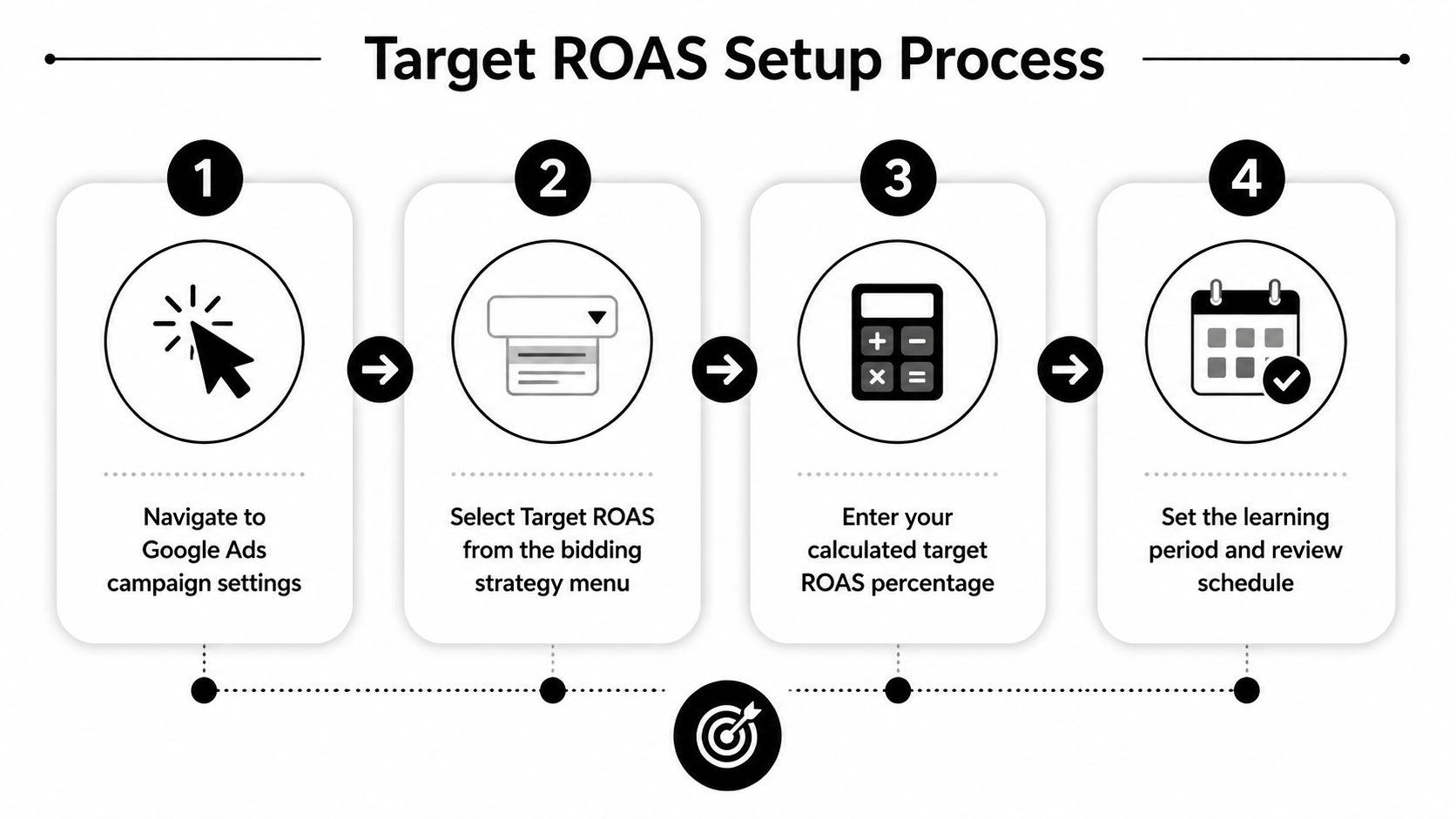
For Shopping campaigns, Google's setup requires adding the bidding strategy and specifying the conversion value target. The campaign path is:
Campaigns > Settings > Bidding > Change bid strategy > Target ROAS > Save
Follow Google's Shopping bidding setup documentation to confirm the current workflow. The interface may show related value-based options, so check that the selected strategy matches the campaign's intended optimization goal.
Build campaigns around comparable economics
Products with sharply different margins can compete under the same target. High-value products may attract delivery because they can produce stronger revenue relative to cost, while lower-value products receive limited traffic despite their commercial importance. Group products or services with similar economics where practical, and make sure the conversion value model represents the outcomes the business values.
Set the target close enough to recent performance for the system to compete in available auctions. Large changes can restrict delivery when the auction pool cannot support the requested efficiency. Keyword structure also affects the quality of that traffic. For campaign organization and intent review, the Surnex guide to PPC keywords connects keyword research with practical account structure.
Before publishing, test the conversion implementation from click through to recorded value. Use Keywordme's guide to setting up conversions in Google Ads to structure the review, then verify transactions, lead values, primary actions, and imported events against the account's own records. Clean search term data, tighter negative lists, and reliable conversion values give bidding better inputs across platforms, even though Google and Microsoft require separate setup checks.
Common Mistakes That Kill Your ROAS Performance
The most damaging Target ROAS mistakes usually come from advertiser impatience. The campaign behaves normally during an adjustment period, someone sees an unattractive day, and the team changes the target again. That creates a moving objective and makes the data harder to interpret.
Setting an impossible target
A target should describe an economically useful return that the campaign has a reasonable chance to approach. Setting it far above recent performance can make Google bid so selectively that delivery contracts. The campaign may look efficient in a narrow slice of traffic while failing to spend enough to produce useful volume.
Use recent, lag-adjusted performance as the anchor. If the business needs a higher return, move toward it in measured steps after the campaign demonstrates stability. Don't use the target as a wish list.
Changing the rules too often
Target changes, budget changes, product-feed changes, conversion-action changes, and major structural edits can all muddy the learning process. Frequent intervention prevents you from separating normal volatility from a genuine problem.
- Target changes: Make them for a clear economic reason, not because of one poor reporting day.
- Budget changes: Tie increases to available profitable demand, not just to a desire for more spend.
- Campaign pauses: Avoid pausing and restarting as a routine troubleshooting tactic because it disrupts continuity.
- Reporting windows: Account for conversion lag before judging recent performance.
A campaign can't learn a stable pattern from a team that keeps rewriting the objective.
Mixing incompatible margins
A blended target can hide poor economics. If one product category has healthy margins and another has little room for acquisition cost, a single campaign-level target may steer spend toward the easier revenue while starving strategically important products.
Separate campaigns, product groups, or value rules when the economics differ. Then decide whether Target ROAS is still the right strategy. If the account lacks reliable conversion values, has too little usable data, or needs maximum conversion volume rather than value efficiency, Maximize Conversions or another approach may be more appropriate.
Using Keywordme to Supercharge Your Target ROAS Results
Target ROAS can only evaluate the traffic entering the campaign. It doesn't replace search-term management, offer positioning, landing-page work, or conversion tracking. A campaign can have advanced bidding and still waste spend on irrelevant queries that dilute the value signal.
The useful workflow is operational. Export the search-term report, separate clearly irrelevant intent from promising themes, and build negative keyword groups that reflect the account's products, services, and sales process. Review the remaining terms for new high-intent patterns that deserve keyword expansion or tighter ad-group alignment.
Keep the search-term loop active
A practical sequence looks like this:
- Collect: Pull recent search-term data from the relevant Google Ads campaigns.
- Classify: Mark irrelevant, research-only, competitor, low-intent, and commercially useful queries.
- Negate: Add suitable negatives at the campaign or shared-list level, checking that they won't block valuable variants.
- Expand: Turn recurring, high-intent themes into deliberate keyword or ad-group additions.
- Recheck value: Compare the cleaned traffic with conversion value, not clicks alone.
Keywordme is one option for this workflow. Its Chrome plugin supports match-type application, bulk search-term handling, negative keyword list building, and campaign expansion from search-term data. Used carefully, that makes it easier to remove obvious waste while Target ROAS continues evaluating value across the remaining auctions.
The important boundary is control. Don't add negatives because a term has low recent volume, and don't promote a keyword because it generated one attractive conversion. Search-term decisions should reflect intent, product fit, lead quality, and the time required for conversion data to mature.
Clean inputs also improve team communication. When an account manager can show which query themes were excluded, which were expanded, and how value tracking is defined, performance discussions become more concrete than “the algorithm isn't working.”
Navigating the Google vs Microsoft ROAS Shift
Google and Microsoft now require different interface language for a similar business objective. Google continues to document Target ROAS as a value-based automated bidding strategy. Microsoft Advertising announced that, beginning August 4, 2025, Target ROAS would no longer be offered as a standalone bidding strategy for new campaigns and would instead become an optional target inside Maximize Conversion Value. Microsoft's Target ROAS bidding documentation describes that change.
That difference matters less to the customer than it does to the operating team. A platform migration can preserve the intent of a target while changing where the target lives, how it's named, and how staff explain delivery behavior. If reports use “tROAS campaign” for Google and “Maximize Conversion Value with target” for Microsoft without a shared definition, stakeholders may compare labels instead of outcomes.
Standardize the business language
Use a network-neutral reporting vocabulary:
| Reporting concept | What teams should record |
|---|---|
| Conversion value goal | The business outcome the campaign is optimizing |
| Value definition | How revenue or lead value enters the platform |
| Efficiency target | The desired return expressed consistently |
| Actual ROAS | Conversion value divided by cost, multiplied by 100 |
| Delivery context | Budget limits, lag, structure, and platform behavior |
This approach lets an agency compare networks without pretending their controls are identical. Each platform still needs its own implementation notes, but the commercial definition remains stable.
Operationally, the workflow is moving from “set tROAS” to “set conversion-value goals, then layer a target.”
For multi-network budgets, document the target at the campaign level, the platform-specific setting that represents it, and the reporting window used for evaluation. Teams should also record whether a target change was intended to protect margin, increase volume, or test a new value model. That context prevents a migration from turning into a silent strategy change.
Your 30-Day Target ROAS Testing and Optimization Plan
A useful first month is deliberately uneventful. The aim isn't to produce a dramatic dashboard screenshot. It's to validate inputs, give the strategy a coherent baseline, and make only decisions that the data can support.
Week one
Audit conversion actions, transaction values, primary and secondary settings, campaign eligibility, and conversion lag. Document the historical value-per-cost baseline and identify campaigns whose products or services have incompatible economics.
Week two
Launch or transition the selected campaign with a target grounded in recent performance. Keep the structure stable, confirm that values are recording correctly, and define the reporting window before the first results arrive.
Week three
Monitor spend, conversion value, cost, conversion volume, search-term quality, and delivery status without reacting to ordinary daily volatility. Separate tracking failures from genuine performance changes, and resist target edits made solely to improve a short reporting snapshot.
Week four
Use Keywordme for a focused search-term cleanup, then review whether negatives removed irrelevant traffic or accidentally restricted useful intent. For broader measurement discipline, ClipCreator.ai's guide to mastering agency KPIs in 2026 provides context for connecting channel metrics with agency-level reporting.
Scale budgets when the campaign has reliable value data, acceptable economics, and enough eligible demand to absorb more spend. Restructure instead when value tracking is inconsistent, product margins conflict, or search-term quality remains poor. Target ROAS works best as part of that operating system, not as a substitute for it.
Keywordme helps PPC teams organize search-term cleanup, build negative keyword lists, apply match types, and expand campaigns from real query data, all within a practical Google Ads workflow. Visit Keywordme to see how it can support cleaner inputs and more disciplined Target ROAS optimization.
.svg)