
Psychology and Advertising: Unlocking Ethical Persuasion
Psychology and Advertising: Unlocking Ethical Persuasion


The ad looked ordinary at first glance. Same product category, same crowded feed, same scroll-stopping thumbnail. Then the copy hit the right note, the visual removed a little friction, and the offer felt less like a pitch and more like the obvious next click. That's the part many PPC teams miss. The ad didn't win because it was louder. It won because it matched how people decide.
That's the overlap between psychology and advertising. The discipline stopped being guesswork in the early 20th century, when Walter Dill Scott's The Theory of Advertising appeared in 1903, and by 1920 J. Walter Thompson was already using motivational studies, scientific copy research, and consumer panels to study buyer behavior, a shift captured in the historical record from EBSCO's overview of that turning point in advertising history (EBSCO's history of Scott and early advertising psychology). From there, advertising grew into a mass system that spread with newspapers, radio, television, the internet, and mobile devices, becoming embedded in modern media and business budgets at scale (historical advertising overview).
Why Some Ads Just Work
A campaign doesn't need to be clever to perform. It needs to feel familiar enough to lower resistance and specific enough to trigger action. That's why a mediocre offer can beat a polished one if the first speaks to a real motivation and the second just looks nice.
The strongest ads usually do three things at once. They reduce uncertainty, they make the choice feel personally relevant, and they give the brain a simple reason to keep paying attention. In practice, that means the ad isn't fighting the user's mental shortcuts. It's using them.
What your audience's brain is doing
People don't sit there and weigh every option like a spreadsheet. They skim, compare, and react fast, then justify later. That's why emotion, familiarity, and social cues matter so much in the first second of exposure.
A useful way to think about it is this. If your ad feels like the last cookie in the jar, scarcity rises. If it feels like the choice everyone else already made, social proof rises. If it sounds like a brand that gets the audience's situation, liking rises. None of that is abstract. It's the psychology of reducing effort.
Practical rule: If your ad takes too much mental work to interpret, people won't reward you for being subtle. They'll move on.
The trick for PPC managers is not to cram every lever into one asset. It's to identify which lever fits the campaign's job. A prospect who's already warm may respond to reassurance. A colder audience may need a sharper emotional hook. A hesitant buyer may need evidence that others already chose the product. That's why the best teams test psychology, not just button colors and headlines.
The Core Psychological Levers in Advertising
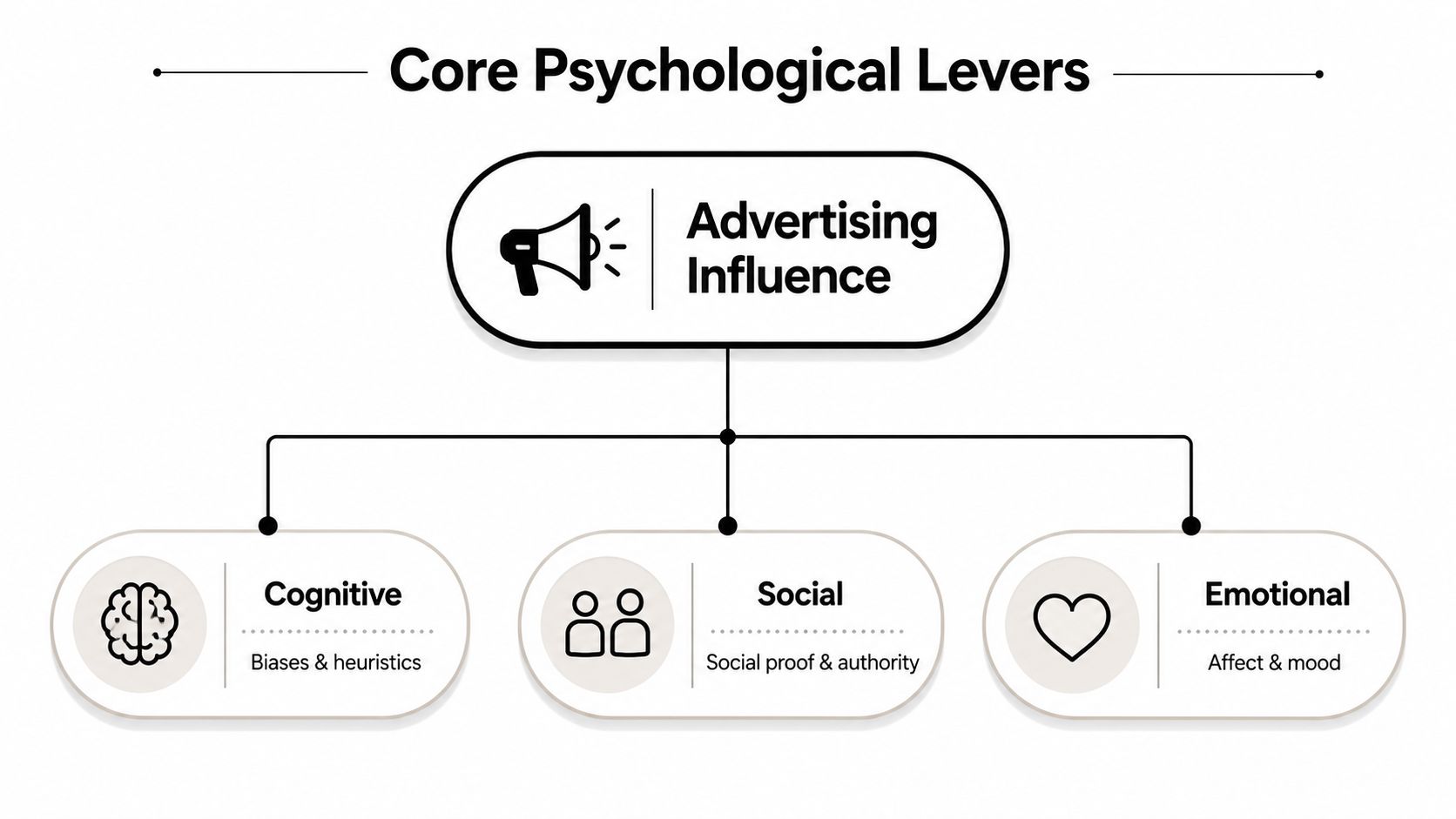
A strong ad usually works because it gives the brain less work to do. The buyer sees a cue, makes a quick judgment, and keeps moving. That's why the core levers in advertising are best grouped into cognitive, social, and emotional signals. Each one shapes attention in a different way, and the best PPC creative often uses all three without making the message feel crowded.
Cognitive levers
Cognitive levers change how people sort and interpret information. Framing is the clearest example. “95% fat-free” and “5% fat” communicate the same fact, but the first version feels like a gain while the second feels like a loss. The mind reacts to the frame before it finishes evaluating the fact, which is why wording can change response without changing the underlying offer.
Anchoring works in a similar way. The first number or comparison someone sees becomes the reference point for everything that follows. Pricing pages, bundle structures, and comparison charts can all steer judgment before the buyer has finished scanning the ad. The goal is not to trick anyone, it is to set the first reference point so the offer feels easier to judge.
For PPC teams, testing gets practical. A headline, a price cue, or a comparison line can be swapped to see whether a different frame improves click-through rate or downstream conversion quality. Small wording changes can act like moving the starting line in a race, the whole decision feels different even when the offer stays the same.
Social levers
Social levers answer a simple question, “Do people like me already trust this?” Social proof reduces hesitation by showing that other buyers have already made the choice. Authority lowers doubt by borrowing confidence from a credible source. In both cases, the ad does less selling on its own and more borrowing trust from the signals around the product.
That logic matters in paid media because people rarely want to be the first one taking the risk. A review snippet, a creator mention, or a customer quote can do more than a long feature list because it gives the brain a shortcut. The shortcut is the point. It lets the audience borrow confidence from a group they trust or want to belong to.
The same idea also shows up in audience segmentation guide thinking, because different groups respond to different social signals. A cautious buyer may want customer proof. A more status-driven audience may care more about who endorses the offer. A team that tests those differences in PPC can separate which social cue helps the click from which one only adds noise.
Emotional levers
Emotional levers create the feeling that makes a click feel worth taking. That feeling can be relief, excitement, belonging, pride, or fear of missing out. The USC summary of the psychology of advertising points out that effective ads should speak to what consumers feel, not only what they see or understand, and that the feeling should make the brand more appealing (USC's psychology of advertising overview).
The strongest emotional ads do not need drama. They need fit. If the emotion matches the product and the audience, the message feels natural. If it misses, the ad feels forced, even if the copy is technically polished.
PPC managers can test this with variations that change the emotional angle while keeping the offer constant. One version can stress relief, another can stress confidence, and another can stress belonging. If one tone consistently brings better engagement from the right audience, the campaign has found an emotional cue the market responds to, not just one that sounds clever in the ad account.
Applying Psychology to Ad Creative and Copy
The easiest copy test in the world is often the one teams skip. When people feel uncertain, concrete language beats abstract language, and research on communication under uncertainty found that concrete advertising language is more persuasive than abstract language in both retailing and during a sports event (study on concrete language under uncertainty). That makes copy choices feel a lot less philosophical and a lot more operational.

Turn vague claims into sensory proof
“Improve your workflow” is vague. “Cut manual keyword cleanup before launch” is concrete. One sounds like a promise in a deck. The other sounds like a job the buyer already wants done.
That shift matters in headlines, descriptions, and landing page hero sections. Concrete copy gives the audience something to visualize. It also lowers skepticism because the claim feels easier to check against reality. For PPC, that usually means fewer airy brand phrases and more specific outcomes, product actions, or use cases.
Use emotion without making the ad melodramatic
The emotional side of copy doesn't need to be dramatic. It needs to be clear. If the buyer wants confidence, the copy should feel steady. If the buyer wants relief, the copy should remove pressure. If the buyer wants status, the copy should make the choice feel smart and selective.
That's where creative often goes wrong. Teams try to “add emotion” by making the ad louder, more saturated, or more urgent. But the core work usually happens in the sentence structure, the imagery, and the promise. A calm ad can be more persuasive than a noisy one if it matches the emotional state of the searcher.
A useful internal check is simple. Ask whether the ad sounds like a brochure or like a person who understands the user's problem. If it sounds like the former, tighten the language. If it sounds like the latter, you're closer.
Let the visual do part of the persuasion
Images and video should carry part of the argument. If the copy says “fast setup,” the visual should show speed. If the copy says “easy cleanup,” the visual should show the mess disappearing. That alignment makes the brain work less, which is exactly what strong creative should do.
For copy ideas and structure, a practical starting point is this ad copy examples guide. Use it as a reference point for wording, then layer psychology on top of it instead of treating the two as separate jobs.
Using Psychology for Smarter Audience Targeting
A strong ad can still miss the mark if it reaches people whose minds are pointed elsewhere. That is why psychographic targeting often matters more than broad demographic guesses. Age and location can help you find an audience, but motivation and personality usually explain why someone stops, clicks, or keeps scrolling.
Field experiments spanning more than 3.5 million people found that ads personalized to extraversion or openness produced up to 40% more clicks and up to 50% more purchases than mismatched or unpersonalized ads (psychographic targeting field experiments). The takeaway for PPC teams is practical. When the message fits the person's psychological profile, the ad does more work before the landing page even appears.
Where psychographics beat demographics
A 32-year-old in London and a 32-year-old in Austin can look identical in a dashboard. Their reasons for clicking may be completely different. One may be drawn to novelty, while the other wants security. One may respond to experimentation, while the other needs reassurance.
That is why audience strategy should begin with intent, values, and discomfort, not just age bands. If you are building segments, ask what the buyer is trying to avoid, what they want to signal, and what language feels safe. Those answers usually shape stronger ad angles than broad life-stage assumptions.
For a practical framework on segment building, this audience segmentation guide serves as a solid companion. If your team is already working inside Google Ads, the logic should map cleanly to this Google Ads audience targeting workflow. For planning tests after those segments are in place, the A/B testing guide for ad creatives helps turn psychological ideas into clean experiments.
Decision rule: Use demographics to narrow the field, then use psychology to decide which message deserves the click.
How to think about audience fit
The wrong psychological angle can waste budget even when the product is strong. A novelty-seeking audience gets bored by safe, generic copy. A cautious audience gets uneasy when the ad feels too aggressive. A buyer looking for validation may want proof from peers, while a status-driven buyer may want to feel ahead of the curve.
That does not mean every audience needs a separate campaign. It means your testing should reflect different motivations, like trying different keys in the same lock. If two ad variants are shown to the same audience, the one that matches the dominant mindset should usually earn the stronger response. That is the idea worth testing, not just the demographic label.
How to Test and Measure Psychological Tactics
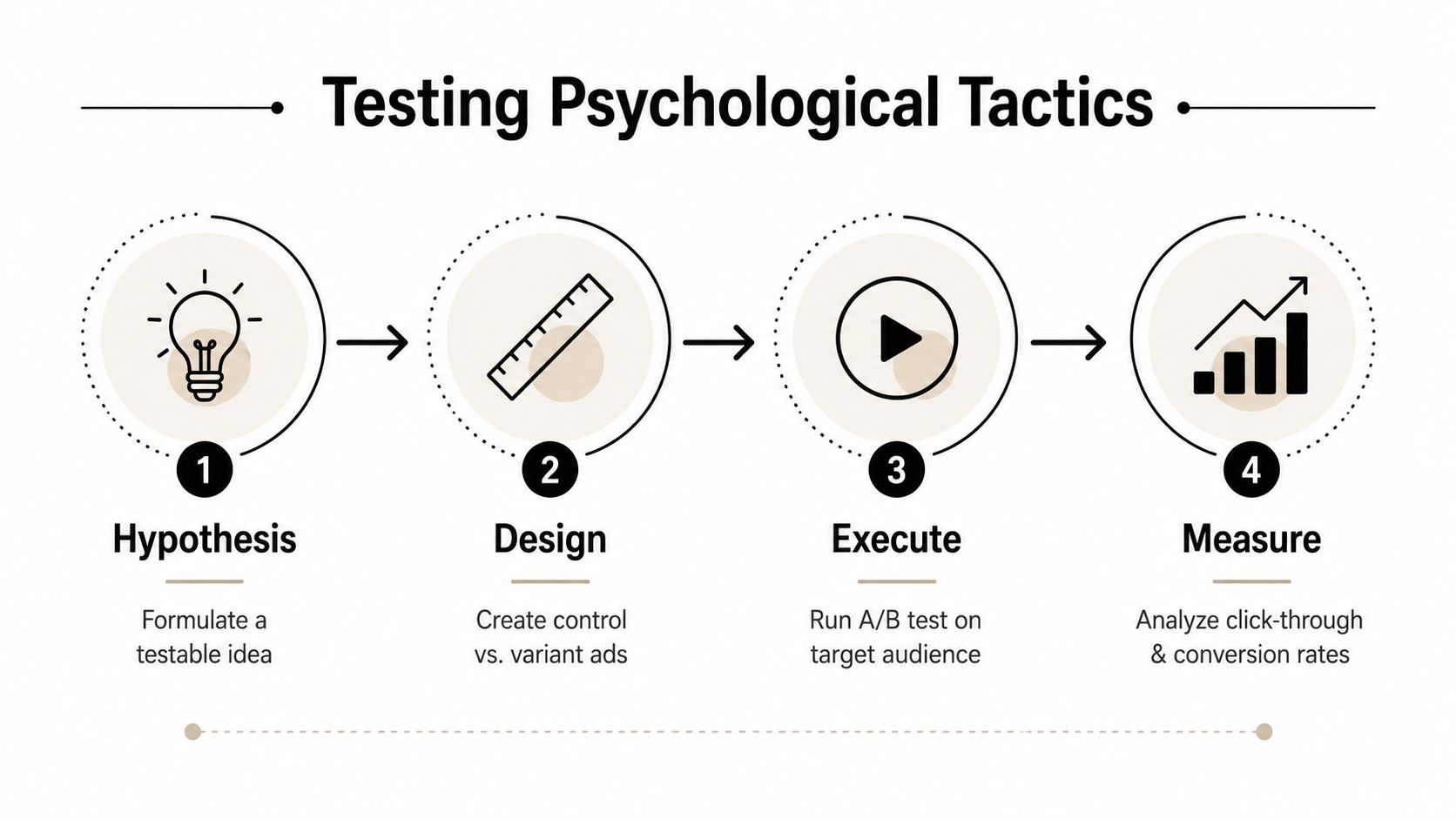
If psychology stays in the brainstorm stage, it never becomes a growth lever. The point is to turn each idea into a testable hypothesis, then let the data settle the argument. That's where PPC gets fun, because the platform gives you enough traffic to separate guesswork from signal.
Start with one psychological variable
Don't test a “better ad.” Test a loss frame against a gain frame. Test social proof against scarcity. Test a concrete claim against an abstract one. If you change five things at once, you won't know which psychological lever moved the result.
That's also where the timing of the message matters. Neuroscience-based ad testing suggests that emotional signals predict ad liking very early, around the third second of video exposure, while social-cognitive signals emerge later and stay stable (AMA summary of neuroscience-based ad testing). For video, that means the opening seconds need to earn attention fast, while the rest of the sequence needs enough substance to keep liking alive.
Measure more than the click
CTR is useful, but it's not the whole story. A psychological test should also watch conversion rate, post-click engagement, bounce behavior, and lead quality if your funnel supports it. If a scarcer ad lifts clicks but hurts downstream conversion, the lever may be attracting the wrong people or creating distrust.
Use landing pages to isolate the effect when possible. Keep the audience constant, then swap the message frame. Or keep the message constant and vary the proof element. That makes the result much easier to read. On video, pay attention to the opening hook, because early emotional response may matter more than the later social-cognitive layer when attention is thin.
A simple workflow helps:
- Write the hypothesis. State the psychological idea in one sentence.
- Create the variant. Change only the lever you want to test.
- Run the test. Keep audience and budget conditions as close as possible.
- Read the outcome. Look beyond CTR and check what happened after the click.
The goal isn't to prove psychology in general. It's to prove which psychological lever works for this offer, this audience, and this channel.
The Ethics of Persuasion in Advertising
A strong ad can guide attention, but it can also push too hard. In PPC, that difference shows up fast. A message that gets the click by making people feel tricked, shamed, or boxed in may win the auction, yet it can weaken the brand relationship the moment the landing page opens.
Persuasion is strongest when it feels honest
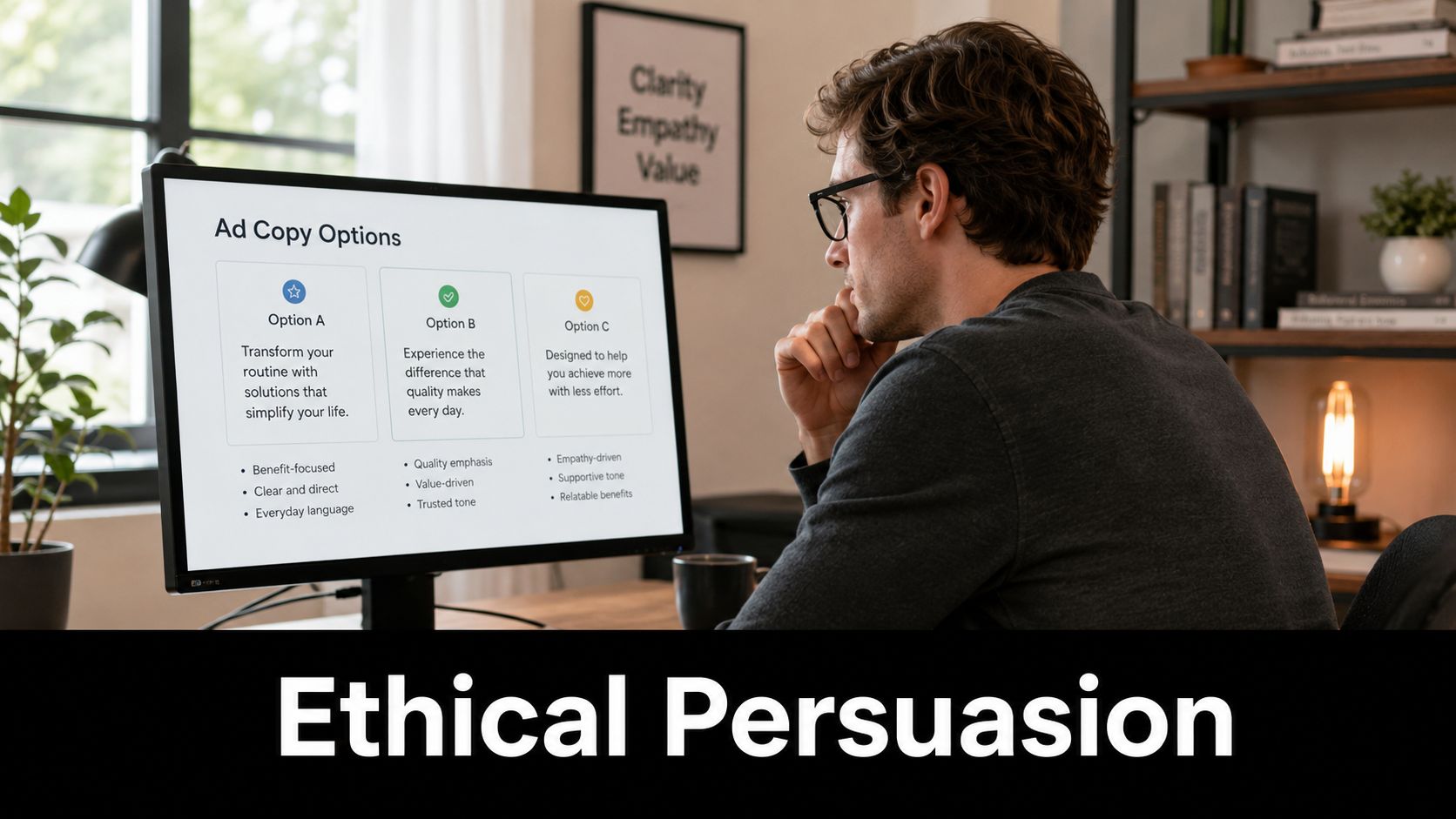
The cleanest campaigns do not hide the mechanism. They make the value easier to understand, and they leave the buyer feeling informed rather than cornered. That is the ethical line in practice. If the emotional hook matches the product and the promise is clear, the ad can feel helpful instead of pushy.
A good check is simple. Ask whether the ad is helping someone choose with more confidence, or steering them into a decision they will regret later. The first builds trust. The second spends trust like a limited budget. Fear, false urgency, and slippery wording can produce a short burst of action, but the cost usually shows up later in weaker relationships and lower confidence in the brand.
Where the line usually gets crossed
The line shifts when marketers confuse influence with pressure. Social proof becomes manipulation when the proof is made up. Scarcity becomes manipulation when the timer is fake. Emotional appeal becomes manipulation when the feeling is used to hide a weak offer.
If a buyer would feel embarrassed after understanding how the ad worked, the tactic probably belongs in the waste bin.
The safer route is to make the value clearer, not the user more trapped. Be specific about what the product does, who it is for, and which problem it solves. Psychological tactics should lower confusion and support better judgment. Used that way, they support long-term trust and cleaner performance.
Your Next Campaign Starts in the Mind
The best PPC teams don't treat psychology as a branding extra. They treat it like a performance lever that shapes the click, the conversion, and the relationship that follows. Cognitive framing, social validation, and emotional resonance each matter, but they only help when they fit the audience and the offer.
That's why the process is more important than any single trick. Build the ad around a real motivation. Match the message to the audience's mindset. Test one psychological idea at a time. Then keep the tactics that improve not just clicks, but meaningful conversions and trust.
The simplest takeaway is also the most useful. Don't ask how to make people act faster. Ask how to make the right action feel clearer, safer, and more relevant. That's the point where psychology and advertising stop feeling like separate topics and start working like one system.
Keywordme helps PPC teams apply that mindset with cleaner keyword workflows, faster optimization, and less wasted spend. If you want to turn psychological insight into sharper Google Ads execution, visit Keywordme and see how it can support your next campaign.
.svg)