
9 Best PPC Optimization Tools Compared for 2026
This comprehensive PPC optimization tool comparison evaluates nine leading platforms for 2026, helping advertisers eliminate wasted ad spend and streamline campaign management. The guide examines solutions ranging from in-platform optimization tools to competitive intelligence platforms and enterprise automation software, focusing on how each addresses common pain points like irrelevant clicks, manual workflow bottlenecks, and cross-channel campaign efficiency.


If you've ever watched your ad budget drain on irrelevant clicks, you know the pain of unoptimized PPC campaigns. The difference between a profitable Google Ads account and one that bleeds money often comes down to the tools you use—and how efficiently you can act on the data they surface. Whether you're eliminating junk search terms, testing ad variations, or tracking competitor strategies, the right PPC optimization tool can save you hours of manual work and thousands in wasted spend.
Here's the reality: most advertisers are stuck toggling between spreadsheets, third-party dashboards, and the actual ad platform. That friction slows you down and creates room for costly mistakes. The tools we're covering here solve that problem in different ways—some live directly inside your ad account, others offer deep competitive intelligence, and a few are built for enterprise-scale automation across multiple channels.
We've tested these platforms, evaluated their workflows, and broken down exactly who they're best for. Let's get into it.
1. Keywordme
Best for: Advertisers who want to optimize Google Ads campaigns without leaving the interface.
Keywordme is a Chrome extension that integrates directly into Google Ads' Search Terms Report, letting you remove junk keywords, add negatives, apply match types, and build new keyword groups with a single click.

Where This Tool Shines
The biggest advantage here is eliminating the spreadsheet shuffle. Most PPC managers export search term reports, manipulate them in Excel, then re-upload changes back into Google Ads. Keywordme skips all that by letting you take action right where you're already working.
It's particularly useful for agencies managing multiple client accounts. The multi-account support and team features mean you can standardize workflows across your entire roster without forcing everyone to learn a separate dashboard. One-click negative keyword additions and instant match type application turn what used to be a 20-minute task into something you can knock out in under two minutes.
Key Features
One-Click Negative Keyword Additions: Flag and exclude irrelevant search terms instantly without exporting data.
Instant Match Type Application: Apply broad, phrase, or exact match modifiers directly in the Search Terms Report.
Keyword Clustering and Bulk Editing: Group related keywords automatically and make changes across multiple terms at once.
Multi-Account and Team Support: Manage multiple Google Ads accounts and collaborate with team members seamlessly.
Native Interface Integration: Works inside Google Ads—no separate login, no context switching.
Best For
Solo freelancers and small agencies who spend hours each week cleaning up search term reports. If you're managing 5-20 Google Ads accounts and your current workflow involves exporting CSVs, this will feel like a massive upgrade. Also ideal for advertisers who value speed and simplicity over complex automation rules.
Pricing
Flat-rate pricing at $12/month per user with a 7-day free trial. No ad spend minimums, no tiered plans—just straightforward access to all features.
2. Optmyzr
Best for: Agencies and advanced advertisers who need custom automation rules and detailed reporting.
Optmyzr is a comprehensive PPC management platform with rule-based automation, custom scripts, and cross-platform support for Google, Microsoft, and Amazon Ads.

Where This Tool Shines
Optmyzr's Rule Engine is where it separates itself from simpler tools. You can build custom automation workflows that trigger based on specific performance thresholds—like pausing keywords when CPA exceeds a certain amount or increasing bids when conversion rates spike. This level of control appeals to advertisers who don't want a black-box AI making decisions for them.
The one-click optimizations are also well-designed. Instead of just telling you what to fix, Optmyzr explains why each recommendation matters and lets you apply changes with a single click. The white-label reporting is a nice touch for agencies that want to deliver client dashboards without building them from scratch.
Key Features
Rule Engine for Custom Automations: Create if-then rules that execute automatically based on campaign performance.
One-Click Optimizations with Explanations: Review suggested changes with context before applying them instantly.
Shopping Campaign Management: Dedicated tools for managing product feeds and Shopping ads.
Budget Pacing and Alerts: Monitor spend velocity and get notified when budgets are at risk of overspending or underspending.
White-Label Reporting: Generate branded client reports with customizable metrics and visualizations.
Best For
Mid-sized agencies managing 20+ accounts who need scalable automation without sacrificing control. Also a strong fit for in-house PPC teams at larger companies who want to standardize optimization processes across multiple campaigns.
Pricing
Starts at $249/month with pricing tiers based on ad spend and number of accounts managed.
3. WordStream
Best for: Small businesses and new advertisers who need guided optimization workflows.
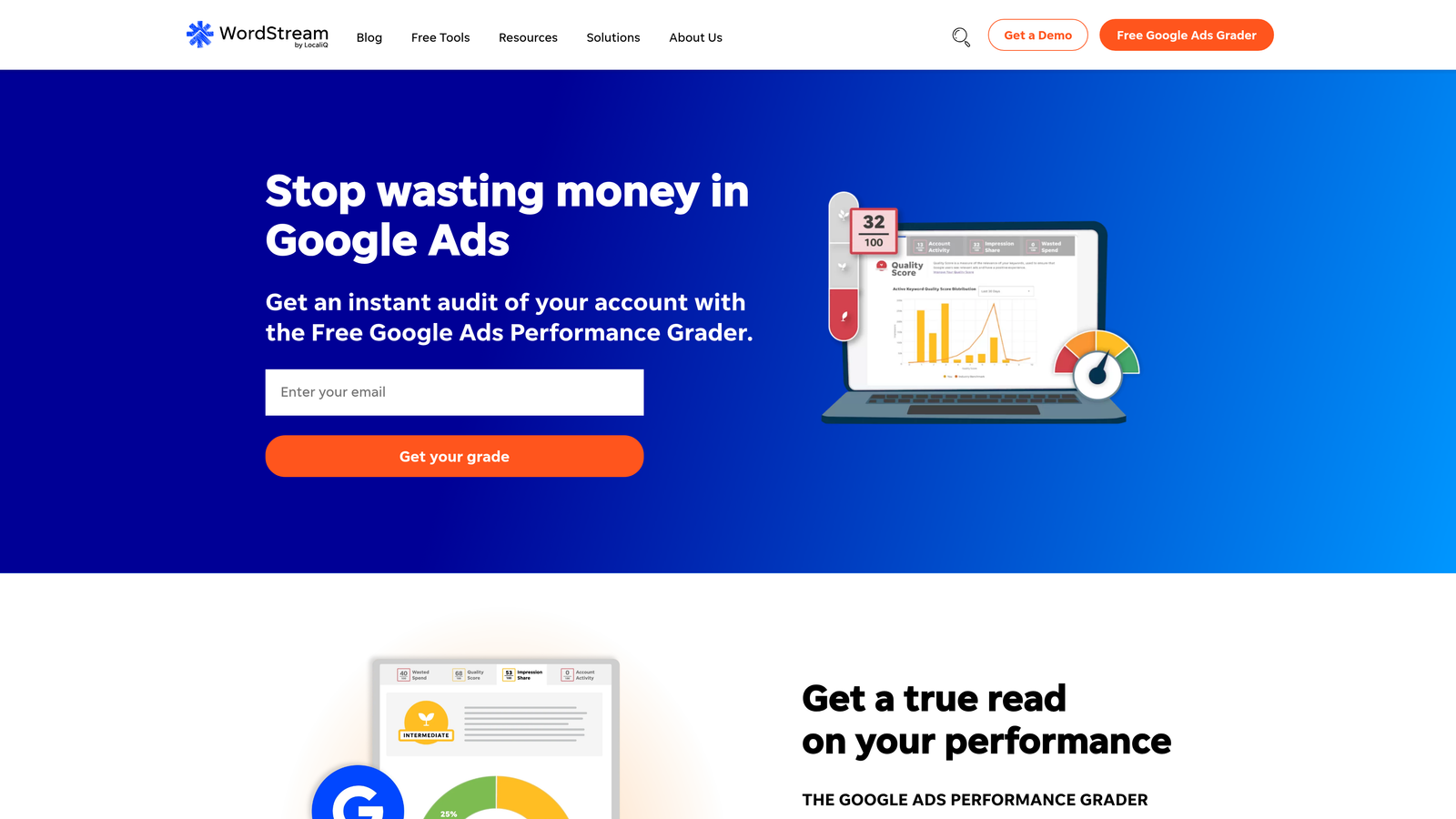
WordStream is a PPC management platform designed for users who want structured recommendations and cross-platform support without a steep learning curve.
Where This Tool Shines
WordStream's "20-Minute Work Week" is built around the idea that most small business owners don't have hours to spend optimizing ads. The platform surfaces the highest-impact changes you can make in a short session—things like pausing underperforming ads, adjusting bids on top keywords, and testing new ad copy.
The performance grader is also useful for benchmarking. It compares your account metrics against industry averages and highlights specific areas where you're lagging. If you're managing Google and Facebook Ads together, the unified dashboard saves time by consolidating both platforms in one place.
Key Features
20-Minute Work Week Optimization Workflow: Guided daily tasks that prioritize high-impact changes.
Google and Facebook Ads Management: Manage both platforms from a single interface.
Performance Grader and Benchmarks: Compare your account performance against industry standards.
Landing Page Creation Tools: Build and test landing pages without needing a separate tool.
Call Tracking Integration: Track phone call conversions directly from your ads.
Best For
Local businesses, consultants, and small marketing teams managing modest ad budgets across Google and Facebook. If you're spending under $10K/month and want a tool that tells you exactly what to do next, WordStream fits that niche well.
Pricing
Custom pricing based on your monthly ad spend—contact sales for a quote.
4. Adalysis
Best for: Advertisers obsessed with ad testing and Quality Score optimization.
Adalysis is a PPC analysis platform focused on automated ad testing, Quality Score tracking, and audit recommendations.
Where This Tool Shines
If you run a lot of ad variations and struggle to determine statistical significance, Adalysis automates that analysis for you. It monitors your ad tests, flags winners and losers based on confidence intervals, and even pauses underperforming ads automatically if you want it to.
The Quality Score monitoring is another standout feature. Most advertisers only check Quality Score when something breaks—Adalysis tracks it continuously and alerts you when scores drop. The N-gram analysis helps you spot patterns in search terms that you might miss manually, like recurring phrases that indicate low intent.
Key Features
Automated Ad Testing Analysis: Identifies statistically significant winners in your ad tests without manual calculation.
Quality Score Monitoring and Alerts: Tracks Quality Score changes over time and notifies you when scores decline.
N-Gram Analysis for Search Terms: Surfaces common word patterns in your search query data.
Anomaly Detection: Flags unusual performance shifts that might indicate issues or opportunities.
Customizable Audit Checklists: Build repeatable audit workflows tailored to your optimization priorities.
Best For
Performance marketers and agencies who run aggressive ad testing programs and care deeply about incremental improvements. If you're the type of advertiser who tests 5+ ad variations per ad group and wants data-driven decisions, this tool will save you hours of spreadsheet analysis.
Pricing
Starts at $149/month with pricing based on ad spend and number of accounts.
5. SEMrush PPC Toolkit
Best for: Marketers who need competitive PPC research alongside campaign management.
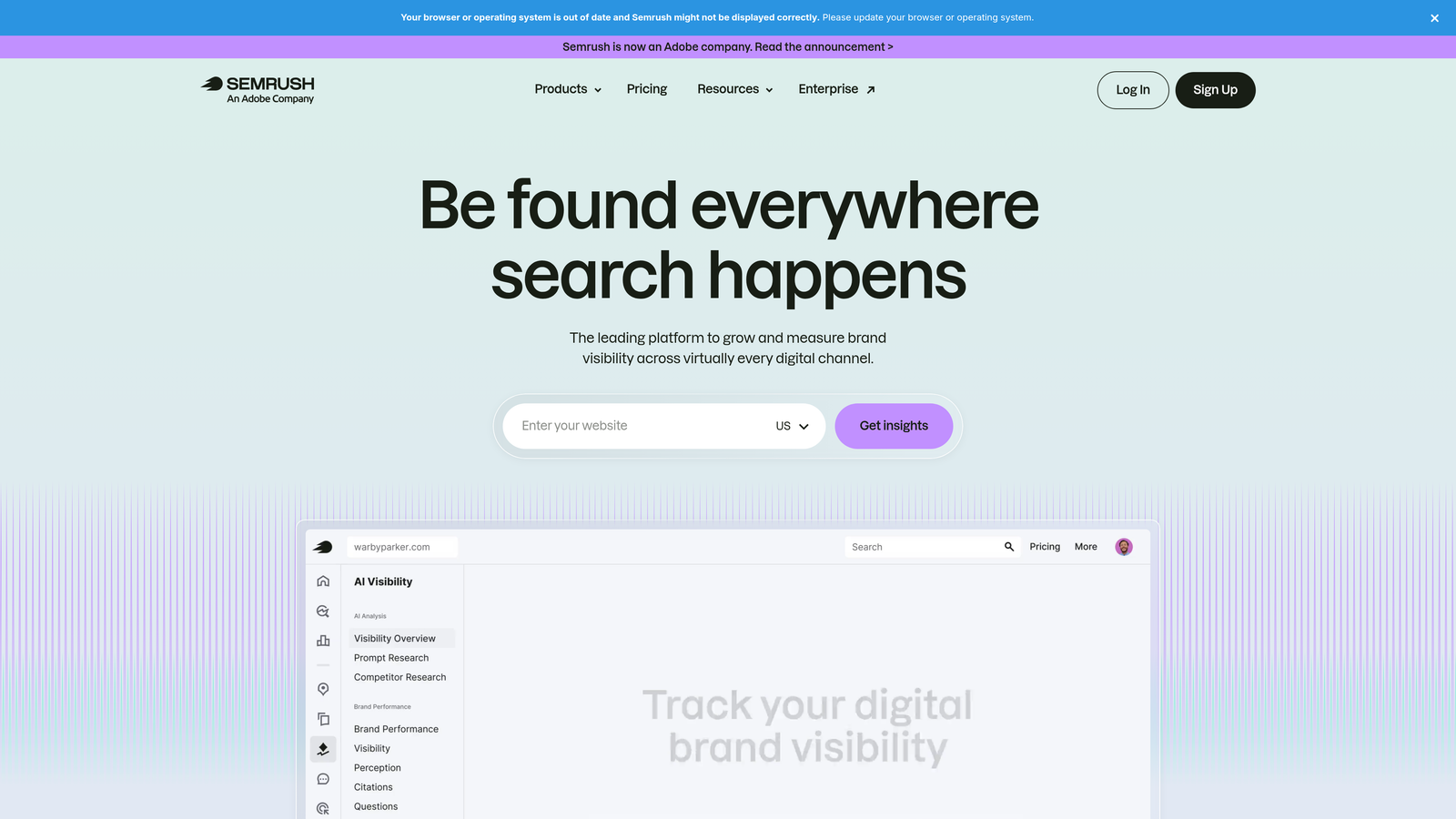
SEMrush is an all-in-one marketing suite with powerful PPC research tools including competitor ad analysis, keyword research, and an AI-assisted ad builder.
Where This Tool Shines
SEMrush excels at competitive intelligence. You can see which keywords your competitors are bidding on, view their historical ad copy, and analyze their Shopping campaigns. This is incredibly useful when you're entering a new niche or trying to understand why a competitor is outranking you.
The keyword gap analysis is particularly helpful for finding opportunities you're missing. It compares your keyword list against competitors and highlights terms they're targeting that you aren't. The ad builder with AI assistance speeds up ad creation by suggesting headlines and descriptions based on your landing page content.
Key Features
Competitor PPC Keyword Research: See which keywords competitors are bidding on and estimate their traffic.
Ad History and Copy Analysis: View historical ad variations from any advertiser in Google's index.
PLA (Shopping) Research: Analyze competitor Shopping campaigns and product listings.
Keyword Gap Analysis: Identify keyword opportunities by comparing your campaigns to competitors.
Ad Builder with AI Assistance: Generate ad copy suggestions based on your landing page content.
Best For
Marketing teams that need both PPC and SEO tools in one platform. If you're already using SEMrush for organic research, the PPC toolkit is a natural extension. Also ideal for advertisers who spend significant time on competitive analysis and strategy development.
Pricing
Starts at $139.95/month for the full SEMrush suite, which includes PPC tools alongside SEO, content, and social features.
6. SpyFu
Best for: Competitive intelligence and historical PPC data analysis.
SpyFu specializes in competitive research with a massive database of historical ad data going back over a decade.

Where This Tool Shines
SpyFu's historical ad database is unmatched. You can see every ad variation a competitor has run for years, which helps you understand their messaging evolution and identify what's worked long-term. This is especially useful if you're trying to reverse-engineer a competitor's strategy or avoid repeating their mistakes.
The PPC keyword grouping suggestions are also helpful for structuring new campaigns. SpyFu analyzes your keyword list and recommends logical ad group structures based on semantic relationships. The Google Ads Advisor feature provides specific optimization recommendations tailored to your account data.
Key Features
Competitor Keyword Downloads: Export complete lists of keywords your competitors are bidding on.
Historical Ad Copy Database: Access years of ad variations from any advertiser.
PPC Keyword Grouping Suggestions: Get recommendations for structuring keywords into ad groups.
Ad Spend Estimates: See estimated monthly ad budgets for competitors.
Google Ads Advisor Recommendations: Receive actionable optimization tips based on your account performance.
Best For
Competitive researchers, affiliate marketers, and agencies that need deep historical data on competitor strategies. If you're launching campaigns in competitive niches and want to understand what's already been tested, SpyFu gives you that intelligence at a fraction of SEMrush's cost.
Pricing
Starts at $39/month with higher tiers for increased data limits and features.
7. Marin Software
Best for: Enterprise teams managing cross-channel campaigns at scale.
Marin Software is an enterprise-grade advertising platform for managing search, social, and ecommerce campaigns across multiple channels.
Where This Tool Shines
Marin is built for advertisers spending millions annually across Google, Microsoft, Facebook, Instagram, and Amazon. The unified dashboard consolidates all channels in one place, which is critical when you're trying to optimize budget allocation across platforms. The automated bidding algorithms are sophisticated—they factor in cross-channel attribution and adjust bids based on incremental value, not just last-click conversions.
The enterprise reporting capabilities are also robust. You can build custom dashboards for different stakeholders, automate report delivery, and drill down into performance by channel, campaign, or audience segment. For large organizations with complex approval workflows, Marin's collaboration features help streamline campaign launches and changes.
Key Features
Unified Cross-Channel Management: Manage search, social, and shopping campaigns from a single platform.
Automated Bidding Algorithms: AI-driven bid optimization that accounts for cross-channel attribution.
Budget Allocation Optimization: Automatically shift budgets to the best-performing channels and campaigns.
Attribution Modeling: Track customer journeys across multiple touchpoints and assign credit appropriately.
Enterprise Reporting and Analytics: Build custom dashboards and automate report distribution.
Best For
Large enterprises and holding companies managing eight-figure annual ad budgets across multiple platforms. If you have dedicated teams for search, social, and ecommerce but need a unified view of performance, Marin solves that coordination problem.
Pricing
Custom enterprise pricing based on ad spend and platform requirements—expect to contact sales for a quote.
8. Skai (formerly Kenshoo)
Best for: AI-powered omnichannel marketing with advanced machine learning capabilities.
Skai is an enterprise marketing platform that uses AI-driven bid optimization, incrementality measurement, and creative intelligence to manage campaigns at scale.
Where This Tool Shines
Skai's AI bidding is more advanced than most competitors. Instead of simple rule-based automation, it uses machine learning models that predict conversion likelihood and adjust bids in real-time based on contextual signals like device, location, time of day, and audience segment. The incrementality measurement feature is particularly valuable—it helps you understand which campaigns are driving truly new customers versus just capturing demand that would have converted anyway.
The retail media management capabilities are also strong. If you're advertising on Amazon, Walmart, Instacart, or other retail platforms, Skai provides unified management and optimization across all of them. The creative intelligence tools analyze which ad formats and messaging perform best, then feed those insights back into campaign optimization.
Key Features
AI-Driven Bid Optimization: Machine learning models that predict conversion probability and adjust bids dynamically.
Retail Media Management: Unified platform for managing campaigns across Amazon, Walmart, and other retail channels.
Incrementality Measurement: Understand which campaigns drive new customers versus capturing existing demand.
Creative Intelligence: Analyze creative performance and apply insights to optimize ad formats and messaging.
Cross-Channel Attribution: Track customer journeys across search, social, display, and retail media.
Best For
Enterprise brands and large ecommerce companies with significant retail media budgets. If you're spending heavily on Amazon Ads and want sophisticated AI optimization across multiple channels, Skai is purpose-built for that use case.
Pricing
Custom enterprise pricing—contact sales for a quote based on your ad spend and platform needs.
9. Channable
Best for: Ecommerce advertisers automating product feed campaigns.
Channable is a feed management and PPC automation platform that generates and optimizes ads dynamically from product data feeds.
Where This Tool Shines
Channable excels at automating the tedious parts of ecommerce advertising. Instead of manually creating ads for thousands of products, you connect your product feed and Channable generates campaigns automatically. The rule-based automation lets you set conditions like "pause ads for products with less than 5 units in stock" or "increase bids by 20% for products with 4+ star reviews."
The feed optimization tools are also valuable for improving product data quality. You can transform titles, add custom labels, and enrich descriptions—all of which improve ad performance and approval rates. Multi-marketplace support means you can manage Google Shopping, Facebook Catalog ads, Amazon, and other channels from one platform.
Key Features
Dynamic Ad Generation from Feeds: Automatically create and update ads based on product inventory data.
Automated Google Ads Campaigns: Build Shopping and Dynamic Search campaigns directly from product feeds.
Product Feed Optimization: Transform and enrich product data to improve ad performance.
Multi-Marketplace Support: Manage campaigns across Google, Facebook, Amazon, and other platforms.
Rule-Based Campaign Automation: Set conditions to pause, adjust bids, or update ads based on inventory, pricing, or performance.
Best For
Ecommerce brands and agencies managing large product catalogs. If you're running Shopping campaigns with hundreds or thousands of SKUs, Channable eliminates the manual work of keeping ads in sync with inventory and pricing changes.
Pricing
Starts at €29/month with pricing tiers based on the number of products and channels managed.
Making the Right Choice
The best PPC optimization tool depends on where you actually do your work and what you're trying to accomplish. If you're a solo advertiser or small agency spending most of your time in Google Ads, Keywordme eliminates the friction of exporting and re-uploading data—you just optimize in real-time where you're already working.
Agencies managing larger portfolios will get more value from Optmyzr or Adalysis, which offer custom automation rules and detailed audit workflows. If competitive research drives your strategy, SEMrush and SpyFu give you the intelligence you need to outmaneuver competitors. Enterprise teams juggling cross-channel budgets should evaluate Marin or Skai for unified management and attribution. And if you're running product feed campaigns at scale, Channable automates the repetitive work of syncing ads with inventory.
Here's the thing most advertisers get wrong: they pick tools based on feature lists instead of workflow fit. The platform with the longest list of capabilities isn't necessarily the one that saves you the most time. Think about where you spend your hours each week. Are you stuck in spreadsheets cleaning up search terms? Struggling to coordinate changes across multiple accounts? Trying to reverse-engineer competitor strategies? Match the tool to the actual bottleneck in your process.
Most of these platforms offer free trials—take advantage of them. Spend a week using the tool in your real workflow, not just clicking through demo data. You'll know pretty quickly if it actually makes your life easier or just adds another dashboard to check.
If you're managing Google Ads campaigns and want to eliminate the spreadsheet shuffle, start your free 7-day trial of Keywordme. Remove junk search terms, build high-intent keyword lists, and apply match types instantly—right inside Google Ads. No spreadsheets, no switching tabs, just quick, seamless optimization. Then just $12/month to keep optimizing faster.
.svg)