
Optimising Google Ads: The 2026 Efficiency Playbook
Optimising Google Ads: The 2026 Efficiency Playbook


Optimising Google Ads often feels like this: spend climbs, click volume looks fine, and conversions barely move.
That usually means the account does not need more activity. It needs a better workflow. Most underperforming accounts are not short on ideas. They are buried in slow, manual work, weak decision-making, and too many changes made in the wrong order.
The fix is not another bloated checklist. It is a system. Good PPC managers diagnose first, clean up fast, push signal quality higher, and only then scale what is working. That is how optimising google ads becomes manageable instead of endless.
Beyond the Basics of Google Ads Optimisation
A lot of Google Ads advice still lives at the surface level. Improve your ads. Add negatives. Test landing pages. Use Smart Bidding. None of that is wrong. It is just incomplete.
A core problem is operational. Teams know what they should do, but they cannot do it consistently because the account is too noisy and the workflow is too slow.

What the averages tell you
In 2025, Google Ads benchmarks showed an average CTR of 6.66% for search ads and an average conversion rate of 7.52% across campaigns, according to WordStream’s 2025 Google Ads benchmarks.
Those numbers are useful, but only if you treat them as a reference point, not a target you celebrate for hitting. A campaign can post a decent CTR and still waste money on weak search intent. It can convert reasonably well and still be full of terms that never should have triggered your ads in the first place.
That is why efficient optimisation matters. You do not improve an account by tinkering everywhere. You improve it by finding the few levers that change both relevance and speed of execution.
Where most accounts get stuck
The pattern is familiar:
- Search terms are messy: Good queries and junk queries sit in the same report, and no one processes them fast enough.
- Match types drift: Broad match brings in useful discovery, but it also opens the door to waste when nobody harvests winners and blocks losers.
- Automation gets blamed: Smart Bidding gets the criticism, even when the underlying issue is poor conversion data and weak keyword hygiene.
- Teams work too slowly: Manual copy-paste tasks eat the time that should go into strategy.
Better results usually come from better account hygiene and faster decisions, not from constant campaign rebuilds.
If you need a broader primer before tightening your own process, this definitive guide to Paid Search Ads is a useful companion because it frames the channel clearly without turning it into theory.
Optimising google ads in 2026 is less about finding one secret tactic and more about building a loop you can repeat every week without drowning in admin.
Your First Move An Account Health Audit
If you start by changing bids, you are guessing.
A proper audit tells you where money leaks, where intent is strong, and where reporting is lying to you. That matters because a lot of “bad performance” stems from poor visibility into what happened.
Near the top of that audit, I always want the same thing: the search terms report.

Start with what users typed
Keywords are your instructions. Search terms are reality.
That distinction matters. If your account is built around neat keyword themes but the search queries are loose, low intent, or irrelevant, your structure is not helping you. It is hiding the problem.
Look for patterns such as:
- Irrelevant modifiers: Terms that pull in the wrong audience, wrong use case, or wrong level of intent.
- Research-heavy queries: Searches that suggest curiosity rather than buying intent.
- Mismatched geo intent: Queries that mention places you do not serve.
- Brand confusion: Searches clearly aimed at competitors or unrelated products.
When you audit this report properly, you usually find two things at once. The first is wasted spend. The second is opportunity. Good search terms often deserve promotion into their own tighter keyword targets and ad groups.
For a more detailed framework, this PPC audit checklist template is a practical starting point for reviewing account setup without missing obvious drains.
Check settings that waste budget
A surprising amount of spend disappears because of settings, not strategy.
Run through these fast:
| Audit area | What to look for | Why it matters |
|---|---|---|
| Networks | Whether Search campaigns are also serving on partner placements or other network settings you did not intend | Mixed traffic can muddy performance analysis |
| Locations | Presence in places you do not sell to or cannot service well | Geo mismatch lowers efficiency fast |
| Ad schedule | Time periods that produce weak leads or poor sales quality | Spend should match actual buying windows |
| Conversion actions | Multiple actions included when only one should guide bidding | Bidding logic breaks when the goal is wrong |
A campaign can look busy and still be structurally off. The account health audit is where you catch that before scaling the wrong thing.
Attribution can hide your best work
One of the biggest blind spots in modern accounts is attribution. Last-click attribution can make top-of-funnel traffic look disposable when it is initiating the path to conversion.
As noted by Cometly on Google Ads optimization, optimizing Google Ads for multi-touch attribution blind spots is critical, as last-click models undervalue upper-funnel campaigns. Prospects from broad match may convert via branded searches, but without data-driven attribution models, agencies waste spend on overvalued branded terms.
That changes how you read an audit. If a non-brand campaign introduces qualified users and branded search closes them later, you should not judge the first campaign like it failed just because it did not get the final click.
If you only reward the last click, branded campaigns often look smarter than they are.
This walkthrough is worth watching before you start making changes:
A strong audit does not just find waste. It tells you what to trust, what to stop, and what needs a deeper read before you cut budget.
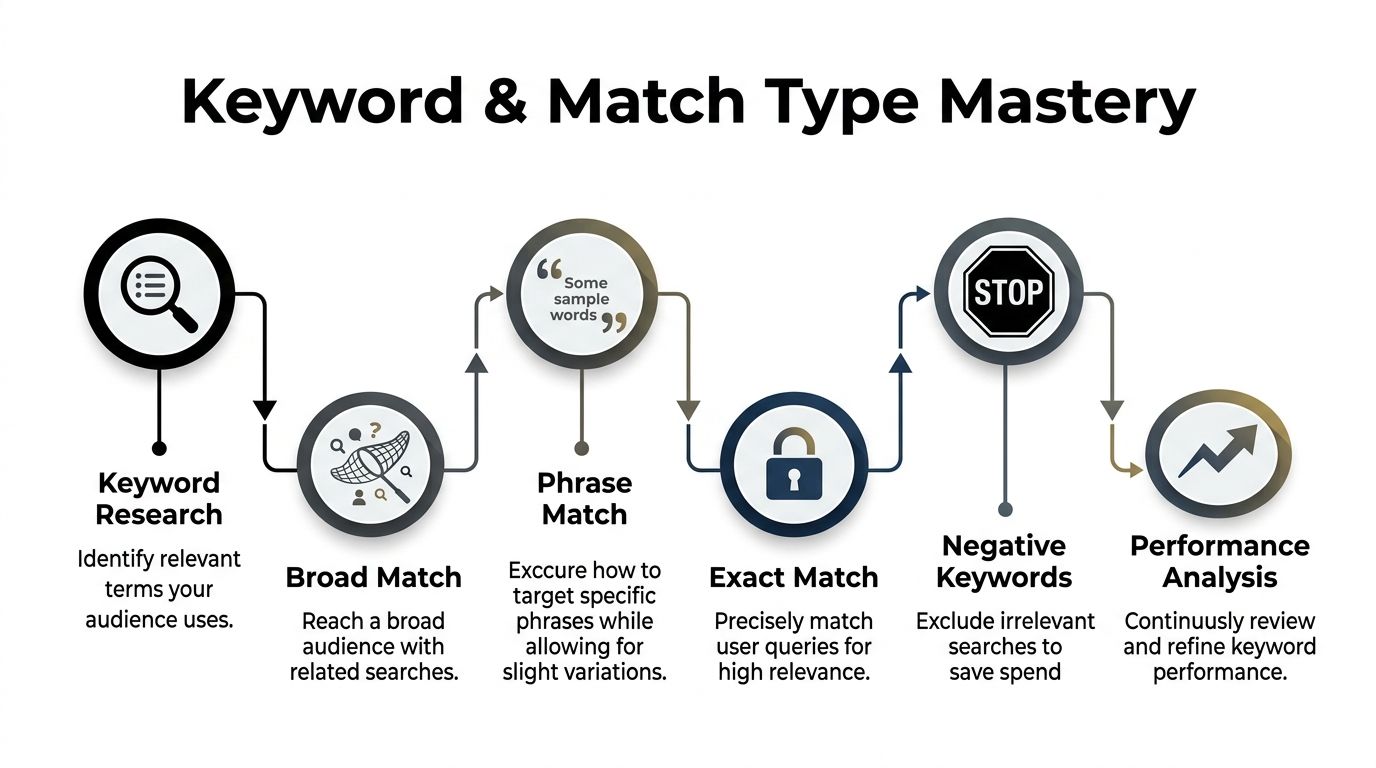
Mastering Keywords and Match Types for Profit
Manual keyword management is where a lot of accounts lose momentum.
Not because the work is unimportant. The opposite. It matters so much that doing it slowly becomes expensive. When teams postpone search term cleanup, they keep funding weak queries. When they delay promoting strong queries into tighter match types, they leave control on the table.
Broad match is not the enemy
The old habit was simple: avoid broad, protect budget, cling to exact.
That mindset misses how modern accounts improve. Broad match can be useful when you treat it as a discovery engine, not a set-and-forget targeting method. It gives you fresh query data. Your job is to process that data fast and turn it into something usable.
That means two jobs happening together:
- Harvest winners into phrase or exact when a real query proves its value.
- Block losers with aggressive negative keyword management.
If you only do the first, waste grows. If you only do the second, the account stops learning.
Mine intent where competitors are lazy
One of the easiest ways to improve relevance is to stop fighting for every generic term.
According to Pixis on beating competitors in Google Ads, competitor-driven long-tail keyword mining is an underserved strategy; mining terms like "CRM software for real estate teams" at an $8 CPC can beat out generic terms at a $30 CPC, reducing competition while signaling higher intent.
That is the trade-off in plain English. Generic terms give you volume. Long-tail terms often give you cleaner intent and less auction pressure.
A practical workflow looks like this:
- Pull competitor positioning themes: Look at what they emphasize, such as low price, speed, compliance, or premium service.
- Build long-tail variants around use case: Industry, team type, feature need, or buyer problem.
- Map each term to a matching ad message: If the query is niche, the ad should sound niche too.
- Watch the search terms report closely: Long-tail structures still need pruning.
If your negative coverage is thin, this negative keyword list is a useful reference for common exclusions you may want to adapt to your own account.
Match types should reflect confidence
I tend to think about match types like this:
| Match type | Best use | Risk if unmanaged |
|---|---|---|
| Broad | Discovery and query expansion | Rapid spend drift |
| Phrase | Controlled coverage around a theme | Can still pull in weak variants |
| Exact | Tight control on proven intent | Limits learning if overused early |
The mistake is not using broad. The mistake is using broad without a harvesting routine.
The mistake is not using exact. The mistake is forcing exact too early, before you know what language buyers use.
For finding themes worth building out, this guide on how to find best keywords for PPC fits well with a search-term-first workflow.
Speed changes the economics
Where tooling matters. If your process requires exporting reports, cleaning columns, reformatting match types, then pasting everything back into Google Ads, you will optimise too slowly.
Keywordme is built for this exact bottleneck. Inside the Google Ads interface, it lets you turn real search terms into keywords with the right match type or add them as negatives without the usual copy-paste routine. That changes keyword work from occasional cleanup into a regular profit task.
The account that processes query data faster usually gets cleaner traffic, tighter ad groups, and better decisions from automation.
Smart Bidding and Budgeting in the AI Era
Smart Bidding works well when the account gives it clean signals. It works badly when the account feeds it noise.
That is the key dividing line. Advertisers often ask whether they should trust automation. The better question is whether their setup deserves trust.
The algorithm needs better inputs
Google’s AI systems have become much more capable, but they still depend on visibility into what drives conversions. According to ALM Corp’s review of Google Ads 2025 updates, Google's 2025 AI Max with Smart Bidding Exploration delivered an 18% increase in unique search query categories with conversions and a 19% overall conversion lift, which points to how much stronger automation becomes when search term visibility improves.
That should change how you think about prep work.
Negative keyword cleanup is not admin. It sharpens the traffic mix.
Better match type decisions are not account tidying. They improve the quality of search intent feeding the bidding model.
Clean conversion tracking is not a technical checkbox. It is the difference between useful automation and expensive confusion.
Audience layering helps without choking reach
A practical move here is to add audiences in observation mode first.
That lets you see how different user groups behave without restricting traffic too early. You get data on segments that may deserve more budget, more specific ads, or separate campaign treatment later.
A few strong audience uses:
- Remarketing signals: Useful for understanding whether return visitors convert differently from cold traffic.
- Stage-based segmentation: Pricing-page visitors and blog readers should not be treated as the same user.
- Fit filters for B2B: Some demographics or business profiles are less likely to become qualified pipeline.
The common mistake is moving to hard targeting too quickly. That narrows reach before the account has learned enough.
Budgeting should follow evidence, not habit
A lot of accounts still budget by tradition. The same campaigns get the same share each month because no one wants to disrupt performance.
That is not optimisation. It is inertia.
Use budget changes to reinforce what the account proved:
| Scenario | Better move |
|---|---|
| Search terms are improving and lead quality is stable | Protect and scale that campaign carefully |
| Conversions exist but traffic quality looks mixed | Hold spend and clean targeting first |
| Campaign drives clicks but weak post-click behaviour | Fix intent or landing page before adding budget |
| Branded campaign captures demand created elsewhere | Do not over-credit it when reallocating spend |
For a practical companion on bid strategy selection, this article on how can automated bidding help optimize my campaigns is worth reviewing alongside your own conversion setup.
Smart Bidding is a multiplier. It amplifies signal quality. If the signal is messy, the scaling gets messy too.
Refining Ads and Landing Pages with A/B Testing
Most ad tests fail for one reason. People change things too fast.
They swap headlines after a few good days, keep the ad with the prettier CTR, then wonder why lead quality drops. That is not testing. That is reacting.
Test ads with discipline
A more useful method is simple and boring, which is why it works.
As outlined by Define Digital Academy’s Google Ads optimization advice, create 2-3 Responsive Search Ad variations per ad group and run tests for 2-4 weeks or until you reach statistical significance, like 100+ conversions per variant, before making changes.
That approach forces patience. It also stops you from declaring winners based on noise.
Use RSA testing to answer specific questions:
- Headline angle: Is the offer stronger when it leads with price, speed, or outcome?
- CTA style: Do users respond better to direct action or lower-pressure language?
- Qualifier language: Does calling out the audience improve lead quality?
- Trust signals: Does proof-based messaging help more than promotional messaging?

CTR is useful, but it is not the finish line
A high CTR can mean the ad is compelling. It can also mean the ad is overpromising.
That is why I care more about the chain of performance than one headline metric. Good ads attract the right click, hand the user to a relevant landing page, and keep the promise made in the search result.
A simple testing hierarchy helps:
- Check conversion rate first.
- Review cost per conversion next.
- Use CTR as a supporting signal, not the main judge.
- Read asset reports to find repeat winners and weak components.
When a headline consistently supports strong post-click behaviour, keep it in the rotation or pin it where appropriate. When a flashy line drives cheap clicks but weak outcomes, remove it.
Message match lifts the whole experience
Plenty of accounts write ads in one voice and send traffic to pages that talk about something else.
That disconnect hurts performance in ways people miss. Users bounce because the page feels off. Conversion rates soften because the offer changed. Quality Score can suffer because the ad and landing page are not aligned.
The best ad test often starts on the landing page. If the page does not continue the same promise, the click was only half won.
Look for message match on three levels:
- Intent match: Does the page answer the exact query theme?
- Offer match: Is the promotion, promise, or value proposition consistent?
- Friction match: Does the form or CTA fit the user’s stage of intent?
Strong ad testing is not a copywriting contest. It is a system for reducing mismatch between search intent, ad promise, and landing page experience.
Your Continuous Optimisation Engine
The accounts that keep improving are rarely the ones with the fanciest structure. They are the ones with a repeatable operating rhythm.
That rhythm is straightforward. Audit the account. Process search terms. tighten keyword targeting. Feed cleaner signals into bidding. Test ads and landing pages with patience. Then repeat before drift sets in.
What this loop changes
When you work this way, a few things happen.
You stop making random edits because the audit tells you where to focus. You stop treating keyword work like occasional cleanup because query management becomes part of weekly control. You stop blaming automation for weak results because you can see whether the inputs are good enough.
A useful optimisation loop usually includes:
- Routine account hygiene: Search terms, settings, and conversion checks
- Controlled expansion: Promoting real winners instead of guessing new keywords
- Signal improvement: Better audience data and cleaner conversion inputs
- Creative refinement: Testing ads and pages around actual user intent
Efficiency is a key advantage
Many teams know what to optimise. The bottleneck is execution.
When repetitive tasks eat the week, strategic work gets postponed. Search term reviews happen late. Negatives pile up. New keyword builds wait. Ad tests run without follow-up. That is how decent accounts go stale.
Optimising google ads is easier when the workflow removes friction. The less time you spend formatting, copying, and cleaning by hand, the more time you can spend making the calls that improve performance.
Strong PPC management is not about doing more tasks. It is about shortening the distance between account insight and account action.
If your current process for search term cleanup, match type updates, and negative keyword handling still runs through spreadsheets, Keywordme is worth a look. It brings those keyword tasks directly into your Google Ads workflow so you can act on real query data faster and keep optimisation moving without the usual manual drag.
.svg)