
Unlock Growth with Low Cost Online Advertising
Unlock Growth with Low Cost Online Advertising


Stretch Your Ad Budget Further Than Ever
Think you need a massive budget to make an impact with online ads? You don't. Most small teams aren't losing because they spend too little. They're losing because they spread budget across the wrong channels, target too broadly, or let junk traffic drain campaigns that should've been profitable. If you're trying to lower customer acquisition cost, the first win usually isn't "spend more." It's "waste less."
That matters even more now because digital keeps taking a bigger share of media budgets. In 2026, global digital ad spend reached $740 billion and represented 73% of total global media spend, according to Digital Applied's 2026 digital advertising statistics. Cheap doesn't mean ineffective anymore. It means the internet gives you more controllable ways to buy attention than traditional media ever did.
Still, low cost online advertising has a trap. Reach is easy. Conversion is hard. HubSpot notes that the average conversion rate across e-commerce sites stays under 2%, with skincare among the highest-performing niches at 2.7%, in its marketing statistics roundup. So the right play isn't finding the cheapest clicks. It's finding the cheapest clicks that can turn into customers.
1. Keywordme

A common small-budget Google Ads problem looks like this. Spend is steady, clicks keep coming in, and conversions stay flat because irrelevant search terms are slipping through faster than the account gets cleaned up. Keywordme earns its place at the top of this list because it helps fix that first.
The appeal is practical. Keywordme runs as a Chrome plugin inside Google Ads, so you can work in the account instead of exporting reports, sorting spreadsheets, formatting match types, and pasting changes back in later. For a solo marketer, a lean in-house team, or a small agency, that time savings matters because low-cost online advertising only works when the account stays tight week after week.
Why it earns a spot before another ad platform
Most advertisers with a limited budget do not need another traffic source on day one. They need cleaner traffic from the source they already use.
Keywordme helps with the work that usually gets skipped when time is short: spotting weak queries, building negative keywords, organizing keyword ideas, and applying match types with more control. This is the core trade-off here. You are not buying reach. You are buying faster account hygiene, which often improves results before you raise spend by a dollar.
Budget-wise, it stays accessible. The tool offers a 7-day free trial and starts at $12 per seat per month, which is low enough for smaller teams to test without treating it like a software procurement project.
Adventure Media explains in its guide to digital advertising metrics why CPC and CPA need to be read together. Cheaper clicks only help if they still come from searches with buying intent. Keywordme supports that by making search term cleanup and negative keyword management faster, which is often where wasted spend builds up in small accounts.
Practical rule: Clean the search terms before expanding the campaign. More volume in a messy account usually means more wasted spend, not more growth.
First step with Keywordme
Start with a live campaign that already gets search volume. Do not begin by generating more keywords. Begin by removing what should never have matched in the first place.
Use Keywordme in this order:
- Cut obvious waste first: Review recent search terms and remove low-intent queries fast.
- Build negatives right away: Run the AI scan, then approve irrelevant themes as negative keywords.
- Tighten match types around buyer intent: Keep proven terms controlled, then test broader coverage after cleanup.
That sequence matters. Small budgets disappear when teams expand too early and clean later.
If you also plan to test cheaper search inventory outside Google, read Keywordme's breakdown of the difference between Google Ads and Microsoft Ads. It helps frame when search expansion makes sense and when the smarter move is to improve traffic quality first.
The limitations are clear. You need Chrome, and per-seat pricing is less convenient for teams that want one shared workspace across a larger group. Still, for advertisers trying to stretch a modest Google Ads budget, Keywordme handles a job that directly affects efficiency: stopping bad traffic before it drains the account.
2. Microsoft Advertising
Microsoft Advertising is one of the easiest places to find cheaper search traffic without rebuilding your whole paid search operation. If you're already running Google Ads, you can import campaigns and get into market quickly through Microsoft Advertising. That's the appeal. Low friction, decent intent, and often less competition.
The big limitation is scale. You'll usually get less volume than Google, so this isn't where most brands build their whole acquisition engine. But for B2B, local services, and products that sell to desktop-heavy or older audiences, it can be a solid second channel.
Where it fits best
I like Microsoft Ads when a team has a search campaign that's already producing clean intent signals on Google and wants incremental reach without taking a huge risk. Search and Shopping formats cover the basics, and Audience ads can stretch the campaign beyond pure search if you need more exposure.
Budgets are also manageable. There isn't a platform-wide minimum, and the daily target model gives small advertisers tight control over pacing. That's useful when you're trying to validate a niche before opening the budget wider.
Don't judge Microsoft Ads too early. New campaigns can under-deliver at first, especially if bids and audience signals haven't settled yet.
First step with Microsoft Advertising
Don't build from scratch unless your Google setup is a mess. Import a tight, high-intent campaign first. Then review:
- Search terms first: Keep only the ad groups that already show strong commercial intent.
- Desktop behavior: Watch whether your audience converts better on desktop-heavy query sets.
- Partner traffic quality: Segment performance so syndicated inventory doesn't eat budget unobserved.
If you're deciding between the two search engines, Keywordme's breakdown of Google Ads vs. Microsoft Ads gives a practical comparison.
One more reason this channel belongs on the list. Online advertising costs 70% to 85% less per 1,000 impressions than offline media, according to Top Draw's comparison of online and offline ad costs. Microsoft Ads isn't always the cheapest digital option, but it still plays inside a much more efficient environment than traditional media.
3. Reddit Ads
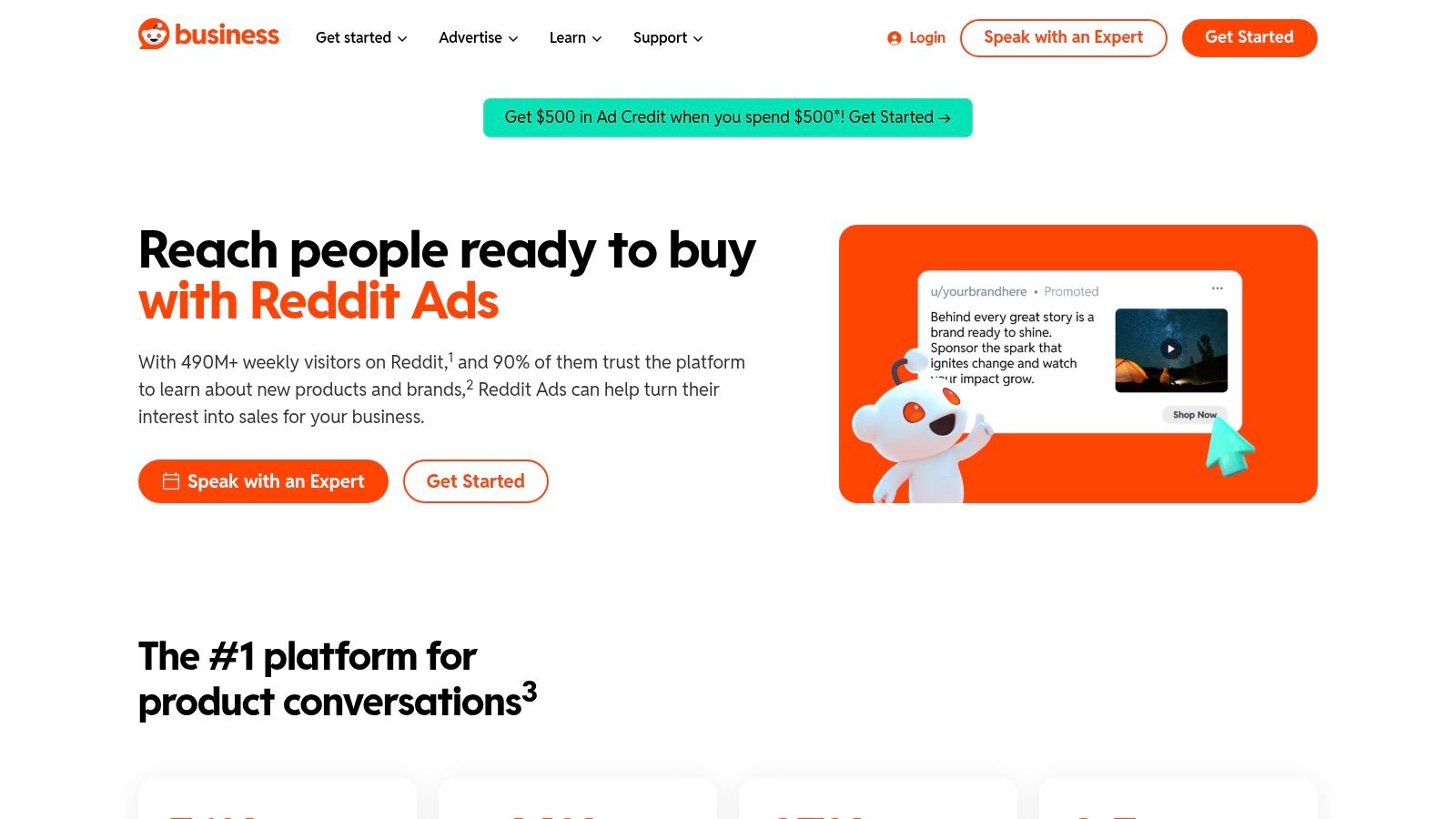
Reddit Ads can work absurdly well or completely flop. The difference is usually tone. If your ad sounds like marketing, Reddit users will punish it fast. If it sounds like a useful contribution and lands in the right subreddit, you can buy qualified traffic without a huge upfront commitment through Reddit Ads.
This platform is built for testing. You can target by subreddit, interests, keywords, and location, which makes it attractive for niche products, early-stage offers, and direct-response experiments. The self-serve barrier is low, and the campaign minimum is $5, which makes it easier to run micro-tests without committing a big budget.
What actually works on Reddit
The best campaigns usually don't look polished in the traditional social sense. They look relevant. Text-forward copy, straightforward claims, and a landing page that matches the conversation usually beat glossy brand creative.
Reddit is not a channel where you can force broad-market messaging into communities and expect it to convert. You have to know the room.
- Match the subreddit voice: Formal ad copy often underperforms against plainspoken, specific language.
- Offer substance quickly: Lead with the product use case, not branding.
- Test community by community: One subreddit can be excellent while another burns budget with similar targeting.
First step with Reddit Ads
Pick one subreddit where buyers already discuss the problem your product solves. Write one promoted post that sounds native to that conversation. Keep the ask small. Click, read, compare, try.
For small teams that need more paid ideas before launching, Keywordme's roundup of advertising ideas for small businesses is a helpful companion.
The catch is consistency. Reddit can be volatile. A weak creative angle or a tone mismatch can sink performance quickly. But if your audience hangs out in communities with clear purchase intent, it's one of the better low cost online advertising test beds around.
4. Quora Ads

Quora Ads sits in a useful middle ground between search intent and social discovery. People go to Quora because they have questions, and that makes Quora Ads especially useful for products with a longer consideration cycle. SaaS, B2B services, education, and higher-thought consumer purchases all fit well here.
Targeting options are the main draw. You can place ads against topics, questions, keywords, and audiences. That gives you more context than many social platforms and more flexibility than pure search.
Why small budgets can work here
Quora supports CPC, CPM, conversion-optimized bidding, and auto-bidding. It also allows a minimum CPC bid starting at $0.01. That doesn't mean you'll win meaningful delivery at the absolute floor, but it does make the platform accessible for careful, low-risk testing.
Promoted Answers can also feel more native than standard ad creative when you have something useful to explain. That format is underrated for products that need education before action.
A weak Quora ad usually fails because it jumps to the pitch before it answers the question.
First step with Quora Ads
Start with three to five high-intent questions your buyers would realistically read before purchasing. Then align each ad to one question cluster.
- Use question-level context: Write ad copy that continues the user's thought process.
- Send traffic to proof-heavy pages: Quora clicks often need reassurance, not hype.
- Track custom conversions: Don't optimize only for clicks if the buying cycle takes time.
The trade-off is inventory. Quora doesn't have the same scale as Meta or TikTok, so you may hit a ceiling faster. But if you need affordable intent-rich traffic and your offer benefits from explanation, Quora can be one of the cleaner places to spend a modest budget.
5. Snapchat Ads
Snapchat Ads is easy to underestimate. A lot of advertisers dismiss it as a young-audience awareness channel and stop there. That leaves room for brands that understand the platform. If your product fits younger consumers and your creative feels native to vertical video, Snapchat Ads can be a low-cost test worth taking seriously.
The platform supports Snap Ads, Story Ads, Collection Ads, and AR formats. For smaller advertisers, Instant Create is the important piece because it lowers setup friction and lets you get live without a heavyweight production process.
Where Snapchat can be efficient
Snapchat tends to reward simple, fast creative. Strong hooks in the first seconds, clear product visuals, and direct offers work better than overproduced brand videos. It can handle awareness, but I like it more when a brand already knows its audience skews younger and has a product people can understand quickly on mobile.
The budget barrier is also friendly. Published self-serve minimums are commonly reported around $5 per day, which gives small businesses room to test without overcommitting.
- Use native-looking video: Ads should feel like content from the platform, not repurposed TV creative.
- Keep the offer obvious: Confusing creative dies fast in a swipe-heavy environment.
- Refresh often: Fatigue shows up quickly, so plan for new assets.
First step with Snapchat Ads
Launch one short-form video aimed at a single audience segment, not your whole market. Keep the message narrow. One problem, one product angle, one action.
The risk is creative burnout. Snapchat is not forgiving if you run the same assets too long. If you can't produce fresh vertical content regularly, this channel gets harder to sustain. But for youthful audiences and impulse-friendly offers, it can stretch a small test budget well.
6. TikTok Ads

TikTok is one of the most attractive paid channels for discovery-driven products, and one of the easiest places to waste money if you treat it like polished social advertising. On TikTok Ads, creative is the targeting. The platform can find buyers, but only if the ad earns attention in-feed.
Spark Ads are the standout format because they let you amplify creator content or strong organic posts instead of forcing every campaign through branded assets. That's often the smartest path for small brands that need social proof without producing everything in-house.
The real trade-off on TikTok
TikTok can deliver broad reach and efficient exposure, but small advertisers need to respect the budget floor. Commonly reported minimums are around $50 per day at the campaign level and $20 per day at the ad group level. That raises the testing threshold compared with channels like Reddit or Snapchat.
The other cost is operational. TikTok demands creative iteration. If you don't have a pipeline of hooks, edits, angles, and creators, performance stalls.
Watch for this: If your first few seconds don't stop the scroll, bidding strategy won't save the campaign.
For teams building a stronger short-form plan before spending harder here, this 2026 TikTok promotion playbook is a useful creative companion.
First step with TikTok Ads
Don't launch with five broad ideas. Launch with one offer and three creative angles. Test a founder-style video, a problem-solution video, and a creator-led testimonial. Then cut whatever doesn't hold attention quickly.
TikTok is rarely my first recommendation for the tiniest budget. But if your buyers discover products socially and your team can keep feeding the machine with fresh video, it can absolutely earn its place in a low cost online advertising mix.
7. Pinterest Ads
Pinterest Ads works best when people are planning something. A room redesign, a skincare routine, a seasonal recipe list, a wardrobe refresh, a wedding purchase. That planning mindset makes Pinterest Ads different from interruption-heavy social channels. Users aren't just scrolling. They're collecting ideas with intent.
That's why Pinterest can be efficient for visual retail categories. Shopping ads, standard Pins, video ads, catalogs, and keyword plus interest targeting give you enough control to run thoughtful small-budget campaigns without needing enterprise-level setup.
Why it deserves a spot on this list
Pinterest isn't always the cheapest click in every vertical, but it often gives advertisers a better context for discovery. The audience is already in browse-and-compare mode. That helps products with longer visual consideration windows.
The platform also offers flexible daily or lifetime budgeting and automated optimization options like Performance+, which can be useful when you don't want to micromanage every lever. The caution is delivery. Very low bids and budgets can stall out, and categories outside visual commerce often struggle.
- Lean into planning keywords: Build around the use case or project, not only the product name.
- Use strong product imagery: Pinterest users decide quickly from the visual.
- Match landing pages to the pin: A disconnect here kills momentum.
First step with Pinterest Ads
Start with your best-selling visual product line and create a small set of pins around one customer intent theme. Think "small apartment storage" or "summer skin prep," not just a generic product push.
A broader point matters here too. Programmatic real-time bidding accounted for 54.28% of the global online advertising market in 2025 and is projected to grow at an 11.22% compound annual growth rate through 2031, according to Mordor Intelligence's online advertising market report. In practice, that means cheap digital buying increasingly depends on automation doing the allocation well. Pinterest's automated optimization fits that direction, but you still need strong inputs.
Low-Cost Online Advertising: 7-Platform Comparison
| Channel / Tool | Implementation 🔄 | Resources ⚡ | Expected outcomes ⭐📊 | Ideal use cases 💡 | Key advantages |
|---|---|---|---|---|---|
| Keywordme | Low, install Chrome plugin; runs inside Google Ads | Low, $12/seat/mo; requires Chrome + Google Ads | High ⭐, up to 10x faster keyword workflows; reduced wasted spend | PPC teams, agencies, freelancers managing Google Ads keywords | In-Google-Ads workflow, one-click negatives, bulk formatting |
| Microsoft Advertising (Bing + partners) | Moderate, platform setup; easy import from Google | Moderate, flexible budgets; no platform minimum | Medium ⭐, lower CPCs, incremental search volume | B2B, older desktop-skewing audiences, incremental search reach | Lower CPCs, import tools, precise auction pacing |
| Reddit Ads | Low, self-serve setup; requires subreddit selection expertise | Low, $5 min; low entry cost but targeting requires testing | Variable ⭐, can deliver qualified traffic if tone aligns | Niche/community-driven products; micro-tests and experiments | Subreddit targeting, low entry cost, engaged communities |
| Quora Ads | Low, simple setup; supports pixel and bid types | Low to Moderate, very low CPC tests possible; scaling needs higher daily spend | Good ⭐, high contextual relevance for research-stage audiences | B2B, consideration-stage marketing, problem/solution queries | Topic/question targeting, extremely low technical CPC floor |
| Snapchat Ads | Moderate, supports vertical video & AR; Instant Create eases setup | Moderate, low published mins (~$5/day) but creative-intensive | High for young demos ⭐, effective for awareness/DR with right creative | Gen Z/young Millennials, AR experiences, short-form video campaigns | Low test budgets, competitive CPMs, AR & vertical video formats |
| TikTok Ads | Higher, creative-driven setup; campaign/ad-group mins apply | High, commonly $50/day campaign min; ongoing creative investment | High ⭐, massive reach and strong commerce discovery when creative fits | DTC, app installs, viral product discovery, creator collaborations | Massive reach, Spark Ads, strong native discovery & creative tools |
| Pinterest Ads | Moderate, visual asset/catalog setup; supports automated optimization | Moderate, flexible daily/lifetime budgets; catalog/shopping resources required | Strong for commerce ⭐, planning-stage intent yields efficient results in retail verticals | Home, fashion, beauty, DIY, retail planners and shoppers | Planning/intent environment, shopping integrations, Performance+ optimization |
Your Next Move From Low-Cost to High-Impact
Low cost online advertising works when you stop treating "cheap" like the goal. Cheap clicks, cheap impressions, cheap reach. None of that matters if the audience is wrong or the campaign structure leaks spend. What matters is efficient acquisition. That starts with channel fit, then gets decided by execution.
For most smaller teams, I'd keep it simple. Pick one intent-driven channel and one discovery-driven channel. Search plus one social test is usually enough to learn where your budget behaves best. If you're local, don't ignore free visibility either. Local SEO and Google Business Profiles remain free, low-cost ways to build steady long-term visibility, while PPC delivers faster gains, as discussed in this small business marketing discussion on local SEO and Google Business Profiles.
The bigger market shift supports this approach. The global online advertising market surpassed $680 billion in total spend in 2026, with digital channels taking over 70% of total media budgets worldwide, according to SearchLab's 2026 online advertising statistics. Businesses keep moving budget online because digital gives you control, feedback loops, and lower entry costs that traditional media usually can't match.
That said, low-budget advertising still breaks when teams chase surface-level efficiency. A cheap platform with bad targeting is expensive. A modest platform with sharp targeting, clean keyword handling, and disciplined creative testing is often the better buy. This is why tools like Keywordme matter. They don't magically create demand. They help you stop paying for the wrong traffic, which is often the fastest route to better results.
If you're trying to build an edge, start with the leaks. Tighten search terms. Add negatives. Match ad copy to intent. Refresh creatives before fatigue drags performance down. Then scale only what's earning the right to scale. If you want a broader view of how teams use outside data to sharpen paid social strategy, these ScrapeCreators API insights are worth a look too.
Your budget doesn't need to be huge. It needs to be protected.
If you want a simple way to make your Google Ads budget work harder, try Keywordme. It helps you clean up junk search terms, build negative keyword lists faster, apply match types in one click, and stay inside Google Ads instead of wrestling with spreadsheets. For small teams and busy PPC managers, it's one of the fastest ways to cut wasted spend without adding more complexity.
.svg)