
9 Best In-Platform Google Ads Tools for Faster Optimization
This guide compares nine of the best in-platform Google Ads tools that connect directly to your live account, helping advertisers skip manual spreadsheet exports and optimize campaigns faster in 2026. Each tool is evaluated on how tightly it integrates with Google Ads, covering everything from search term cleanup to bulk edits and account health checks.


If you manage Google Ads accounts, you already know the drill: export the Search Terms Report, dump it into a spreadsheet, sort through hundreds of rows, add negatives back in, then hope you didn't miss anything. The tools below skip that cycle. Each one either lives natively inside the Google Ads interface or connects directly to your live account, so you're working with real data in real time instead of a static export. We picked these based on how tightly they integrate with the platform itself, not on feature bloat or flashy dashboards.
Quick Comparison
- Keywordme: best for advertisers who want fast search term cleanup without leaving Google Ads; starts at $12/month per user; the only tool here that applies match types and builds negative lists with one click directly in the Search Terms Report.
- Google Ads Editor: best for agencies making bulk changes across accounts; free; lets you stage hundreds of edits offline before uploading them live.
- Recommendations Page (Optimization Score): best for a quick account health check; free; surfaces account-specific suggestions with zero setup.
- Performance Planner: best for pre-change budget forecasting; free; the only tool here built to model spend and conversion outcomes before you commit.
- Google Ads Scripts: best for hands-off, rules-based automation; free; runs on a schedule with no manual clicking required.
- Auction Insights Report: best for tracking competitive pressure; free; the only native way to see auction trends without third-party competitor tools.
- Smart Bidding Strategies: best for accounts with steady conversion volume; free; adjusts bids per auction using signals no manual bidder can process.
- Keyword Planner: best for early-stage keyword research; free; feeds ideas straight into campaign build-out.
- Google Ads Mobile App: best for monitoring on the go; free; the only tool here designed for reacting to account issues from a phone.
1. Keywordme
Keywordme is a Chrome extension that adds one-click optimization actions directly inside the Google Ads Search Terms Report. It's built for the specific moment where you're staring at a long list of search terms trying to figure out which ones are wasting spend and which ones deserve to become new keywords, without ever exporting that data anywhere.
What separates it from the native Google Ads tools on this list is that it works on top of the interface you're already using, adding functionality Google doesn't offer natively, like bulk negative list building and instant match type application, without requiring a separate login or dashboard.
- Removes junk search terms and adds them to negative keyword lists in a single click, instead of manually copying terms into a spreadsheet first
- Applies match types to new keywords instantly from within the Search Terms Report, so you skip the export-edit-reimport cycle
- Clusters related search terms together, making it easier to spot keyword opportunities buried in long reports
- Supports bulk editing across many search terms at once rather than one row at a time
- Includes multi-account and team support, useful for agencies juggling several client accounts
Setup is quick: install the Chrome extension, connect it to your Google Ads account, and the new controls appear inside the existing Search Terms Report. Day to day, it's typically run by whoever handles search term review, whether that's a solo advertiser or an account manager on an agency team.
It's not a full campaign management suite. There's no bid strategy modeling, forecasting, or cross-platform reporting here, it's purpose-built for search term and keyword list cleanup, so if you need budget forecasting or automation scripting, you'll pair it with other tools on this list.
Pricing is a flat $12/month per user, with a 7-day free trial to test it against your own account before committing.
Best for: Solo advertisers and agencies who want to clean up search terms and build keyword lists without leaving Google Ads.
2. Google Ads Editor
Google Ads Editor is Google's free downloadable application for making bulk changes offline and uploading them back into your live account. It's aimed at anyone managing campaign structures large enough that clicking through the web interface one change at a time isn't realistic.
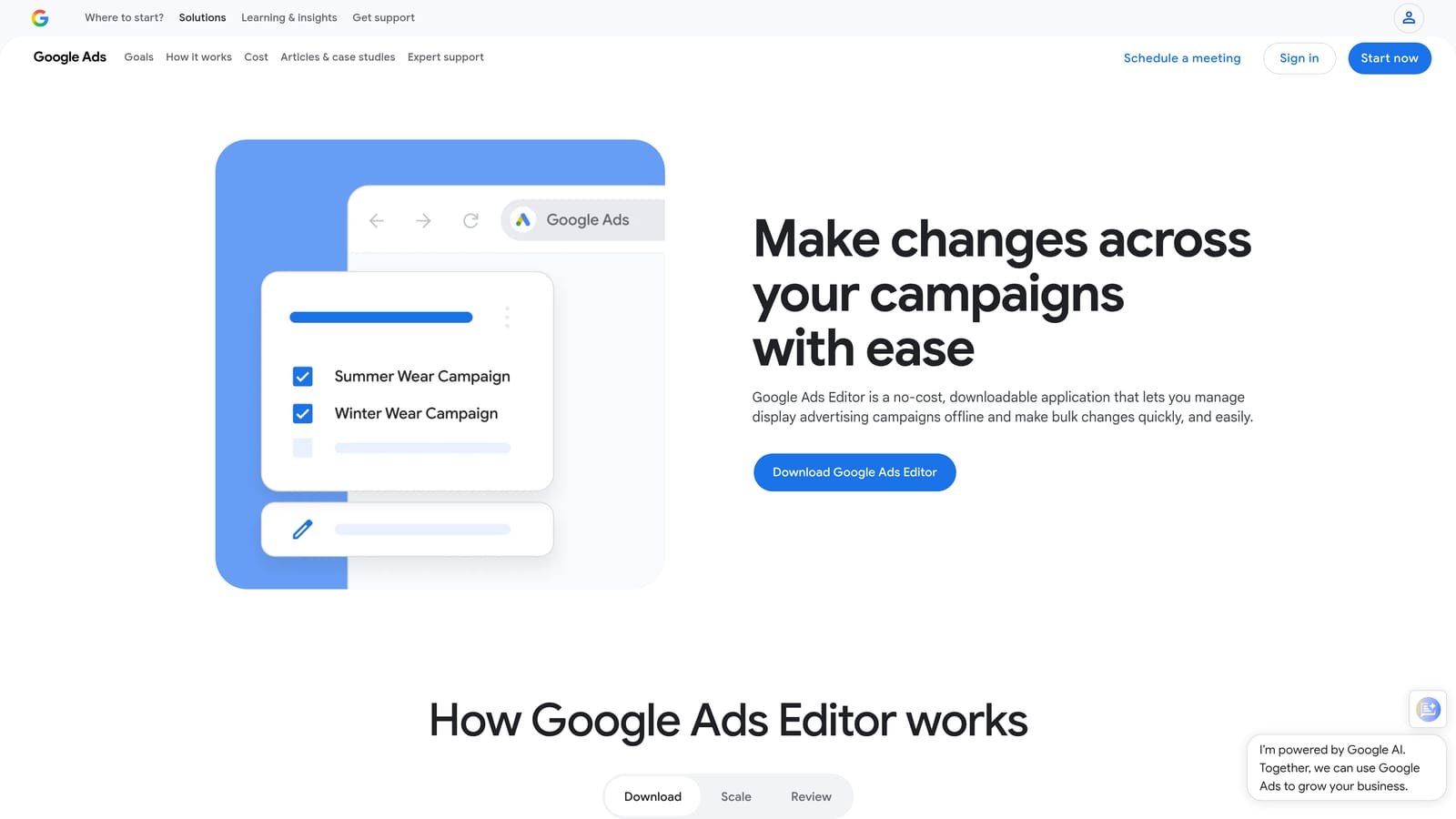
Where this tool stands out on this list is the offline review step. You can stage hundreds of changes, edits to keywords, bids, ad copy, budgets, across multiple campaigns or accounts, and review every single one before anything goes live. Nothing else here gives you that buffer.
- Lets you edit campaigns, ad groups, keywords, and ads in bulk instead of one at a time in the browser
- Works offline, so you can build out changes without an active connection and upload when ready
- Accepts copy-paste from spreadsheets, useful if you're migrating existing keyword lists or bid data
- Manages multiple accounts from a single interface, which matters if you're an agency with several clients
It syncs directly with any Google Ads account you have access to. Setup means downloading the desktop application and signing in, no plugin or browser extension required. Agencies and in-house teams handling large accounts typically have one or two people who own this tool as part of their regular workflow.
It's not built for analysis. There's no search term insight, no reporting dashboard, and no recommendations engine, it's purely for making and reviewing edits. If you need to figure out what to change, you'll still lean on the Search Terms Report or another tool on this list first.
It's completely free, with no tiers or usage limits tied to account size.
Best for: Agencies making large structural changes across many campaigns or accounts at once.
3. Recommendations Page (Optimization Score)
The Recommendations page is a native section of your Google Ads account that scores your setup and suggests specific changes, from bid adjustments to new keywords, that you can apply with a click.
Its main draw is that it requires no setup at all. Open your account and it's already generating suggestions based on your actual campaign data, without needing you to configure anything or connect an external tool.
- Shows an overall optimization score as a percentage, giving you a rough gauge of account health
- Breaks recommendations into individual cards covering bids, keywords, ads, and automated bidding options
- Lets you apply or dismiss each suggestion directly on the page, no navigating elsewhere
- Keeps a history of what you've applied or dismissed, so you can track decisions over time
It's native to your account dashboard, so there's nothing to install. Account managers usually check it periodically, weekly or monthly depending on account size, as part of a routine review rather than a daily task.
The real limitation is that a high optimization score doesn't guarantee better performance. Google's own documentation frames it as a guide, not a guarantee, and several recommendations, like broadening match types or adding more budget, push toward more spend rather than more efficiency. Review each suggestion against your actual goals before applying it rather than chasing a higher score for its own sake.
It's free and included with every Google Ads account.
Best for: Advertisers who want a quick, guided starting point for account health checks.
4. Performance Planner
Performance Planner is a native forecasting tool that models how budget or bid changes would affect conversions and spend before you actually make them. Instead of reacting to last month's results, you're testing "what if" scenarios against your account's own history.
Where it fits in your workflow
This is the only tool on this list built specifically for forward-looking budget planning rather than analyzing past performance or automating current actions. If you're heading into a quarterly budget review or a seasonal push, like holiday campaigns, this is where you model the tradeoffs before committing spend.
- Forecasts conversions, cost, and clicks under different budget scenarios you define
- Lets you compare multiple plans side by side to weigh tradeoffs
- Factors in seasonality trends so forecasts account for known demand shifts
- Works at both the campaign and account level depending on what you're planning
Who should use it, and who shouldn't rely on it
It's native to your account and pulls from historical campaign data automatically, no setup needed beyond having an active account with some performance history. Whoever owns budget decisions, often a media buyer or account lead, typically runs these forecasts before a planning meeting.
The catch is that forecasts are only as good as the data behind them. Newer accounts or campaigns with low traffic get less reliable projections simply because there's not enough historical signal to model from. Treat forecasts as directional for young accounts, not precise.
Free, included with Google Ads.
Best for: Planning quarterly or seasonal budget shifts before making changes.
5. Google Ads Scripts
Google Ads Scripts is a native JavaScript-based automation feature, documented by Google's Help Center, that runs custom rules inside your account on a schedule without any manual clicking.
Its standout quality is that it's the only genuinely hands-off tool on this list. Once a script is written and scheduled, it runs on its own, pausing underperforming keywords, sending budget pacing alerts, or logging performance data, with no one needing to log in and take action.
- Automates repetitive tasks like pausing keywords past a CPA threshold or flagging budget overspend
- Draws from Google's script gallery of pre-built templates, so you're not always writing from scratch
- Runs natively within the account on Google's servers, no external hosting needed
- Can pull performance data into Google Sheets for custom reporting outside the standard dashboards
Setup happens inside the account under the Scripts section, where you paste in JavaScript code and set a run schedule. This is typically owned by whoever on the team is comfortable with code, often a technical account manager or someone in an agency's operations role, since most teams adapt existing script templates rather than writing entirely new logic.
The barrier to entry is real. If nobody on your team knows JavaScript or is comfortable modifying an existing script, this tool isn't accessible without outside help. It's also not a substitute for judgment, a poorly tested script can pause the wrong keywords or misfire on an alert threshold, so test any script on a small scale before letting it run unsupervised.
Free, included with Google Ads.
Best for: Technically inclined advertisers who want rules-based automation without manual review.
6. Auction Insights Report
The Auction Insights report is a native reporting feature that compares your impression share and position against other advertisers competing in the same auctions.
It's the only tool on this list that gives you competitive context without needing a separate research tool or manual competitor tracking. You get a direct read on how your account is trending relative to others bidding on the same terms, straight from your existing reports.
- Shows impression share, overlap rate, and position above rate for a clear read on competitive standing
- Available at the keyword, ad group, or campaign level depending on how granular you need to go
- Displays historical trends over a custom date range, so you can spot shifts in competitive pressure over time
- Requires no setup, it's built into the standard reporting section
Because it's native, there's nothing to configure beyond selecting the report and date range you want. Anyone with reporting access, from a solo advertiser to a client-facing account manager, can pull it up as part of a regular performance review.
The limitation is that the data is anonymized and aggregate. You'll see that your overlap rate with competitors rose 15% over the last month, for example, but not which specific competitors you're up against or what they're bidding. It tells you pressure is increasing, not who's causing it or why.
Free, included with Google Ads.
Best for: Checking competitive pressure trends before adjusting bids or budgets.
7. Smart Bidding Strategies
Smart Bidding covers Google's native automated bidding strategies, including Target CPA, Target ROAS, and Maximize Conversions, documented at Google Ads Help, that adjust bids in real time using machine learning.
What makes this different from manual bid management is scale and speed. These strategies factor in signals, device, location, time of day, audience behavior, at the moment of each auction, processing far more variables than a person adjusting bids by hand ever could.
- Adjusts bids automatically per auction based on real-time conversion signals
- Offers multiple strategy types so you can match the bidding approach to your actual goal, whether that's cost per acquisition, return on ad spend, or raw conversion volume
- Applies seasonality adjustments for known demand spikes, like a planned sale, so bidding accounts for expected shifts ahead of time
- Includes bid simulators that let you preview how a strategy might perform before switching to it
These strategies live in your campaign settings, so there's no external setup, just choosing a bidding strategy when building or editing a campaign. Whoever manages the campaign day to day generally sets it and then monitors performance rather than adjusting bids manually.
The tradeoff is data dependency. Smart Bidding needs a reasonable volume of conversion data to learn from, accounts with sparse conversions may see inconsistent results early on. Switching strategies frequently also resets the learning period, so it rewards patience over constant tinkering.
Free, included with Google Ads.
Best for: Accounts with steady conversion data who want to stop manually adjusting bids.
8. Keyword Planner
Keyword Planner is Google's free native research tool for finding keyword ideas and volume estimates before building or expanding campaigns. It's essentially the front-end counterpart to the Search Terms Report: one is about finding keywords to bid on, the other is about reviewing what people actually typed once your ads are live.
- Provides search volume and forecasted bid estimates for keywords you're considering
- Generates keyword ideas from a seed term or by scanning a website URL
- Lets you add selected keywords straight into a campaign or ad group without switching tools
- Includes historical metrics and trend data to spot rising or declining search interest
It's native to Google Ads and requires no setup beyond having an account. New advertisers and anyone launching a fresh campaign or expanding into a new ad group typically use it at the research stage, before any keywords go live.
Its limitation is precision: volume figures come as ranges rather than exact numbers, and it doesn't look at your existing account's actual search term data. That's an important distinction to keep straight. Keywords are the terms you choose to bid on; search terms are what users actually typed to trigger your ad. Keyword Planner only deals in the former, it won't tell you what's actually happening in your live campaigns.
Free, included with Google Ads.
Best for: Early-stage keyword research when building new campaigns or ad groups.
9. Google Ads Mobile App
The Google Ads mobile app is Google's official iOS and Android app for monitoring campaigns and making quick changes away from a desktop.
Its distinct role here is location, not features. It's the only tool on this list designed for checking on and reacting to your account from a phone, useful when you're traveling, in a client meeting, or just away from your desk when a budget alert fires.
- Delivers real-time performance monitoring and alerts so you're not blindsided by a sudden spend spike
- Lets you pause or enable campaigns on the go if something needs an immediate fix
- Sends push notifications for budget pacing issues and other anomalies
- Gives quick access to recommendations and account snapshots without opening a laptop
Setup is just downloading the app and signing into your existing Google Ads account, it syncs immediately with live data. Anyone with account access can use it, though it's most useful for whoever is responsible for catching urgent issues outside normal working hours.
The feature set is deliberately limited compared to desktop. There's no meaningful search term cleanup, no bulk editing, and no detailed keyword work here, it's built for monitoring and light action, not deep optimization. Treat it as a safety net, not your primary workspace.
Free.
Best for: Checking account health and catching budget issues while away from your desk.
Matching the Tool to the Task at Hand
Most accounts end up running a combination rather than picking just one. For daily search term cleanup, the kind of task that eats an hour a day if you're still exporting to spreadsheets, Keywordme handles it fastest since it works right inside the report you're already looking at. For agencies pushing bulk changes across several client accounts at once, Google Ads Editor's offline review step is hard to beat. If you want optimization to happen without anyone touching the account, Scripts covers the automation side, provided someone on your team can write or adapt the JavaScript. And for the planning and research stages, before you've built the campaign or before you commit next quarter's budget, Performance Planner and Keyword Planner are the native tools built for exactly that.
If your biggest time sink is still the Search Terms Report, that's the easiest place to start. Start your free 7-day trial of Keywordme and see how it feels to remove junk search terms, build keyword lists, and apply match types instantly, all without leaving Google Ads. After the trial, it's a flat $12/month per user, no spreadsheets, no extra tabs, just faster optimization where you already work.
.svg)