
8 Best In-Interface PPC Tools for Google Ads
This guide reviews the 8 best in-interface PPC tools for Google Ads in 2026, covering solutions that reduce manual effort on negative keyword management, search term analysis, and keyword organization—all without leaving the native Google Ads interface. Whether you manage a few campaigns or dozens of client accounts, these tools are built to save time where it matters most.


If you're still exporting search term reports to spreadsheets and manually hunting for negative keywords, you're spending hours on work that should take minutes. In-interface PPC tools fix that by letting you optimize campaigns directly inside Google Ads—no tab-switching, no CSV uploads, no clunky external dashboards.
This list covers the best tools that either live inside Google Ads natively or integrate so tightly with it that the workflow feels seamless. We've focused on tools that genuinely reduce manual effort for the tasks that eat up the most time: negative keyword management, search term analysis, match type control, and keyword organization.
Whether you're a solo freelancer managing a handful of campaigns or an agency juggling dozens of client accounts, there's something here for you.
1. Keywordme
Best for: Google Ads users who want to optimize search terms and manage negatives without leaving the native UI.
Keywordme is a Chrome extension that operates directly inside Google Ads' Search Terms Report, turning what's normally a slow, manual process into a series of quick clicks.

Where This Tool Shines
Most PPC tools pull your data into their own dashboard, which means you're constantly switching between tabs, re-learning layouts, and uploading changes back into Google Ads. Keywordme skips all of that. Because it's a Chrome extension that modifies the Google Ads interface itself, every action you take happens right where you're already working.
This is especially useful during search term reviews. Instead of exporting a CSV, filtering in a spreadsheet, and then manually adding negatives one by one, you can flag junk terms, apply match types, and build out keyword lists without ever leaving the report. For agencies managing multiple accounts, the multi-account and team support features extend that same efficiency across the whole client roster.
Key Features
One-click negative keyword management: Remove junk search terms and add them to negative keyword lists directly from the Search Terms Report.
High-intent keyword addition: Add performing search terms as positive keywords and apply match types in the same workflow.
Keyword clustering: Group related search terms into logical clusters for faster campaign organization.
Bulk editing: Apply actions across multiple search terms at once instead of working through them individually.
Multi-account and team support: Manage negative keyword lists and optimization tasks across multiple Google Ads accounts from one workflow.
Best For
Keywordme suits solo advertisers, freelancers, and agency teams whose biggest time drain is the weekly or daily search term review. If you're spending significant time on negative keyword management and keyword list building, this is the tool most directly designed to cut that time down. It's less relevant if your primary need is keyword research from scratch or cross-channel reporting.
Pricing
$12 per user per month (flat rate). A 7-day free trial is available with no commitment required.
2. Google Ads Search Terms Report (Native)
Best for: Any Google Ads advertiser who needs a free, always-available baseline for reviewing actual search queries.
The Google Ads Search Terms Report is the built-in view inside Google Ads that shows the actual queries users typed before clicking your ads—distinct from the keywords you're bidding on.

Where This Tool Shines
It's the foundation of every search term workflow. You can filter by date range, campaign, ad group, and performance metrics, then add any search term directly as a positive keyword or negative keyword without leaving the interface. No setup, no integration, no cost.
The limitation is scale. Adding negatives one at a time is fine when you're reviewing a small account, but it becomes genuinely slow when you're working through hundreds of search terms across multiple campaigns. There's no bulk clustering, no smart filtering by intent, and no way to apply match types in bulk. It's the right starting point, but it's also the reason tools like Keywordme exist.
Key Features
Real search term visibility: Shows actual user queries that triggered impressions and clicks, not just the keywords you're bidding on.
Flexible filtering: Filter by date range, campaign, ad group, match type, and performance columns.
Direct keyword actions: Add any search term as a positive keyword or negative keyword from within the report.
No cost or setup: Accessible to every Google Ads account with no additional tools required.
Performance data alongside terms: View clicks, impressions, cost, and conversions for each search term in context.
Best For
Every Google Ads user, as a baseline. It's particularly sufficient for small accounts with low search term volume where manual review is manageable. For larger accounts or anyone doing frequent optimization, it's most useful as the interface layer that other tools (including Keywordme) build on top of.
Pricing
Free. Included with every Google Ads account.
3. Google Ads Keyword Planner
Best for: Advertisers researching new keyword opportunities and planning campaign structure before launch.
Google Ads Keyword Planner is Google's native research tool inside the Google Ads interface, providing keyword ideas, search volume ranges, competition indicators, and bid estimates.

Where This Tool Shines
Keyword Planner is most useful at the planning stage. You can enter seed terms or a URL and get a list of related keyword ideas with estimated search volumes, competition levels, and suggested bid ranges. Crucially, you can add keywords directly to existing campaigns or ad groups from within the tool itself, keeping the workflow inside Google Ads.
One thing worth knowing: search volume data is shown as ranges rather than exact figures for accounts that haven't met Google's spend thresholds. This can make it harder to make precise decisions, but the directional data is still useful for prioritization. Keyword Planner is also not designed for negative keyword work—it's a discovery and planning tool, not an optimization one.
Key Features
Keyword idea generation: Discover related keywords from seed terms or a landing page URL.
Volume and competition data: See search volume ranges and competition level indicators for each keyword idea.
Bid range estimates: Review low and high bid estimates to inform budget planning.
Direct campaign integration: Add selected keywords to existing campaigns or ad groups without leaving the tool.
Forecast tool: Project estimated clicks and conversions at different bid levels before committing spend.
Best For
Advertisers building new campaigns or expanding into new keyword territories. It's a natural fit for anyone who wants to do keyword research without leaving Google Ads. Less useful for ongoing search term optimization or negative keyword management.
Pricing
Free. Included with every Google Ads account.
4. Google Ads Editor
Best for: PPC managers who need to make large-scale bulk changes to campaigns, keywords, and negatives efficiently.
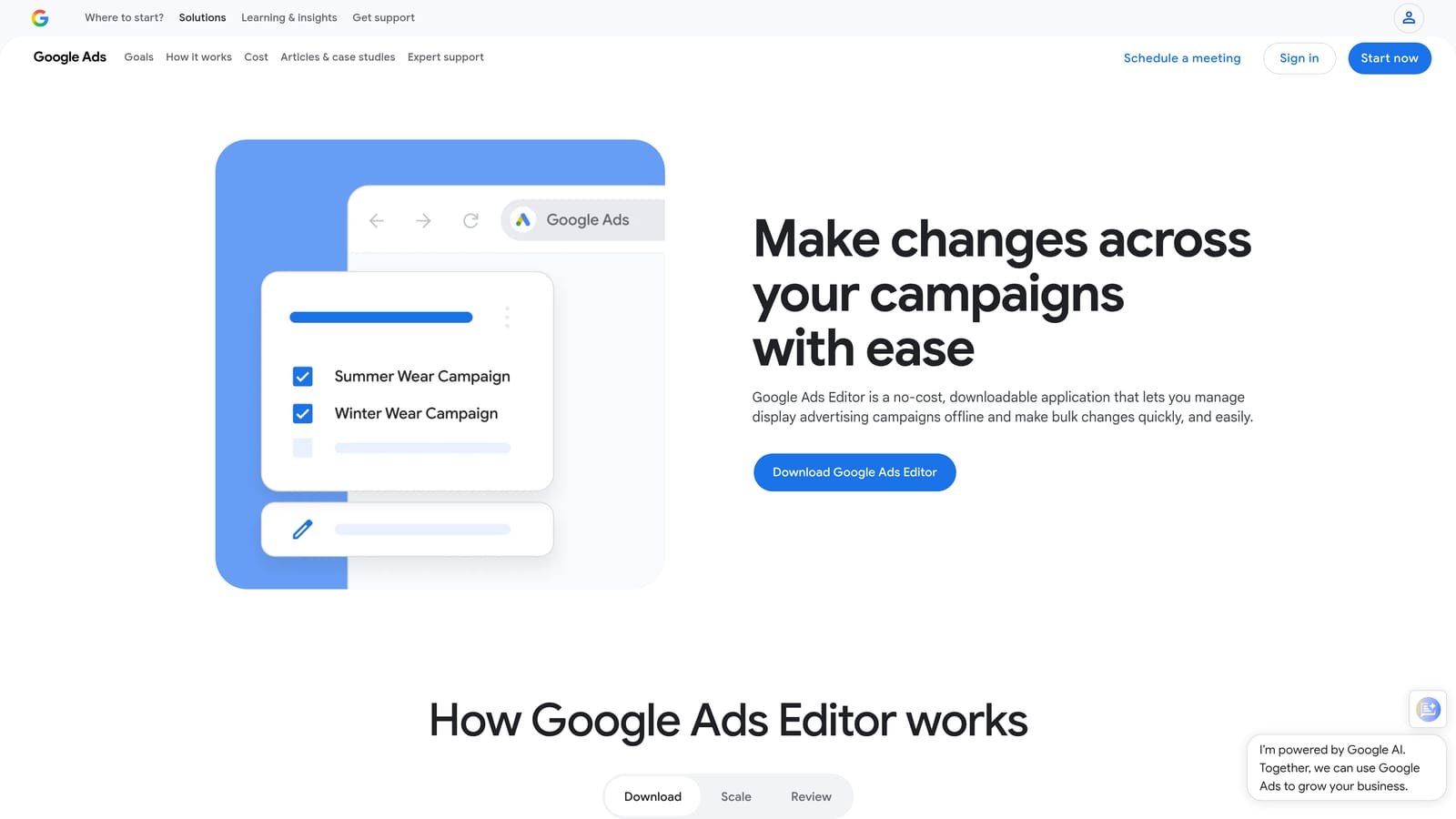
Google Ads Editor is Google's free desktop application for offline bulk editing, allowing you to make extensive changes locally and upload them to Google Ads in one go.
Where This Tool Shines
When you need to restructure a large account, add hundreds of negative keywords across multiple campaigns, or apply sweeping changes to ad copy, Editor is the right tool. The offline workflow means you can work without a live connection, stage all your changes, review them before they go live, and upload everything at once. The find-and-replace function alone saves significant time on large accounts.
It's worth being clear that Editor is not truly in-interface in the same sense as a Chrome extension. It's a separate desktop application that syncs with your Google Ads account. But it's tightly integrated with Google's ecosystem, free, and purpose-built for bulk operations that would take far longer inside the native browser UI.
Key Features
Bulk offline editing: Edit campaigns, ad groups, keywords, negative keywords, ads, and extensions without a live connection.
Find-and-replace: Apply text changes across the entire account or selected campaigns in seconds.
Multi-account management: Manage multiple Google Ads accounts from a single desktop application.
Staged changes: Review all edits before uploading to Google Ads, reducing the risk of unintended changes going live.
CSV import and export: Use spreadsheets for structured bulk operations and import them directly into Editor.
Best For
PPC managers and agencies handling large accounts with frequent structural changes. If you regularly need to add negative keyword lists across dozens of campaigns or restructure ad groups at scale, Editor is the most efficient free option available.
Pricing
Free. Available as a downloadable desktop application directly from Google.
5. Google Ads Scripts
Best for: Technical PPC managers who want to automate repetitive tasks without relying on third-party software.
Google Ads Scripts is JavaScript-based automation that runs natively inside Google Ads, giving you API-level access to your account without leaving the Google ecosystem.
Where This Tool Shines
Scripts can handle tasks that would otherwise require daily manual attention: automatically adding negative keywords when a search term exceeds a cost-per-conversion threshold, sending performance alerts when a campaign drops below a target, or generating weekly reports from account data. Because scripts run inside Google Ads on a schedule you set, the automation happens without you needing to open a third-party tool.
The honest limitation is the technical barrier. Writing scripts from scratch requires JavaScript knowledge. That said, a large community of PPC practitioners has published pre-built scripts covering common use cases, so non-developers can often find and adapt existing scripts without writing code themselves. If you can work with that, Scripts offers a level of customization no off-the-shelf tool can match.
Key Features
Native automation: Runs directly inside Google Ads with no third-party software or external connection required.
Negative keyword automation: Automatically add negative keywords based on performance rules you define.
Scheduled execution: Set scripts to run hourly, daily, or weekly without manual triggering.
Pre-built script library: Access community-contributed scripts for common PPC tasks without writing code from scratch.
Full account data access: Read and write to campaigns, ad groups, keywords, and performance data at the API level.
Best For
Technical PPC managers or developers who want custom automation without paying for a third-party platform. Also useful for agencies that have an in-house developer who can maintain scripts over time. Not the right fit for non-technical users who need a point-and-click workflow.
Pricing
Free. Included with Google Ads. JavaScript knowledge or access to pre-built scripts is required to use them effectively.
6. Optmyzr
Best for: Agencies and larger accounts that need rule-based automation and one-click optimization recommendations across multiple clients.
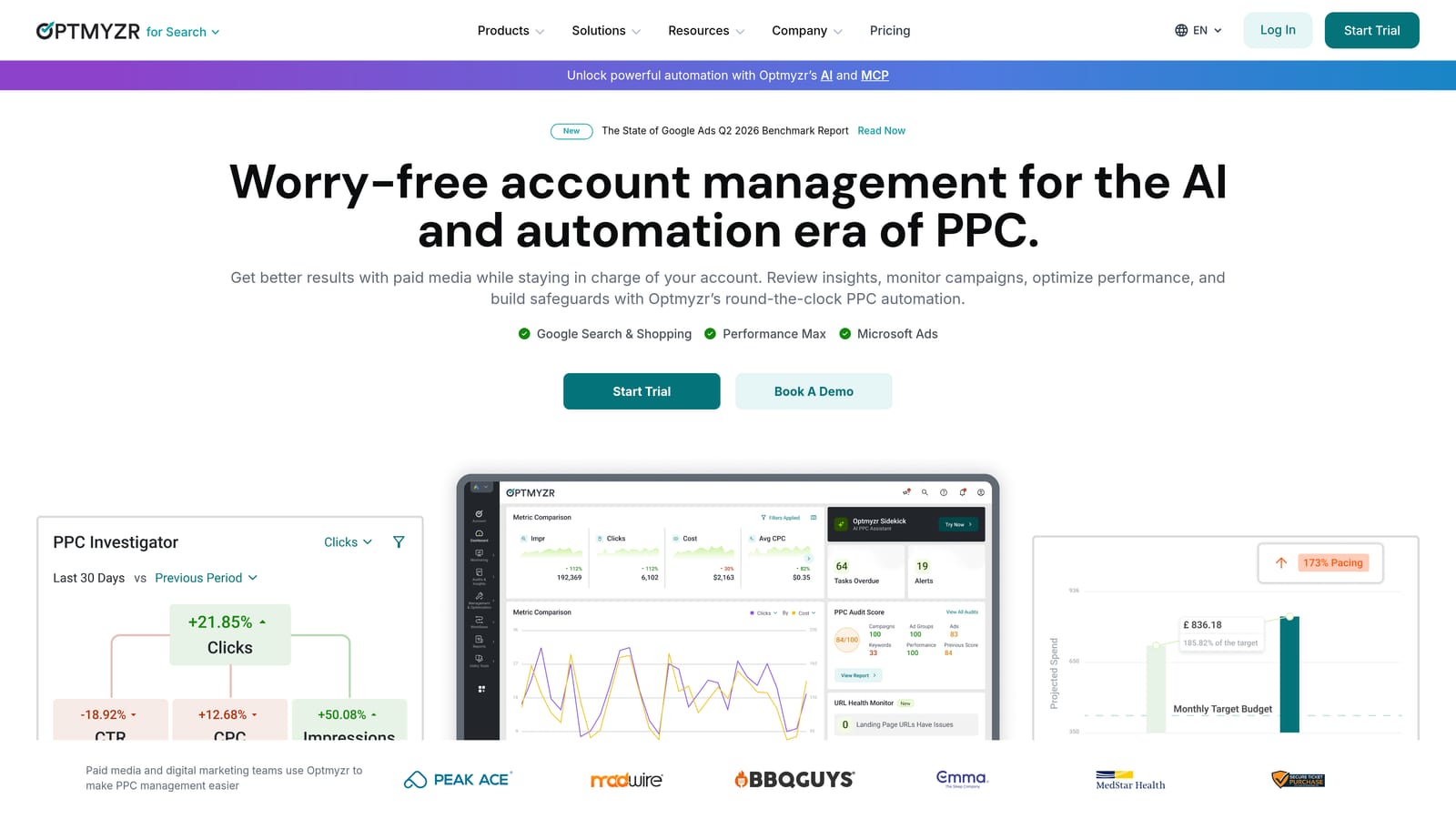
Optmyzr is a third-party PPC management platform that connects to Google Ads via API, offering automation, optimization suggestions, and a Search Terms Miner for negative keyword discovery.
Where This Tool Shines
Optmyzr sits in a different category from the native Google tools above. It operates through its own dashboard rather than inside the Google Ads interface, but its strength is the depth of automation it enables. The rule-based automation layer lets you set conditions for bid changes, budget adjustments, and keyword actions that execute with human review before anything goes live. That human-in-the-loop design is a deliberate choice and suits accounts where you want automation with oversight rather than fully autonomous changes.
The Search Terms Miner is particularly relevant here: it surfaces negative keyword opportunities from your search term data and presents them for one-click action. It's not in-interface, but it compresses a task that would otherwise take significant time into a faster review workflow.
Key Features
Rule-based automation: Set conditional rules for bids, budgets, and keyword management that trigger based on performance data.
Search Terms Miner: Identifies negative keyword opportunities from your search term history and surfaces them for review.
One-click optimization suggestions: Review recommended changes and apply them with a single click after human review.
Multi-account dashboard: Manage multiple client accounts from a centralized interface.
Automated reporting: Generate and schedule performance reports for clients or internal stakeholders.
Best For
Agencies and mid-to-large accounts that need structured automation and reporting across multiple clients. Less suited to solo advertisers or small accounts where the platform's price point may not be justified by the account size.
Pricing
Multiple pricing tiers aimed at agencies and larger accounts. Check optmyzr.com for current pricing, as tiers change periodically.
7. Search Atlas
Best for: Teams managing both SEO and paid search who want keyword research and Google Ads planning in one platform.
Search Atlas is an all-in-one SEO and PPC platform that combines keyword research with Google Ads campaign planning, connecting to Google Ads via API for data import.
Where This Tool Shines
Search Atlas is relevant in this list primarily for teams where SEO and PPC keyword strategies overlap. Rather than running separate tools for organic keyword research and paid keyword planning, Search Atlas brings both into one workflow. You can analyze competitor keyword strategies across both channels and use that data to inform your Google Ads campaign structure.
It's important to be clear: Search Atlas operates as an external platform, not inside the Google Ads interface. It connects via API for data import, which means you're working in a separate dashboard. For teams whose primary need is cross-channel keyword strategy rather than in-interface optimization, that trade-off is worth it. For advertisers focused purely on Google Ads workflow efficiency, it's a less direct fit.
Key Features
Combined organic and paid keyword research: Research keywords across SEO and PPC in a single tool.
Campaign structure planning: Plan Google Ads campaign and ad group structure with keyword grouping tools.
Competitor keyword analysis: Review competitor keyword strategies to inform your own PPC targeting.
Google Ads integration: Connect to Google Ads via API to import campaign and performance data.
Cross-channel workflow: Manage SEO and PPC keyword strategies from one platform for teams covering both channels.
Best For
Marketing teams or agencies managing both organic and paid search, where aligning keyword strategy across channels is a priority. Feature availability and integration depth evolve regularly, so verify current Google Ads capabilities at searchatlas.com before committing.
Pricing
Multiple plans available. Check searchatlas.com for current pricing.
8. Adalysis
Best for: Mid-to-large Google Ads accounts that need systematic auditing, search term analysis, and ad testing at scale.
Adalysis is a Google Ads-connected optimization and auditing platform focused on search term analysis, quality score monitoring, and structured ad testing for accounts with significant volume.
Where This Tool Shines
Adalysis is built for accounts where the sheer volume of data makes manual review impractical. Its automated search term analysis surfaces negative keyword recommendations systematically, rather than requiring you to scroll through reports manually. The quality score monitoring and historical tracking add a layer of diagnostic depth that's hard to replicate inside the native Google Ads interface alone.
Like Optmyzr and Search Atlas, Adalysis operates through its own dashboard connected to Google Ads via API, so it's not in-interface in the strict sense. Its value is in the systematic, auditing-led approach: it's designed to surface what you'd miss if you were reviewing data manually, and to present those findings in a way that makes action straightforward. That's a different proposition from tools that speed up actions you're already taking.
Key Features
Automated search term analysis: Surfaces negative keyword recommendations from your search term data without manual review.
Quality score monitoring: Track quality score changes over time and identify campaigns where improvements are needed.
Ad testing framework: Run structured ad tests with statistical significance tracking to make testing decisions on reliable data.
Account audit tools: Systematically surface optimization opportunities across campaigns, ad groups, and keywords.
Multi-account support: Manage and audit multiple Google Ads accounts from one platform.
Best For
PPC managers and agencies running mid-to-large accounts where volume makes manual auditing unrealistic. Particularly well suited to accounts that prioritize ad testing and quality score management alongside search term optimization. Pricing is based on account spend, so check adalysis.com for plans that match your account size.
Pricing
Pricing is based on account spend. Check adalysis.com for current plans.
Choosing the Right Tool for Your Workflow
The clearest way to cut through this list is to ask one question: where does the friction actually live in your day-to-day Google Ads work?
If your biggest time drain is the search term review—flagging junk terms, adding negatives, building keyword lists—and you want to do all of that without leaving Google Ads, Keywordme is the most direct answer. It's the only third-party tool on this list that operates inside the native interface rather than pulling you into a separate dashboard.
For advertisers who don't need a paid tool yet, the native Google options cover a lot of ground. The Search Terms Report handles individual keyword actions. Keyword Planner handles research and planning. Google Ads Editor handles bulk offline changes. And Scripts handles repeatable automation if you have the technical ability to set them up. Together, they're a capable free stack—just a slower one.
For agencies managing multiple clients at scale, Optmyzr and Adalysis offer structured automation and auditing depth that justifies their cost at higher account volumes. Search Atlas is the right call when SEO and PPC keyword strategy need to live in the same workflow.
The tools that sit closest to the Google Ads interface—Chrome extensions, native tools, and Editor—tend to offer the lowest friction for day-to-day optimization. The further a tool sits from the native UI, the more context-switching it requires, which is exactly the problem this category of tooling exists to solve.
If search term management is your primary bottleneck, the most efficient next step is to try the tool built specifically for that job. Start your free 7-day trial of Keywordme and see how much faster your next search term review goes—right inside Google Ads, no spreadsheets required. After the trial, it's $12 per user per month.
.svg)