
9 Best Google Ads Software Alternatives Comparison in 2026
This Google Ads software alternatives comparison reviews 9 tools chosen for pricing transparency and how directly they solve search-term cleanup and bid-management headaches, rather than bloated all-in-one marketing suites. It's built for freelancers and small agencies as well as enterprise teams managing Google Ads accounts daily.


If you manage Google Ads accounts for a living, you've probably hit the same wall twice: the native interface makes search term review and bid adjustments slower than they should be, and most "PPC platforms" are built for teams ten times your size. This comparison focuses on tools that solve real workflow pain, cleaning up search terms, managing bids, reporting to clients, rather than bloated marketing suites that treat Google Ads as an afterthought. Tools were picked for pricing transparency, how directly they fix search-term and bid-management headaches, and whether they fit freelancers and small agencies as well as enterprise teams.
Quick Comparison
- Keywordme: best for solo advertisers and small agencies doing search term cleanup; starts at $12/month per user; works directly inside the native Google Ads Search Terms Report, no exports required.
- Optmyzr: best for agencies running multiple client accounts; quote-based pricing; combines rule-based automation with white-label reporting in one platform.
- Adalysis: best for teams wanting ongoing QA and ad testing; quote-based pricing; runs automated, statistically-driven ad copy tests continuously in the background.
- WordStream Advisor: best for time-strapped SMB in-house marketers; quote-based pricing; guides you through a prioritized "20-Minute Work Week" task list.
- Search Ads 360: best for large teams managing cross-engine campaigns; quote-based enterprise pricing; ties directly into Google Analytics 4 and Campaign Manager 360.
- Semrush PPC Toolkit: best for marketers who want competitor ad research; starts around $139.95/month; bundles organic and paid competitor intelligence in one subscription.
- Marin Software: best for large advertisers coordinating multiple channels; quote-based enterprise pricing; allocates budget across search, social, and e-commerce from one console.
- Skai: best for enterprise brands running retail media alongside search; quote-based enterprise pricing; strongest retail media integrations (Amazon, Walmart Connect) on this list.
- Google Ads Editor: best for anyone needing free bulk offline edits; free; the only tool here with zero cost and official Google support.
1. Keywordme
Keywordme is a Chrome extension that sits directly on top of the Google Ads Search Terms Report, turning manual cleanup into one-click actions. It's built for advertisers who are tired of exporting search term data to spreadsheets just to figure out which terms are wasting spend and which ones deserve to become keywords.
What sets it apart from every other tool on this list is that it doesn't ask you to leave Google Ads at all. Rule-based platforms and dashboards like Optmyzr or Adalysis pull you into a separate interface; Keywordme layers its actions onto the screen you're already working in, which cuts the back-and-forth that eats up a Monday morning optimization session.
- Removes junk or irrelevant search terms with a single click instead of a manual negative keyword build
- Applies match types to new keywords instantly, without opening a separate editor
- Builds negative keyword lists directly from the search terms you're already reviewing
- Groups related keywords through clustering, so you're not sorting them by hand
- Supports bulk editing across large search term reports
- Handles multi-account and team access, useful if you're managing several clients under one login
Setup is quick: install the Chrome extension, connect it to your Google Ads account, and the tools appear inside the Search Terms Report itself. There's no separate dashboard to learn, which means whoever already runs your search term reviews, an account manager, a freelancer, a junior PPC hire, can pick it up without a training session.
It's not a fit for teams needing full bid automation, cross-channel reporting across Meta or Amazon Ads, or enterprise forecasting. Keywordme is purpose-built around search term and keyword workflow, so if you need a platform that also manages bids across three ad networks, you'll want to pair it with something else or look further down this list.
Pricing is a flat $12 per month per user, as of 2026, with a 7-day free trial. There's no spend-based tier or feature gating, what you see is what you get regardless of account size.
Best for: Solo advertisers and small agency teams who want faster, in-interface search term cleanup without adding another dashboard to their day.
2. Optmyzr
Optmyzr is a PPC management platform built for agencies juggling multiple client accounts across Google, Microsoft, and Amazon Ads. It leans heavily on rule-based automation, letting you set logic like "pause any keyword with zero conversions after 100 clicks" and have it run without daily manual checks.
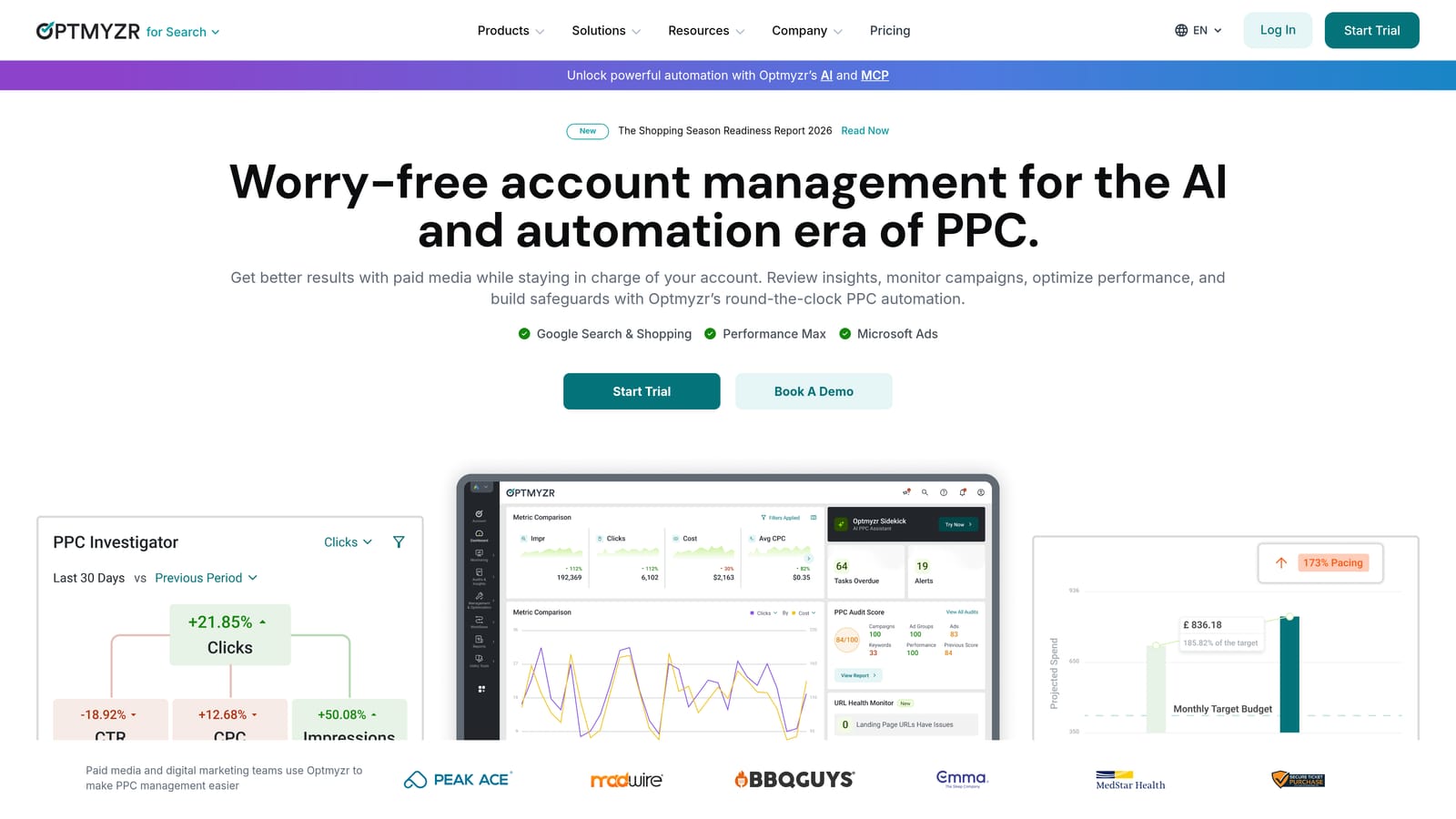
Where it stands out compared to the rest of this list is the combination of automation depth and agency-facing reporting in one place. You're not stitching together a bid tool and a separate reporting tool, Optmyzr handles both.
- Automates bid changes and budget pacing using rules you define or AI-assisted suggestions
- Forecasts budget pacing so you catch overspend or underspend before month-end
- Tracks Quality Score trends over time instead of just a snapshot
- Generates white-label reports you can hand to clients without extra formatting work
- Manages campaigns across Google, Microsoft, and Amazon Ads from one login
Setup requires connecting each ad account and configuring your automation rules, which takes more upfront time than a plug-and-play extension. It's typically run by a dedicated PPC manager or agency account lead rather than someone doing occasional optimization.
The tradeoff is cost. Optmyzr's pricing scales with the amount of ad spend under management, so a small account or a freelancer with a handful of low-budget clients may find the cost hard to justify relative to the automation they'll actually use.
Pricing is quote-based and tiered by managed ad spend; check the current tiers on their site, as of 2026, before committing.
Best for: Agencies managing multiple client accounts who need automated bid rules and client-ready reports in one subscription.
3. Adalysis
Adalysis is built around one core job: continuous ad copy testing and account-wide error checking across Google and Microsoft Ads. Instead of you manually setting up A/B tests and remembering to check results, it runs the tests and flags statistically significant winners on its own schedule.
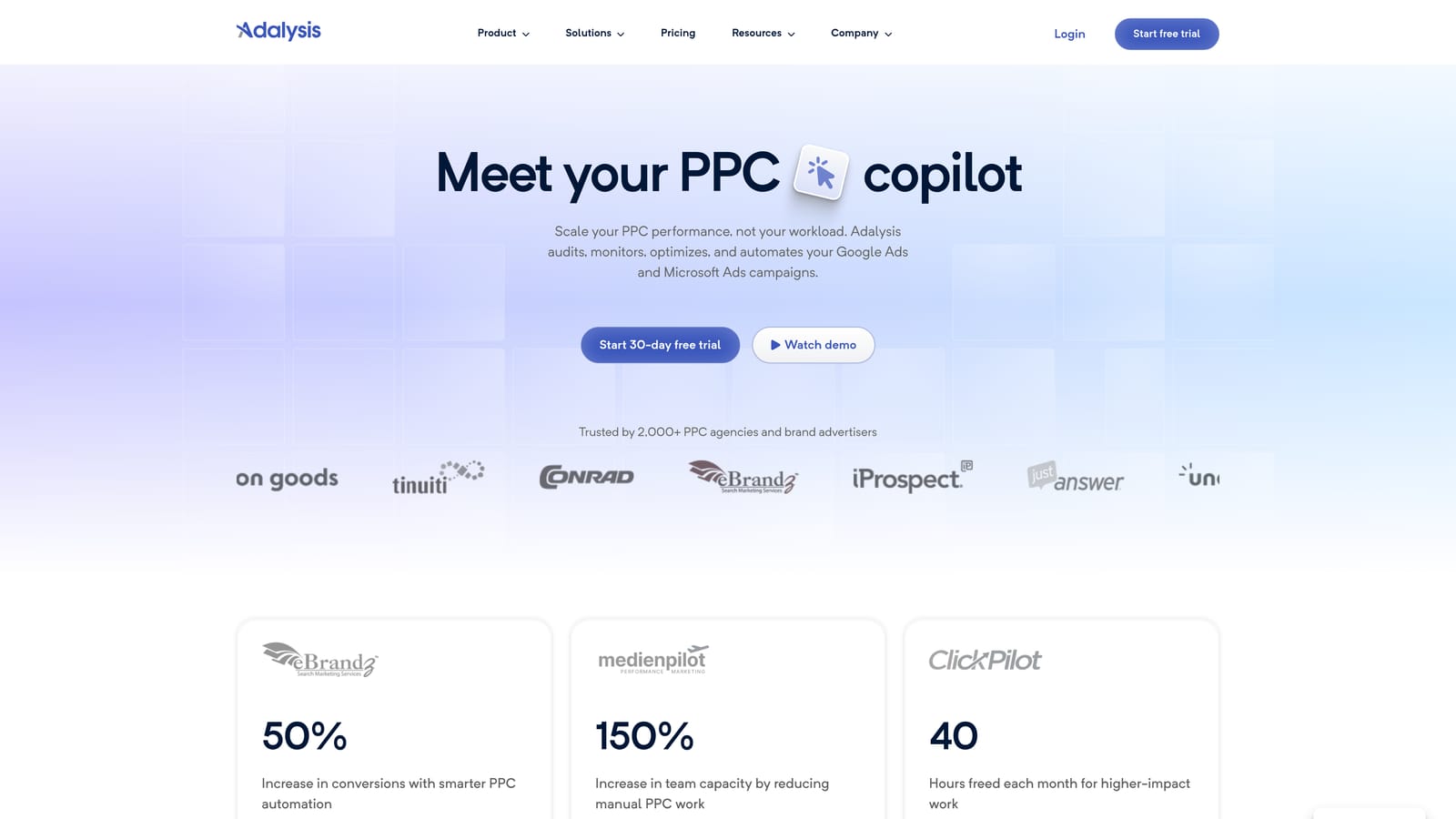
Its distinct strength on this list is that it never really stops working in the background. Where Keywordme is something you actively click through during a review session, Adalysis runs daily checks and testing cycles whether or not you log in that day.
- Runs automated ad copy split tests at scale across ad groups and campaigns
- Flags account errors and anomalies daily, so broken tracking or paused ads don't sit unnoticed
- Tracks Quality Score history so you can see trends rather than a single point-in-time number
- Audits search terms for irrelevant matches feeding into your keywords
It's dashboard-driven, meaning you log into a separate Adalysis interface rather than working inside Google Ads itself. That's a reasonable tradeoff for the automated testing it offers, but it does mean another tab in your workflow rather than an extension layered onto the one you already use.
Adalysis works best for accounts with enough ad volume to make split testing statistically meaningful. A very small account running one or two ads per group won't generate the volume needed for the tool's testing engine to shine.
Pricing is quote-based and scales with the number of managed accounts; current tiers are listed on their site as of 2026.
Best for: Teams that want ongoing ad copy testing and account QA running in the background without manual spreadsheet audits.
4. WordStream Advisor
WordStream Advisor, from LOCALiQ, is built for in-house marketers who own PPC as one of several responsibilities rather than their full-time job. Its signature feature, the "20-Minute Work Week," turns optimization into a short, prioritized task list instead of an open-ended audit.
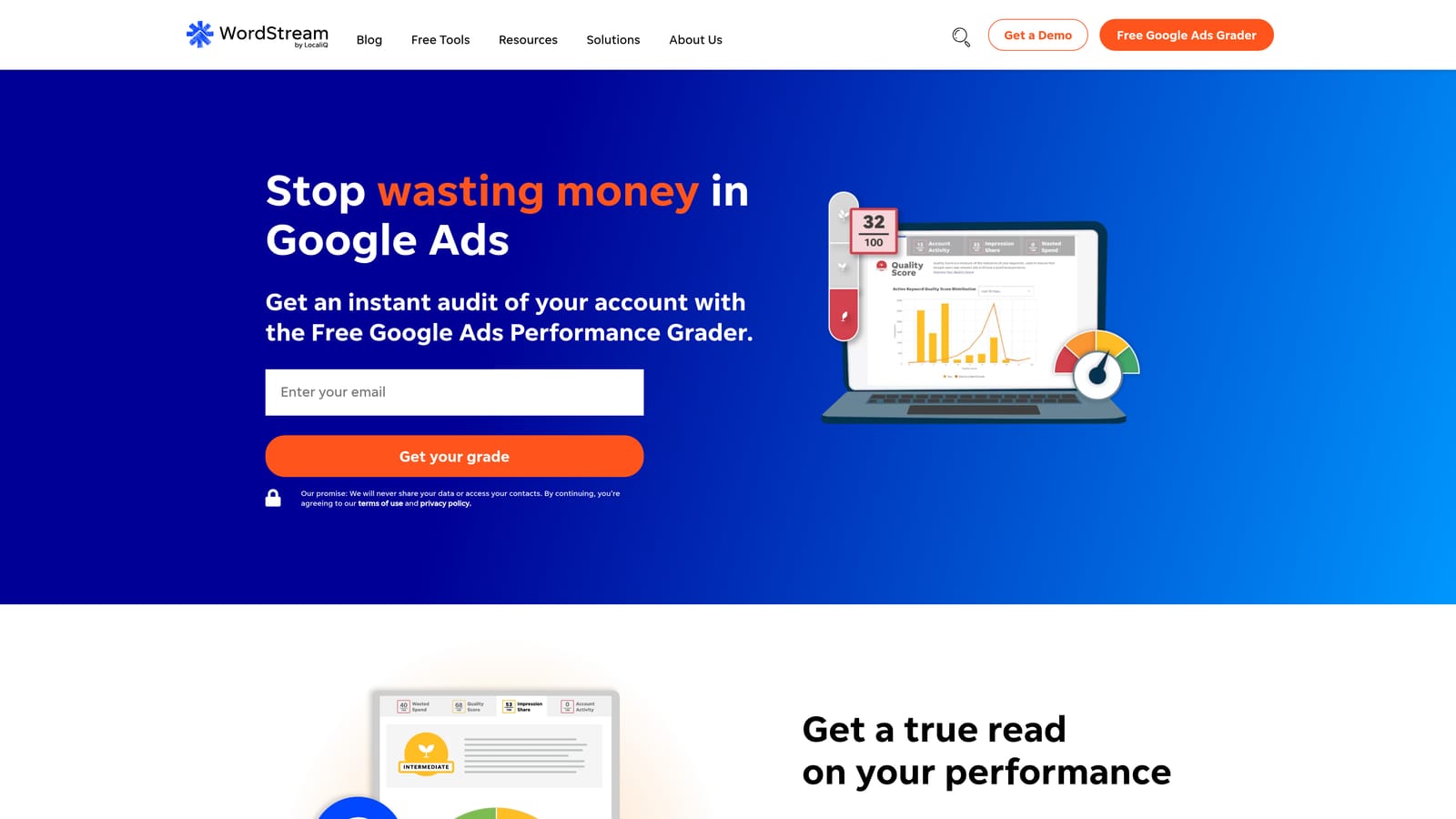
Compared to the rest of this list, WordStream is the most generalist-friendly. Optmyzr and Adalysis assume some PPC specialization; WordStream assumes you might be running Google Ads alongside social media, email, and a dozen other marketing duties, and structures its workflow accordingly.
- Walks you through a guided, prioritized task list so you know what to fix first each session
- Grades your account for free through the Google Ads Performance Grader, useful for a quick health check before committing to a subscription
- Suggests keywords and flags negative keyword opportunities without deep manual research
- Reports across Google and Microsoft Ads in one consolidated view
It's typically run by a marketing generalist or small business owner rather than a dedicated PPC specialist, and that's by design. Setup involves connecting your ad accounts and letting the tool surface its task recommendations.
The tradeoff for that simplicity is control. Power users who want granular rule-based bidding or deep statistical ad testing will find WordStream's guided approach too shallow for their needs; it's optimized for time savings, not maximum sophistication.
Pricing is quote-based, typically billed monthly; check current pricing on their site as of 2026.
Best for: SMB in-house marketers who want a structured, low-time-commitment optimization routine.
5. Search Ads 360
Search Ads 360 is Google's own enterprise bid management platform, part of Google Marketing Platform. It's designed for large teams managing search campaigns across Google Ads, Microsoft Advertising, and Yahoo Japan from a single console.

Why it's different from third-party tools
Being a Google product gives it integration depth no third-party tool can fully match: it connects natively to Google Analytics 4 and Campaign Manager 360, so cross-channel attribution and bid strategy tie back to the same data source without manual reconciliation.
- Manages bids across Google, Microsoft, and Yahoo Japan search engines from one dashboard
- Runs automated bidding strategies tied to specific business goals like target ROAS or CPA
- Integrates directly with Google Analytics 4 and Campaign Manager 360 for unified data
- Handles enterprise-scale reporting and custom data feeds for large account structures
Who should skip it
Setup and onboarding require a Google sales relationship and technical implementation, this isn't a self-serve signup. It's run by dedicated search teams within large in-house marketing departments or holding-company agencies, not by a solo advertiser or a two-person shop. The complexity and enterprise pricing make it impractical for freelancers or small agencies who just need faster search term cleanup.
Pricing is quote-based through Google Marketing Platform sales, as of 2026.
Best for: Large in-house teams or holding-company agencies running cross-engine campaigns at scale.
6. Semrush PPC Toolkit
Semrush's PPC Toolkit is a module within the broader Semrush platform, aimed at marketers who want competitor ad intelligence alongside their existing SEO research. If you're already using Semrush for organic keyword research, the PPC Toolkit extends that same data into paid search.
Its distinct value here is combining organic and paid competitor research in one place. None of the other tools on this list let you see a competitor's organic keyword gaps and their ad copy history in the same subscription.
- Shows competitor ad copy and landing pages so you can see what's working in your niche
- Runs keyword gap analysis blending organic and paid data to find opportunities you're missing
- Estimates search volume and CPC for PPC keyword research
- Pulls Advertising Research reports by domain, useful for competitive audits
Setup is straightforward if you already have a Semrush account, since the PPC Toolkit lives inside the existing platform. It's typically used by marketers or strategists doing research and planning rather than day-to-day bid or search term management.
That's also its limitation: the PPC-specific optimization features are lighter than what you'd get from a dedicated bid-management or search-term tool. It's a research companion, not a replacement for hands-on account management.
Pricing starts around $139.95 per month for the base Semrush plan, as of 2026, though the PPC Toolkit's full feature set may require a higher tier. Check current pricing on their site before subscribing.
Best for: Marketers who want competitor ad research bundled with their existing SEO toolset.
7. Marin Software
Marin Software manages advertising across search, social, and e-commerce networks for large advertisers who need to coordinate budgets across more than just Google Ads. It's built for cross-channel budget strategy rather than single-platform optimization.
Marin's standout capability is budget allocation across channels from a single console, letting you shift spend from underperforming Google Ads campaigns to better-performing Meta or Amazon placements without manually pulling reports from three separate places.
- Manages campaigns across search, social, and e-commerce ad networks in one platform
- Applies customizable automated bidding rules across channels
- Consolidates reporting across platforms into one view
- Allocates budget dynamically based on channel performance
It's an enterprise tool with a learning curve to match, and it's typically run by a dedicated media buying team rather than a solo advertiser or small agency. The quote-based enterprise pricing reflects that scale, and it's simply not built for someone managing a handful of client accounts on modest budgets.
Pricing is quote-based enterprise licensing; check the vendor site for current details as of 2026.
Best for: Large advertisers coordinating budgets across multiple ad channels beyond just Google Ads.
8. Skai
Skai, formerly known as Kenshoo, is an enterprise advertising platform built for large brands managing search, social, and retail media together. Its AI-driven forecasting is aimed at teams making budget decisions across multiple channels at once rather than optimizing one campaign at a time.
What separates Skai from the other enterprise tools on this list is its retail media integration. Direct connections to Amazon and Walmart Connect let brands manage retail media spend alongside traditional search and social from the same platform, which matters increasingly for consumer brands selling through major retailers.
- Forecasts budget needs and allocation using AI-driven modeling
- Unifies management of search, social, and retail media campaigns
- Connects directly to retail media networks including Amazon and Walmart Connect
- Provides enterprise-grade reporting dashboards for cross-channel visibility
Skai is built for brands managing multi-million-dollar budgets across channels, and the platform's complexity and pricing reflect that. Smaller PPC teams or agencies focused primarily on Google Ads search term optimization won't find much use for its retail media and cross-channel forecasting depth, and the cost wouldn't be justified for that narrower use case.
Pricing is quote-based enterprise licensing; contact the vendor for current terms as of 2026.
Best for: Enterprise brands and agencies running large-scale retail media and search campaigns together.
9. Google Ads Editor
Google Ads Editor is Google's free, official desktop application for making bulk offline edits to campaigns before pushing changes live. It's the tool most PPC practitioners already have installed somewhere, even if they don't use it daily.
Its advantage over every paid tool on this list is simple: it's free and built directly by Google, with no third-party account connection required. For large-scale structural work, restructuring hundreds of ad groups, copying campaigns across accounts, bulk-updating ad copy, it's often faster than working inside the browser-based Google Ads interface.
- Lets you make bulk edits offline, then review and upload changes when ready
- Supports copy-paste of campaigns, ad groups, and keywords across accounts
- Manages multiple accounts from a single desktop application
- Previews changes before they go live, reducing the risk of accidental publishing
The catch is that it does exactly one job well: bulk structural editing. There's no automation, no reporting, no search term cleanup functionality, and no AI-driven suggestions. It doesn't replace an optimization tool like Keywordme or a reporting platform like Optmyzr; it's a companion for the mechanical work of building and restructuring campaigns.
It's free to download and use for anyone with a Google Ads account.
Best for: Anyone needing free, offline bulk edits for large campaign builds or restructures.
Matching the Tool to Your Workflow
If your biggest time drain is reviewing search terms and building negative keyword lists, Keywordme handles that job directly inside the interface you already use, without the spreadsheet detour. Agencies that need deeper bid automation and client reporting should look at Optmyzr, while teams that want ongoing ad copy testing and account QA running quietly in the background will get more out of Adalysis. SMB in-house marketers short on time tend to do well with WordStream's guided task list, and enterprise teams coordinating budgets across search, social, and retail media should look toward Search Ads 360, Marin, or Skai depending on how many channels they're juggling. Google Ads Editor is worth keeping installed regardless of which platform you choose, since it's free and handles bulk structural work none of the others are built for.
Optimize Google Ads campaigns 10x faster without leaving your account. Keywordme lets you remove junk search terms, build high-intent keyword lists, and apply match types instantly, right inside Google Ads. No spreadsheets, no switching tabs, just quick, seamless optimization. Start your free 7-day trial (then just $12/month) and take your Google Ads game to the next level.
.svg)