
9 Best Google Ads Optimization Software Tools (With Pricing) in 2026
Google Ads optimization software pricing ranges from $12/month for basic Chrome extensions to over $1,000/month for enterprise platforms, with the cost reflecting automation depth and account scale rather than just features. This guide breaks down nine top tools across budget tiers—helping solo advertisers, growing agencies, and large operations match the right solution to their workflow needs without overpaying for unnecessary capabilities or wasting hours on manual campaign management tasks.


Google Ads optimization tools range from $12/month for focused Chrome extensions to $1,000+/month for enterprise platforms—and the price difference isn't just about features. It's about workflow integration, automation depth, and whether you're managing two accounts or two hundred. Most advertisers waste hours exporting search terms to spreadsheets, manually building negative keyword lists, and switching between tools that don't talk to each other. The right optimization software eliminates that friction, but only if you match the tool to your actual needs and budget.
Here's what you need to know: lightweight tools with flat pricing work great for solo advertisers and small teams who want specific functionality without bloat. Mid-tier platforms around $200-500/month offer broader automation and reporting for growing agencies. Enterprise solutions with custom pricing bring AI-powered bidding and cross-channel attribution for large-scale operations. The mistake most advertisers make is buying more tool than they need—or choosing based on features they'll never use instead of workflow efficiency.
This guide breaks down the actual pricing, core strengths, and ideal users for top Google Ads optimization tools. No marketing fluff, no vague "contact sales" dodges—just real numbers and honest assessments to help you pick the right fit.
1. Keywordme
Best for: Advertisers who want fast search term optimization without leaving Google Ads
Keywordme is a Chrome extension that integrates directly into Google Ads' search terms report, letting you optimize campaigns up to 10x faster by eliminating the spreadsheet export workflow entirely.

Where This Tool Shines
The biggest time-suck in Google Ads optimization is the search term review process—export to sheets, manually filter junk keywords, copy-paste into negative lists, switch back to add new keywords. Keywordme kills that entire workflow by putting one-click actions directly in the interface where you're already working.
What makes it different is the workflow integration. You're not learning a new dashboard or managing another login. You're just adding powerful functionality to the Google Ads UI you already know, which means zero learning curve for your team.
Key Features
One-Click Junk Removal: Remove irrelevant search terms instantly without exporting data or switching tabs.
In-Interface Negative Building: Create and apply negative keyword lists directly from the search terms report.
Match Type Application: Apply broad match, phrase match, or exact match to new keywords with a single click.
Keyword Clustering: Automatically group related search terms to identify high-intent patterns faster.
Multi-Account Support: Manage multiple Google Ads accounts with team collaboration features for agencies.
Best For
Solo advertisers and agencies who spend more time optimizing search terms than building strategy. If you're managing 5+ accounts and still using spreadsheets for negative keyword management, this eliminates hours of manual work weekly. Also ideal for teams who need consistent optimization processes across multiple account managers.
Pricing
$12/month per user with a 7-day free trial. Flat pricing regardless of ad spend, which makes it predictable for agencies scaling their client roster.
2. Optmyzr
Best for: Agencies and large advertisers who need comprehensive automation and white-label reporting
Optmyzr is a full-featured PPC management platform with rule-based automation, bid management, and detailed reporting tools designed for advertisers managing significant ad budgets.

Where This Tool Shines
Optmyzr's Rule Engine lets you build custom automations that go way beyond Google's built-in rules. You can create complex if-then scenarios that adjust bids, pause keywords, shift budgets, or send alerts based on performance triggers you define. This level of control appeals to experienced PPC managers who know exactly what they want to automate.
The platform also excels at Shopping campaign management, which is notoriously tedious in the native Google Ads interface. Their product group optimization tools make it easier to identify winning products and adjust bids at scale.
Key Features
Rule Engine: Build custom automation rules with complex logic for bid adjustments, budget management, and performance alerts.
One-Click Optimizations: Pre-built optimization suggestions across search terms, ad copy, and bid strategies.
Shopping Campaign Tools: Advanced product group management and bid optimization for e-commerce advertisers.
Budget Monitoring: Track spend pacing across campaigns with automated alerts when budgets run high or low.
White-Label Reporting: Customizable client reports with your agency branding and automated delivery schedules.
Best For
Agencies managing $50K+/month in ad spend across multiple clients who need sophisticated automation and professional reporting. Also fits in-house teams at mid-sized companies who want more control than Google's Smart Bidding provides but don't need enterprise-level complexity.
Pricing
Starts at approximately $208/month for the Core plan, with pricing scaling based on total ad spend managed. Higher tiers unlock additional automation features and increase account limits.
3. WordStream
Best for: Small businesses with limited PPC expertise who need guided optimization workflows
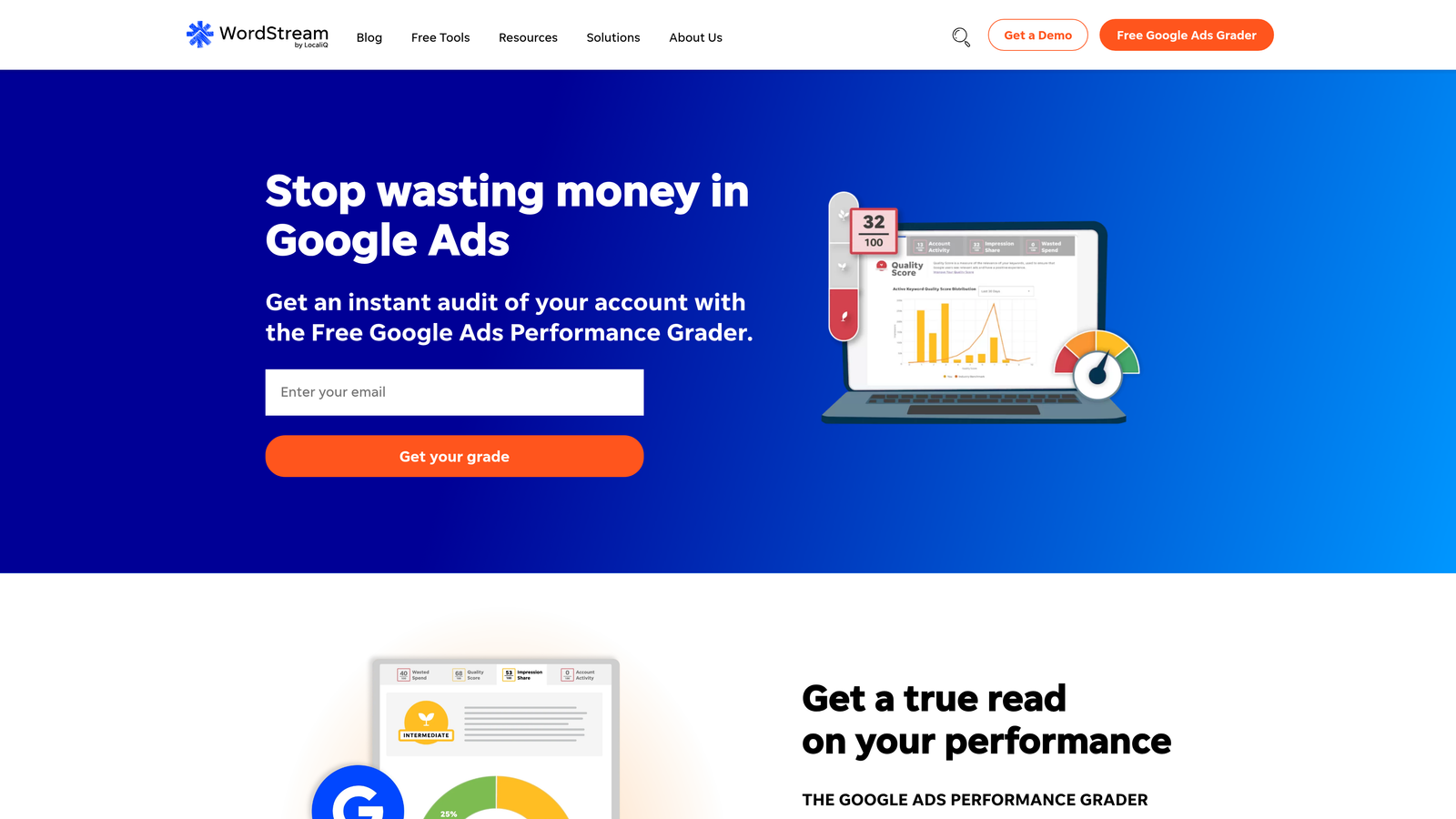
WordStream is a guided optimization platform built around the "20-Minute Work Week" concept, designed to help advertisers with minimal PPC knowledge make effective optimization decisions quickly.
Where This Tool Shines
WordStream assumes you're not a PPC expert—and that's the point. The platform surfaces the highest-impact optimization opportunities first and walks you through exactly what to do about them. This makes it valuable for business owners managing their own ads or small marketing teams without dedicated PPC specialists.
The Performance Grader tool provides a quick account health check with specific recommendations ranked by potential impact. It's less about granular control and more about making sure you're not missing obvious wins.
Key Features
20-Minute Work Week: Prioritized optimization tasks presented in a guided workflow that focuses on high-impact changes.
Performance Grader: Free account audit tool that identifies optimization opportunities and benchmarks performance against industry averages.
Cross-Platform Management: Manage Google Ads, Facebook Ads, and Microsoft Advertising from a single dashboard.
Automated Recommendations: AI-generated suggestions for bid adjustments, keyword additions, and ad copy improvements.
Reporting and Analytics: Simplified performance dashboards that translate data into actionable insights.
Best For
Small to mid-sized businesses spending $5K-50K/month on ads who don't have in-house PPC expertise. Also works for marketing generalists who manage multiple channels and need Google Ads to be less time-consuming without sacrificing performance.
Pricing
Quote-based pricing that typically ranges from $300-500+/month depending on ad spend and platform coverage. WordStream doesn't publish transparent pricing, which usually signals they adjust based on budget size.
4. Adalysis
Best for: Advertisers focused on ad testing and Quality Score improvement through systematic analysis
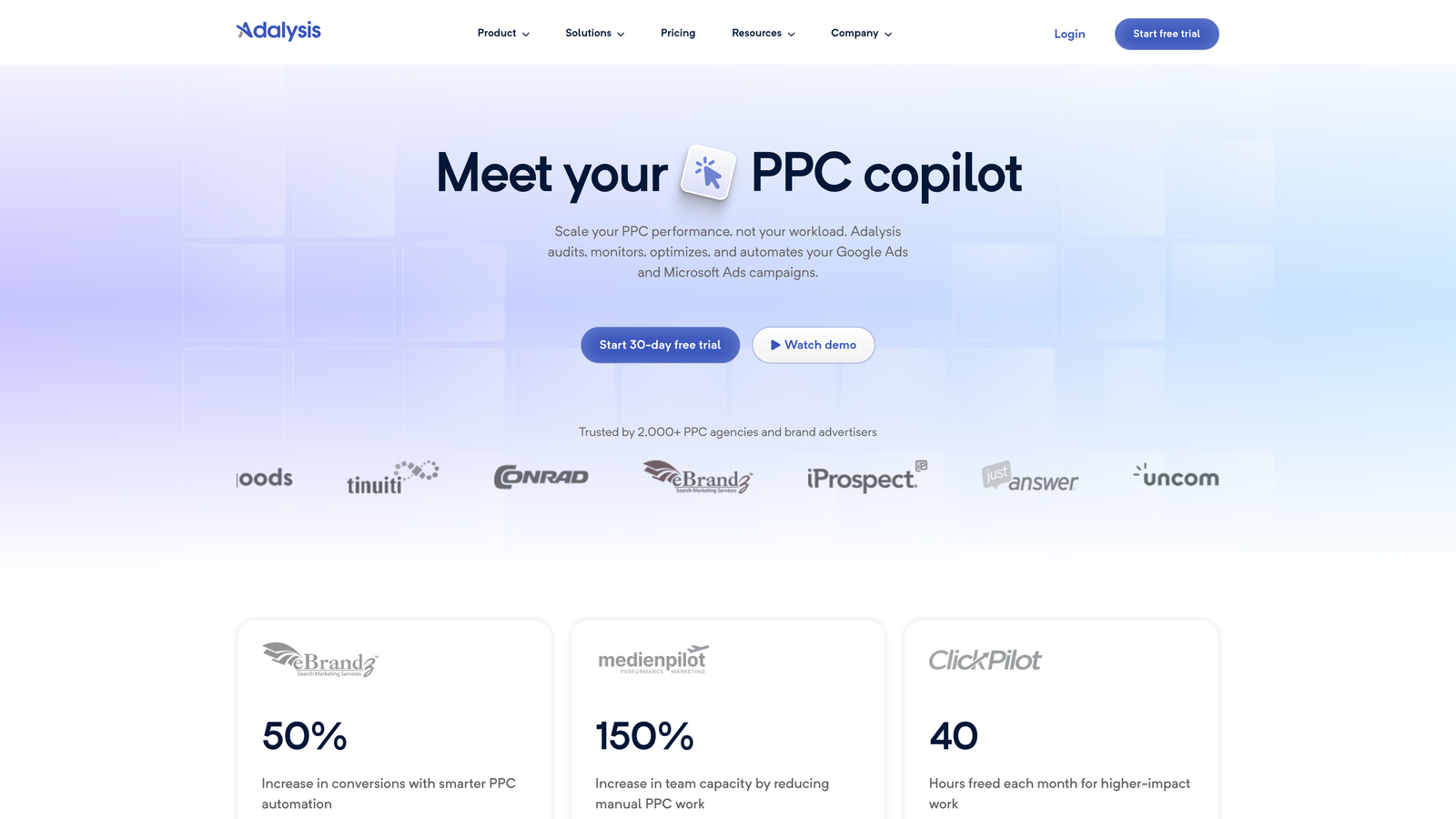
Adalysis is an ad testing and Quality Score monitoring platform with strong automation for A/B testing and performance analysis, designed for advertisers who take a data-driven approach to optimization.
Where This Tool Shines
Adalysis automates the ad testing process that most advertisers do manually—if they do it at all. The platform continuously rotates ad variations, tracks statistical significance, and automatically pauses underperforming ads when you have a clear winner. This systematic approach to ad testing typically improves CTR by identifying better messaging faster than manual reviews.
The Quality Score tracking goes deeper than Google's native reporting by showing historical trends and breaking down the three components (expected CTR, ad relevance, landing page experience) so you can diagnose exactly why scores drop.
Key Features
Automated A/B Testing: Set up ad experiments that run continuously, tracking statistical significance and auto-pausing losers.
Quality Score Monitoring: Track Quality Score changes over time with component-level breakdowns to identify improvement opportunities.
N-gram Analysis: Analyze search term patterns to discover high-intent keyword variations and negative keyword opportunities.
Negative Keyword Suggestions: Automated recommendations for negative keywords based on search term performance.
Performance Alerts: Get notified when campaigns, ad groups, or keywords hit performance thresholds you define.
Best For
Performance-focused advertisers who run multiple ad variations and want to optimize based on statistical significance rather than gut feeling. Particularly valuable for accounts with high impression volume where small CTR improvements create meaningful cost savings.
Pricing
Based on monthly ad spend, starting around $99/month for smaller accounts (under $10K spend). Pricing scales as spend increases, with custom quotes for large accounts.
5. Tenscores
Best for: Advertisers who want to systematically improve Quality Scores to reduce CPCs
Tenscores is a specialized tool focused exclusively on Quality Score optimization and monitoring, helping advertisers improve their QS metrics through detailed tracking and analysis.

Where This Tool Shines
Quality Score directly impacts your cost per click—higher scores mean lower CPCs for the same ad positions. But Google's native Quality Score reporting is limited and doesn't show historical data, making it hard to track improvement efforts. Tenscores fills that gap by recording Quality Score history and showing trends over time.
The platform breaks down each keyword's Quality Score components so you can see whether low scores come from poor expected CTR, weak ad relevance, or landing page issues. This diagnostic approach lets you focus optimization efforts where they'll actually move the needle.
Key Features
Quality Score Dashboard: Centralized view of Quality Scores across all campaigns with filtering and sorting capabilities.
Historical QS Data: Track Quality Score changes over time to measure the impact of optimization efforts.
Landing Page Analysis: Identify keywords with low landing page experience scores and prioritize page improvements.
Expected CTR Monitoring: See which keywords have low expected CTR scores and need better ad copy or restructuring.
Account-Level Insights: Aggregate Quality Score metrics to understand overall account health and identify patterns.
Best For
Advertisers in competitive industries where small CPC reductions create significant savings. Also valuable for accounts with large keyword inventories where manual Quality Score tracking becomes impossible.
Pricing
Starts around $25/month for accounts under $5K monthly spend. Pricing increases with spend tiers, but remains relatively affordable compared to full-featured optimization platforms.
6. Adzooma
Best for: Budget-conscious advertisers who want basic optimization without monthly fees
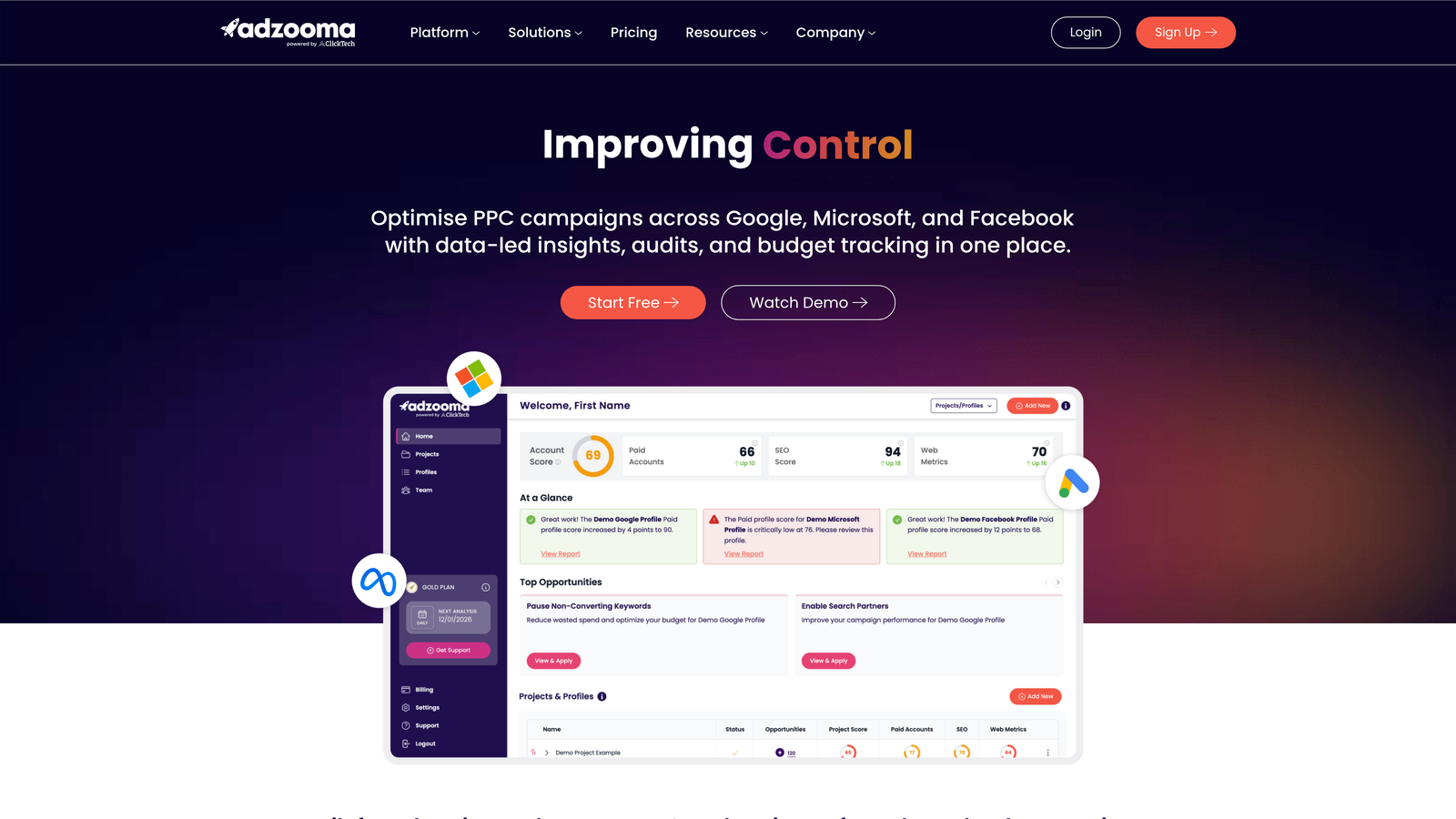
Adzooma is a beginner-friendly optimization platform with a genuinely free tier, offering automated recommendations and cross-platform support for Google Ads, Facebook, and Microsoft Advertising.
Where This Tool Shines
The free tier actually works—you get real optimization suggestions, performance reporting, and one-click actions without paying anything. This makes Adzooma ideal for testing optimization software before committing to paid tools or for small advertisers with tight budgets.
The platform surfaces optimization opportunities across all connected ad accounts in a single dashboard, making it easier to spot issues when you're managing multiple platforms. The recommendations are straightforward and actionable, though not as sophisticated as paid alternatives.
Key Features
Free Optimization Tier: Access core optimization features including opportunity detection and performance reporting at no cost.
Automated Opportunity Detection: Platform scans accounts for optimization opportunities like underperforming keywords or budget inefficiencies.
Cross-Platform Management: Manage Google Ads, Facebook Ads, and Microsoft Advertising from a unified interface.
Performance Reporting: Basic reporting dashboards that consolidate metrics across platforms.
One-Click Optimizations: Apply recommended changes directly from the platform without manual implementation.
Best For
Small businesses or freelancers managing under $10K/month in ad spend who want optimization help without adding another monthly expense. Also works as a testing ground before investing in more expensive platforms.
Pricing
Free tier available with core features. Plus plan starts at $99/month and unlocks advanced automation, white-label reporting, and priority support.
7. Skai (formerly Kenshoo)
Best for: Enterprise advertisers who need AI-powered bidding and cross-channel attribution at scale
Skai is an enterprise-level marketing platform with AI-powered bidding, forecasting, and cross-channel optimization for large-scale advertisers managing millions in ad spend.
Where This Tool Shines
Skai's AI bidding algorithms use machine learning to optimize bids across search, social, and retail media simultaneously—something Google's Smart Bidding can't do since it only sees Google Ads data. This cross-channel intelligence becomes valuable when you're running coordinated campaigns across multiple platforms and need unified attribution.
The budget forecasting tools help enterprise teams plan quarterly budgets by modeling expected performance under different spend scenarios. This level of financial planning matters more at scale where budget allocation decisions involve hundreds of thousands of dollars.
Key Features
AI-Powered Bidding: Machine learning algorithms that optimize bids across multiple advertising platforms simultaneously.
Budget Forecasting: Predictive modeling tools that forecast performance outcomes under different budget scenarios.
Cross-Channel Attribution: Unified attribution models that track customer journeys across search, social, display, and retail media.
Retail Media Support: Native integrations with Amazon Advertising, Walmart Connect, and other retail media networks.
Advanced Audience Targeting: Audience segmentation and targeting tools that work across all connected advertising platforms.
Best For
Enterprise brands and large agencies managing $500K+/month in ad spend across multiple channels who need sophisticated attribution and forecasting. The platform assumes you have dedicated PPC teams who can leverage advanced features.
Pricing
Custom enterprise pricing, typically starting around $1,000+/month minimum. Actual costs scale significantly with ad spend and platform coverage—expect to contact sales for quotes.
8. Marin Software
Best for: Enterprise advertisers who prioritize unified reporting and attribution across search, social, and display
Marin Software is an enterprise cross-channel advertising platform focused on unified reporting and attribution across search, social, and display advertising.
Where This Tool Shines
Marin's strength is consolidating performance data from multiple advertising platforms into a single source of truth. When you're running campaigns across Google Ads, Facebook, LinkedIn, Microsoft Advertising, and display networks, comparing performance in native dashboards becomes impossible. Marin normalizes the data and provides consistent metrics across channels.
The attribution modeling goes beyond last-click to show how different channels contribute to conversions throughout the customer journey. This matters for enterprise advertisers who need to justify budget allocation across teams and channels.
Key Features
Cross-Channel Reporting: Unified dashboards that consolidate performance metrics from all connected advertising platforms.
Automated Bidding: Proprietary bidding algorithms that adjust bids based on cross-channel performance data.
Attribution Modeling: Multi-touch attribution models that show how different channels contribute to conversion paths.
Budget Management: Centralized budget tracking and pacing tools across all advertising channels.
Audience Analytics: Cross-platform audience insights that identify high-value segments across channels.
Best For
Large brands with complex marketing stacks who need to prove ROI across multiple advertising channels. Works best for organizations with dedicated marketing operations teams who can implement and maintain the platform.
Pricing
Enterprise pricing based on a percentage of ad spend—typically requires contacting sales for quotes. Expect minimum commitments and implementation fees for enterprise contracts.
9. PPC Entourage
Best for: E-commerce sellers running campaigns on both Amazon Advertising and Google Ads
PPC Entourage is an optimization tool bridging Amazon advertising and Google Ads, designed for e-commerce sellers running campaigns across both platforms.
Where This Tool Shines
Most optimization tools focus exclusively on Google Ads or Amazon Advertising—PPC Entourage is one of the few that handles both. This matters for e-commerce brands selling through Amazon while also driving traffic to their own websites through Google Ads. The platform helps you identify which keywords work on Amazon and test them on Google, or vice versa.
The keyword harvesting automation saves hours by automatically moving high-performing search terms from automatic campaigns to manual campaigns on Amazon, then suggesting related keywords for Google Ads campaigns. This cross-platform intelligence helps you scale winning keywords faster.
Key Features
Amazon and Google Integration: Manage both Amazon Advertising and Google Ads campaigns from a single platform.
Keyword Harvesting: Automated workflows that move winning search terms from automatic to manual campaigns.
Negative Keyword Management: Centralized negative keyword lists that sync across campaigns and platforms.
Bid Optimization: Automated bid adjustments based on performance targets you set for each campaign.
Campaign Analytics: Performance dashboards that compare Amazon and Google Ads metrics side-by-side.
Best For
E-commerce sellers who sell through Amazon while also running Google Shopping or Search campaigns to drive traffic to their own stores. Particularly valuable for brands testing keyword strategies across both platforms to find the most profitable channels.
Pricing
Starts around $47/month for the basic plan covering smaller ad accounts. Pricing scales with ad spend and feature access, with higher tiers unlocking advanced automation and multi-account support.
Making the Right Choice
The pricing spectrum for Google Ads optimization software breaks down into three clear tiers, each serving different needs and budgets.
Under $50/month: Keywordme ($12/month), Tenscores ($25/month starting), and Adzooma (free tier) work for solo advertisers and small teams who need specific functionality without enterprise complexity. These tools focus on doing one thing exceptionally well rather than trying to be everything to everyone.
$50-500/month: Adalysis (~$99/month), Optmyzr (~$208/month), WordStream ($300-500/month), and PPC Entourage ($47/month starting) fit agencies and growing in-house teams managing $20K-100K/month in ad spend. You're paying for broader automation, better reporting, and multi-account management.
Enterprise ($500+/month): Skai and Marin Software require custom quotes and typically start around $1,000/month minimum. These platforms make sense when you're managing $500K+/month across multiple channels and need sophisticated attribution modeling and forecasting.
Here's what actually matters when choosing: workflow integration beats feature lists. A tool that saves you 10 hours per week at $12/month delivers better ROI than a $500/month platform you barely use because it requires exporting data and learning a new interface. The most common mistake is buying based on impressive feature lists rather than daily workflow efficiency.
For freelancers and solo advertisers, start with tools that integrate directly into your existing workflow. Keywordme eliminates the spreadsheet export process entirely by working inside Google Ads. Tenscores focuses exclusively on Quality Score improvement without forcing you to learn a complex platform.
Agencies managing 10+ client accounts need multi-account support and white-label reporting. Optmyzr and WordStream both offer agency-specific features, but Optmyzr gives you more control through custom automation rules while WordStream prioritizes simplicity for teams with varying PPC expertise.
In-house teams at mid-sized companies often benefit most from platforms like Adalysis that systematize ad testing and Quality Score monitoring—two areas that significantly impact performance but get neglected when teams are stretched thin.
Enterprise advertisers should evaluate Skai or Marin based on attribution needs. If you're running coordinated campaigns across search, social, and retail media and need to prove cross-channel ROI, the investment makes sense. If you're primarily focused on Google Ads optimization, you're paying for features you won't use.
The bottom line: match tool complexity to your actual needs. Most advertisers waste money on enterprise platforms when a focused Chrome extension would deliver faster results. Start with the simplest tool that solves your biggest time-sink, then add complexity only when you've maxed out simpler solutions.
Start your free 7-day trial of Keywordme and optimize Google Ads campaigns 10X faster without leaving your account. Remove junk search terms, build high-intent keyword lists, and apply match types instantly—right inside Google Ads. No spreadsheets, no switching tabs, just quick, seamless optimization at $12/month after your trial.
.svg)