
8 Best Google Ads Optimization Platforms With a Free Trial in 2026
This guide compares 8 Google Ads optimization platforms offering a free trial in 2026, ranging from one-click search term cleanup to full cross-channel bid automation, so advertisers can test real results against their own account data before committing.


Testing a new PPC tool against a live demo account tells you almost nothing. What you actually want is a real trial run against your own search terms, your own bid history, and your own budget constraints, so you can see whether a platform saves time or just adds another tab to check. The eight tools below were chosen because each vendor currently publishes a trial or free-tier offer as of 2026, and each takes a genuinely different approach to Google Ads optimization, from in-interface cleanup to full cross-channel automation.
Quick Comparison
- Keywordme: best for solo advertisers and agencies doing search term cleanup; $12/month per user; runs one-click actions directly inside Google Ads' native Search Terms Report.
- Optmyzr: best for agencies needing bid automation plus client reporting; pricing on site; combines rule-based automation with white-label reports.
- Adalysis: best for ongoing account health monitoring; pricing on site; runs continuous automated audits instead of manual spot-checks.
- WordStream Advisor: best for PPC beginners; pricing on site; gives prescriptive, guided recommendations rather than raw data.
- SEMrush PPC Toolkit: best for combined SEO/PPC research; pricing on site; adds competitor ad and keyword intelligence to campaign work.
- Adzooma: best for a quick cross-platform health check; free tier plus paid plans; scores accounts in a way that's easy to show clients.
- Revealbot: best for teams running paid social alongside Google Ads; pricing on site; builds automation rules that work the same way across channels.
- Shape.io: best for lead-gen advertisers; quote-based; ties bid decisions to CRM-reported lead quality instead of clicks alone.
1. Keywordme
Keywordme is a Chrome extension that adds one-click optimization actions directly inside the Google Ads native Search Terms Report. Rather than exporting data to a spreadsheet or logging into a separate dashboard, you work from the same screen you already use to review what people typed before your ads showed.
The distinctive part is where it lives. Most of the tools on this list pull your account data into their own interface. Keywordme does the opposite: it stays inside Google Ads itself, so there's no new login, no data sync delay, and no exported CSV to reconcile against what's live in your account.
- Clears junk search terms from the report with a single click instead of manual selection and bulk-action menus
- Builds negative keyword lists quickly, so irrelevant queries stop draining budget without a spreadsheet detour
- Applies match types to new keywords instantly, cutting out repetitive manual edits
- Groups related search terms through keyword clustering, making it easier to spot patterns in what's converting
- Supports multi-account and team access, useful for agencies juggling several client accounts
Setup is a Chrome extension install, and it works wherever you already manage your Search Terms Report, so there's essentially no learning curve for anyone who already knows Google Ads. It's not built for bid automation, budget pacing, or cross-channel management, so if you're looking for a tool that also runs Microsoft Ads or Meta campaigns, you'll need something broader. Pricing is a flat $12 per month per user, billed monthly as of 2026, with a 7-day free trial to test it against real search term data before paying.
Best for: Solo advertisers and agencies who want faster search term cleanup without leaving Google Ads.
2. Optmyzr
Optmyzr is a PPC management platform built around rule-based bid automation, budget management, and account audits, covering both Google Ads and Microsoft Ads.
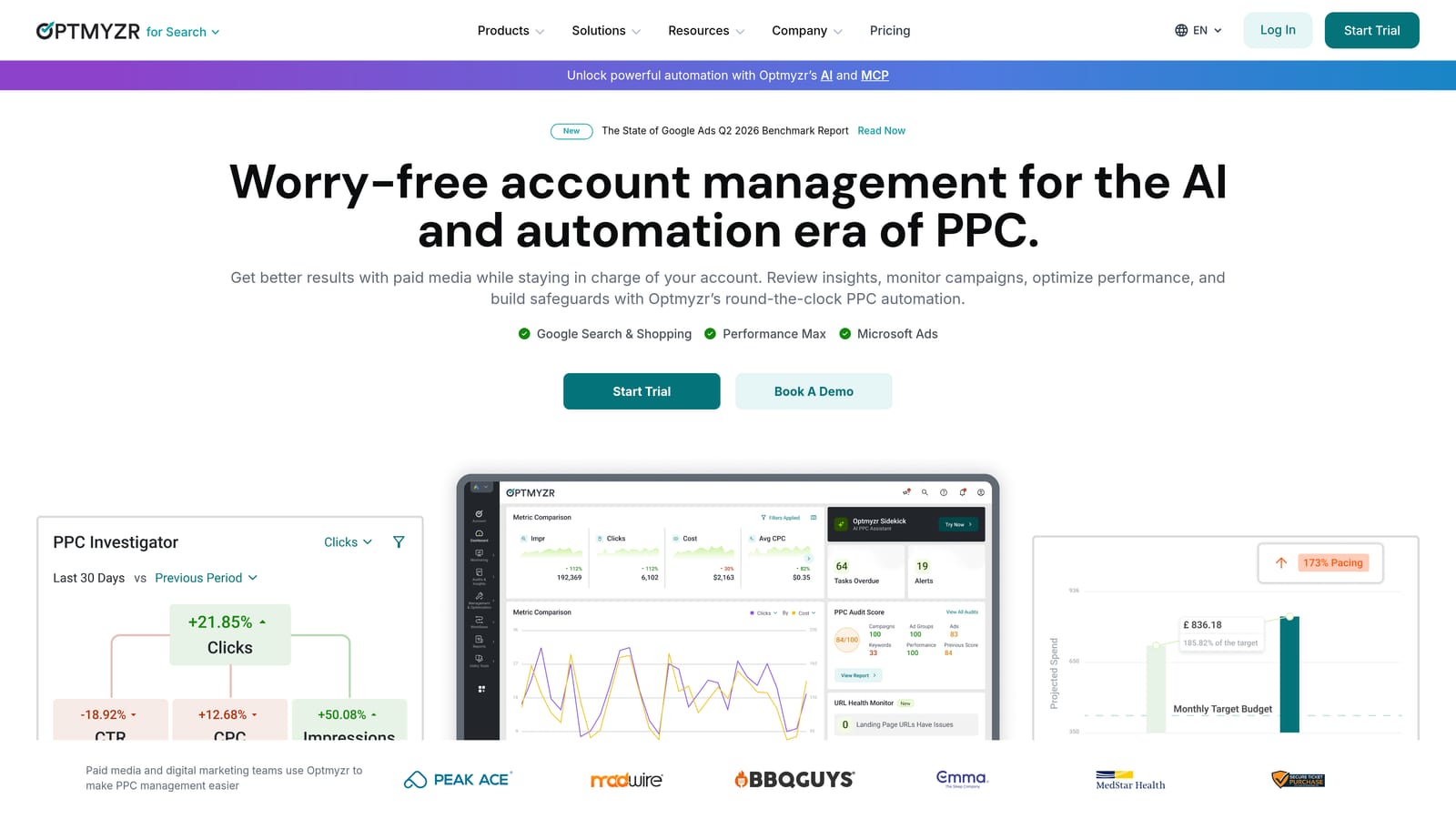
Where Keywordme focuses narrowly on search terms and keywords, Optmyzr goes wider: it automates bid changes based on rules you define, checks budget pacing, and flags quality score issues across an entire account. Agencies that need to standardize optimization across dozens of client accounts tend to lean on this depth.
- Automates bid and budget adjustments based on rules you set, cutting down on manual bid changes
- Runs account audits that flag structural and quality score issues before they hurt performance
- Produces white-label reports that agencies can hand directly to clients
- Manages campaigns across both Google Ads and Microsoft Ads from one place
It integrates with Google Ads, Microsoft Ads, and Google Analytics, and it's typically run by a dedicated PPC manager or agency account lead rather than someone dabbling in ads part-time. The breadth of features means new users face a real learning curve, especially if all you actually need is quick search term cleanup rather than full automation. Pricing is tiered; confirm the current trial length and cost on the official site, since these details change.
Best for: Agencies managing many accounts that need automation plus client-facing reports.
3. Adalysis
Adalysis is an account auditing and ad testing platform that runs continuous, automated checks on your Google Ads and Microsoft Ads accounts to surface issues and testing opportunities.
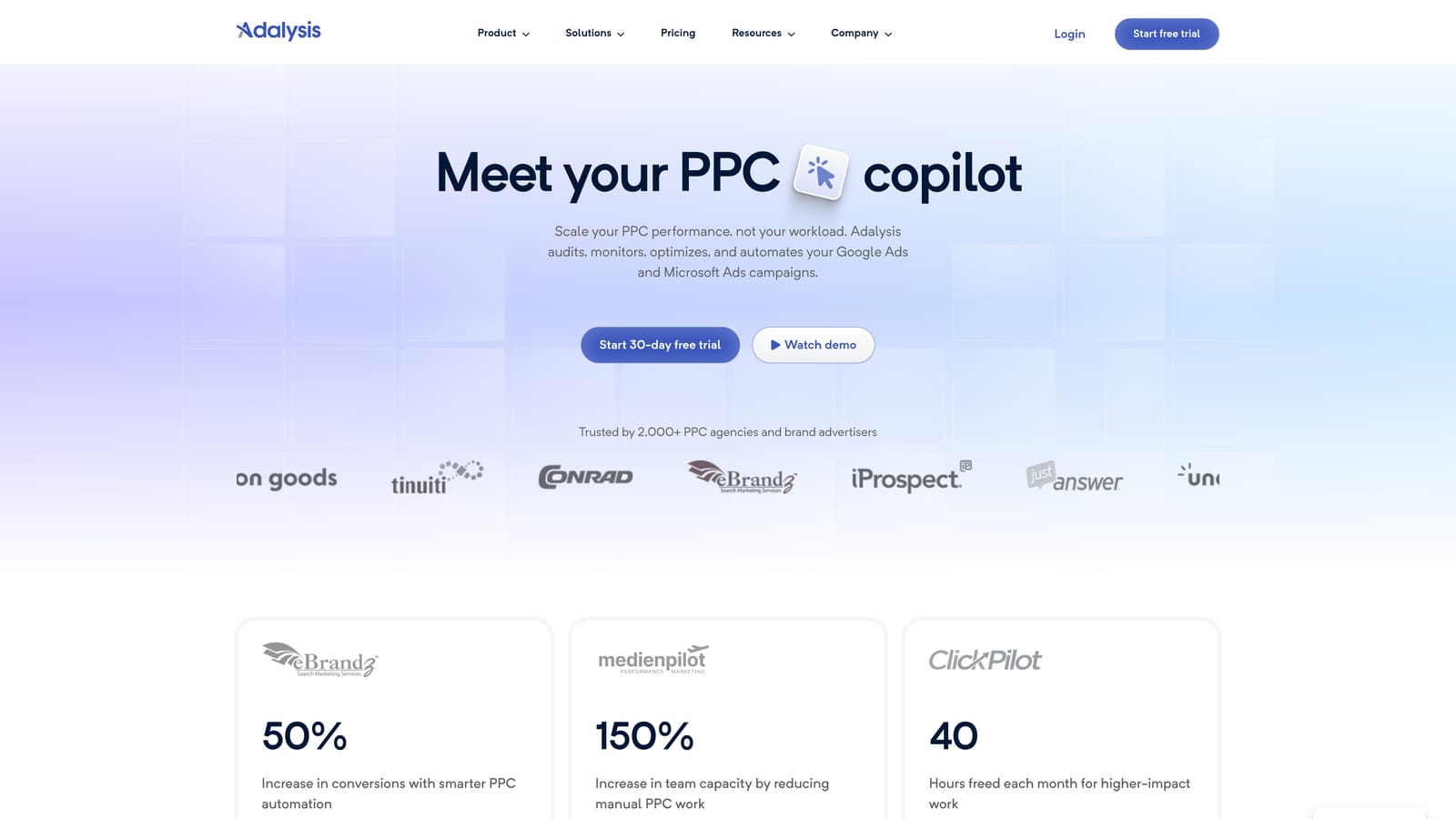
Its main strength is persistence. Instead of you remembering to run an audit every few weeks, Adalysis checks daily and flags new problems as they appear, whether that's a dropping quality score or an ad group missing enough active ad variations for a fair test.
- Tests ad copy automatically and reports which variations are statistically pulling ahead
- Runs daily health checks so issues get flagged before they compound
- Tracks quality score trends over time instead of just a single snapshot
- Lets you set custom alert rules so you only see the issues that matter to your accounts
It connects to Google Ads and Microsoft Ads, and it's typically managed by whoever owns day-to-day account health, often a PPC specialist checking a dashboard a few times a week rather than living inside it all day. It's not designed for fast, one-off search term cleanup between campaigns; it's built for ongoing monitoring, so if your main pain point is a bloated search terms report today, this isn't the fastest fix. Pricing is subscription-based; confirm current trial length and cost on the official site.
Best for: PPC managers who want automated, ongoing account health monitoring.
4. WordStream Advisor
WordStream Advisor is built around what the company calls a "20-Minute Work Week," a guided workflow that tells advertisers what to fix and in what order, across Google Ads, Microsoft Ads, and Meta Ads.
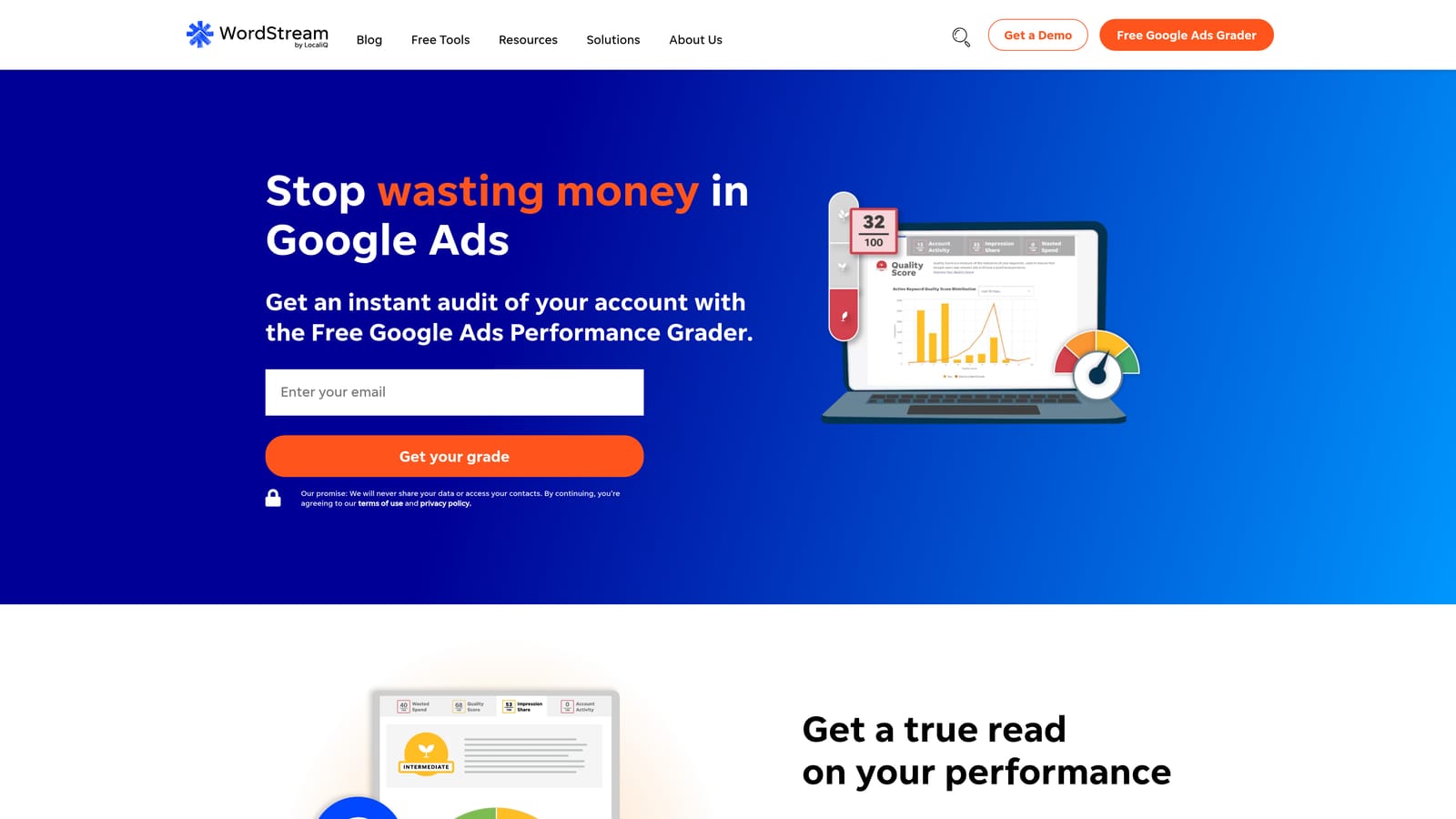
This tool suits a different buyer than the rest of the list. Instead of giving you raw levers to pull, like bid rules or keyword clustering, WordStream tells you what to do next in plain language, which matters if you're managing ads as one part of a broader marketing job rather than as a full-time PPC specialist.
- Walks you through a guided optimization routine instead of leaving you to figure out priorities
- Manages campaigns across Google, Microsoft, and Meta from a single account
- Grades your account performance so you can see where you stand at a glance
- Sends alert-based recommendations when something needs attention
It's typically run by a small business owner, freelancer, or in-house marketer without a dedicated PPC background, and setup mostly involves connecting your ad accounts and following prompts. The trade-off is control: advanced users who want granular rule-building or search-term-level automation often find the guided approach limiting. Pricing is subscription-based; confirm current trial terms on the official site.
Best for: Small businesses and freelancers who are newer to PPC and want guided suggestions.
5. SEMrush PPC Toolkit
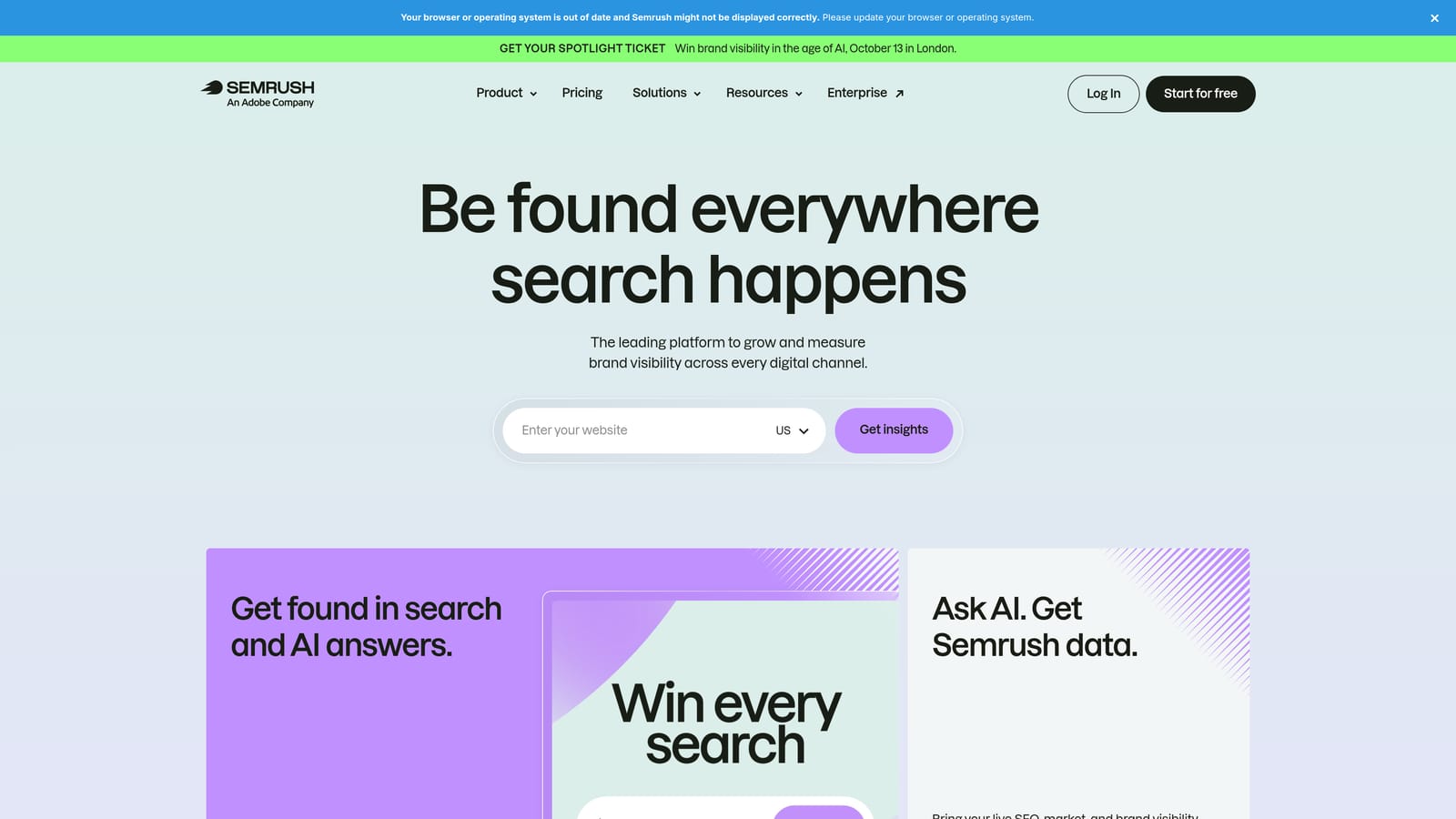
The SEMrush PPC Toolkit sits inside the broader SEMrush marketing suite, adding competitor ad research, keyword gap analysis, and campaign tools alongside SEMrush's well-known SEO features.
What sets it apart
None of the other tools on this list show you what your competitors are bidding on or what their ad copy looks like. SEMrush does, which makes it less a Google Ads optimization tool in the strict sense and more a research layer that feeds your keyword and messaging strategy before you optimize inside the account itself.
- Surfaces competitor ad copy and the keywords they're targeting
- Runs keyword gap analysis to find terms competitors rank or bid on that you don't
- Includes a dedicated PPC keyword research tool for building out campaigns
- Combines SEO and paid search reporting in one place, useful if you own both channels
Fit and limitations
It integrates with Google Ads, Google Analytics, and Google Search Console, and it's usually run by a marketer who owns both SEO and PPC rather than a PPC-only specialist. The catch is that PPC sits inside a much larger SEO-first suite, so if all you want is in-account optimization, you're paying for a lot of tooling you won't touch. Pricing is subscription-based; confirm the current trial length on the official site.
Best for: Marketers who want combined SEO and PPC competitive research, not just campaign optimization.
6. Adzooma
Its main limitation is depth: recommendations are broad and score-based rather than granular search-term-level control, so power users may find it a starting point rather than a full solution once they know their account better. Adzooma is a cross-platform dashboard that scores your Google Ads, Microsoft Ads, and Facebook Ads accounts and highlights quick-fix opportunities.
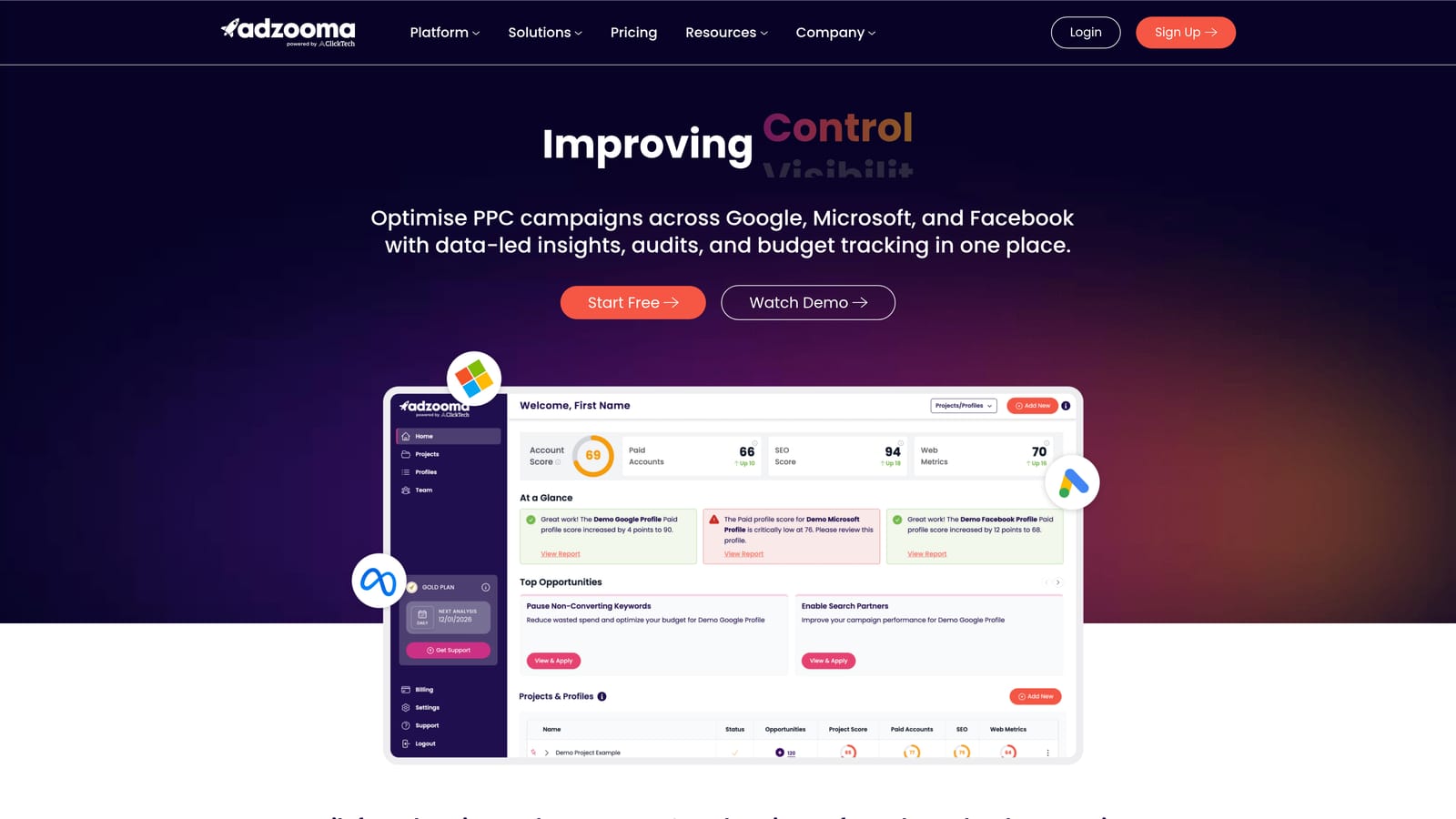
The opportunity score is the standout. It condenses account health into a single number that's easy to explain to a client or a boss who doesn't want to read a search terms report, which makes Adzooma useful less as a deep optimization engine and more as a fast diagnostic and communication tool.
- Scores account health so you can track improvement over time in one metric
- Gives a unified view across Google Ads, Microsoft Ads, and Facebook Ads
- Suggests one-click fixes for common issues it detects
- Lets you set automation rules for recurring tasks
Setup is straightforward, connect your ad accounts and the dashboard populates, and it's typically used by marketers who want a fast health check rather than a dedicated PPC analyst running deep audits. Adzooma offers a free tier plus paid plans; confirm current trial and pricing details on the official site since these shift.
Best for: Advertisers who want a quick, visual health check across multiple ad platforms.
7. Revealbot
Revealbot is an automation and alerting platform for building custom rules across Google Ads, Meta Ads, and TikTok Ads.
Its edge is consistency across channels. If you're pausing underperforming ad sets on Meta the same way you pause underperforming keywords on Google, Revealbot lets you build one rule logic that applies across platforms instead of learning separate automation systems for each.
- Builds custom automation rules that trigger on the metrics you define
- Manages campaigns across Google Ads and social platforms from one interface
- Sends real-time alerts when a rule fires or a metric crosses a threshold
- Generates automated reports so performance data doesn't need manual pulling
It connects with Google Ads, Meta Ads, and TikTok Ads, and it's generally run by a performance marketing team managing budget across multiple platforms rather than a single Google Ads account. If you only run Google Ads and have no plans to expand into paid social, the cross-channel automation is more than you need, and simpler tools will get you to the same result faster. Pricing is subscription-based; confirm the current trial length on the official site.
Best for: Performance marketing teams running paid social alongside Google Ads.
8. Shape.io
Shape.io is a predictive bid management and reporting platform built specifically for lead-generation advertisers, connecting ad spend to CRM-reported lead quality rather than clicks or form fills alone.
This is the most specialized tool on the list. Instead of optimizing toward conversions as Google Ads defines them, Shape.io pulls lead outcome data from your CRM, so a form fill that turned into a closed deal carries more weight in bid decisions than one that went nowhere.
- Adjusts bids predictively based on which leads are likely to convert downstream
- Pulls CRM data to score leads by quality, not just volume
- Automates performance reporting tied to actual sales outcomes
- Builds dashboards oriented around lead-gen metrics rather than generic ecommerce KPIs
It integrates with Google Ads and CRM platforms, and getting real value out of it requires a working CRM feedback loop, someone on your team needs to make sure lead outcomes are logged accurately, or the bid predictions have nothing useful to learn from. That makes it a poor fit for ecommerce advertisers with no CRM step and overkill for anyone running a simple, low-volume account. Pricing is quote-based; confirm current trial availability on the official site.
Best for: Local service and lead-gen advertisers who want spend tied to CRM-reported lead quality.
Matching the Right Platform to Your Account
If your main problem is a Search Terms Report full of irrelevant queries eating budget, Keywordme is the fastest fix since it works right inside Google Ads with no new dashboard to learn. If you're running an agency and need full account automation, audits, and client reporting, Optmyzr and Adalysis cover different halves of that job, one leans toward bid and budget rules, the other toward continuous auditing and ad testing. WordStream fits best if you're newer to PPC and want step-by-step guidance rather than raw levers to pull yourself.
SEMrush makes sense if you want competitive research feeding both SEO and PPC decisions, not just in-account optimization. Adzooma and Revealbot both suit teams working across multiple ad platforms, Adzooma for a quick visual health score, Revealbot for building consistent automation rules across channels. Shape.io is worth a look specifically if you're in lead generation and already have a CRM tracking which leads actually close.
Trial lengths, pricing tiers, and free-tier limits change often, so confirm the current terms on each vendor's site before you sign up anywhere. If search term cleanup is eating your week, Start your free 7-day trial of Keywordme (then just $12/month) and see how much faster your Search Terms Report moves when you're not leaving Google Ads to fix it.
.svg)