
8 Best Google Ads Management Tool Subscriptions in 2026
This guide compares 8 Google Ads management tool subscription options for 2026, breaking down pricing and standout features so freelancers and agencies can pick the right fit for search term cleanup, bid automation, and reporting.


If you manage Google Ads accounts for a living, you've probably hit the point where native reports and manual spreadsheets stop cutting it. Search term cleanup takes too long, bid changes get buried in tabs, and reporting eats hours you'd rather spend on strategy. This list looks at eight subscription tools that marketers, freelancers, and agencies actually use to speed up those workflows, chosen for transparent (or at least verifiable) pricing, real feature sets, and a clear answer to the question: what specific job does this tool solve better than the rest?
Quick Comparison
- Keywordme: best for solo advertisers and small agencies cleaning up search terms fast; starts at $12/month per user; the only tool here that puts one-click search term actions directly inside the native Google Ads interface.
- Optmyzr: best for agencies running rule-based automation across many accounts; pricing scales with spend and account count; its white-label reporting is built specifically for client-facing agency work.
- Adalysis: best for teams running rigorous ad copy tests; starts around $99/month; it's the only tool here with a built-in statistical significance checker for A/B tests.
- WordStream Advisor: best for beginners who want a guided routine; quote-based pricing; its "20-Minute Work Week" checklist is unique among these tools.
- SEMrush Advertising Toolkit: best for teams that want competitor research bundled with PPC management; starts around $139.95/month; it layers competitor keyword and ad copy intelligence on top of campaign data.
- Revealbot: best for marketers running Google Ads alongside Meta or TikTok; starts around $99/month; it's the only tool here that automates rules across search and social in one dashboard.
- SpyFu: best for pre-launch competitor research; starts around $39/month; its multi-year historical archive of competitor keywords and ads is the deepest on this list.
- Search Ads 360: best for enterprise agencies managing cross-engine bidding; quote-based pricing; it's the only tool here built for bidding across multiple search engines at enterprise scale.
1. Keywordme
Keywordme is a Chrome extension that adds one-click optimization actions directly into the Google Ads Search Terms Report. Instead of exporting data to a spreadsheet, sorting through search terms, and pasting negatives back into your account, you act on them where they already live: inside Google Ads itself.
What sets it apart from every other tool on this list is that narrow focus. It doesn't try to be a full campaign dashboard or a cross-channel automation platform. It's built for one recurring, tedious job: turning the search terms report into clean keyword lists without switching tabs.
- Removes junk search terms with a single click instead of a manual export-and-filter process
- Adds high-intent search terms as new keywords and applies match types instantly
- Builds negative keyword lists without leaving the Google Ads interface
- Groups related search terms through keyword clustering to speed up decision-making
- Supports bulk editing and multi-account or team access, useful for agencies juggling several client accounts
Setup is minimal: install the Chrome extension, connect it to your Google Ads account, and it appears inside the Search Terms Report you already use. There's no separate dashboard to learn, which makes it approachable for a solo advertiser as well as an agency account manager who just wants faster cleanup.
The trade-off is scope. Keywordme doesn't handle bid automation, budget pacing, or cross-channel ad management, so if you need rule-based bidding or reporting across Meta and TikTok, you'll pair it with another tool or look further down this list. It's also Google Ads-specific, with no Microsoft Ads support as of 2026.
Pricing is a flat $12 per month per user, with a 7-day free trial (check the site for current terms before signing up, since pricing details can shift). There's no tiered structure based on ad spend, which keeps costs predictable for agencies adding seats.
Best for: Solo advertisers and small agencies who want faster search term cleanup without leaving Google Ads.
2. Optmyzr
Optmyzr is built for agencies and in-house teams managing enough accounts that manual optimization stops scaling. It's less about one-click cleanup and more about setting rules that run continuously across dozens of accounts.
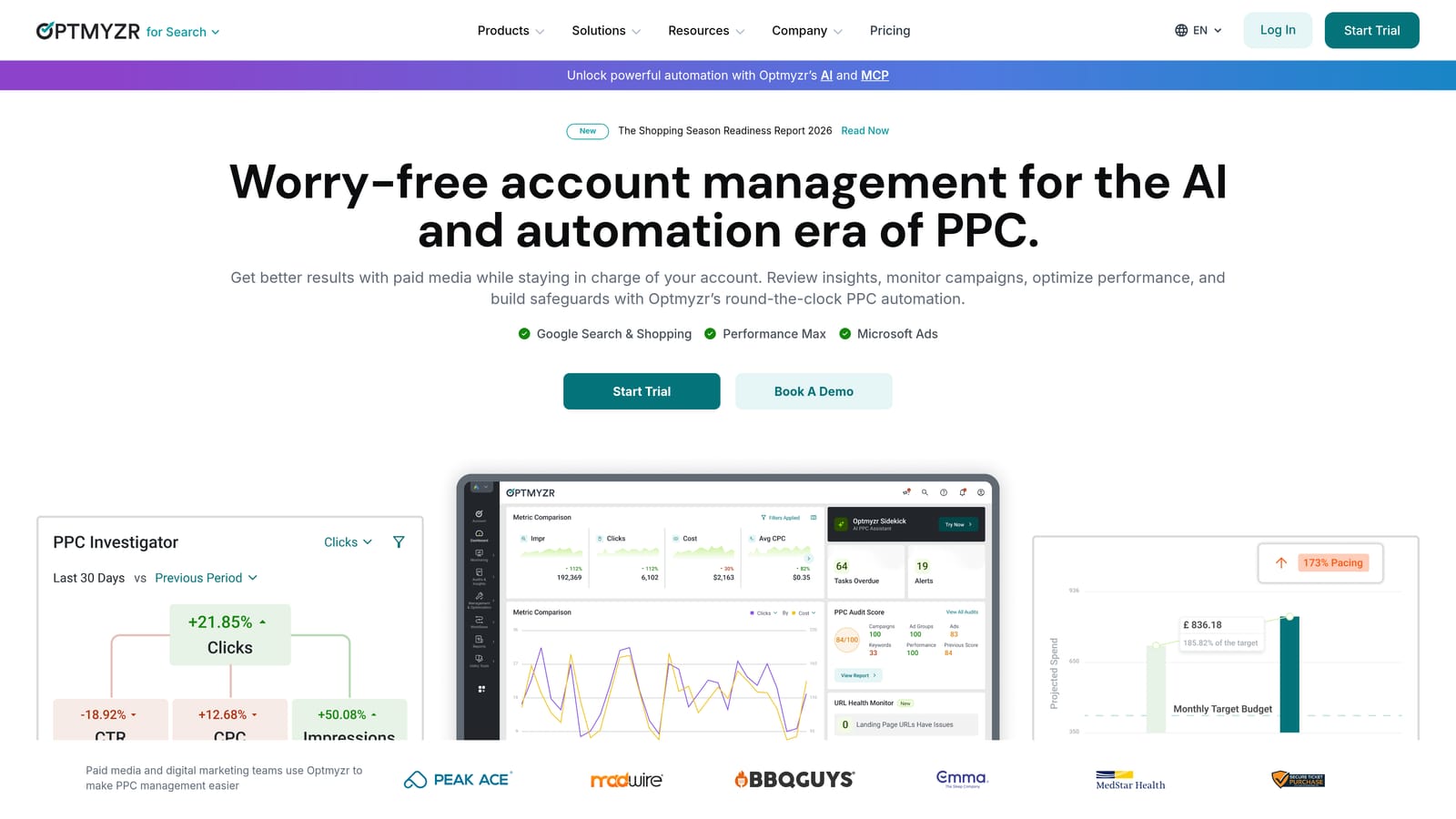
Where it distinguishes itself from Keywordme and Adalysis is breadth: Optmyzr combines bid and budget automation with white-label client reporting in one subscription, so an agency can both manage accounts and hand clients a polished report without stitching together two tools.
- Automates bid and budget adjustments based on rules you define, cutting manual account checks
- Gives account managers a single dashboard to monitor performance across many client accounts at once
- Generates white-label reports in one click, saving the manual work of building client decks
- Surfaces search term and negative keyword suggestions for ongoing account hygiene
- Sends budget pacing alerts so accounts don't overspend or underspend mid-month
Integrations cover Google Ads, Microsoft Ads, and Google Analytics, which makes it a reasonable fit for agencies running search campaigns across engines. Setup involves connecting each account and configuring automation rules, a task typically owned by a PPC manager or account lead rather than a junior team member.
The catch is pricing structure. Because plans scale with ad spend and the number of managed accounts, a single small account can end up paying for capacity it doesn't need. Optmyzr is built for volume, and it shows in the cost curve.
Pricing is tiered based on spend and account count; check Optmyzr's site for current tiers as of 2026, since these numbers move with the market.
Best for: Agencies managing many client accounts that need automation and consolidated reporting.
3. Adalysis
Adalysis takes a different angle than the automation-first tools above. Adalysis is built around auditing accounts for problems and testing ad copy with statistical rigor, rather than automating bids.
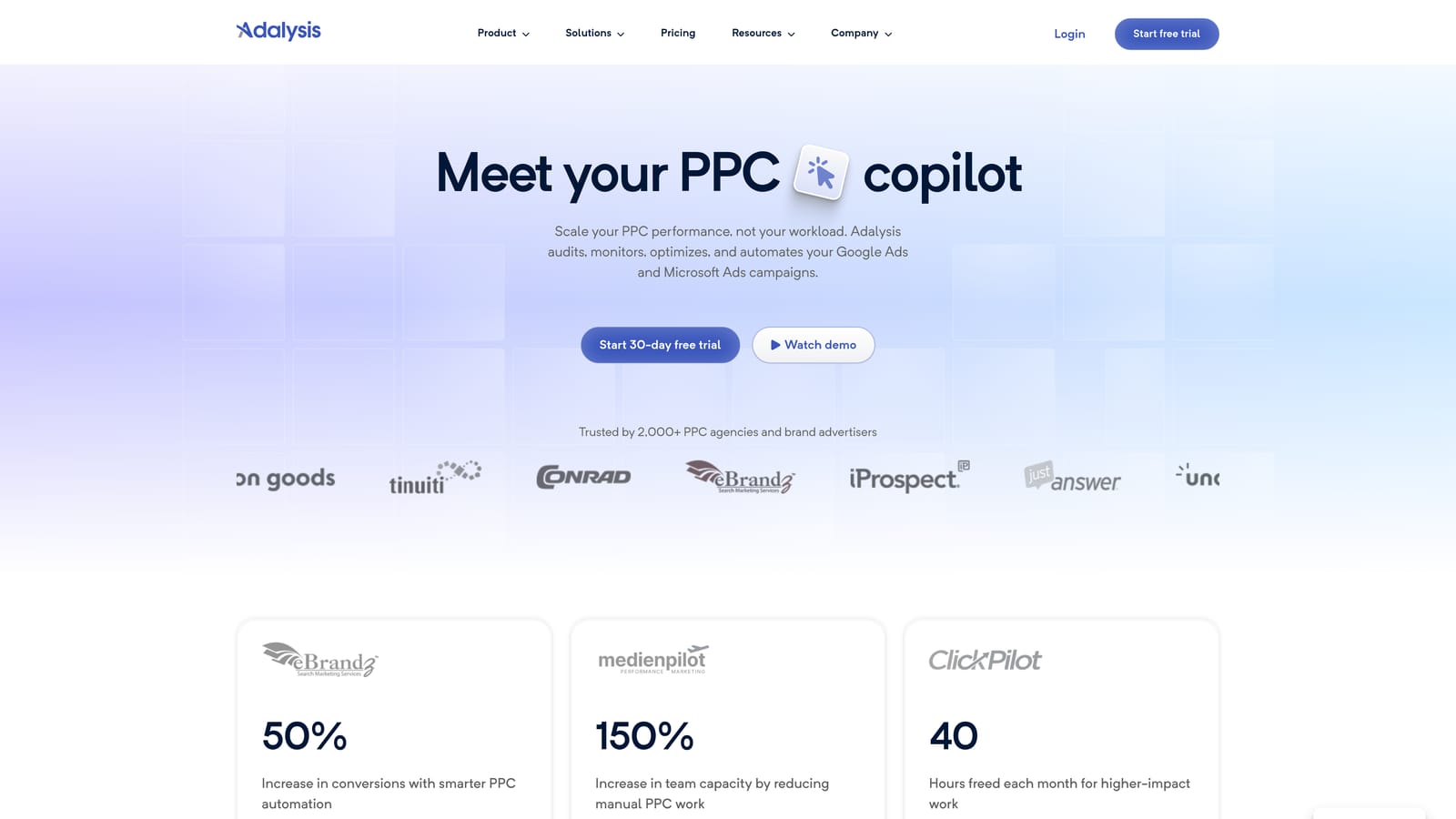
Its standout feature, and the reason it earns a spot separate from Optmyzr, is a built-in statistical significance checker for ad copy experiments. Instead of eyeballing click-through rate differences between two ad variants, Adalysis tells you when a result is actually meaningful and when it's still noise.
- Runs automated account audits that flag missing negatives, Quality Score issues, and gaps in ad testing
- Calculates statistical significance for ad copy tests so you know when to declare a winner
- Suggests search term and negative keyword additions based on account activity
- Sends scheduled alerts when meaningful account changes happen, so nothing slips through unnoticed
Adalysis connects to Google Ads and Microsoft Ads, and it's typically run by a hands-on PPC manager rather than handed to a junior team member, since the interface leans data-dense. There's a learning curve to reading its audit reports and test results compared with a simpler tool like Keywordme.
That density is also its main limitation: newer advertisers or teams that just want quick search term cleanup may find it more tool than they need. It's built for practitioners who already understand statistical testing and want software to formalize it, not for beginners looking for guidance.
Plans start around $99 per month depending on account size, though you should verify current pricing on Adalysis's site before committing, as tiers can change.
Best for: Accounts that need statistically rigorous ad testing and recurring account audits.
4. WordStream Advisor by LocaliQ
If you're newer to Google Ads or don't have time to build your own optimization routine, WordStream Advisor takes a structured approach that the other tools on this list don't attempt.
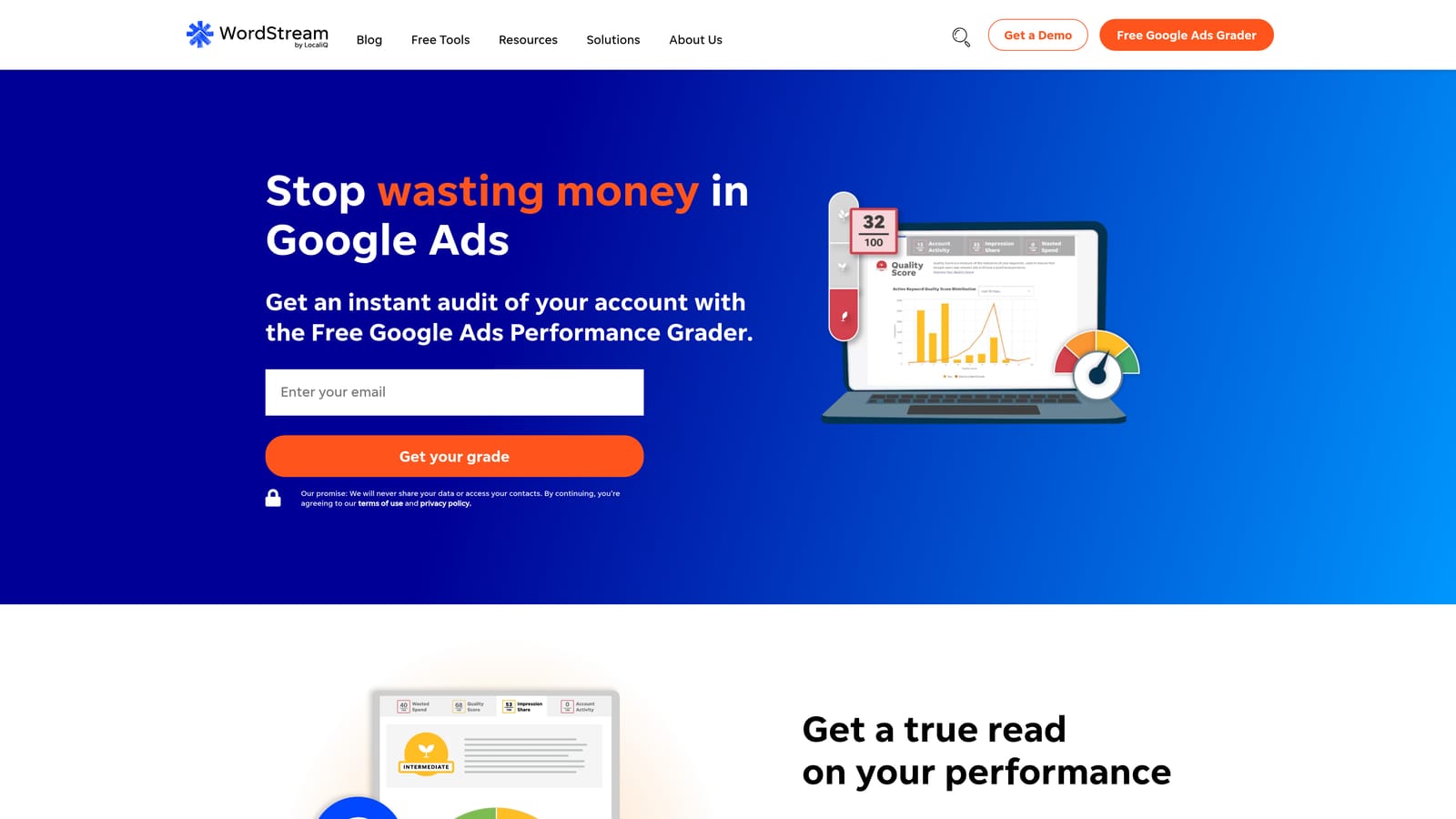
The 20-Minute Work Week
Its defining feature is a guided checklist called the "20-Minute Work Week," which walks you through a short, repeatable set of optimization tasks each week. It's designed for advertisers who don't want to figure out what to check and when, they just want to follow a routine.
- Walks you through a weekly checklist of optimization tasks instead of leaving you to figure out priorities
- Grades account performance against industry benchmarks so you know where you stand
- Manages Google Ads and Microsoft Ads campaigns from one place
- Flags wasted spend with alerts, useful for catching budget leaks early
Where it falls short
WordStream integrates with Google Ads, Microsoft Ads, and Facebook Ads, and it's aimed at small business owners or marketers managing their own accounts without a dedicated PPC specialist on staff. Setup typically involves a sales conversation with LocaliQ rather than self-serve signup.
That sales process is also the main drawback: there's no published, transparent pricing, and some advertisers find the conversation leans toward upselling managed services rather than a straightforward software subscription.
Pricing is quote-based, sold through LocaliQ's sales team, with no public self-serve tier as of 2026.
Best for: Small businesses or beginner advertisers who want a guided, checklist-style optimization routine.
5. SEMrush Advertising Toolkit
SEMrush approaches Google Ads management from a research angle rather than an in-account optimization angle. It's part of the broader SEMrush suite, which also covers SEO, so PPC features sit alongside tools for organic search.
What separates SEMrush from the rest of this list is competitive intelligence: you can see what keywords and ad copy competitors are running, historically, and use that to shape your own campaigns before you spend a dollar.
- Runs competitor keyword gap analysis to find terms you're missing that competitors are bidding on
- Tracks historical competitor ad copy so you can study messaging trends over time
- Builds PPC keyword lists pre-launch using its keyword research tool
- Tracks keyword position and reporting alongside your paid campaign data
It integrates with Google Ads, Google Analytics, and Google Search Console, which lets you cross-reference paid and organic performance in one place. Setup is straightforward for anyone already using SEMrush for SEO, since the advertising toolkit lives in the same account.
The limitation is cost efficiency: PPC features are bundled into a suite built primarily for SEO, so if you only need Google Ads management, you're paying for tools you may never touch. Teams that already run SEO through SEMrush get more value out of the bundle than those coming for PPC alone.
Plans start around $139.95 per month for the base suite tier, though PPC-specific access and current pricing should be verified on SEMrush's site, since suite pricing changes periodically.
Best for: Teams that want competitor intelligence alongside campaign management.
6. Revealbot
Revealbot is built for marketers who don't run Google Ads in isolation. If your budget spans Google Ads, Meta, and TikTok, Revealbot lets you set performance rules across all three from a single dashboard, something none of the other tools here attempt.
Its distinguishing strength is that cross-channel reach. Optmyzr and Adalysis go deep on Google and Microsoft Ads specifically; Revealbot trades some of that depth for coverage across search and social platforms at once.
- Lets you build custom automation rules for budgets and bids that apply across channels
- Manages Google Ads, Meta Ads, and TikTok Ads campaigns from one dashboard
- Sends Slack and email alerts when a rule triggers, so you're notified without checking manually
- Generates automated reporting dashboards that pull data from each connected platform
Setting up Revealbot takes more upfront time than a plug-and-play extension: you'll define rules for each channel, which usually falls to a performance marketer or media buyer comfortable working across platforms. Once rules are built, day-to-day maintenance is lighter.
The trade-off is that its Google Ads-specific features aren't as deep as a dedicated tool like Optmyzr, and its reporting, while useful, isn't as robust as a dedicated analytics platform. It's a strong fit if cross-channel automation is your priority, less so if Google Ads is your only channel.
Subscription tiers are based on managed ad spend, starting around $99 per month; confirm current tiers on Revealbot's site since spend-based pricing shifts.
Best for: Performance marketers running Google Ads alongside Meta or TikTok who want cross-channel automation.
7. SpyFu
SpyFu is a research tool first, not a live account manager. Its value shows up before you launch a campaign, when you're trying to understand what competitors have bid on and how their ad copy has evolved.
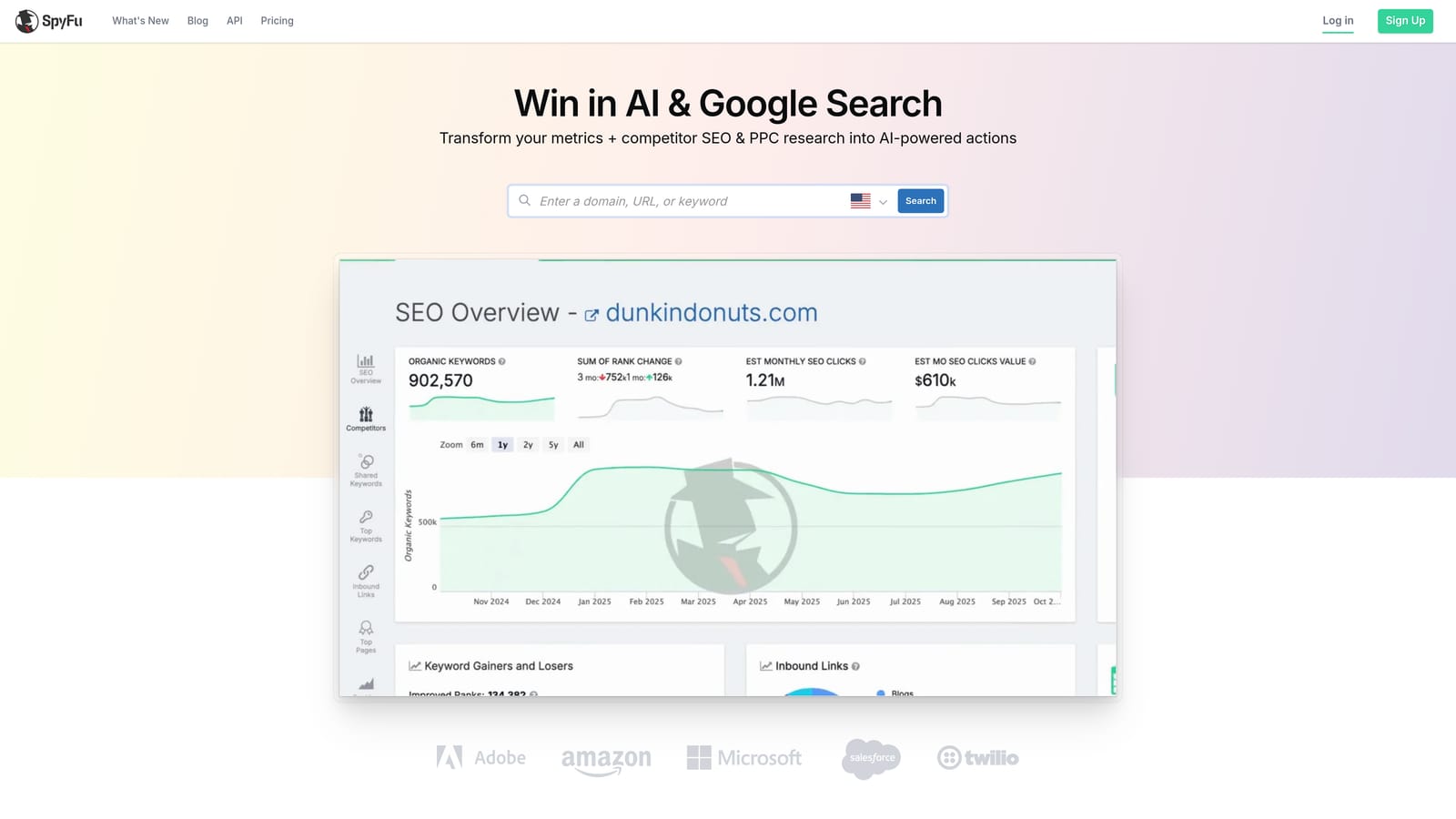
Its standout feature is depth of history: SpyFu maintains years of historical competitor keyword and ad copy data, which lets you see how a competitor's PPC strategy changed over time rather than just a snapshot of what they're running today.
- Stores years of historical competitor keyword and ad copy data for long-term trend analysis
- Offers keyword gap and "kombat" comparison tools to find terms competitors bid on that you don't
- Combines PPC and SEO keyword research in one search, useful for planning both paid and organic strategy
- Runs domain-versus-domain competitive reports to benchmark against specific rivals
SpyFu connects to Google Ads mainly through keyword list export and import, rather than live account syncing. That makes it easy to adopt: there's no deep integration to configure, and a marketer can pull insights and hand a keyword list to whoever manages the live account.
Its clear limitation is that it stops at research. Once you've built your keyword list, SpyFu doesn't help you manage bids, clean up search terms, or automate anything inside the live account, so most advertisers pair it with an execution tool.
Plans start around $39 per month for basic access; check SpyFu's site for current pricing, as tiers and included data volume can change.
Best for: Advertisers researching competitor keyword and ad history before building campaigns.
8. Search Ads 360
Search Ads 360 is Google's own enterprise bid management platform, built for agencies and large advertisers running search campaigns across multiple engines at once.
What separates it from everything else on this list is scale and scope: it's designed to manage bidding across Google Ads, Microsoft Ads, and other search engines simultaneously, within the broader Google Marketing Platform ecosystem, something no other tool here is built to do at the same level.
- Manages bids across Google Ads, Microsoft Ads, and other search engines from one platform
- Applies enterprise-grade automated bidding algorithms tuned for large, complex account structures
- Pulls in data from other Google Marketing Platform products for a fuller view of performance
- Consolidates reporting across engines so large teams aren't stitching together separate exports
Search Ads 360 is typically implemented and run by a dedicated agency team or in-house enterprise PPC group, since setup involves connecting multiple engine accounts and configuring bidding strategies at scale. It's not something a solo advertiser installs in an afternoon.
That's also its main drawback. The complexity and enterprise pricing structure make it impractical for solo advertisers or small budgets. If you're managing one or two accounts, this platform is more infrastructure than you need.
Pricing is enterprise and quote-based, arranged through Google Marketing Platform sales rather than published tiers.
Best for: Large enterprises or agencies managing cross-engine bidding at scale.
Matching the Tool to Your Workflow
If your main headache is search term cleanup and you don't want to add another complex platform to your stack, Keywordme is the straightforward pick: it works inside Google Ads, costs $12 a month per user, and solves one job well. For agencies that need automation rules running across dozens of accounts, or teams that want statistically sound ad copy testing, Optmyzr and Adalysis respectively cover that heavier lifting. WordStream Advisor suits beginners who want a routine handed to them rather than built from scratch.
If competitive research is your priority before you even launch, SEMrush and SpyFu both dig into competitor keywords and ad history, with SEMrush bundling in a full SEO suite and SpyFu offering a leaner, research-only option. Revealbot makes sense once your budget spans Google Ads and social platforms together, and Search Ads 360 is built for enterprise teams managing bids across multiple search engines at once.
Optimize Google Ads campaigns 10x faster without leaving your account. Keywordme lets you remove junk search terms, build high-intent keyword lists, and apply match types instantly, right inside Google Ads. No spreadsheets, no switching tabs, just quick, seamless optimization. Start your free 7-day trial (then just $12/month) and take your Google Ads game to the next level.
.svg)