
8 Best Google Ads Keyword Clustering Tools in 2026
This guide reviews the 8 best Google Ads keyword clustering tools in 2026, evaluating each on clustering accuracy, workflow speed, pricing, and team fit. Whether you manage campaigns in-platform or via standalone research tools, it cuts through the noise to help you structure ad groups that improve relevance and stretch your budget further.


Keyword clustering sounds straightforward until you're looking at 500 search terms trying to figure out which ones belong in the same ad group. Get it right and your campaigns run tighter, your ad relevance improves, and your budget goes further. Get it wrong and you're paying for irrelevant clicks while your best-performing keywords get lost in poorly structured ad groups.
The tools below are built to speed this up. Some work directly inside Google Ads. Others are standalone research platforms you export data into. A few use AI to cluster by search intent rather than just text similarity. This list covers the top options for marketers, freelancers, and agency owners managing Google Ads campaigns in 2026, with honest notes on what each one actually does well and where it falls short.
Selection criteria: in-platform usability, clustering accuracy, workflow speed, pricing fairness, and fit for different team sizes.
1. Keywordme
Best for: Google Ads users who want keyword clustering and optimization actions inside the native interface
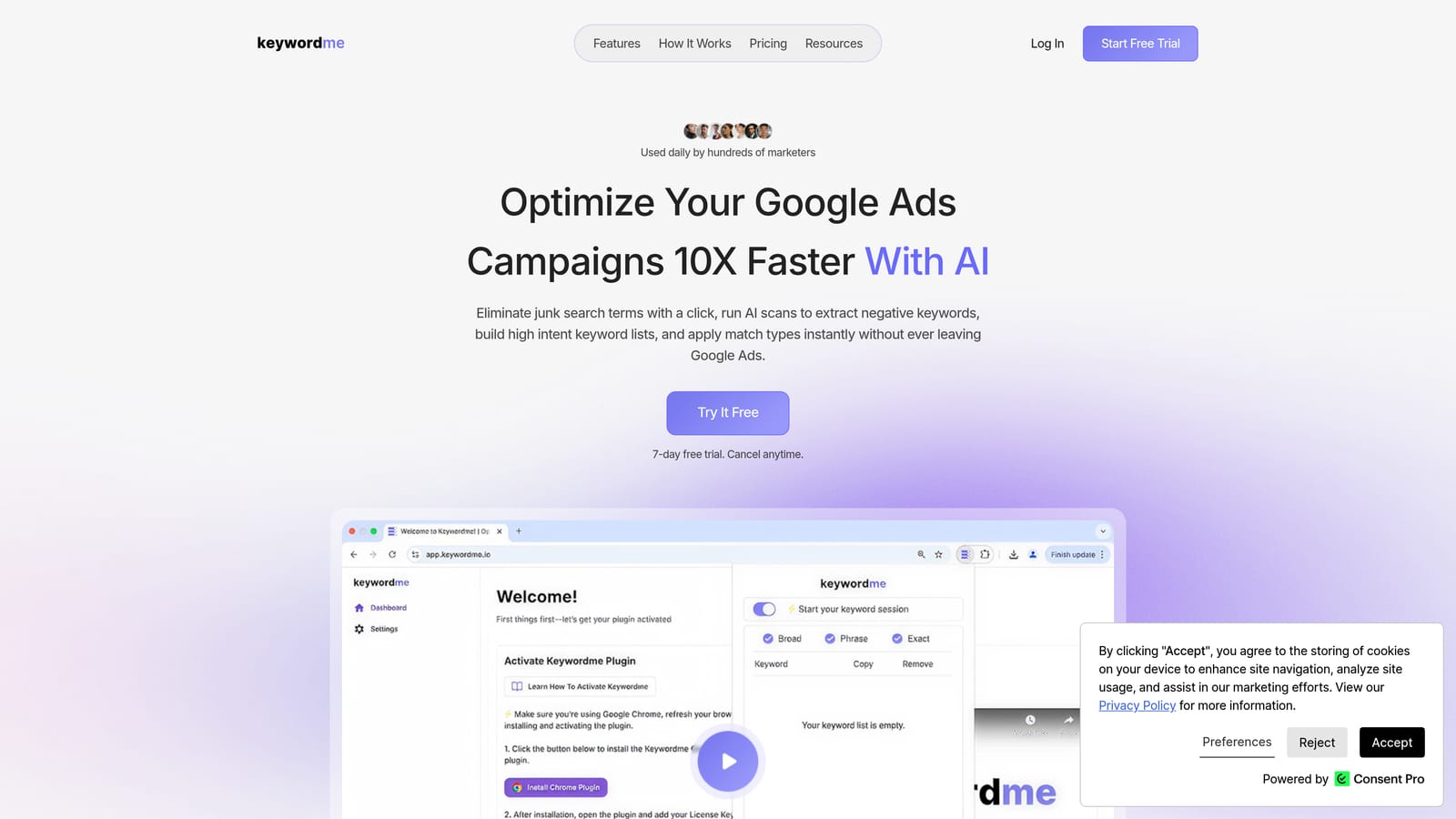
Keywordme is a Chrome extension that adds keyword clustering and one-click optimization tools directly inside Google Ads' Search Terms Report, with no exports or third-party dashboards required.
Where This Tool Shines
Most clustering tools require you to export data, work in a spreadsheet or external platform, then re-import your changes. Keywordme skips all of that. Because it lives inside the Google Ads interface itself, you can cluster search terms, apply match types, add negative keywords, and build new keyword groups without ever switching tabs.
This matters more than it sounds. The friction of exporting and re-importing is exactly why keyword management tasks get deferred. Keywordme removes that friction, which means the work actually gets done. For agencies handling multiple client accounts, the multi-account and team support makes it practical at scale, not just for solo advertisers.
Key Features
In-interface keyword clustering: Groups related search terms directly inside the Search Terms Report without requiring any data export.
One-click negative keyword addition: Lets you flag and remove junk search terms instantly, keeping ad groups cleaner without manual list-building.
Match type application: Apply broad, phrase, or exact match to keywords in bulk without leaving the native Google Ads UI.
Bulk editing: Make changes across multiple keywords and search terms simultaneously, which is especially useful when restructuring large ad groups.
Multi-account and team support: Designed for agency workflows where multiple users manage multiple client accounts from the same tool.
Best For
Freelancers and agency owners who spend significant time inside Google Ads and want to speed up the clustering and optimization process without adding another platform to their stack. Also a strong fit for in-house PPC managers who want faster execution on routine optimization tasks.
Pricing
$12/month per user, flat rate. A 7-day free trial is available with no commitment required.
2. Google Ads Keyword Planner
Best for: Advertisers who want free, native keyword grouping during campaign creation
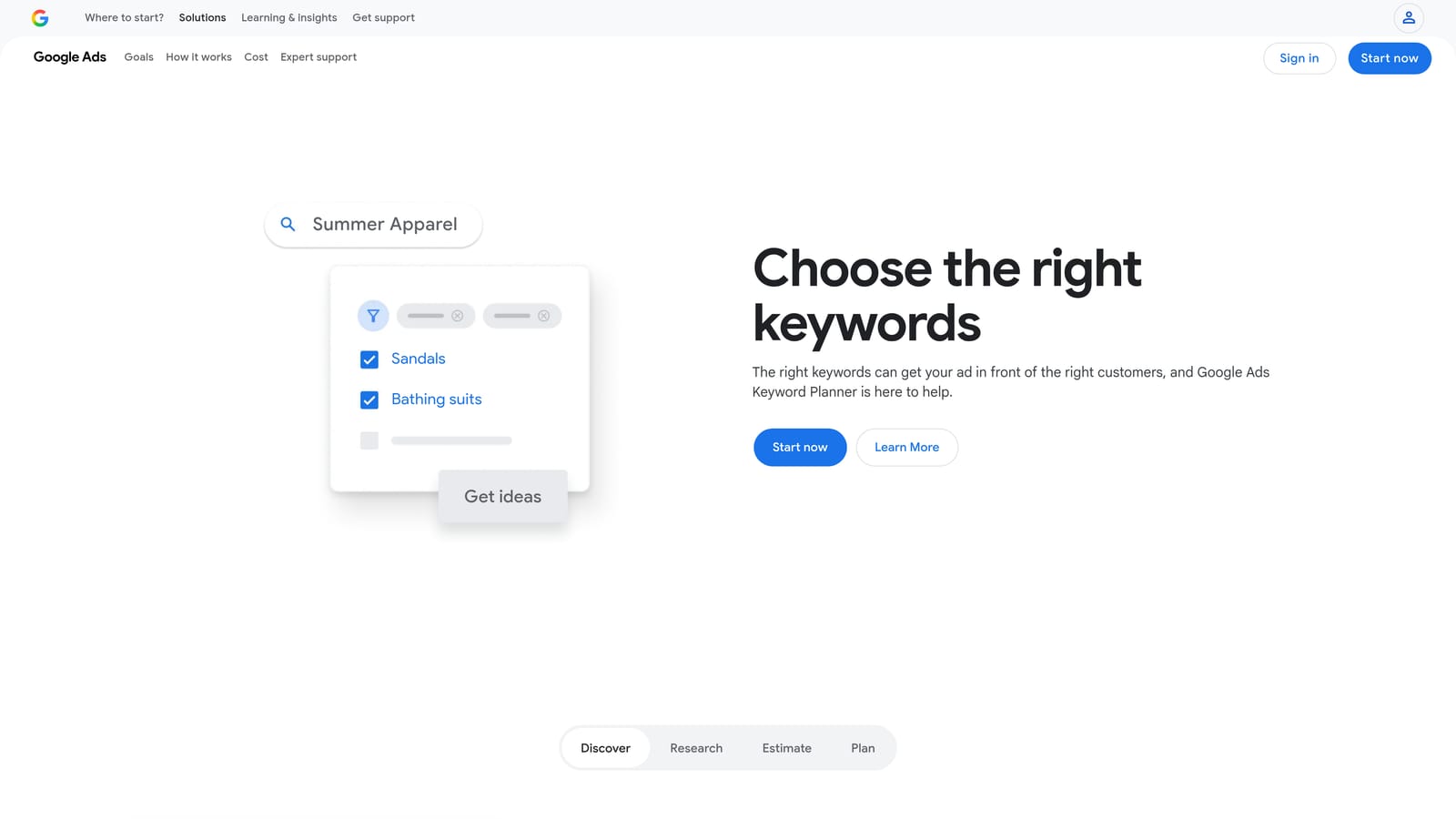
Google Ads Keyword Planner is Google's built-in research tool that automatically organizes keyword ideas into suggested ad groups as part of the campaign setup workflow.
Where This Tool Shines
Keyword Planner is the most accessible starting point for clustering because it's free and already inside your Google Ads account. When you enter seed keywords, it doesn't just return a flat list: it suggests how those keywords could be grouped into ad groups, which gives you a basic clustering structure to work from.
The forecasting feature is genuinely useful for PPC planning. You can see estimated clicks and spend by keyword group before committing budget, which helps validate whether a cluster is worth building out. The main limitation is that this tool is designed for new campaign creation, not for restructuring existing campaigns or analyzing live search term data.
Key Features
Automatic ad group suggestions: Groups keyword ideas into suggested ad group structures during the discovery phase.
Search volume and competition data: Provides volume estimates, competition levels, and bid range data for each keyword.
Forecasting tool: Estimates clicks and spend by keyword group to inform budget planning before campaigns go live.
Direct campaign integration: Keyword groups can be pushed directly into a new campaign without manual re-entry.
Free access: Available to any advertiser with a Google Ads account at no additional cost.
Best For
Advertisers building new campaigns from scratch who want a free, low-friction starting point for ad group structure. Less suited to optimizing existing campaigns or working with live search term data from running accounts.
Pricing
Free with any active Google Ads account.
3. SEMrush Keyword Magic Tool
Best for: Teams that need large-scale keyword research with intent filtering and PPC/SEO overlap
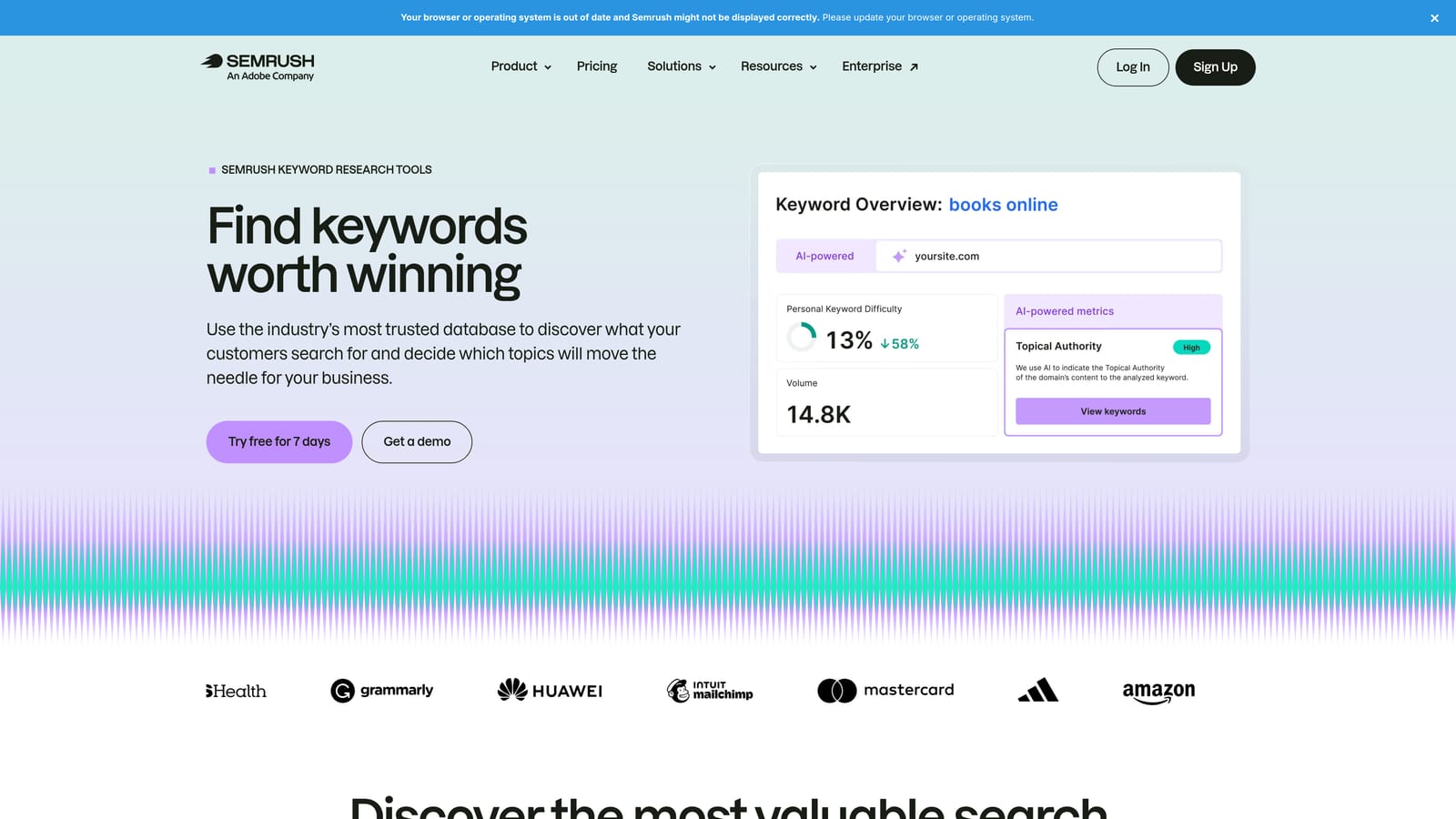
SEMrush Keyword Magic Tool is a keyword research platform with built-in topic grouping, intent classification, and a Keyword Manager for organizing clusters across both PPC and SEO campaigns.
Where This Tool Shines
SEMrush's database is large, and the Keyword Magic Tool does a solid job of breaking keyword results into topic and subtopic groups automatically. The search intent filters (informational, commercial, transactional, navigational) are particularly useful for PPC work because they help you separate keywords worth bidding on from those that are better suited to content.
The Keyword Manager feature lets you save and organize keyword clusters across projects, which is helpful when you're managing research for multiple campaigns or clients. The main caveat: SEMrush is primarily an SEO platform. PPC clustering is a secondary use case, and the tool doesn't connect directly to your Google Ads account for execution.
Key Features
Topic and subtopic grouping: Automatically organizes large keyword sets into themed groups based on subject matter.
Search intent filters: Classifies keywords by intent type so you can isolate commercially relevant clusters for PPC.
Keyword Manager: A dedicated space for saving, organizing, and refining keyword clusters across campaigns and projects.
CPC and competition data: Includes cost-per-click estimates and competition metrics relevant to paid search planning.
Google Ads export: Lets you export keyword clusters in a format compatible with Google Ads import.
Best For
Agencies and in-house teams with both SEO and PPC responsibilities who want a single research platform. If your work is PPC-only, the price point may be harder to justify given that the clustering features are secondary to SEMrush's core SEO functionality.
Pricing
Paid plans only; no free tier for full feature access. Verify current pricing at semrush.com before purchasing, as plans are updated periodically.
4. Ahrefs Keywords Explorer
Best for: Research-stage clustering using SERP-based grouping to identify which keywords can share an ad group
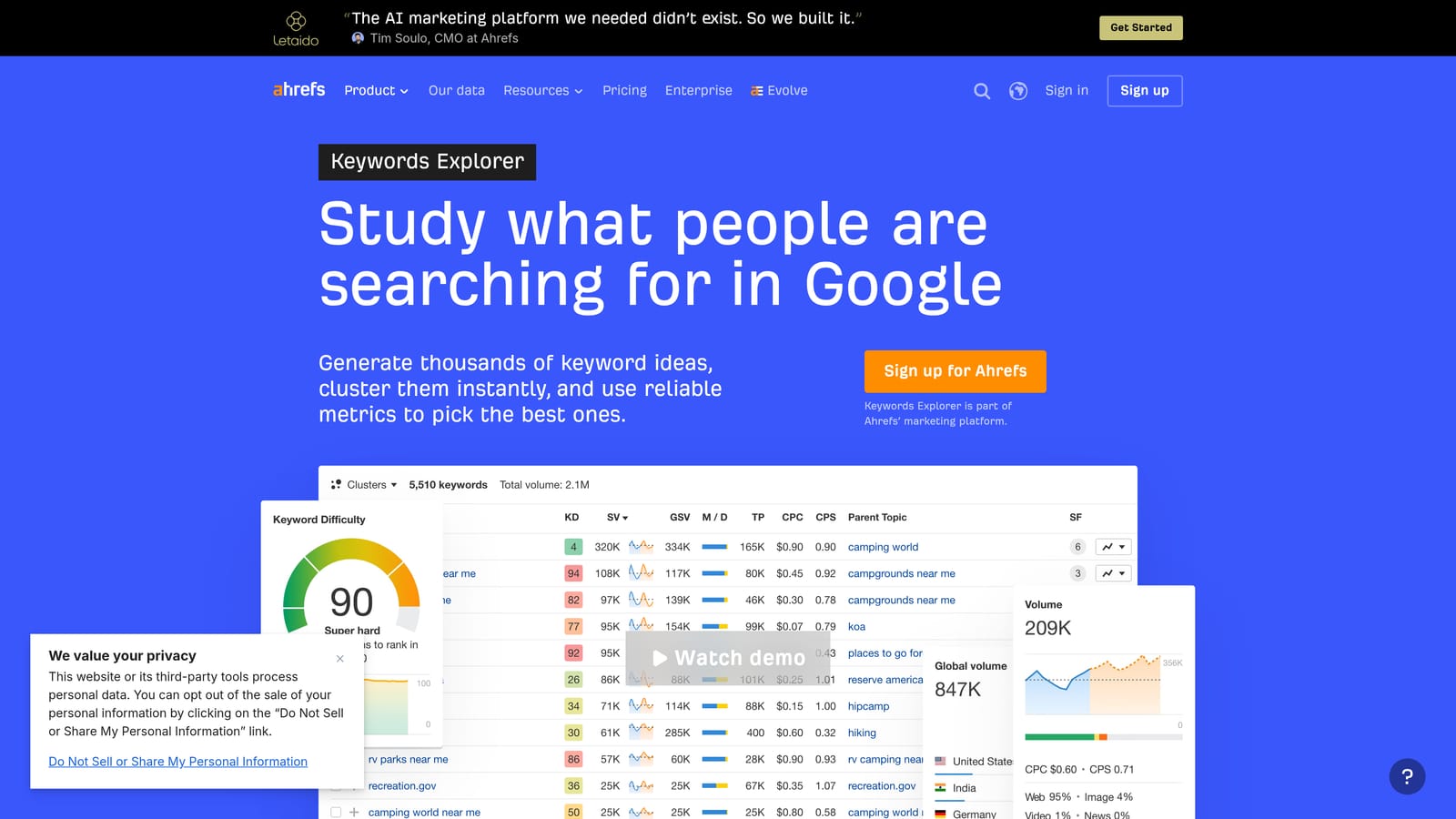
Ahrefs Keywords Explorer is a keyword research tool whose Parent Topic feature naturally surfaces clustering opportunities by grouping keywords that share the same top-ranking pages in search results.
Where This Tool Shines
Ahrefs takes a different approach to clustering than most tools on this list. Instead of grouping keywords purely by text similarity, the Parent Topic feature identifies which keywords tend to rank the same pages at the top of search results. For PPC, this is useful because it helps you identify which keywords genuinely share user intent and could realistically share an ad group and landing page.
The SERP overview feature lets you validate whether a proposed cluster actually makes sense before you build it out. Like SEMrush, though, Ahrefs is fundamentally an SEO research tool. There's no direct connection to Google Ads for execution, so your workflow still involves exporting and manually applying the clusters.
Key Features
Parent Topic grouping: Identifies which keywords share the same top-ranking pages, indicating genuine intent alignment for ad group planning.
SERP overview: Lets you validate cluster intent by seeing what actually ranks for each keyword before committing to a structure.
Click and traffic data: Provides click-through estimates alongside search volume, giving a more complete picture of keyword value.
Keyword difficulty and CPC estimates: Useful for prioritizing which clusters to build first based on competitiveness and cost.
Keyword lists: Allows you to organize and export clusters for use in campaign planning.
Best For
PPC practitioners who also manage SEO and want a research tool that informs both disciplines. Strong for the planning stage of campaign builds; not designed for ongoing campaign optimization or in-account execution.
Pricing
Paid plans only; verify current pricing at ahrefs.com. No free tier for Keywords Explorer access.
5. WordStream (LocaliQ)
Best for: Small to mid-sized advertisers who want guided keyword grouping within a broader campaign management workflow
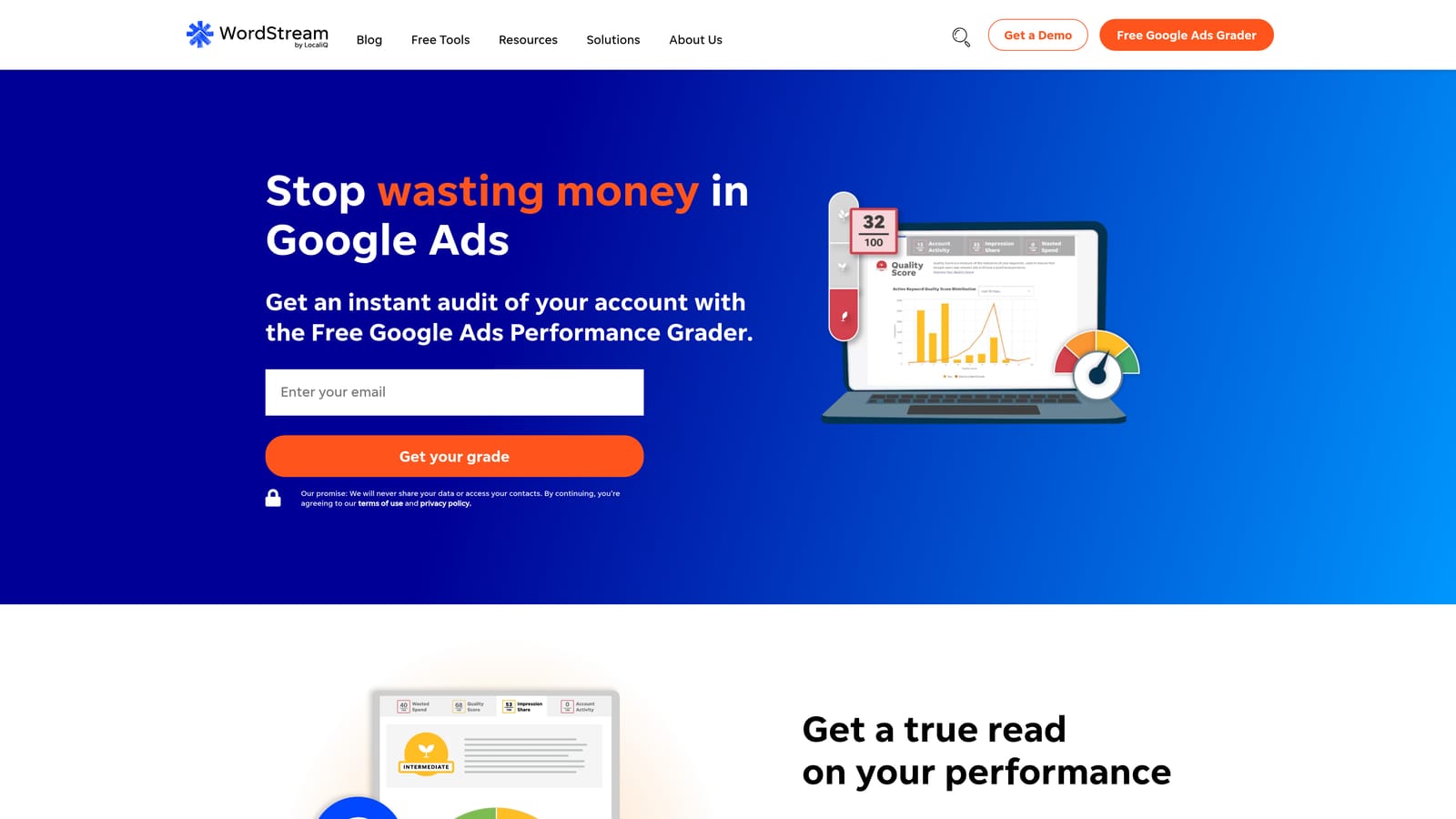
WordStream, now part of LocaliQ, is a Google Ads management platform with automated keyword grouping tools that suggest ad group structures based on your account's existing keyword and search term data.
Where This Tool Shines
WordStream's approach to clustering is workflow-driven rather than research-driven. Instead of starting from a blank keyword list, the platform analyzes your existing account data and surfaces grouping suggestions based on what's already running. This makes it practical for advertisers who want to improve structure in an active account without starting from scratch.
The negative keyword recommendations that appear alongside clustering suggestions are a useful pairing: you're not just grouping keywords, you're also identifying terms to exclude. The platform's guided interface is approachable for advertisers who don't want to manage everything manually, though more experienced PPC managers may find it less flexible than they'd like.
Key Features
Automated keyword grouping: Suggests ad group structures based on your existing account keywords and search term data.
Negative keyword recommendations: Surfaces exclusion opportunities alongside grouping suggestions to improve cluster quality.
Workflow-guided interface: Walks users through optimization tasks in a structured way, which reduces decision fatigue.
Performance grader: Audits your campaign structure and flags keyword organization issues that may be affecting results.
Google Ads and Microsoft Ads integration: Works across both major paid search platforms.
Best For
Small business advertisers and freelancers managing a moderate number of accounts who want a guided optimization experience. Agencies with complex multi-account needs may find the platform less suited to their scale than tools like Optmyzr.
Pricing
Paid platform; pricing has changed since the LocaliQ acquisition. Verify current plans and rates at wordstream.com before committing.
6. Optmyzr
Best for: Agencies managing multiple accounts who need automated keyword grouping and campaign restructuring at scale
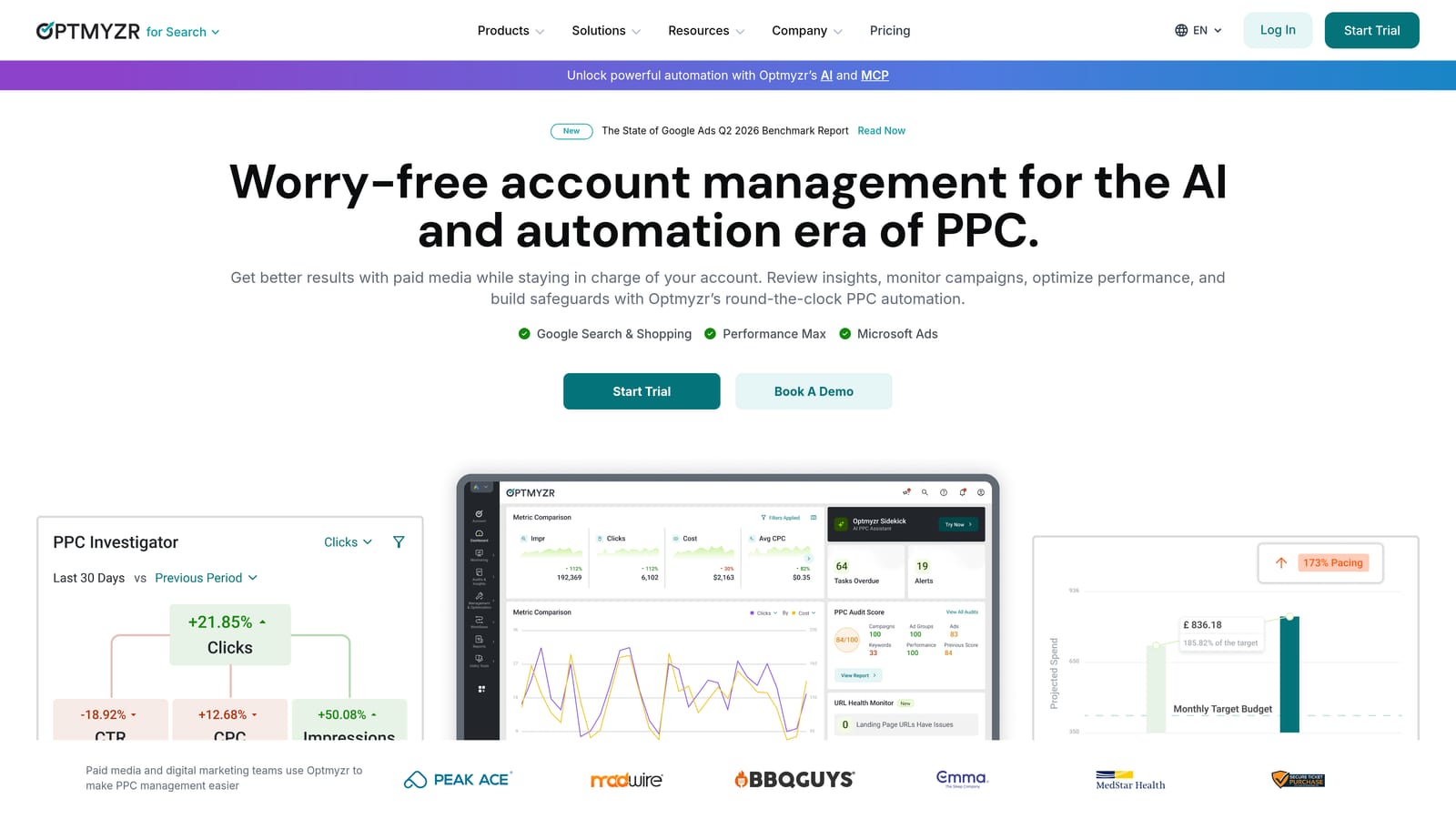
Optmyzr is an agency-focused PPC management platform with rule-based and AI-assisted tools for keyword grouping, campaign restructuring, and bulk optimizations across multiple accounts.
Where This Tool Shines
Optmyzr is built for teams managing volume. The Campaign Automations feature lets you set up rule-based workflows that can trigger clustering and restructuring actions automatically, which is valuable when you're handling dozens of accounts and can't manually review every keyword group on a regular cadence.
The audit tools are particularly useful for agencies taking on new clients: they surface keyword structure issues quickly, which helps you identify where clustering work is needed before diving in. The platform integrates with Google Ads, Microsoft Ads, and Amazon Ads, which is an advantage for agencies with mixed channel responsibilities.
Key Features
Campaign Automations: Rule-based workflows that can trigger keyword grouping and restructuring actions automatically across accounts.
Multi-account management: Designed for agencies managing multiple client accounts with team collaboration support.
Audit and reporting tools: Surfaces keyword structure issues and campaign inefficiencies across accounts at a glance.
AI-assisted optimization: Offers AI-assisted recommendations for keyword management alongside rule-based automation.
Cross-platform integration: Works with Google Ads, Microsoft Ads, and Amazon Ads from a single interface.
Best For
Mid-to-large agencies with significant account volume who need automation and team collaboration built into their clustering and optimization workflow. The pricing reflects this positioning: it's less suited to solo advertisers or small freelance operations.
Pricing
Paid plans; pricing starts at a higher tier suited to agency budgets. Verify current rates at optmyzr.com, as plans are updated periodically.
7. Keyword Insights
Best for: SERP-based keyword clustering for PPC ad group structuring and content planning
Keyword Insights is an AI-powered clustering tool that groups keywords by SERP similarity and search intent rather than text matching alone, making it useful for both PPC ad group planning and content strategy.
Where This Tool Shines
The key differentiator here is how Keyword Insights clusters. Instead of grouping keywords that look similar in text, it analyzes which keywords return overlapping search results. If two keywords consistently surface the same pages in Google's results, the tool treats them as belonging to the same cluster. For PPC, this means your ad groups are built around genuine intent alignment, not just surface-level keyword similarity.
The search intent classification layer adds another useful filter for paid search work. You can separate transactional and commercial clusters (worth bidding on) from informational ones (better suited to content) before you start building ad groups. The main limitation is that this tool is a standalone platform: there's no direct connection to Google Ads, so clustering happens outside the interface.
Key Features
SERP-based clustering: Groups keywords by actual search result overlap rather than text similarity, producing intent-aligned clusters.
Search intent classification: Labels clusters by intent type (informational, commercial, transactional) to guide PPC versus content decisions.
Bulk keyword processing: Handles large keyword uploads and returns cluster reports at scale.
Exportable cluster reports: Outputs clusters in a format suitable for ad group planning and campaign builds.
Content brief generation: Useful for aligning landing page content with cluster intent, which supports Quality Score improvement.
Best For
PPC managers and content teams who want SERP-validated clustering rather than text-based grouping. Particularly useful for large keyword sets where manual grouping would take significant time.
Pricing
Credit-based and subscription tiers available; verify current pricing at keywordinsights.ai as plans are subject to change.
8. DataForSEO
Best for: Technical teams building custom keyword clustering pipelines with full control over the logic
DataForSEO is an API-first data platform that provides keyword data, search volumes, and SERP results for teams who want to build custom clustering workflows without relying on a pre-built tool's logic.
Where This Tool Shines
DataForSEO doesn't cluster keywords for you. What it does is give you the raw data, keyword metrics, SERP results, related keyword suggestions, and search volumes, so your team can build the clustering logic that fits your exact needs. If you've ever found that off-the-shelf clustering tools group things in ways that don't match how you actually structure campaigns, this is the alternative.
The pay-per-use pricing model is a genuine advantage for teams that need data in bursts rather than on a continuous basis. You're not paying a monthly platform fee when you're not actively running a clustering project. The obvious limitation: this is a developer tool. If your team doesn't have someone comfortable working with APIs, DataForSEO won't be usable in its raw form.
Key Features
Keyword data API: Returns search volume, CPC, and competition metrics for any keyword set you query.
SERP API: Provides live search result data that teams can use to build SERP-similarity clustering logic from scratch.
Keyword suggestions endpoint: Surfaces related keywords and subtopics to expand cluster coverage during research.
Pay-per-use pricing: No mandatory subscription; you pay for the API calls you make, which suits project-based workflows.
Language and platform flexibility: Supports custom workflows built in any programming language, with no constraints on how you apply the data.
Best For
In-house development teams and technically sophisticated agencies who want to build proprietary clustering tools or integrate keyword data into existing internal systems. Not suitable for non-developers or teams looking for a ready-to-use clustering interface.
Pricing
Pay-per-use API credits; verify current rates and credit packages at dataforseo.com.
Keyword Grouping for Small Business: A Simple Starting Framework
Small accounts don't need an enterprise clustering platform. They need ad groups tight enough that each ad and landing page matches what people actually search. Here's a lightweight way to get there.
Group by intent first, wording second
Start with the service or product you sell, then split keywords by what the searcher wants. "Emergency plumber near me" and "how to fix a leaking tap" share words but not intent. The first belongs in a campaign; the second probably doesn't belong in one at all.
A practical process for small budgets
- Pick one offer per campaign. Each service, product line, or location gets its own campaign so budget isn't split between unrelated goals.
- Keep ad groups to one theme. A good test: could one headline and one landing page honestly answer every keyword in the group? If not, split it.
- Start small. Aim for a handful of tightly related keywords per ad group rather than long lists. You can expand once the data shows what converts.
- Mine your Search Terms Report. Real queries that triggered your ads are the best source for new groups. Promote converting terms to their own ad group and add irrelevant ones as negative keywords.
- Review monthly. Small accounts change slowly, so a regular search-term review is usually enough to catch drifting groups.
Which tool fits a small business
If you're building a campaign from scratch, Google Ads Keyword Planner is free and gives you suggested groupings. If you already have a running account, working directly from your search terms is more useful than external research, and Keywordme lets you do that inside the Search Terms Report for a flat $12/month per user. SERP-based tools like Keyword Insights or the SEO suites above are usually more than a small account needs.
Which Tool Is Right for Your Workflow
The best clustering tool isn't necessarily the most powerful one. It's the one you'll actually use consistently. If a tool adds friction to your process, it won't get used, and your keyword structure will stay messier than it should be.
Here's a quick guide by situation:
Solo advertiser on a budget: Start with Google Ads Keyword Planner for research, then use Keywordme to cluster and optimize directly inside your account. You get solid coverage without paying for a full SEO suite.
Freelancer managing multiple clients: Keywordme's multi-account support and in-platform speed make it the most practical choice for fast, repeatable optimization across accounts without context-switching between tools.
Agency with both SEO and PPC responsibilities: SEMrush or Ahrefs for the research and planning phase, then Keywordme for execution inside Google Ads. The two layers complement each other without overlap.
Agency wanting full automation at scale: Optmyzr is built for this. The rule-based automation and multi-account infrastructure suit teams running high volumes of accounts where manual review isn't realistic.
Technical team wanting custom pipelines: DataForSEO gives you the raw data to build exactly what you need, with no constraints on clustering logic or workflow design.
Teams prioritizing intent-validated clusters: Keyword Insights is worth evaluating if SERP-based grouping matters more to you than text similarity, particularly for large keyword sets where manual validation isn't feasible.
If you want to start with the tool that removes the most friction from your day-to-day Google Ads work, Keywordme is worth trying first. It fits directly into the workflow you already have, rather than adding a new one alongside it.
Keywordme lets you remove junk search terms, build high-intent keyword lists, and apply match types instantly, right inside Google Ads. No spreadsheets, no switching tabs, just faster optimization where you're already working. Start your free 7-day trial and see how much time you get back on your next optimization session.
.svg)