
Google Ads Broad Match Out of Control? Here's How to Fix It
Google Ads Broad Match Out of Control? Here's How to Fix It


You log into Google Ads, open the search terms report, and instantly know something's off. Queries are drifting. Spend is climbing. Clicks are coming in from searches that make you wonder whether Google even read your keyword list.
If your Google Ads broad match feels out of control, that reaction is fair. Plenty of smart advertisers have had the same moment lately. The fix is not to panic, slash everything blindly, and hope the account settles down on its own. The fix is to regain control in layers: stop the waste, understand why it happened, then rebuild the structure so it doesn't keep happening.
That Sinking Feeling Your Ad Spend is Spiraling
The ugly version of broad match usually shows up fast. A campaign looked fine at launch. Maybe performance even looked promising for a minute. Then the search terms start widening, your click quality drops, and you realize the machine is interpreting “related intent” a lot more generously than you would.
That's not just you being overly cautious. Google changed the environment. A major shift came in July 2024, when broad match became the default for new Search campaigns, paired with a campaign-level setting that can force all keywords to broad match when conversion-based Smart Bidding is active, as covered by Search Engine Land's reporting on Google's broad match control changes. That changed the baseline. Broad match stopped being a selective experiment in many accounts and started becoming part of the default setup.
So when someone says, “My Google Ads broad match is out of control,” I usually don't treat that as amateur panic. I treat it as a valid read on the platform. The system now gives automation more room, and manual guardrails less room, unless you put them back in yourself.
Practical rule: Broad match is not broken. But unmanaged broad match is expensive.
There's also a psychological trap here. A lot of PPC managers still assume the campaign is behaving the way it behaved a couple of years ago. It often isn't. The account might look familiar, but the matching logic underneath it has shifted enough that old habits can leave you exposed.
If your budget suddenly feels slippery, start by assuming the problem is structural, not personal. Then act accordingly. If you need help spotting where spend is leaking before you touch the account, this breakdown on why your Google Ads spend is so high is a useful companion.
What this feeling usually means
| Signal | What it often points to |
|---|---|
| Irrelevant search terms | Broad match is stretching intent too far |
| Spend jumps without quality | Smart Bidding is learning from messy signals |
| Conversions get less predictable | Search traffic quality is mixed |
| Team loses confidence in the account | Structure and monitoring lag behind automation |
The good news is that broad match chaos is usually reversible. You just can't solve it with one negative keyword list and wishful thinking.
Your First 15 Minutes Taming The Beast
When broad match starts spraying budget into nonsense, the first job is not elegance. It's containment.
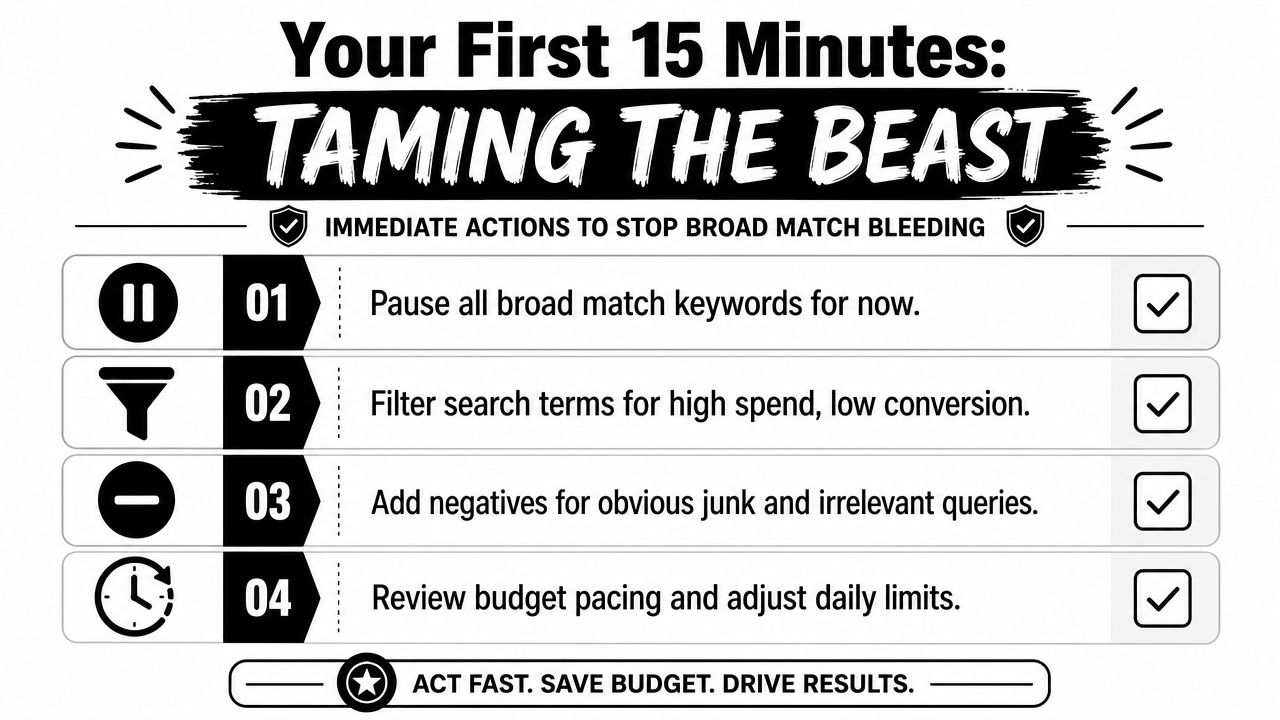
Open the one report that matters
Go straight to the Search terms report. Don't get distracted by campaign summaries, recommendation tabs, or broad performance charts. You need to see the actual queries.
Filter for the obvious offenders first.
- High spend, no business intent: Terms that are clearly researchy, educational, freebie-seeking, job-seeking, or unrelated.
- Clicks with zero conversion value to date: Not because every non-converting query is bad, but because this filter quickly surfaces waste.
- Brand mismatches: Searches for competitors, adjacent services, or products you don't sell.
- Geographic junk: Locations you don't serve, especially if your targeting settings are loose.
The reason this matters is simple. Broad match can drift into searches that are only loosely related in meaning. Industry guidance still reflects that tension. One industry source says only 62% of advertisers use broad match as a primary match type, which tells you a substantial minority still avoid leaning on it too hard, as noted in Eight Oh Two's broad match guidance.
Make quick decisions, not perfect ones
In the first pass, I use a rough triage rule. Every bad search term gets one of three reactions immediately.
- Add as a negative now if it's obviously wrong.
- Pause the broad keyword or ad group if the junk is widespread and not isolated.
- Leave it alone for the moment only if the query is imperfect but plausibly relevant.
Don't overthink single-query edge cases while the budget is still leaking.
If the search term makes you say, “Technically maybe, but probably not,” it usually belongs on the watchlist, not in the active budget path.
Use a fast negative sweep
Build a temporary “stop the bleeding” negative list. This is not your polished master list. It's your emergency brake.
Good candidates usually include:
- Job intent
- Training and education intent
- Free or low-intent bargain hunting
- DIY and informational modifiers
- Adjacent categories you never want
If you need a solid refresher on the mechanics, this guide on how to cut wasted ad spend with negative keywords is worth keeping handy.
Pull the pause lever when needed
A lot of advertisers wait too long to pause broad match because they're afraid of losing volume. That fear is understandable, but bad volume isn't helping you. If one ad group is generating mostly junk, pause it and protect the account while you sort out the root issue.
A simple emergency checklist looks like this:
- Pause broad match first: If you need immediate control, this buys time.
- Check budget pacing: Make sure one unstable campaign isn't swallowing the day.
- Scan location and device segments: Sometimes “broad match problem” is really broad match plus loose targeting.
- Review conversion actions: If the account is optimizing against soft or messy conversions, broad match can go wandering.
What not to do in those first minutes
| Bad reaction | Why it backfires |
|---|---|
| Adding hundreds of negatives blindly | You can block useful future traffic |
| Rebuilding campaign structure immediately | You'll do surgery while the patient is still bleeding |
| Trusting Recommendations to fix it | Automation won't reliably undo automation problems |
| Leaving broad active “to gather more data” | If the data is junk, you're paying to learn the wrong lesson |
The first 15 minutes should leave the account calmer than you found it. That's enough for now.
The Deep Audit Rebuilding Your Ad Groups
Once the budget leak is contained, the account needs an audit that goes beyond yesterday's panic. Pull a wider search term window and read it like a pattern-finding exercise, not a cleanup chore.
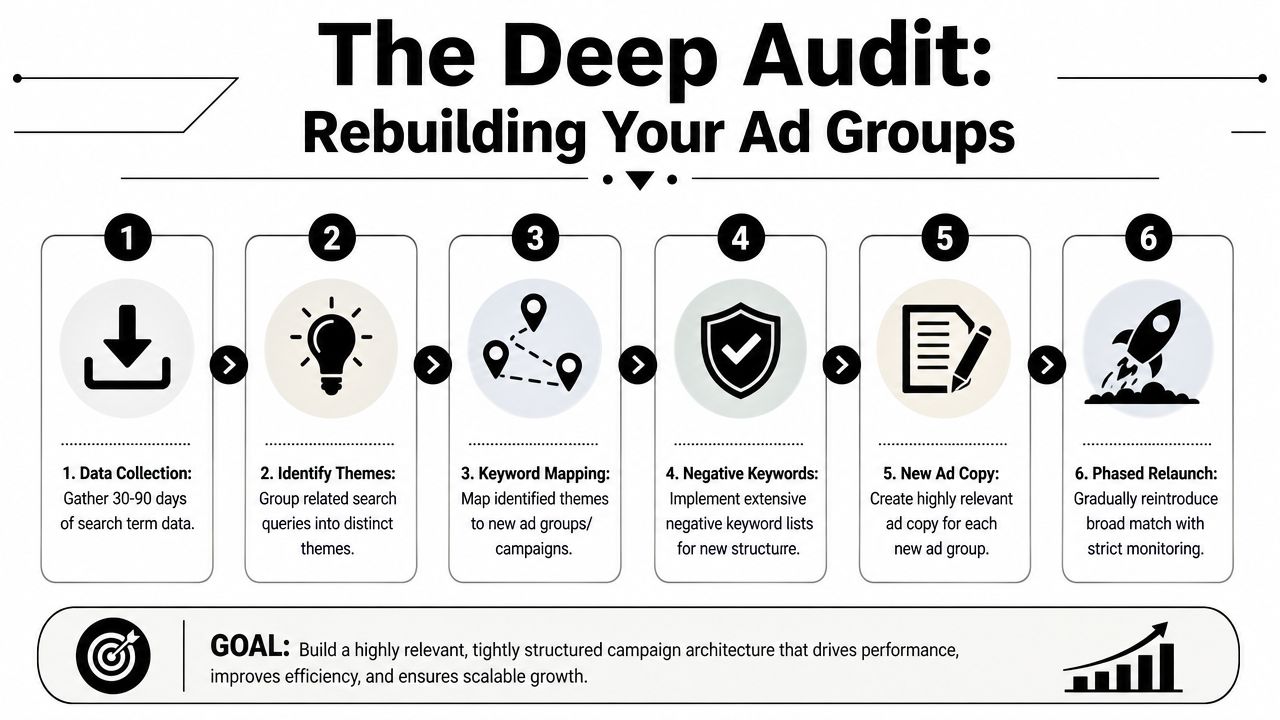
Sort every search term into three buckets
At this point, broad match stops being only a threat and starts becoming market research.
I use three buckets.
Junk
These are the easy rejects. They include irrelevant audiences, unrelated product categories, informational rabbit holes, and anything that clearly doesn't belong.
Add these to negatives at the right level. Some belong at the ad group level. Others belong campaign-wide. A few belong on a shared list if they're toxic across the account.
Gems
These are the terms broad match found that deserve a promotion. They're tightly aligned with your offer, they show solid intent, and they deserve their own cleaner path.
Don't leave gem queries buried inside a broad match keyword forever. Pull them out and build around them using tighter match types, dedicated ad copy, and a landing page that speaks directly to that query theme.
Maybe
This is the category most advertisers mishandle. “Maybe” terms aren't junk, but they aren't proven enough to graduate. They often represent adjacent intent, vague wording, or searches that could convert in the right context.
These belong on a watchlist. Monitor them. Group them. See whether they repeat. Don't rush to kill them or crown them.
Audit lens: Broad match chaos becomes useful once you separate discovery from decision-making.
Rebuild around themes, not keyword piles
A lot of ad groups go off the rails because they were never tightly themed to begin with. Broad match just exposes the weakness faster.
If an ad group contains multiple intentions, Google has too much room to interpret relevance. Your ad copy gets generic. Your landing page fit gets weaker. Your negatives become reactive instead of strategic.
A cleaner rebuild usually looks like this:
- One clear intent per ad group: Don't mix service variants, audience types, and product categories unless they belong together.
- Dedicated ads per theme: The headline should feel like a direct continuation of the query.
- Landing page alignment: If the page answers a different problem than the query, the whole system gets noisier.
- Negative separation between themes: Protect ad groups from cannibalizing each other.
For a more detailed framework on structure, this guide on how to create tight ad group structure is useful.
A practical sorting workflow
Here's a simple way to work through a search term export without drowning in it:
| Bucket | Action | Outcome |
|---|---|---|
| Junk | Add as negative | Less waste |
| Gem | Promote to phrase or exact | More control |
| Maybe | Tag and monitor | Better decisions later |
Here, many accounts recover. Not because the negatives alone fix everything, but because the search term report starts feeding a better architecture.
Rebuild the campaign map
Once themes emerge, redraw the account.
Maybe one bloated ad group becomes three focused ad groups. Maybe one “catch-all” campaign gets split by product line or intent. Maybe branded and non-branded traffic need cleaner separation. Maybe discovery traffic needs its own sandbox.
That map matters because broad match behaves very differently in a tightly designed account than it does in a loose one.
A strong rebuild often includes:
- A core performance lane built around proven themes.
- A controlled discovery lane where broader matching is allowed to explore.
- A negative keyword system that protects both lanes from overlap and junk.
What works and what doesn't
What works
- Promoting repeat high-intent queries into tighter match types
- Splitting vague ad groups into clean themes
- Writing ads that match the actual query language
- Using negatives to separate intent, not just block nonsense
What doesn't
- Keeping everything in one broad-heavy campaign
- Letting “close enough” messaging cover multiple intents
- Treating all non-converting search terms as bad
- Leaving your best discoveries trapped in broad match forever
The point of the audit isn't just to stop damage. It's to turn search term chaos into a stronger account than you had before.
Advanced Strategies for Long-Term Control
If your whole plan is “keep adding negatives forever,” you'll stay busy, but you won't stay in control. That's maintenance, not strategy.
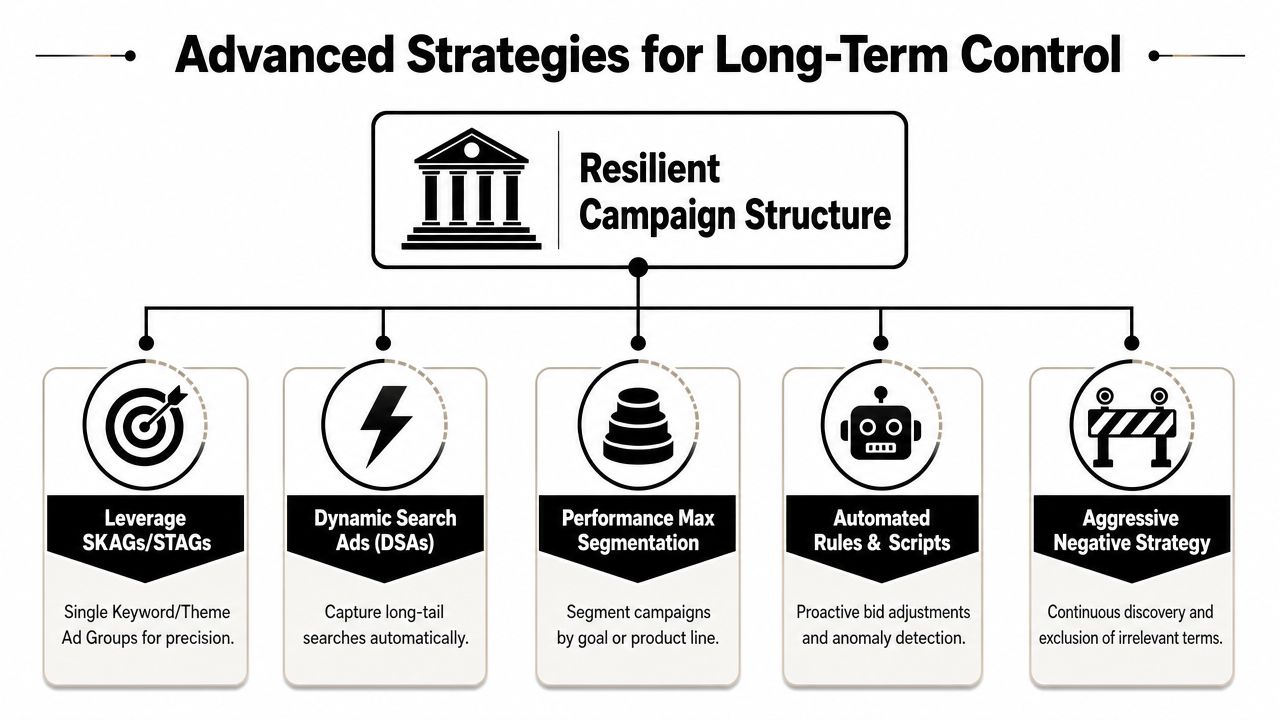
Split discovery from performance
One of the cleanest ways to handle broad match is to stop asking it to do two jobs at once.
Broad match is decent at discovery when the account has clear guardrails. It is not the best place to house your most important, proven queries indefinitely. Those should live in tighter environments where you can control message, budgets, and expectations.
That's why separate campaign lanes work so well:
- One lane for discovery, where broad match explores
- One lane for performance, where phrase and exact carry the proven terms
This can look like an Alpha/Beta setup, a mirror campaign approach, or any other naming system you prefer. The label matters less than the separation.
Separate the campaign that learns from the campaign that pays the bills.
Use layered bidding logic
Not every keyword deserves the same level of aggression. Broad match especially shouldn't get identical treatment to your proven intent terms.
Here's a practical perspective:
| Traffic type | Bid posture | Why |
|---|---|---|
| Broad discovery | More cautious | Exploration carries more noise |
| Phrase winners | Moderate to assertive | Good balance of control and reach |
| Exact proven terms | Most assertive | This is where you want precision |
The exact bidding method depends on the account, but the principle holds. Broad match should earn trust. It shouldn't receive it automatically.
Feed Smart Bidding clean signals
Broad match and Smart Bidding can work together. But when they fail, they usually fail together.
If the account is optimizing on weak lead quality, duplicate conversions, soft engagement actions, or poorly prioritized goals, broad match gets the wrong feedback loop. It starts chasing what the system says is valuable, even if your sales team knows it isn't.
A few things make a real difference:
- Primary conversion hygiene: Keep only meaningful business actions as optimization targets.
- Consistent naming and tracking: Don't let reporting ambiguity cloud bidding signals.
- Lag awareness: Give the system enough time to learn, but not so much time that it burns through obvious waste.
Build controlled experimentation into the structure
The best accounts don't “set and forget” broad match. They give it a fenced-in area to prove itself.
A controlled test environment usually includes:
- a dedicated budget,
- tightly defined themes,
- aggressive search term review,
- and a process for promoting winners out of broad match quickly.
That last point matters. If a term keeps proving itself, move it. Let broad match continue discovering. Let tighter match types handle harvesting.
Don't confuse automation with strategy
Google can automate matching. It cannot define your business boundaries for you.
That's still your job. Your account structure, conversion setup, budgets, negatives, and promotion rules are what keep automation useful instead of chaotic. The advertisers who stay calm with broad match usually aren't luckier. They've just built systems that assume drift will happen and catch it early.
Automate Your Defenses with Keywordme
Manual cleanup works. It also gets old fast.
If you've ever spent an afternoon exporting search terms, tagging junk in a spreadsheet, formatting match types by hand, then copying everything back into Google Ads, you already know the problem. The process is slow, repetitive, and easy to mess up when the account is large.

Use the same audit logic, just faster
The workflow doesn't change. You still identify junk, gems, and maybe terms. What changes is the amount of friction between spotting an issue and acting on it.
With Keywordme, the useful part is that you can handle keyword management directly inside the Google Ads workflow instead of bouncing between exports and manual formatting. That matters more than people think. The fewer handoffs in the process, the fewer delays and mistakes.
A practical way to use it looks like this:
- Review live search terms inside your normal optimization flow.
- Select obvious junk terms in bulk.
- Push them into negative keywords without the copy-paste circus.
- Pull strong search terms into new keyword builds with the intended match type.
- Repeat regularly before the account drifts too far.
Bulk actions are the real win
The scaling problem in PPC usually isn't knowing what to do. It's doing it consistently when there are too many terms to manage by hand.
That's where tools earn their keep. Not because they invent strategy for you, but because they remove the admin load that stops good strategy from getting executed.
Keywordme is especially useful for:
- Negative keyword cleanup at scale
- Promoting search terms into structured keyword sets
- Applying match types quickly
- Reducing spreadsheet dependency
- Keeping search term mining practical across bigger accounts
Keep the human judgment, drop the manual grind
This is the important distinction. Automation should handle repetitive actions, not final judgment.
You still decide whether a term is junk, a gem, or a maybe. You still decide where a keyword belongs. You still set the campaign boundaries. But you don't need to spend half your day formatting and re-entering data to make those decisions real.
The best PPC automation removes keyboard work. It shouldn't remove thinking.
If you want a closer look at that workflow, this article on automating Google Ads keyword management walks through the process in more detail.
For teams managing multiple clients or large in-house accounts, that operational speed matters. Broad match doesn't become safer because the platform suddenly got gentler. It becomes safer because your response time gets shorter.
Building a Bulletproof Monitoring Routine
A lot of advertisers still treat monitoring like cleanup after a problem. That mindset is why broad match gets scary. Control comes from routine, not rescue.
A professional monitoring rhythm doesn't need to be dramatic. It just needs to happen consistently.
Daily checks that take minutes
Every day, look for the stuff that can hurt you quickly:
- Budget pacing: See whether one campaign is running away early.
- Search term outliers: Scan for obvious junk themes.
- Conversion weirdness: Watch for sudden drops, spikes, or low-quality lead patterns.
Weekly review that keeps structure healthy
Once a week, slow down enough to spot patterns:
- Mine search terms for negatives and promotions
- Review ad group theme integrity
- Check whether broad terms still belong where they sit
- Look for repeated “maybe” queries that now deserve a decision
Monthly review that protects the system
Now, you stop acting like a medic and start acting like an account manager.
| Cadence | Focus |
|---|---|
| Daily | Catch waste early |
| Weekly | Refine search terms and themes |
| Monthly | Rework structure, bidding, and conversion quality |
The common assumption is that broad match becomes manageable once you “fix” it. Not really. It becomes manageable once you build a habit that catches drift before it turns into a spend problem again.
Broad match can still be useful. It just needs adult supervision.
If you're tired of handling search term cleanup, negative lists, and match type promotion the slow way, Keywordme helps you do the work directly inside your Google Ads workflow. It's a practical way to clean up junk faster, build tighter keyword structures, and keep broad match from turning into a weekly fire drill.
.svg)