
Campaign Budget Optimization: Maximize ROI in 2026
Campaign Budget Optimization: Maximize ROI in 2026


SEO Title: Campaign Budget Optimization for Better ROI
Meta Description: Campaign budget optimization playbook for Google Ads. Find wasted spend, set smarter budgets, automate cleanup, and protect ROI long term.
Most Google Ads accounts don't have a budgeting problem first. They have a visibility problem.
You open the account, see spend climbing, conversions wobbling, and one campaign eating more budget than it should. The instinct is to start adjusting budgets right away. Raise one. Cut another. Pause a few keywords. Then performance gets noisier, not cleaner.
That's usually what happens when budget changes come before diagnosis.
Good campaign budget optimization isn't a string of random tweaks. It's a system. You audit where money leaks, rank what deserves funding, give automation enough room to work, and build a repeatable workflow so waste doesn't creep back in next week. That's the part many guides skip. They give you a checklist, but not an operating model.
This playbook is built for managers who want tighter control without living inside reports all day. If your account feels like it's spending with more enthusiasm than discipline, start here.
Diagnose Your Budget Bleed Before You Optimize
A PPC budget audit works like a medical diagnosis. You don't prescribe treatment before you know what's wrong.
The first pass is simple. Look for places where spend and intent are out of sync. In Google Ads, that usually means the Search Terms Report, segmented performance, and impression share diagnostics. If you're making budget decisions without those three views, you're guessing.

Start with the search terms that shouldn't exist
Most wasted spend hides in plain sight. Broad match drift, weak negative keyword coverage, and legacy ad groups pull in queries that look related but don't buy.
Use this review order:
- Sort by spend first: Expensive search terms with no conversions deserve attention before low-volume clutter.
- Check intent mismatch: Queries can be relevant to the product category and still be wrong for the offer.
- Look for repeat junk themes: One bad query is a cleanup task. A recurring pattern means account structure or match type control is weak.
- Separate poor traffic from poor conversion pages: Sometimes the keyword is fine and the landing page is the actual problem.
If your spend feels inflated and you need a practical troubleshooting checklist, this breakdown on why Google Ads spend gets so high is worth keeping nearby.
Use impression share to tell the real story
The Impression Share Lost (Budget) column is one of the fastest ways to stop budget debates based on gut feel. If a campaign is profitable and regularly losing impression share due to budget, more budget may help. If it isn't converting well, that same signal often means you're underfunding the wrong thing.
That's the difference between scarcity and misallocation.
A lot of teams also miss a bigger commercial point. Budget optimization should connect back to margin, product mix, and demand quality, not just lead volume. That's where broader revenue optimization thinking helps. It forces you to ask whether you're funding revenue that the business wants.
Practical rule: If you can't explain where wasted spend is happening by query, device, location, or hour, you're not ready to change budgets yet.
Segment the account until waste becomes obvious
A campaign can look healthy in aggregate and still burn money in one pocket. Break results out by device, location, and time of day.
A few patterns show up often:
| Segment | What to look for | Common action |
|---|---|---|
| Device | High spend with weak conversion efficiency on one device type | Adjust bids, landing page flow, or campaign split |
| Location | Regions spending without quality leads or sales | Exclude, downweight, or isolate |
| Time of day | Hours that absorb budget but rarely convert | Tighten ad scheduling |
Low-budget accounts need this level of scrutiny even more. For campaigns with low budgets, such as under $50 per day, fragmentation across multiple ad sets can cause the algorithm to struggle and can lead to a 40% reduction in ad set delivery, according to KlientBoost's campaign budget optimization analysis. When delivery gets uneven, the platform may skip pockets of traffic entirely, which makes both winners and losers harder to spot.
That matters because bad budgeting often isn't one big leak. It's ten smaller ones.
Prioritize Campaigns with a Tiered Budget Strategy
Flat budget allocation is one of the fastest ways to fund mediocrity.
Every account has a few campaigns carrying the load, a few with upside, and a few that are mostly there because nobody has made a hard decision yet. Treating them all the same makes optimization slower and politics louder. A tiered model fixes that.
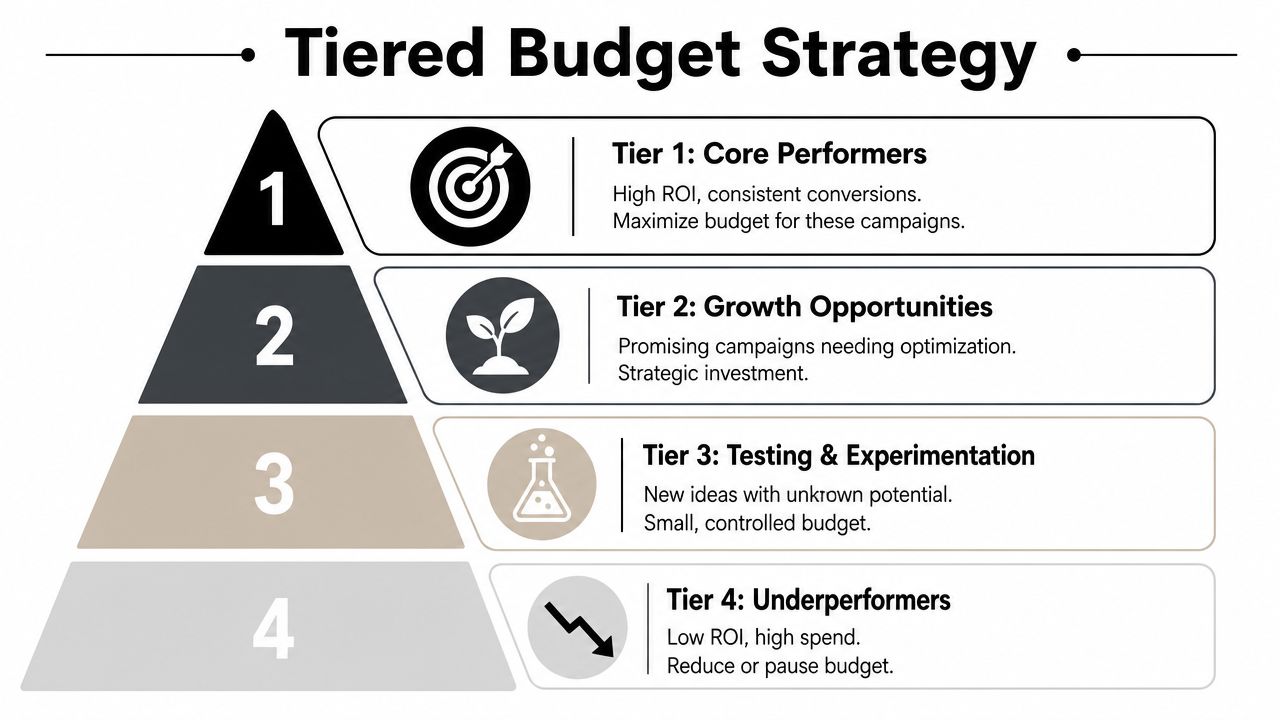
The cleanest starting point is the 70-20-10 rule. Put 70% of budget into proven strategies, 20% into emerging channels or tactics, and 10% into experimental efforts. That framework matters more now because marketing budgets have stabilized at 7.7% of company revenue in 2025, according to Evok's budget optimization overview. When the total budget has limits, allocation discipline matters more than ever.
Build four tiers, not one giant budget bucket
I prefer four operating tiers because they force clearer decisions than a simple good or bad split.
Tier 1: Core performers
Brand, high-intent non-brand, remarketing, and proven bottom-funnel campaigns belong here. These campaigns protect revenue. They get funded first.Tier 2: Growth opportunities
These campaigns have signs of life but need work. Maybe the query mix is right but conversion rate is soft. Maybe lead quality is strong but volume is inconsistent. They deserve budget, but with supervision.Tier 3: Testing and experimentation
New landing pages, new keyword themes, new bidding approaches, or upper-funnel ideas live here. Keep the scope controlled so one rough test doesn't drag down the whole account.Tier 4: Underperformers
These campaigns are expensive, inconsistent, or strategically outdated. Reduce budget, rebuild them, or pause them. Keeping them half-alive usually just drains money slowly.
A quick visual helps when you need buy-in from clients or internal stakeholders:
Judge campaigns by business role, not just platform metrics
A branded search campaign and a broad prospecting campaign should never be held to the same standard. One captures demand. The other creates it. Budgeting them the same way leads to bad calls.
Use questions like these instead:
- How close is this campaign to revenue?
- Would the business feel pain if this campaign lost budget tomorrow?
- Is this campaign proven, promising, or speculative?
- Does this campaign support profitable products or weak-margin offers?
A strong budget strategy protects what's already working while still buying a controlled amount of learning.
The hidden advantage of tiers is emotional control. When every campaign competes equally for budget, teams overreact to short-term swings. When campaigns sit in clear tiers, decisions get calmer. Tier 1 gets defended. Tier 2 gets coached. Tier 3 gets tested. Tier 4 gets challenged.
That structure makes campaign budget optimization sustainable, not just reactive.
Master Automated Bidding and Budget Allocation
Automated bidding works well when you feed it enough data and stop fighting it every day. It works badly when the campaign is underfunded, the target is unrealistic, or the account keeps changing direction before the system can learn.
That's why many advertisers think automation failed them, when the setup failed first.
Match the bid strategy to the business goal
The practical split is straightforward.
Maximize Conversions fits campaigns where volume matters most and you're still giving the system room to find efficient traffic. Target CPA is better when you know what an acceptable acquisition cost looks like and want tighter control. Target ROAS makes more sense for accounts with reliable revenue tracking, especially when order values vary across products or audiences.
Don't choose based on what sounds advanced. Choose based on what the campaign is trying to produce.
Here's a simple comparison:
| Bid strategy | Best fit | Watch out for |
|---|---|---|
| Maximize Conversions | Building conversion volume | Weak lead quality controls |
| Target CPA | Stable acquisition targets | Targets set too aggressively |
| Target ROAS | Revenue-focused ecommerce or value-based lead gen | Incomplete value tracking |
Give the algorithm enough room to breathe
Automated bidding needs budget headroom. A useful rule from TikTok's CBO guidance is to set a daily budget at 5 to 10 times your target CPA. If your target CPA is $25, a budget below $125 to $250 may starve the campaign of conversion data, according to TikTok's campaign budget optimization recommendations.
Even though that guidance comes from a different ad platform, the operating principle applies neatly to Google Ads too. Automation can't optimize efficiently when the campaign barely generates enough signal to learn from.
That also changes how I think about shared budgets versus isolated campaign budgets.
Choose budget structure based on control needs
Use a campaign-level budget when you need guardrails. Maybe one service line has a hard cap. Maybe a market has different economics. Maybe one client category needs tighter spend control.
Use a shared portfolio budget when campaigns are close cousins and should compete for budget naturally. That setup can enable efficiency, but only if the campaigns belong together. Mixing wildly different intents into one shared budget usually creates noise, not savings.
A good test for shared budgets is operational similarity:
- Same sales objective: They should aim at the same core business outcome.
- Comparable intent level: Don't lump pure prospecting with high-intent branded traffic.
- Similar conversion economics: If one campaign can tolerate a much higher CPA, separate it.
If you're refining that setup, this guide on how automated bidding helps optimize campaigns complements the workflow nicely.
For a broader view of where machine learning is changing paid media operations, I also like this piece on Revolutionizing PPC with AI. It frames automation the right way. Not as magic, but as a system that depends on signal quality, constraints, and disciplined inputs.
Automation is best at pattern recognition. Humans are still better at setting priorities, defining guardrails, and spotting when the machine is chasing the wrong goal.
Run Smart Experiments to Find What Works
Testing budgets by gut feel is expensive. Testing them inside controlled experiments is how you scale without wrecking a healthy account.
Google Ads gives you a safe way to do this with Experiments. Use it. Too many accounts still rely on live edits in production campaigns, which makes every budget decision harder to interpret. If performance changes, you don't know whether the lift came from the budget shift, the auction, the season, or a change you forgot you made three days earlier.
Test one meaningful variable at a time
If you're evaluating budget strategy, keep the experiment narrow. Raise budget on a strong campaign and keep the rest of the setup intact. Or test one bidding strategy against another while leaving targeting and creatives alone.
Good experiment ideas tend to sound almost boring:
- Increase budget on one efficient campaign
- Compare Maximize Conversions against Target CPA
- Test a shared budget versus separate campaign budgets
- Try a tighter query control setup with stronger negatives
Bad experiments usually bundle too much. New landing page, new match types, new ad copy, and new budget. That's not a test. That's a reshuffle.
Let the learning phase finish before judging anything
Patience is the part people skip because it feels unproductive. It's also the part that protects you from false conclusions.
Ad platforms recommend waiting at least 3 to 4 days or until you have 50 conversion events before making major changes or judging a test, according to Dash Social's campaign budget optimization guidance. Change things too early and you can reset learning, which muddies the result.
Don't evaluate an experiment while the platform is still trying to understand the new environment.
Read outcomes like an operator, not a spectator
When the experiment ends, don't just ask whether conversion volume went up. Ask what the business gained.
A budget increase that adds more conversions but wrecks efficiency may still be the wrong move. A tighter bidding strategy that trims spend but improves lead quality could be the better call. Results need commercial context.
I like to review experiments through three lenses:
Efficiency
Did cost per acquisition or return on ad spend move in the right direction?Scale
Did the campaign achieve more useful volume?Stability
Did performance hold, or did it become more erratic after the change?
That process turns campaign budget optimization into a series of learnable decisions instead of a stream of reactive edits.
Build an Automated Waste Reduction Workflow
Manual cleanup works for a while. Then the account grows, search terms pile up, and the weekly review turns into an unfinished tab you keep promising to revisit.
That's when waste becomes habitual.
The fix isn't working harder inside spreadsheets. It's building a workflow that catches junk traffic fast, pushes winning queries into structure, and keeps the account cleaner with less effort.

What the manual version usually looks like
Most PPC managers know the routine. Export search terms. Filter by spend. Tag negatives. Copy them into lists. Double-check match types. Add good queries into ad groups. Repeat next week.
Nothing about that process is strategic. It's just necessary maintenance.
The problem is that repetitive work gets postponed first. When cleanup slips, two things happen:
- Irrelevant queries keep spending
- Useful queries sit buried in reports instead of becoming assets
That's how budget waste survives even in well-run accounts.
Build a feedback loop, not a one-time cleanup
A healthier system has a rhythm:
| Workflow step | Purpose | Result |
|---|---|---|
| Search term review | Spot irrelevant and high-intent queries | Waste becomes visible |
| Negative keyword action | Block bad traffic quickly | Spend leakage slows down |
| Query expansion | Promote strong terms into structure | Winners get more support |
| Ongoing repetition | Keep the account from drifting | Optimization compounds |
The important shift is mindset. Search terms aren't just a report. They're a live feed of market intent. Some terms should be excluded immediately. Others should be upgraded into exact or phrase match ad groups, supported with customized ad copy and stronger landing page alignment.
That kind of process becomes much easier when the account isn't relying on manual copy-paste steps for every negative and every expansion. If this is the bottleneck in your workflow, this piece on automating negative keyword management is a practical next read.
The accounts that stay efficient aren't the ones with the smartest one-time audit. They're the ones with the cleanest repeatable workflow.
A strong waste reduction system also changes how you spend your time. Instead of digging through low-value admin tasks, you can focus on campaign strategy, bidding logic, landing page relevance, and offer positioning. That's where the bigger wins usually sit.
Track the Right KPIs to Stay on Target
A budget strategy only matters if you can tell whether it's working.
Too many reports bury the signal under activity metrics. Clicks rise. Impressions swing. Average CPC moves around. None of that tells you whether the budget is being deployed well. You need a compact operating view that ties spend to outcomes.
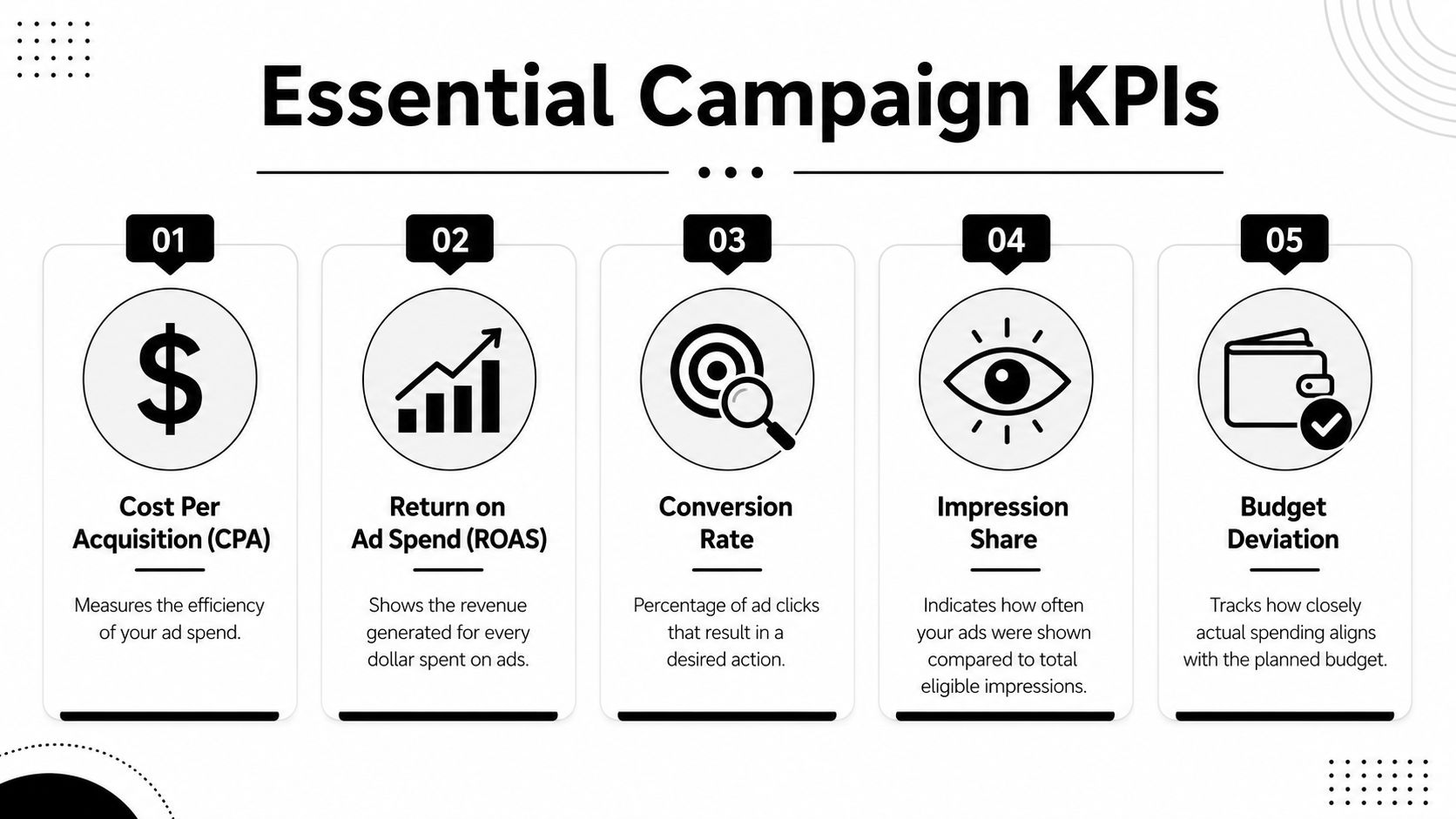
The KPI set that actually matters
A lean dashboard should center on:
Cost per acquisition
This tells you how efficiently the account is buying conversions.Return on ad spend
This shows whether spend is producing enough revenue value.Conversion rate
Helpful for spotting landing page and traffic-quality issues.Impression share
Useful for diagnosing whether strong campaigns are missing auctions they should be winning.Budget deviation
This keeps planned spend and actual spend aligned, especially across multiple campaigns or markets.
A helpful reporting principle from Evok's budgeting framework is to focus on ROAS, CAC, and CLV instead of vanity metrics, and to use attribution and centralized data to identify diminishing returns more clearly. That same mindset works well when designing key performance indicator dashboard concepts for paid media teams.
Keep the reporting cadence simple
You don't need a massive BI project to stay in control. A weekly snapshot is enough for many if it's consistent.
Review the same questions every time:
- Which campaigns are spending above plan?
- Which campaigns are efficient enough to earn more budget?
- Where is non-converting spend accumulating?
- Which segments are drifting from prior performance?
The goal isn't prettier reporting. It's faster decision-making. Good campaign budget optimization depends on a feedback loop you can trust.
Frequently Asked Budget Optimization Questions
Should I use campaign-level budgets or ad group control
Use campaign-level budget optimization when the campaigns or ad sets inside that structure are competing for the same business goal. That setup works best when the intent level is similar and you want the platform to shift spend toward the strongest opportunity.
For social platforms, CBO generally needs 3 to 5 active ad sets to function well, and on Facebook and TikTok it won't really have a job to do if only one ad set is present, as explained in Jon Loomer's campaign budget optimization guidance. If you need strict control by audience, geography, or business unit, manual allocation is usually the cleaner move.
How often should I change budgets
Less often than many marketers do.
Frequent edits make it harder to tell whether performance changed because of your action or because the platform was still adjusting. In practice, I prefer scheduled reviews and selective changes, not constant nudging. If a campaign is stable and efficient, leave it alone long enough to produce a trustworthy pattern.
What if my budget is small
Small budgets need concentration, not fragmentation.
If spend is too spread out across too many campaigns, ad groups, audiences, or products, the platform may never gather enough useful signal to optimize. Consolidate where possible. Protect the highest-intent themes first. Delay experiments until the core traffic is clean and conversion tracking is solid.
When does campaign budget optimization stop making sense
It usually breaks down when the structure is too thin or the budget is too constrained for meaningful learning. If the platform can't distribute enough spend across competing units, manual control often becomes more practical.
One simple test is operational. If you can't explain why multiple campaigns or ad sets should compete for the same pooled budget, they probably shouldn't.
Keyword cleanup is where a lot of budget efficiency is won or lost. If you want a faster way to review search terms, build negative keyword lists, and turn strong queries into better campaign structure, Keywordme is built for exactly that workflow.
.svg)