
9 Best Platforms for PPC Optimization in 2026
Managing PPC campaigns shouldn't mean drowning in spreadsheets and missed opportunities. This guide reviews the 9 best platforms for PPC optimization in 2026, covering everything from lightweight Chrome extensions to enterprise-level suites that automate bid adjustments, eliminate wasted ad spend, and surface high-converting keywords faster—whether you're a solo freelancer or managing dozens of client accounts.


Managing PPC campaigns often feels like you're drowning in data while somehow still missing the obvious wins. You're clicking through endless search term reports, copy-pasting keywords into spreadsheets, and trying to remember which negative keywords you already added last week. The right platform doesn't just organize this chaos—it eliminates most of it entirely.
The best platforms for PPC optimization help you cut wasted ad spend, find high-converting keywords faster, and automate the tedious stuff that eats up your day. Whether you're a freelancer managing a handful of accounts or an agency juggling dozens of clients, the right tool can make the difference between profitable campaigns and money down the drain.
This guide covers 9 platforms that actually deliver—from lightweight Chrome extensions to full-scale enterprise suites. We've focused on tools that solve real problems: cleaning up search terms, automating bid adjustments, and giving you actionable insights without requiring a data science degree.
1. Keywordme
Best for: Fast, in-interface Google Ads optimization without spreadsheets or platform-switching
Keywordme is a Chrome extension that lives directly inside your Google Ads Search Terms Report, letting you optimize campaigns without ever leaving the native interface.

Where This Tool Shines
Most PPC tools force you to bounce between dashboards, export CSVs, or learn entirely new interfaces. Keywordme does the opposite—it meets you exactly where you're already working. You're reviewing search terms in Google Ads, you spot junk queries eating budget, and you eliminate them with one click. No tab-switching, no copy-pasting, no friction.
The real power shows up when you're managing multiple accounts or working under tight deadlines. What used to take 20 minutes of spreadsheet wrestling now happens in under two minutes. You can apply match types, cluster related keywords, and build negative lists without disrupting your workflow.
Key Features
One-Click Search Term Cleanup: Remove junk search terms directly from the Search Terms Report without exporting data or switching tools.
Instant Match Type Application: Apply exact, phrase, or broad match modifiers to keywords without manual formatting or leaving the interface.
Keyword Clustering: Automatically group related search terms into logical keyword themes for faster campaign structuring.
Multi-Account Support: Manage multiple client accounts with team collaboration features designed specifically for agencies.
Bulk Editing: Make sweeping changes across campaigns without building complex spreadsheets or using clunky bulk upload tools.
Best For
Keywordme works especially well for agencies managing multiple Google Ads accounts, solo freelancers who need to move fast, and in-house marketers tired of spreadsheet-based workflows. If you spend significant time in the Search Terms Report and want to eliminate repetitive manual tasks, this tool directly addresses that pain point.
Pricing
Flat-rate pricing at $12 per month per user with a 7-day free trial. No ad spend tiers, no hidden fees—just straightforward monthly billing that scales with your team size.
2. Optmyzr
Best for: Comprehensive automation and rule-based optimization across Google, Microsoft, and Amazon ads
Optmyzr is a full-featured PPC management platform that combines automated rules, one-click optimizations, and custom scripting capabilities for advertisers managing complex accounts.

Where This Tool Shines
Optmyzr excels when you need sophisticated automation with human oversight. The Rule Engine lets you set up conditional logic for bid adjustments, budget pacing, and performance alerts without writing code. But unlike fully automated platforms, you maintain control—every suggested change requires your approval before it goes live.
The platform also handles shopping campaigns particularly well. If you're running Google Shopping ads with hundreds or thousands of SKUs, Optmyzr's feed optimization and negative keyword tools help you stay on top of product-level performance without drowning in data.
Key Features
Rule Engine: Build custom automation rules for bids, budgets, and alerts using conditional logic that runs on your schedule.
One-Click Optimizations: Review suggested changes across campaigns with approve/reject controls before implementation.
Custom Scripts and Dashboards: Deploy Google Ads scripts and create custom reporting views without leaving the platform.
Shopping Campaign Tools: Optimize product feeds, manage negative keywords at the product level, and track SKU-level performance.
Cross-Platform Support: Manage Google Ads, Microsoft Ads, and Amazon Advertising from a single interface with unified reporting.
Best For
Optmyzr is ideal for experienced PPC managers running large accounts or agencies handling multiple clients across different ad platforms. If you're comfortable with automation but want final approval on changes, this strikes the right balance between efficiency and control.
Pricing
Pricing starts around $249 per month and scales based on monthly ad spend. Higher tiers unlock additional features like advanced scripts and agency-level reporting.
3. WordStream
Best for: Small business owners and non-experts who need simplified PPC management
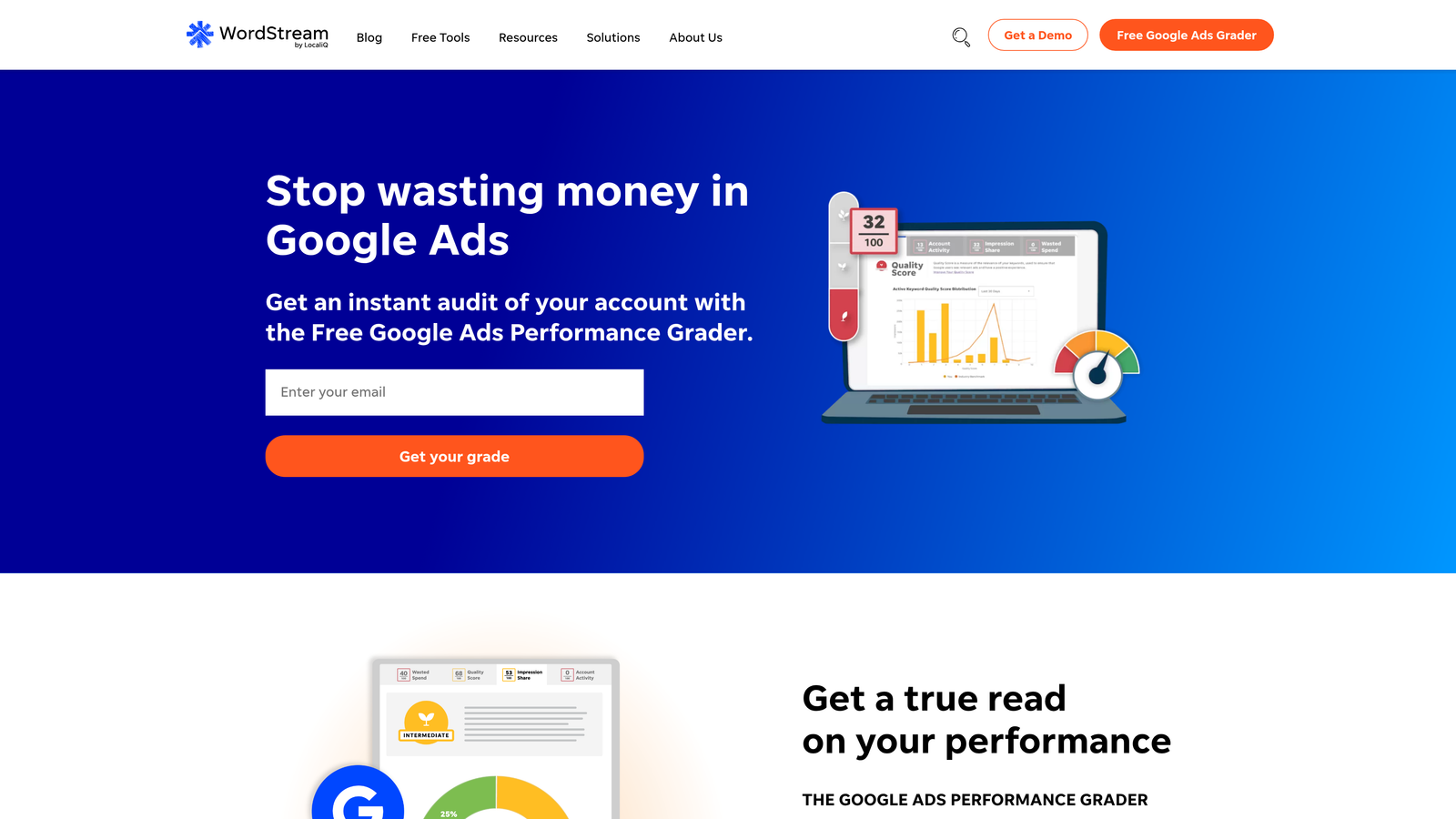
WordStream is a user-friendly PPC platform designed around the "20-Minute Work Week" concept—giving you actionable weekly recommendations without requiring deep technical knowledge.
Where This Tool Shines
WordStream removes the intimidation factor from PPC management. Instead of staring at endless data tables, you get a curated list of specific actions ranked by potential impact. The interface guides you through optimizations with plain-language explanations, making it accessible for business owners who don't live and breathe Google Ads.
The platform also includes cross-platform support for both Google and Facebook ads, which helps small businesses manage their entire paid strategy from one place. The Performance Grader tool benchmarks your account against industry standards, giving you context for whether your results are actually good or just feel good.
Key Features
Weekly Action-Based Recommendations: Receive prioritized optimization tasks each week with clear impact estimates and implementation guidance.
Cross-Platform Management: Handle Google Ads and Facebook campaigns from a unified dashboard with consistent reporting.
Performance Grader: Benchmark your account performance against industry averages to identify gaps and opportunities.
Simplified Interface: Navigate PPC management without technical jargon or overwhelming data displays designed for casual users.
Smart Bidding Integration: Access automated bidding recommendations that explain why changes are suggested in understandable terms.
Best For
WordStream works best for small business owners managing their own ads, marketing generalists who handle PPC alongside other responsibilities, and teams that need a less technical approach to campaign optimization. If you want guidance without complexity, this platform delivers.
Pricing
Custom pricing based on monthly ad spend, typically starting around $300 per month. Pricing includes onboarding support and ongoing optimization recommendations.
4. Adalysis
Best for: Ad testing, quality score monitoring, and search term optimization
Adalysis is a specialized PPC platform focused on improving ad performance through systematic testing, quality score tracking, and detailed search term analysis.

Where This Tool Shines
Adalysis takes ad testing seriously in a way most platforms don't. It tracks statistical significance automatically, so you know when a winning ad variation actually represents a real performance difference versus random noise. This prevents premature optimization decisions that can hurt performance.
The quality score monitoring is equally valuable. Adalysis tracks quality score changes at the keyword level and sends alerts when scores drop, helping you catch issues before they significantly impact costs. The N-gram analysis breaks down search terms into component phrases, making it easier to spot patterns and build more effective negative keyword lists.
Key Features
Automated Ad Testing: Run statistically valid ad tests with automatic winner detection based on confidence intervals and sample size.
Quality Score Monitoring: Track quality score changes over time with alerts for drops and recommendations for improvement.
N-Gram Analysis: Break search terms into component phrases to identify patterns, themes, and negative keyword opportunities.
Customizable Audit Checklists: Create and schedule automated account audits that check for common issues and optimization opportunities.
Performance Alerts: Set custom thresholds for metrics like CPA, conversion rate, or impression share with automatic notifications.
Best For
Adalysis is ideal for performance-focused advertisers who want to improve ad copy systematically, agencies that need quality score monitoring across client accounts, and PPC managers who prefer data-driven testing over gut-feel optimization.
Pricing
Pricing starts at $99 per month for smaller accounts and scales based on the number of accounts managed and monthly ad spend.
5. Google Ads Editor
Best for: Bulk campaign editing and offline management of Google Ads accounts
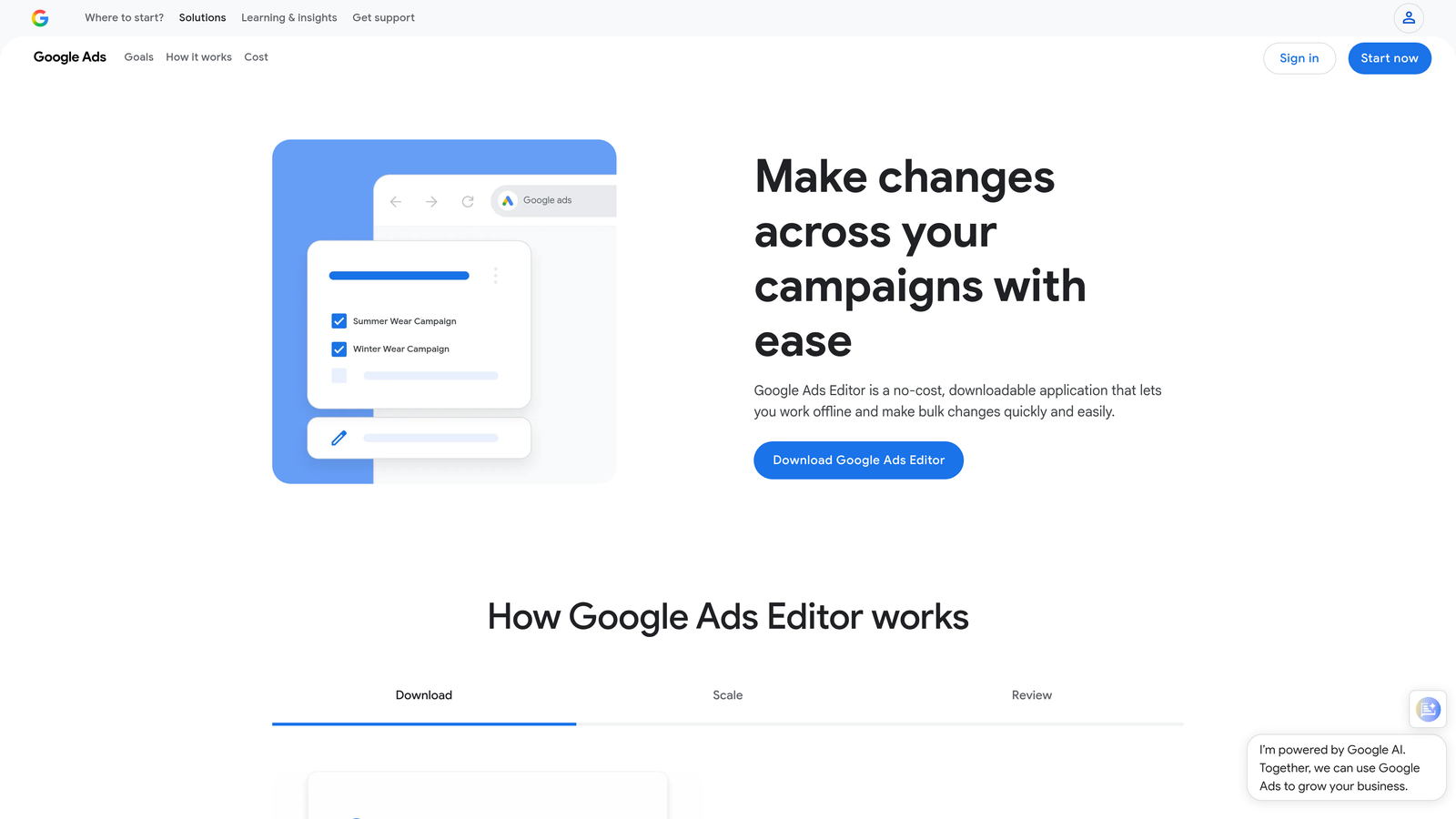
Google Ads Editor is a free desktop application from Google that lets you download campaigns, make bulk changes offline, and upload them when ready.
Where This Tool Shines
Google Ads Editor excels at bulk operations that would be painfully slow in the web interface. Need to update 500 ad headlines? Easy. Want to copy an entire campaign structure between accounts? Done in minutes. The offline editing capability also means you can work on campaigns during flights or in areas with spotty internet.
The find-and-replace functionality is particularly powerful for large accounts. You can update tracking parameters, swap out brand names, or fix common errors across thousands of ads without touching them individually. For agencies managing multiple client accounts, the ability to copy campaign structures and quickly adapt them saves enormous amounts of time.
Key Features
Bulk Editing: Make large-scale changes to campaigns, ad groups, keywords, and ads using spreadsheet-like interfaces and bulk operations.
Offline Editing: Download campaigns to work offline, then sync changes back to Google Ads when you're ready.
Find and Replace: Search and replace text across entire accounts for quick updates to URLs, tracking parameters, or ad copy.
Copy Between Accounts: Duplicate campaign structures from one account to another with automatic adjustments for account-specific settings.
Advanced Filtering: Use complex filters to isolate specific campaigns, ad groups, or keywords for targeted bulk changes.
Best For
Google Ads Editor is essential for anyone managing large Google Ads accounts, agencies that need to replicate campaign structures across clients, and advertisers who prefer working in a desktop environment versus the web interface.
Pricing
Completely free. Google provides this tool at no cost as part of the Google Ads ecosystem.
6. Semrush PPC Toolkit
Best for: Competitive keyword research and campaign planning within a broader marketing suite
Semrush is an all-in-one marketing platform that includes dedicated PPC tools for keyword research, competitor ad analysis, and campaign planning alongside SEO and content features.
Where This Tool Shines
Semrush excels at competitive intelligence for PPC. You can see which keywords your competitors are bidding on, view their ad copy variations, and estimate their ad budgets. This competitive visibility helps you identify keyword opportunities you might have missed and understand how competitors position themselves in paid search.
The keyword gap analysis is particularly useful for finding paid search opportunities. It compares your keyword portfolio against competitors and highlights gaps where they're bidding but you're not. This focused approach to keyword research is more efficient than starting from scratch with broad keyword tools.
Key Features
Competitor PPC Research: View competitor keywords, ad copy, landing pages, and estimated ad spend for any domain.
Keyword Gap Analysis: Compare your paid keyword portfolio against competitors to find untapped opportunities and competitive weaknesses.
Ad History and Variations: Access historical ad copy data to see how competitors have tested and evolved their messaging over time.
Budget Estimation Tools: Get approximate ad spend estimates for competitor domains to understand market investment levels.
Integration with SEO Tools: Coordinate paid and organic strategies using Semrush's broader SEO and content marketing features.
Best For
Semrush works well for marketers who handle both PPC and SEO, competitive-focused advertisers who want deep competitor insights, and teams that benefit from having paid and organic research in a single platform.
Pricing
Pricing starts at $139.95 per month for the full Semrush suite, which includes PPC tools along with SEO, content, and social media features. Higher tiers unlock more extensive data and additional user seats.
7. SpyFu
Best for: Historical competitor ad data and long-term PPC competitive intelligence
SpyFu specializes in competitive intelligence for both PPC and SEO, with historical ad data going back years that helps you understand competitor strategies over time.
Where This Tool Shines
SpyFu's historical data is its biggest differentiator. You can see not just what competitors are bidding on now, but what they've tested over the past several years. This historical view reveals which keywords they've consistently invested in versus which ones they've abandoned, giving you insight into what actually works for them.
The ad variation history is equally valuable. You can see how competitors have tested different headlines, descriptions, and calls-to-action over time. This effectively lets you learn from their testing without spending your own budget, helping you avoid approaches that likely didn't work and adopt strategies that have proven successful.
Key Features
Historical Ad and Keyword Data: Access years of competitor PPC history to identify long-term trends and strategy shifts.
PPC Keyword Recommendations: Get keyword suggestions based on competitor gaps and opportunities specific to your industry.
Ad Variation History: Review how competitors have tested and evolved their ad copy over time to learn from their experiments.
Domain Comparison: Compare multiple competitor domains side-by-side to understand relative market positioning and investment levels.
Shared Keyword Analysis: Identify keywords where multiple competitors overlap, signaling high-value search terms worth investigating.
Best For
SpyFu is ideal for competitive-focused advertisers who want to learn from competitor testing, agencies developing PPC strategies for new clients in unfamiliar industries, and marketers who value historical data for strategic planning.
Pricing
Pricing starts at $39 per month for basic access, with higher tiers unlocking more extensive historical data, additional competitor tracking, and unlimited searches.
8. Channable
Best for: E-commerce feed management and shopping campaign automation
Channable is a feed management and PPC automation platform designed specifically for e-commerce advertisers running shopping campaigns and dynamic product ads.
Where This Tool Shines
Channable excels at solving the product feed optimization problem that plagues e-commerce advertisers. You can manipulate product data using rules without touching your actual product database, letting you optimize titles, descriptions, and attributes specifically for ad platforms without affecting your website.
The dynamic text ad generation is particularly useful for retailers with large catalogs. Channable can automatically create text ads based on product feed data, applying templates that pull in product names, prices, and attributes. This automation eliminates the manual work of creating individual ads for hundreds or thousands of products.
Key Features
Automated Feed Optimization: Apply rules to modify product titles, descriptions, and attributes specifically for ad platforms without changing source data.
Dynamic Text Ad Generation: Create text ads automatically from product feed data using customizable templates and rules.
Multi-Channel Export: Push optimized feeds to Google Shopping, Microsoft Shopping, Facebook, and other ad platforms from a single interface.
Rules-Based Feed Manipulation: Use conditional logic to segment products, adjust bids, or exclude items based on performance or inventory data.
Performance Tracking: Monitor feed-level performance metrics to understand which product optimizations drive results.
Best For
Channable is essential for e-commerce retailers running shopping campaigns with large product catalogs, agencies managing multiple e-commerce clients, and advertisers who need to optimize product data specifically for ads without affecting their website.
Pricing
Pricing starts around €39 per month and scales based on the number of SKUs in your product feed and the channels you export to.
9. Marin Software
Best for: Enterprise cross-channel campaign management and advanced attribution
Marin Software is an enterprise-grade advertising platform for managing and optimizing search, social, and display campaigns at scale across multiple channels.
Where This Tool Shines
Marin handles complexity that overwhelms other platforms. When you're managing campaigns across Google, Microsoft, Facebook, Instagram, and display networks simultaneously, Marin provides the unified control and reporting structure needed to maintain consistency and optimize holistically rather than in channel silos.
The AI-powered bidding and budget allocation features work across channels, shifting spend toward better-performing platforms automatically based on your goals. The advanced attribution modeling helps enterprise advertisers understand cross-channel customer journeys, crediting conversions appropriately rather than relying on last-click attribution.
Key Features
Unified Cross-Channel Management: Control search, social, and display campaigns from a single platform with consistent workflows and reporting.
AI-Powered Bidding: Deploy machine learning algorithms that optimize bids and budget allocation across channels based on performance goals.
Advanced Attribution Modeling: Implement multi-touch attribution to understand how different channels and touchpoints contribute to conversions.
Enterprise Reporting: Access sophisticated analytics and custom reporting designed for large organizations with complex approval workflows.
API Integration: Connect Marin to internal systems, data warehouses, and business intelligence tools for comprehensive data integration.
Best For
Marin Software is designed for enterprise marketing teams managing substantial ad budgets across multiple channels, large agencies with complex client requirements, and organizations that need advanced attribution and cross-channel optimization capabilities.
Pricing
Enterprise pricing model tailored to individual needs, typically suitable for advertisers spending $10,000 or more per month across channels. Contact Marin directly for custom quotes.
Making the Right Choice
The best platform for PPC optimization depends entirely on where you're working and what's actually slowing you down. If you're spending hours cleaning up search terms in Google Ads, Keywordme eliminates that friction by letting you optimize directly in the interface you're already using. For agencies managing complex automation across multiple platforms, Optmyzr delivers the rule-based control and oversight needed at scale.
Small business owners who need simplicity over sophistication should start with WordStream—it guides you through optimizations without requiring technical expertise. If competitive intelligence drives your strategy, SpyFu's historical data reveals what competitors have tested over years, helping you learn from their experiments without spending your own budget.
E-commerce retailers running shopping campaigns face unique challenges that general PPC tools don't address. Channable solves the product feed optimization problem elegantly, letting you manipulate data specifically for ads without touching your actual product database. And when you're managing enterprise budgets across search, social, and display simultaneously, Marin provides the unified control and attribution modeling that channel-specific tools can't deliver.
The common thread across effective PPC optimization? Reducing friction between insight and action. The best tools don't just show you what to do—they make doing it faster, easier, and less prone to manual errors. Whether that means working inside Google Ads instead of switching to another dashboard, automating repetitive tasks with rules you control, or getting clear weekly recommendations without technical jargon, the right platform meets you where you work and removes obstacles that waste your time.
Start by identifying your biggest time sink. Is it search term analysis? Ad testing? Competitor research? Feed management? Match your primary pain point to the tool that specifically addresses it, rather than choosing based on feature lists or brand recognition. Most platforms offer free trials—use them to test whether a tool actually saves you time in your real workflow, not just in theory.
Ready to optimize Google Ads campaigns 10X faster without leaving your account? Keywordme lets you remove junk search terms, build high-intent keyword lists, and apply match types instantly—right inside Google Ads. No spreadsheets, no switching tabs, just quick, seamless optimization. Start your free 7-day trial (then just $12/month) and take your Google Ads game to the next level.
.svg)