
9 Best Automated Keyword Clustering Tools in 2026
Automated keyword clustering tools use SERP analysis, NLP, and semantic similarity to automatically group thousands of related keywords into topical clusters, eliminating hours of manual spreadsheet work. These solutions help marketers build smarter SEO content hubs, optimize Google Ads campaigns, and prevent keyword cannibalization through integrated workflows or standalone platforms designed for agencies, freelancers, and in-house teams.


If you've ever stared at a spreadsheet with 2,000 search terms and thought "there has to be a better way to organize this," you're not alone. Keyword clustering tools exist to solve exactly that problem—they automatically group related keywords into topical clusters, saving you hours of manual sorting and helping you build smarter campaigns or content strategies.
Whether you're cleaning up Google Ads search terms, planning SEO content hubs, or trying to prevent keyword cannibalization, these tools use SERP analysis, NLP, or semantic similarity to do the heavy lifting. Some integrate directly into your workflow (like Chrome extensions for Google Ads), while others function as standalone platforms with their own clustering methodologies.
Here are the top automated keyword clustering tools for marketers, freelancers, and agencies in 2026.
1. Keywordme
Best for: Google Ads users who want keyword clustering without leaving the interface
Keywordme is a Chrome extension that brings keyword clustering directly into Google Ads' Search Terms Report.

Where This Tool Shines
Most clustering tools force you to export data, upload it to another platform, wait for processing, then manually implement the results back in Google Ads. Keywordme eliminates that entire workflow by letting you cluster, organize, and apply changes right where you're already working.
This is especially powerful for PPC managers juggling multiple accounts or agencies handling dozens of clients. You can spot patterns in search terms, group related queries, and build negative keyword lists in a fraction of the time it would take with spreadsheets.
Key Features
In-Interface Clustering: Group keywords directly within the Google Ads Search Terms Report without exporting data.
One-Click Negative Lists: Build and apply negative keyword lists instantly from clustered junk terms.
Bulk Editing: Apply match types, add keywords to ad groups, or remove terms across multiple clusters simultaneously.
Multi-Account Support: Switch between client accounts seamlessly with team collaboration features built in.
Match Type Application: Apply exact, phrase, or broad match modifiers to entire keyword clusters with one click.
Best For
Google Ads managers, PPC agencies, and freelancers who spend significant time optimizing search campaigns. If you're constantly working in the Search Terms Report and want to speed up your workflow without adding another tool to your stack, this is built for you.
Pricing
$12/month per user with a 7-day free trial. Flat-rate pricing makes it predictable for agencies managing multiple team members.
2. Keyword Insights
Best for: SEO content planning based on SERP similarity
Keyword Insights groups keywords by analyzing which terms share similar search results, indicating topical relationships.

Where This Tool Shines
Instead of relying purely on semantic similarity, Keyword Insights looks at actual SERP overlap. If two keywords consistently show the same URLs ranking, Google sees them as related—and you probably only need one piece of content to target both. This approach helps prevent keyword cannibalization before it happens.
The platform goes beyond clustering by generating content briefs from your clusters, complete with search intent classification. This makes it particularly valuable for content teams planning editorial calendars or building topical authority in specific niches.
Key Features
SERP-Based Clustering: Groups keywords by analyzing which terms share ranking URLs, not just semantic similarity.
Content Brief Generation: Automatically creates outlines and briefs from keyword clusters to guide writers.
Search Intent Classification: Labels clusters as informational, commercial, transactional, or navigational.
Bulk Processing: Handle thousands of keywords in a single clustering job.
Multiple Export Formats: Download results as CSV, Excel, or integrate with other SEO tools.
Best For
SEO professionals and content strategists building content hubs or planning large-scale content operations. If you're trying to map keywords to URLs and avoid targeting the same terms across multiple pages, this tool makes that decision-making process much clearer.
Pricing
Starts at $58/month for 6,000 keywords. Higher tiers unlock more keyword capacity and additional features like API access.
3. SE Ranking
Best for: All-in-one SEO with integrated keyword grouping
SE Ranking combines keyword research, clustering, rank tracking, and competitive analysis in a single platform.

Where This Tool Shines
SE Ranking's keyword grouper sits inside a full SEO suite, which means you can move from research to clustering to rank tracking without switching tools. The platform offers both automatic clustering (based on SERP similarity) and manual grouping options, giving you control over how aggressive or conservative the clustering algorithm behaves.
The white-label reporting is particularly useful for agencies. You can brand reports with your logo and present clustered keyword strategies to clients without any SE Ranking branding visible.
Key Features
Built-In Keyword Grouper: Cluster keywords directly within the same platform where you conduct research and track rankings.
Automatic and Manual Clustering: Choose between algorithmic grouping or manually adjust clusters to match your strategy.
Competitor Keyword Gap Analysis: Identify keyword opportunities your competitors rank for but you don't.
Rank Tracking Integration: Monitor how your clustered keywords perform over time without exporting data.
White-Label Reporting: Generate branded reports for clients that include keyword clusters and performance metrics.
Best For
Agencies and in-house SEO teams who want clustering as part of a broader SEO workflow. If you're already using multiple tools for research, tracking, and audits, consolidating into one platform can simplify your stack.
Pricing
Starts at $55/month for the Essential plan, which includes keyword grouping. Higher tiers add more projects, keywords, and team seats.
4. Serpstat
Best for: Enterprise-scale clustering with competitive analysis
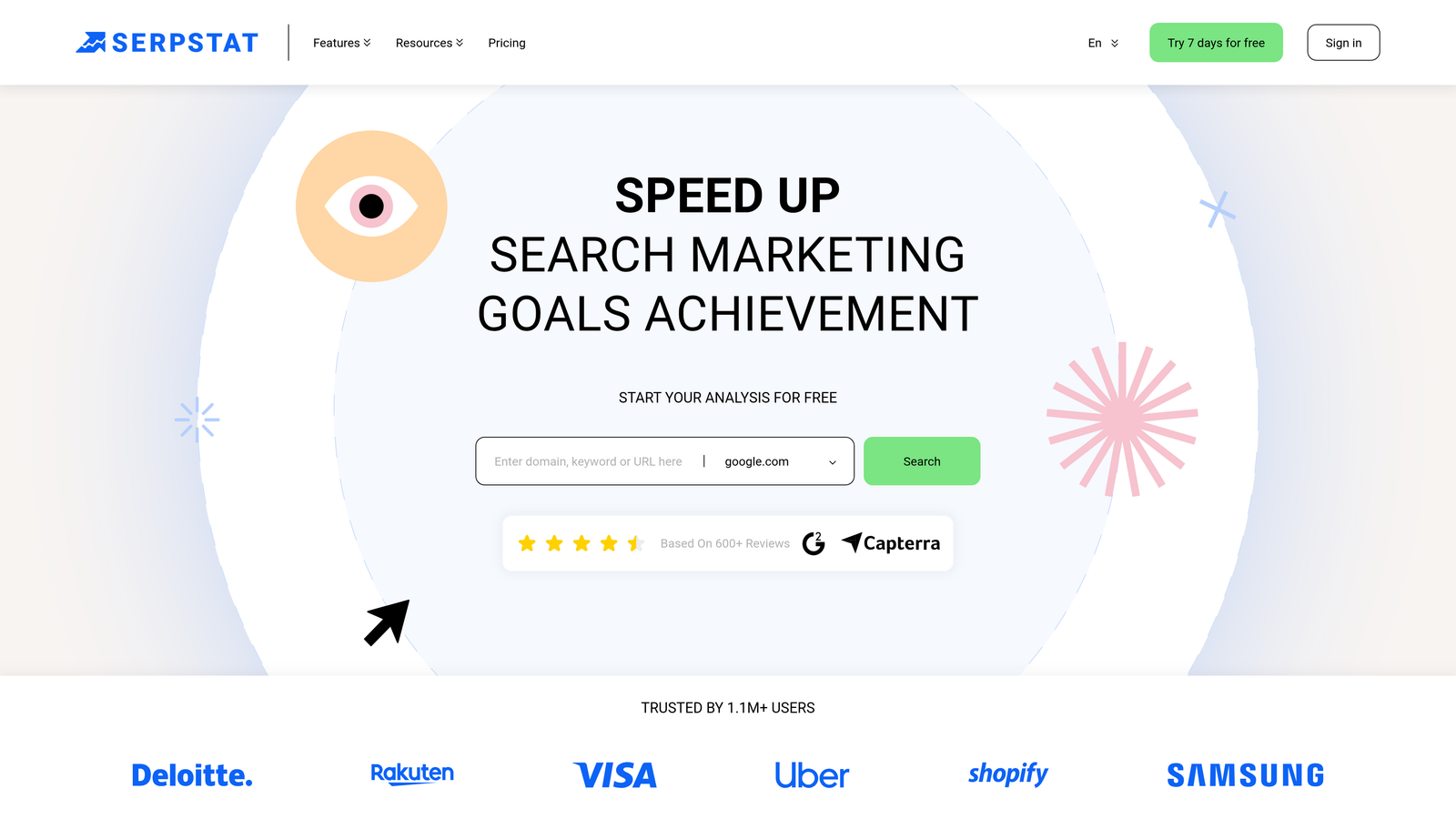
Serpstat is an enterprise-grade SEO platform with robust clustering capabilities designed for handling large keyword datasets.
Where This Tool Shines
Serpstat handles volume well. If you're working with 50,000+ keywords from multiple domains or competitive analysis projects, the platform's clustering engine can process those datasets without choking. The clustering by search intent feature automatically categorizes clusters as informational, commercial, or transactional, which speeds up content planning.
The API access is a standout for teams building custom workflows or integrating clustering into proprietary systems. You can automate recurring clustering jobs and feed results directly into your content management or PPC optimization processes.
Key Features
Large-Scale Clustering: Process tens of thousands of keywords in a single job without performance issues.
Clustering by Search Intent: Automatically classify clusters as informational, commercial, or transactional.
Competitive Domain Analysis: Extract and cluster keywords from competitor domains to identify content gaps.
API Access: Automate clustering workflows and integrate with your existing marketing stack.
Team Collaboration: Share projects, assign tasks, and manage permissions across team members.
Best For
Enterprise SEO teams, large agencies, and marketing departments managing multiple brands or domains. If you need to cluster keywords at scale and integrate that data into broader marketing automation systems, Serpstat's infrastructure supports it.
Pricing
Starts at $59/month for the Individual plan. Enterprise plans with higher limits and API access require custom pricing.
5. Cluster AI
Best for: Simple, focused clustering without feature bloat
Cluster AI does one thing well—grouping keywords into topical clusters without the complexity of full SEO suites.

Where This Tool Shines
Cluster AI uses NLP-based semantic grouping to identify relationships between keywords based on language patterns rather than SERP overlap. This approach works well when you're clustering keywords that don't have established search results yet (like new product categories or emerging topics).
The workflow is dead simple: upload a CSV, click cluster, download results. No learning curve, no feature overload, just fast processing and clean output. This makes it ideal for one-off projects or teams that don't need ongoing clustering as part of their daily workflow.
Key Features
Upload-and-Cluster Workflow: Simple three-step process with no setup required.
NLP-Based Semantic Grouping: Identifies topical relationships using language models rather than SERP data.
Fast Processing: Most clustering jobs complete in under a minute.
CSV Export: Download results in a clean spreadsheet format ready for implementation.
No Learning Curve: Interface is intuitive enough to use without documentation or training.
Best For
Marketers who need occasional clustering for specific projects rather than ongoing workflow integration. If you're working on a content refresh, launching a new product category, or conducting competitive research a few times per quarter, this pay-per-use model makes more sense than a monthly subscription.
Pricing
Pay-per-use model starting around $0.01 per keyword. No subscription required, just buy credits as needed.
6. KeyClusters
Best for: Budget-conscious freelancers and occasional users
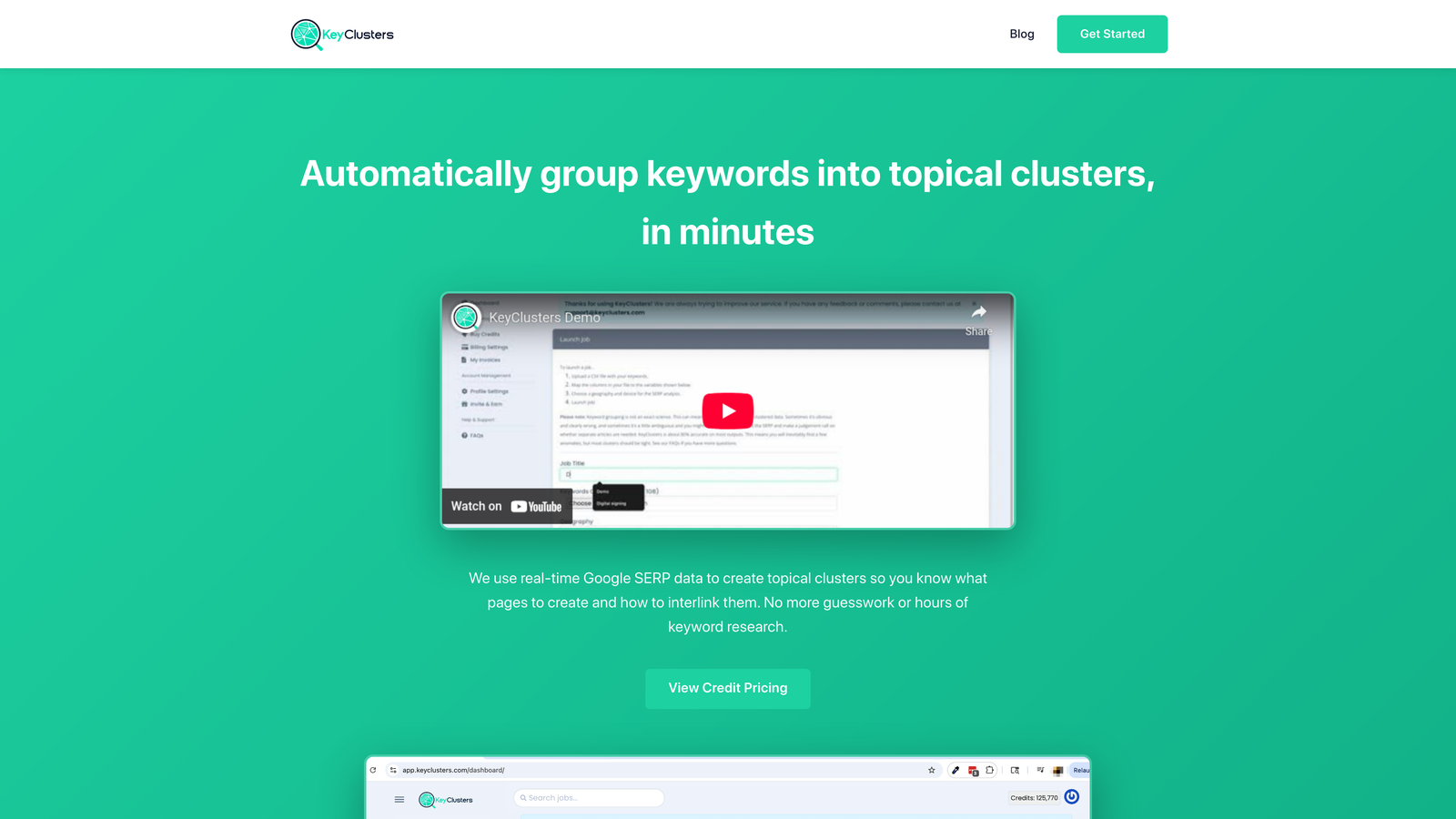
KeyClusters offers SERP-based clustering with a pay-as-you-go model that suits freelancers and occasional users.
Where This Tool Shines
KeyClusters uses SERP overlap methodology similar to higher-priced competitors but charges only for what you use. The adjustable clustering sensitivity is particularly useful—you can make the algorithm more aggressive (creating fewer, larger clusters) or more conservative (creating more granular clusters) depending on your content strategy.
Because there's no subscription, you're not paying for a tool you only use a few times per month. This makes it attractive for freelancers managing a handful of clients or in-house marketers who cluster keywords quarterly rather than weekly.
Key Features
SERP Overlap Clustering: Groups keywords based on which terms share ranking URLs in search results.
Pay-Per-Keyword Pricing: Only pay for the keywords you cluster, no monthly commitment.
Adjustable Sensitivity: Control how aggressively the algorithm groups keywords together.
Simple CSV Output: Download results in a standard format compatible with any spreadsheet tool.
No Subscription Required: Buy credits as needed without recurring charges.
Best For
Freelance SEOs, small agencies, and marketers who cluster keywords sporadically. If you're not running clustering jobs every week, paying per keyword is more economical than maintaining a monthly subscription.
Pricing
Credits-based system, roughly $0.02-0.05 per keyword depending on volume purchased. No expiration on credits.
7. WriterZen
Best for: Content teams combining clustering with topic discovery
WriterZen combines keyword clustering with topic discovery and content brief creation for writers and content teams.

Where This Tool Shines
WriterZen connects clustering to the entire content creation workflow. After grouping keywords, you can generate content briefs that include cluster keywords, related questions, and competitor analysis—all in one place. The keyword golden ratio scoring helps prioritize which clusters represent the best opportunities based on search volume and competition.
The plagiarism checker included in higher-tier plans means writers can research, outline, write, and check originality without leaving the platform. This end-to-end approach works well for content teams producing high volumes of SEO-optimized articles.
Key Features
Topic Discovery with Clustering: Identify content opportunities and automatically group related keywords.
Content Brief Generator: Create detailed outlines from keyword clusters including questions and competitor insights.
Keyword Golden Ratio Scoring: Prioritize clusters based on opportunity scores calculated from volume and competition.
Plagiarism Checker: Verify content originality directly within the platform (higher-tier plans).
Research-to-Writing Workflow: Move from keyword research to published content within a single tool.
Best For
Content marketing teams, editorial departments, and agencies producing high volumes of SEO content. If your workflow involves research, clustering, brief creation, writing, and optimization, consolidating those steps into one platform reduces friction.
Pricing
Starts at $27/month for the Lite plan. Higher tiers unlock more keyword credits, plagiarism checks, and team collaboration features.
8. Zenbrief
Best for: Teams scaling content operations with collaboration features
Zenbrief is a collaborative content platform with clustering features designed for teams scaling their content operations.
Where This Tool Shines
Zenbrief focuses on team workflow and collaboration. After clustering keywords, you can assign clusters to specific writers, track progress through content creation stages, and measure performance after publication. The content optimization scoring provides real-time feedback as writers work, ensuring they're hitting target keywords and cluster terms.
The platform's strength is coordination—if you're managing multiple writers, editors, and stakeholders, Zenbrief keeps everyone aligned on which clusters are being targeted, what content is in progress, and how published pieces are performing.
Key Features
Team Collaboration Tools: Assign clusters to writers, track progress, and manage editorial workflows.
Content Optimization Scoring: Real-time feedback on keyword usage and content quality as writers work.
Keyword Clustering and Grouping: Organize keywords into topical clusters for content planning.
Brief Creation Workflow: Generate detailed content briefs from clusters and assign to team members.
Performance Tracking: Monitor how published content performs for target keyword clusters.
Best For
Content agencies, in-house marketing teams with multiple writers, and publishers managing editorial calendars across several contributors. If coordination and workflow management are as important as the clustering itself, Zenbrief's collaboration features justify the higher price point.
Pricing
Starts at $99/month for the Growth plan. Higher tiers add more team seats and increased keyword capacity.
9. Keyword Cupid
Best for: Visual learners who want mind-map style clustering outputs
Keyword Cupid creates mind-map style outputs to help you understand keyword relationships and topic architecture.
Where This Tool Shines
Keyword Cupid visualizes keyword clusters as hierarchical mind maps, making it easier to see parent topics, subtopics, and supporting keywords at a glance. This visual approach is particularly useful when presenting clustering strategies to stakeholders who aren't as comfortable reading spreadsheets full of keywords.
The URL mapping suggestions help you decide which clusters should target existing pages versus which need new content. The Google Sheets integration means you can pull clustering data directly into your existing project management or content planning spreadsheets without manual exports.
Key Features
Visual Mind-Map Output: See keyword relationships displayed as hierarchical diagrams instead of spreadsheets.
SERP-Based Grouping: Clusters keywords by analyzing which terms share ranking URLs.
Hierarchical Topic Structure: Automatically identifies parent topics and supporting subtopics within clusters.
Google Sheets Integration: Pull clustering data directly into your spreadsheets for planning and collaboration.
URL Mapping Suggestions: Get recommendations on which clusters should target existing pages versus new content.
Best For
Content strategists, SEO consultants, and teams who prefer visual representations of keyword relationships. If you're building topical authority strategies or presenting clustering plans to clients, the mind-map format communicates structure more effectively than raw data tables.
Pricing
Starts at $9/month for 500 keywords. Higher tiers unlock more keyword capacity and additional export options.
Making the Right Choice
The right clustering tool depends on where and how you work. If you're primarily optimizing Google Ads campaigns, Keywordme eliminates the export-cluster-import workflow by letting you organize search terms directly in the interface. For SEO content planning based on SERP similarity, Keyword Insights provides the most robust clustering methodology combined with content brief generation.
SE Ranking makes sense if you want clustering as part of an all-in-one SEO suite rather than a standalone tool. Agencies managing multiple clients will appreciate the white-label reporting and rank tracking integration. For occasional clustering jobs where you don't want a recurring subscription, KeyClusters' pay-per-keyword model offers the best value.
Budget also plays a role. WriterZen and Zenbrief cost more but include full content creation workflows beyond just clustering. If you're only clustering keywords a few times per quarter, Cluster AI or KeyClusters' pay-as-you-go models are more economical than monthly subscriptions.
The clustering methodology matters too. SERP-based tools like Keyword Insights and KeyClusters group keywords that share ranking URLs, which helps prevent keyword cannibalization. NLP-based tools like Cluster AI identify semantic relationships, which works better for emerging topics that don't have established search results yet.
For Google Ads users specifically, the workflow integration matters more than the clustering algorithm. Exporting search terms, clustering them in another tool, then manually implementing changes back in Google Ads wastes hours every week. Keywordme solves that by bringing clustering directly into the Search Terms Report where you're already working.
Optimize Google Ads Campaigns 10X Faster. Without Leaving Your Account. Keywordme lets you remove junk search terms, build high-intent keyword lists, and apply match types instantly—right inside Google Ads. No spreadsheets, no switching tabs, just quick, seamless optimization. Start your free 7-day trial (then just $12/month) and take your Google Ads game to the next level.
.svg)